Three Pillars of Wealth Quotes
by David Shih
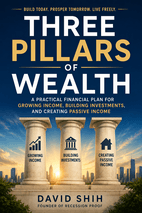
You will find quotes here that cut through the noise and get straight to what works. They focus on systems, schedules, and the real behavior that builds wealth over time, not motivational fluff or get rich quick promises.
What makes this book quotable is its no nonsense clarity. Every line feels like a hard won lesson you can apply right away, whether it is about automating your savings or negotiating a raise. These are the kind of reminders you will want to keep close.
Top Quotes from Three Pillars of Wealth
“If you want one takeaway to carry forward, it is this: wealth builds when you treat your money engines like a schedule.”
The concluding takeaway of the chapter, summarizing the connection rule.
This simple, memorable phrase reframes wealth-building as a disciplined routine, making the abstract concept feel concrete and achievable.
“Job Income buys stability, Investments build long-term growth, and Passive Income reduces your reliance on hours.”
From the final summary explaining how the three pillars work together.
It neatly encapsulates the distinct role of each pillar in a balanced financial strategy, giving readers a clear mental model to follow.
“When you connect all three in one map, you stop waiting for the “right time” and you start compounding your progress month after month.”
The closing line of the chapter, emphasizing the power of integration.
This line inspires action by shifting focus from endless preparation to consistent, compounding effort, which is a core motivator for wealth building.
“Job Income Leverage Loop means you cycle through the same three moves on a schedule: (1) increase your job value in a way your manager can defend, (2) document the results so you can ask for higher pay with receipts, and (3) negotiate the next step before you feel underpaid.”
The author defines the Job Income Leverage Loop.
It provides a clear, actionable three-step process for turning job performance into pay raises, which is empowering and easy to remember.
“When you send money on a fixed schedule, you stop “deciding” each time.”
Explaining the benefit of automated contributions.
It articulates the psychological relief of eliminating repeated financial decisions, a key insight for building lasting wealth.
“Automation still needs monitoring, not motivation.”
Just after the table of transfer options.
This pithy reminder corrects the common misconception that automation is a set-it-and-forget-it solution, emphasizing ongoing oversight.
“You set risk tolerance by testing your behavior, not by guessing your personality.”
This is the key insight at the start of the chapter.
It flips conventional wisdom on its head, emphasizing actionable testing over abstract self-assessment, which resonates with anyone who has mistaken their intentions for their actual reactions.
Themes Behind the Quotes
A central theme is the idea that wealth comes from connecting three distinct income engines into a single repeatable system. Job income provides stability, investments fuel long term growth, and passive income reduces dependency on your time. But none of this works without a schedule that turns targets into automatic actions.
Another major theme is the importance of behavior over personality. The book repeatedly emphasizes that what you actually do during uncomfortable markets matters far more than what you think your risk tolerance is. Automation helps remove the temptation to make emotional decisions, but it still requires monitoring, not motivation. The goal is to build a process that survives real life.
Quotes by Chapter
Set SMART Money Targets
“Targets stay real when you attach them to a calendar.”
This is a key principle from the chapter on setting SMART money targets.
It captures the core idea that goals become actionable only when tied to specific dates, making it a memorable reminder for readers to schedule their financial checkpoints.
“He reviews dividend deposits at the end of each quarter and updates the investing pace if payouts lag.”
Describes the method used by Darius, an example in the chapter, to monitor his passive-income progress.
This concrete action illustrates how to turn a vague income target into a disciplined, periodic review process, inspiring readers to implement similar habits.
Build Your Cash-Flow Baseline
“Quick warning signs you should watch for: + You regularly miss a bill right after you set your investment amount. + You “feel fine” one month and then panic the next. + You can't explain why your cash available changed without pointing to real inflow or outflow moves.”
The author lists red flags that indicate a flawed cash-flow baseline.
These warning signs are immediately relatable and give readers a simple checklist to diagnose whether their budgeting is broken, making the advice practical and memorable.
Emergency Fund and Risk Buffer
“Asimple rule: if your passive income depends on customer demand, you treat that as a risk factor and you fund this rung more fully.”
The author presents a guideline for sizing emergency fund tiers based on income stability.
It distills a key principle of risk management into a single, actionable sentence, making the abstract concept of income volatility concrete for readers.
“Never use this ladder money to cover investment contributions you planned to make that month.”
This is one of the explicit rules written to prevent cross-draining between the emergency fund and investment pillars.
It delivers a strict, memorable boundary that stops the most common self-sabotaging behavior—raiding savings to keep investing during a cash crunch.
“This rule protects your investments from being sold at a bad time and protects your passive income plan from becoming “whenever money is left over.””
The author explains the purpose behind the rule that forbids using emergency funds for planned investment contributions.
It powerfully contrasts disciplined wealth-building with haphazard saving, using the vivid phrase “whenever money is left over” to expose a mindset that undermines financial plans.
Optimize Job Income Leverage
“You pick work that improves reliability, reduces risk, or saves time in ways that show up in daily operations.”
The author explains how to choose projects within the loop.
It gives concrete criteria for selecting high-impact work, helping readers focus on what truly matters to their managers.
“Even if the employer did not adjust pay immediately, Marcos still gained leverage because his manager could see an organized pattern: he improved outcomes, documented them, and pushed for the next step with a deadline.”
The author describes Marcos's experience with the loop.
It reinforces that building leverage is about creating a visible pattern, not just immediate results, which reduces pressure and builds long-term strategy.
“That is how you turn job performance into pay movement without guessing.”
The author concludes the explanation.
It succinctly captures the essence of the chapter, motivating readers to take a systematic approach instead of guessing.
Create a Skills-to-Salary Plan
“She treated this like a production pipeline, not a motivational quest.”
Nadia set a practical goal and weekly rhythm for her job applications.
This line reframes job hunting as a systematic process rather than an emotional endeavor, empowering readers to take consistent, strategic action.
“She didn't wait for someone to “recognize her talent.” She built the missing evidence that recruiters and hiring managers screen for.”
Nadia applied the Skills-to-Salary Roadmap to actively close gaps in her portfolio.
It shifts the mindset from passive hoping to active preparation, reminding readers that proof—not potential—gets them hired.
“The Skills-to-Salary Roadmap worked because it forced her to connect skill to role to pay using concrete proof.”
The chapter summarizes Nadia's successful strategy.
This sentence encapsulates the chapter's core principle: value is created by explicitly linking abilities to market demands with verifiable evidence.
Automate Pillar Contributions
“Automation matters because it changes the default path.”
Opening line of the chapter.
It immediately frames automation as a transformative tool, not a minor convenience, making readers rethink their habits.
“The stake isn’t a motivational slogan; it's whether you build a system that survives real life.”
After describing how automation funds the three pillars.
It contrasts empty inspiration with practical system-building, resonating with anyone who has struggled to stay consistent.
Choose an Investment Time Horizon
“That shift did not make the market kinder. It made her plan fit her calendar.”
After Grace adjusted her investment buckets to align with her time horizons.
This line captures the essential truth that smart investing is about aligning your plan with reality, not controlling the market, making it a memorable and empowering insight.
“She left her retirement bucket as stock-focused with a stabilizer layer, because she planned to hold through market swings.”
Grace's decision for her long-term retirement bucket.
It illustrates the disciplined approach of staying invested through volatility when the time horizon allows, reinforcing a key principle of long-term wealth building.
“Using the Time Horizon Compass, Grace moved her home bucket into cash-like and bond-focused options appropriate for a 3-5 year window.”
The moment Grace applies a practical tool to match her short-term savings with safer investments.
This sentence introduces a concrete, actionable strategy for aligning risk with time, making the concept accessible and directly applicable to readers.
Diversification Without Complexity
“He invests only what he can leave alone for years.”
The chapter describes Hector's rule for investing without risk of forced selling.
This captures a foundational principle of long-term investing—patience and discipline—in a single, memorable sentence.
“Expected outcome: he avoids “forced selling” when markets dip and a car repair hits.”
This is the expected benefit after Hector sets aside an emergency fund and planned bills.
It vividly illustrates how an emergency fund protects investors from making poor timing decisions during market downturns.
“He keeps it to a small set of funds so he can understand what he owns.”
The text explains Hector's approach to choosing a core mix of investments.
It champions simplicity over complexity, reminding readers that understanding one's investments is crucial for long-term confidence and control.
Set Your Risk Tolerance Dial
“The trick is that your best choice depends on what you do when markets get uncomfortable - because you will feel uncomfortable at least once.”
This appears in the explanation of how risk tolerance really works.
It honestly acknowledges the inevitability of discomfort in investing, making the advice feel grounded and relatable rather than idealistic.
“People often treat selling as a way to regain control, even though it usually locks in losses and breaks long-term compounding.”
This is from the troubleshooting section addressing why behavior doesn't match risk scores.
It exposes the psychological trap of selling during downturns, offering a clear warning that resonates with anyone who has felt the urge to act during volatility.
Asset Allocation for Each Goal
“This sits at the edge of the cash-like band and bond layer.”
The author describes the positioning of Viktor's high-priority goal (roof replacement) within the asset allocation framework.
It vividly captures the concept of a goal straddling two asset layers, making the allocation strategy concrete and memorable.