Three Pillars of Wealth Mindmap: Visual Summary of All Chapters | Insta.Page

Three Pillars of Wealth — Interactive Mindmaps

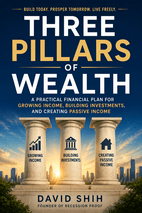
Three Pillars of Wealth by David Shih Book Cover

by David Shih

David Shih's Three Pillars of Wealth presents a structured monthly system connecting Job Income, Investments, and Passive Income, with practical tools like SMART Money Targets and a Cash-Flow Baseline. Written for professionals seeking a repeatable financial plan that moves beyond vague advice to actionable steps.

On Insta.page you also get an Apply This Book tool that lets you combine insights from up to 3 books to solve your specific situation.

Chapter mindmaps

Free preview: chapters 1–4 are fully interactive. Click any node to expand or collapse. Subscribe to unlock the rest.

Chapter 1: The Three-Pillar Wealth Map

Key concepts: The Three-Pillar Wealth Map

1. The Three-Pillar Wealth Map

Passive Income Pillar

  • Requires significantly less time than job income
  • Built through upfront system design and templates
  • Not effortless—deliberately engineered to reduce hourly dependence
  • Revenue becomes steadier with standardized processes

Fixed Monthly Funding Order

  • Fund essentials first for baseline stability
  • Contribute to Investments for long-term growth
  • Build Passive Income last, even with small amounts
  • Order protects stability while advancing all pillars

Managing Tight Months

  • Reduce Passive Income contributions first
  • Never cut essentials or stability funding
  • Clarity reduces stress and maintains momentum
  • Know which pillar to protect in any situation

Three Engines Working Together

  • Job Income buys stability and security
  • Investments buy future growth and wealth
  • Passive Income buys freedom from time-for-money trade
  • Each pillar supports and compounds the others

Consistency Over Perfect Timing

  • Treat money flows as a recurring schedule
  • Stop waiting for the 'right time' to start
  • Progress compounds month by month
  • Discipline in sequence beats perfect execution

Chapter 2: Set SMART Money Targets

Key concepts: Set SMART Money Targets

2. Set SMART Money Targets

Time-Bound Commitment

  • 24-month deadline transforms ambition into commitment
  • Deadline prevents aimless saving without direction
  • Builds a self-correcting system with regular reviews

Staggered Checkpoints

  • Week 2: job-income progress check
  • Month 3: investment contribution review
  • Quarter end: passive-income payout check

Responsive Adjustment

  • Adjust investing pace based on actual payouts
  • Prevents paralysis by breaking big goal into beats
  • Keeps plan flexible, not rigid

Chapter 3: Build Your Cash-Flow Baseline

Key concepts: Build Your Cash-Flow Baseline

3. Build Your Cash-Flow Baseline

Core Concept of Cash-Flow Baseline

  • Single reliable number for monthly finances
  • Countable inflows minus must-pay outflows
  • Eliminates monthly guesswork for decisions

Steps to Build Your Baseline

  • List every inflow you can count on
  • Include regular job and consistent side income
  • List every recurring outflow you must pay
  • Be honest about small unnoticed expenses

Common Mistakes to Avoid

  • Don't blend one-time money into monthly inflow
  • Keep surprise expenses out of variable essentials
  • Create separate tracker for surprise outflows
  • Avoid lumping all expenses into one pile

Warning Signs of a Flawed Baseline

  • Regularly missing bills after setting investments
  • Financial life swings between fine and panicked
  • Can't explain cash changes without specific moves
  • Baseline may be too aggressive or missing expenses

Key Takeaways for Success

  • Use only countable inflows and must-pay outflows
  • Isolate one-time income and surprise expenses
  • Keep expense categories clean and separate
  • Watch warning signs to reveal baseline flaws

Chapter 4: Emergency Fund and Risk Buffer

Key concepts: Emergency Fund and Risk Buffer

4. Emergency Fund and Risk Buffer

Personalized Fund Sizing

  • Volatile income needs more aggressive funding
  • Steady contract income allows gradual building
  • Type of income determines cushion depth

Three-Rung Ladder Structure

  • Rung one: short-term bill emergencies
  • Rung two: medium shocks like repairs
  • Rung three: prolonged income disruption
  • Never dip deeper than necessary

Protect Investments Rule

  • Never use ladder money for planned contributions
  • Prevents selling investments at bad times
  • Saves passive income from being afterthought
  • Write payment rules before panic

Risk Buffer Category List

  • Define qualifying emergencies for each rung
  • Include medical, car, home, job loss
  • Remove emotional negotiation in tight times
  • Avoid treating wants as emergencies

Key Takeaways

  • Fund rungs based on income volatility
  • Use three distinct rungs with clear purposes
  • Protect investments from emergency drain
  • Predefine rules and categories in advance
You've reached the end of the free mindmaps

Next chapter: “Optimize Job Income Leverage” is locked

See every chapter of Three Pillars of Wealth as an interactive mindmap — and unlock all 450+ book summaries with audio and AI Q&A.

$0.00 due today · 7 days free, then $59.99/year ($4.99/mo) · Cancel anytime before day 7

Continue exploring Three Pillars of Wealth