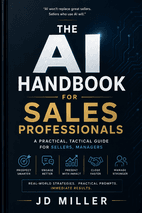
What is the book The AI Handbook for Sales Professionals about?
JD Miller's The AI Handbook for Sales Professionals provides a role-specific roadmap for applying generative AI across sales functions, from quota-carrying sellers to CROs, using the AI Readiness Maturity Model. Written for sales professionals overwhelmed by admin tasks who want to reclaim time for strategy and relationship-building.
Feature
Insta.Page
Blinkist
Shortform
Summary Depth
Full Chapter-by-Chapter
15-min overview
Section-by-section guides
Audio Narration
✓
✓
✓
Visual Mindmaps
✓
✕
✕
AI Q&A
✓
✕
✕
Quizzes
✓
✕
✕
PDF Downloads
✓
✕
✓
Price
$89.99/yr
$146/yr (PRO)
$199/yr
*Competitor data last verified July 2026.
1 Page Summary
This is a practical, tactical guide for sales professionals at every level—from individual contributors to Chief Revenue Officers—who want to harness generative AI without succumbing to either hype or fear. The author, a career sales leader and social scientist, draws a direct parallel between the current AI revolution and the dawn of the consumer web, which they witnessed firsthand. Rather than taking sides in the debate over whether AI will replace jobs, the book synthesizes insights from a survey of over 140 AI tools and decades of industry experience into a structured roadmap. Its central thesis is that AI is a pattern-recognition technology that will follow the same trajectory as the internet: it will become a utility, and early adopters who use it strategically will gain a significant competitive advantage.
The book's distinctive approach is grounded in the AI Readiness Maturity Model, which assesses an organization across six dimensions (strategy, data, technology, culture, governance, and collaboration) at three levels of sophistication. Each subsequent chapter then applies this model to a specific sales role or function. For quota-carrying sellers, the focus is on predictive lead scoring and automating prospecting, with a strong warning against tone-deaf personalization. For sales engineers, AI is a solution to the bottleneck of demo requests, enabling rapid customization. Frontline managers are shown how AI can free them from "super-selling" to focus on high-leverage coaching, while CROs can use it to build dynamic market maps and find hidden customer segments. Revenue Operations teams can shift from manual spreadsheet work to strategic planning, and even board communication is reframed from static reporting to forward-looking alignment.
The intended audience is anyone in a sales-related role who feels overwhelmed by administrative tasks and wants to reclaim time for human-centric activities like strategy, relationship-building, and coaching. Readers will gain a concrete, role-specific playbook for immediately applying AI, from simple prompt engineering to more advanced autonomous agents. The book is distinctive for its insistence on governance and ethics, with a dedicated chapter on legal considerations, including the EU AI Act, GDPR, and liability for AI agent mistakes. Ultimately, it positions AI not as a replacement for human skill, but as a "copilot" that expands a sales professional’s capacity to be more strategic, more personalized, and more effective.
Introduction
Overview
The Introduction opens with a moment of prophetic clarity: a 1993 convocation speaker telling incoming freshmen they’d graduate into jobs that didn’t yet exist. For the author, this wasn’t hyperbole. As a University of Illinois student given one of the first campus email addresses, they had a front-row seat to the birth of the consumer web. NCSA Mosaic, the first graphical browser, was being developed right there; its co-creator Marc Andreessen would soon launch Netscape. The prediction landed. Within a few years, the author was building corporate intranets and watching offices buzz with the same questions we’re now asking about generative AI: Is this real? A fad? Will it replace me?
That historical echo forms the book’s foundation. The author, a career sales leader and social scientist, sees a familiar pattern of hype, skepticism, and middle-ground reality repeating itself. Rather than choose sides, they’ve conducted a survey of over 140 AI tools, observed dozens of companies through private-equity work, and synthesized the findings into a practical roadmap for anyone in sales—from quota carriers to CROs. This chapter sets the stage for why that roadmap is needed now.
From “Nothing Will Replace Your Newspaper” to AI Hallucinations
The media’s track record on predicting technology’s impact is famously poor. Newsweek once assured readers that “no online database will replace your daily newspaper.” The author recalls similar assurances about telecommuting, grocery delivery, and other ideas that soon proved too conservative. Today, critics of generative AI point to hallucinations, basic math errors, and hidden biases as reasons it won’t go mainstream. The parallel is intentional: in both eras, early adopters overpromise while skeptics underestimate adaptation. The truth, the author argues, is always somewhere in between.
The Check-In Kiosk Lesson
A personal story grounds the argument. When the author helped build the first web-based airport check-in kiosks for a major airline, customer service agents feared for their jobs. What actually happened? Air travel volumes exploded—more than five times the number of passengers globally compared to 1990. The role of the traditional phone-based ticket agent diminished, but new, different jobs emerged around self-service systems and increased flight operations. The pattern holds for AI: automation doesn’t simply erase work; it shifts it, often creating new roles that require human judgment and relationship skills.
Delegation Redefined
Early in the author’s management career, a mentor advised delegating to the lowest-cost resource who could do the job successfully. That resource was always a person, usually a junior team member. Today, the lowest-cost resource can be an algorithm. The author’s social-science training adds a crucial constraint: some tasks—especially those involving interpersonal trust, empathy, and complex relationship-building—can only be done by a human. AI is a tool for delegation, not replacement. The book aims to help sales professionals figure out which tasks to delegate to machines and which to keep for themselves.
What This Book Is—and Isn’t
This isn’t a hype piece or a doom-and-gloom warning. It’s a handbook. The author surveyed over 140 AI tools, noting successes and disappointments, and shares what works now. The examples cite specific vendors (like the recent Clari-Salesloft merger), but the point isn’t to endorse products—it’s to illustrate categories of capability that will rapidly evolve. Feature sets will commoditize, new players will emerge, and today’s differentiators may become tomorrow’s table stakes. The book focuses on use cases, not brand loyalty, so readers can do their own vendor research.
#### Key Takeaways
The current generative AI debate mirrors the early-internet cycle of overpromise, skepticism, and eventual middle-ground integration.
Past automation (like airline kiosks) didn’t eliminate jobs—it shifted them and created new demands for human-centric skills.
AI is best seen as the lowest-cost delegation resource for certain tasks, but trust and relationship-building remain uniquely human.
This book offers a practical, use-case-driven roadmap for sales professionals—not vendor hype, but a framework for navigating rapid change.
The AI tool landscape is moving fast; examples illustrate capability classes, not permanent market positions.
Key concepts: Introduction
1. Introduction
Historical Parallels with Early Internet
1993 prediction of jobs not yet existing
Author witnessed birth of consumer web
Same hype cycle repeating with generative AI
Skepticism mirrors past technology underestimation
AI as Job Shifter, Not Eliminator
Airport kiosks didn't eliminate jobs
Air travel volume exploded 5x since 1990
New roles emerged around automation
AI shifts work and creates new human roles
Delegation to Algorithms
Lowest-cost resource now can be AI
Trust and empathy remain uniquely human
AI is a tool for delegation, not replacement
Decide which tasks to delegate or keep
Practical Handbook for Sales
Not hype or doom-and-gloom warning
Surveyed over 140 AI tools
Focus on use cases, not vendor loyalty
Framework for navigating rapid change
Rapidly Evolving AI Tool Landscape
Examples illustrate capability classes
Today's differentiators become table stakes
New players will emerge quickly
Feature sets will commoditize over time
💡 Try clicking the AI chat button to ask questions about this book!
Demystifying AI
Overview
Artificial intelligence might seem like a magical new arrival, but its roots stretch back decades—to Alan Turing's 1950 proposal that a machine could be considered intelligent if a human couldn't tell it apart from another person in conversation. At its core, AI has always been about pattern recognition. What's changed is the scale and speed at which it can operate.
Remember the early spellcheckers? They were clunky, rules-based systems: if a word wasn't in the dictionary, flag it in red. That was symbolic AI—good old-fashioned artificial intelligence. A few years later, with more processing power, those tools could suggest the statistically most likely correct word. Soon after, they could predict what you were about to type in real time. The leap from "recieve is wrong" to offering "receive," "recent," and "reception" as you typed was a revolution in user experience. The same pattern recognition powers your Netflix recommendations, credit card fraud alerts, and traffic predictions—except those systems aren't following fixed rules. They're learning from your behavior, constantly refining their algorithms. That's machine learning.
Then came ChatGPT in November 2022, which felt like magic to many. But it wasn't a new concept—it was a change in scale. Advances in chip technology from companies like NVIDIA allowed pattern analysis to happen on hundreds of millions of pages of text, not just a dictionary. Now, the AI could understand not just which word comes next, but what comes eight paragraphs later, and how all those pieces relate. And it could do it in seconds.
This same approach powers image generation (analyzing pixel relationships across millions of images of "birthday cakes" and "cute kittens"), and has found practical applications in medicine (flagging chest X-rays for early cancer signs), automotive design (detecting lane departures), and search and rescue (scanning drone footage for anomalies). NASA's definition captures this well: any artificial system that can perform tasks under unpredictable circumstances, learn from experience, or solve tasks requiring human-like perception, cognition, and communication. That's the broad yet practical lens I'll use throughout this book.
How AI Actually Works in Sales Tools
When AI is built for a specific sales purpose—like forecasting or suggesting the perfect case study—it follows a four-step workflow:
1. Data Collection: The model needs a large, relevant dataset. A spam filter learns from thousands of emails; a sales AI might learn from call recordings or CRM data about won and lost deals.
2. Feature Extraction: This is where the magic happens. In early machine learning, engineers had to manually define what features to analyze. Today's AI can discover its own—often uncovering patterns no human would think to look for. Consider Gong's finding that sellers are 8% more likely to close a deal when a prospect curses and the seller matches their language. That's deep learning in action: the system automatically detected a complex, abstract pattern (deep rapport and trust) that a human might never label as important.
3. Model Training: The AI iteratively adjusts its parameters to learn the statistical relationships between input features and desired outputs. This can be supervised (with humans labeling data as "spam" or "a good answer") or unsupervised (where the model finds hidden structures on its own, like segmenting customers into personas based on purchasing behavior). Often, both approaches are combined—unsupervised learning guided by human expertise until the model is refined.
4. Prediction or Classification: Once trained, the model is put into production. It takes new, unseen data and uses what it's learned to make a prediction or assign a classification—like determining whether a new chat request is from a high-propensity buyer.
The Limits You Can't Ignore
AI's abilities are remarkable, but its limitations are baked into its design. It's excellent at discriminative tasks—answering "Is this A or B?" That's why it's a natural fit for questions like "Is this prospect likely to buy?" or "Does this conversation suggest decision-making authority?"
It's also good at generative tasks—creating new, original data that's statistically similar to what it was trained on. It can summarize contracts, answer RFP questions, or suggest next steps based on what worked in similar past deals.
But here's where it falls short:
It can't carry context over long periods. Shazam can identify Vivaldi's "Winter" movement, but it doesn't remember that it just identified "Spring." Customer service chatbots might remember your name during a single call, but ask for it again next time. Even advanced systems "lose the plot" in extended conversations.
It has no theory of mind. AI doesn't understand that humans have beliefs, desires, intentions, or emotions that influence their behavior. That automated voice that cheerfully offers "Press one to make a payment" even after you've screamed at it about a service outage? That's the limit in action. While sophisticated AI can simulate empathy—learning that "you're welcome" follows "thank you"—it doesn't genuinely comprehend underlying emotions. And despite what science fiction might suggest, AI has no consciousness, no self-awareness, no real feelings.
And that's precisely why sales professionals are safe.
Since AI is most limited in the essentially human skills of empathy, trust-building, and relationship development—and since those skills are central to selling—I'm confident AI won't eliminate the sales profession. But like the airline customer service agents of the 1990s, sellers need to evolve. Those who delegate repetitive, data-driven tasks to AI, using the insights to be even more impactful with human connection, will be the high performers of the future. Those who don't risk becoming encyclopedia salesmen: people whose primary asset—knowing facts—is instantly devalued when information becomes a universal commodity. The shift isn't about doing your old job faster. It's about evolving into an AI-enabled professional who uses technology to amplify your most unique human strengths.
Key Takeaways
AI is fundamentally about pattern recognition, evolved from simple rules-based systems to machine learning that refines itself with more data.
The ChatGPT "revolution" was a change in scale (massive computing power) not a change in concept.
AI works through four steps: data collection, feature extraction (often discovering patterns humans wouldn't find), model training, and prediction.
AI excels at discriminative tasks ("Is this A or B?") and generative tasks (creating new, statistically similar content).
AI's key limitations are lack of long-term context, no theory of mind, and inability to genuinely understand emotions.
Sales professionals who learn to delegate repetitive tasks to AI while doubling down on empathy, trust, and strategic judgment will thrive.
Key concepts: Demystifying AI
2. Demystifying AI
AI's Core Concept: Pattern Recognition
Roots trace back to Alan Turing's 1950 proposal
AI is fundamentally about pattern recognition
Scale and speed of pattern analysis have changed
Evolution from Symbolic AI to Machine Learning
Early spellcheckers used fixed rules (symbolic AI)
Later systems learned from behavior (machine learning)
Powers Netflix recommendations and fraud alerts
The ChatGPT Breakthrough: Scale, Not Magic
ChatGPT felt magical but wasn't a new concept
Advances in chip tech enabled massive pattern analysis
AI now understands relationships across long texts
Model training uses supervised or unsupervised learning
Prediction classifies new data like buyer propensity
Deep Learning in Sales: Uncovering Hidden Patterns
AI discovers patterns humans wouldn't think to look for
Gong found sellers close 8% more when matching prospect language
System detects abstract patterns like deep rapport
AI's Strengths: Discriminative and Generative Tasks
Excellent at discriminative tasks (Is this A or B?)
Good at generative tasks like summarizing contracts
Can suggest next steps based on past successful deals
Critical Limitations: No Context or Theory of Mind
Cannot carry context over long periods
Has no theory of mind or understanding of emotions
Simulates empathy but lacks genuine comprehension
No consciousness, self-awareness, or real feelings
Getting Ready for AI
Overview
If you accept that AI is following the same trajectory as web technologies at the turn of the century, ignoring it isn’t an option. For modern businesses and sales teams, AI usage is a strategic imperative for survival and growth. Early adopters see real gains—a 2024 Salesforce report shows salespeople spend only 28% of their time selling, and a Bain report cites up to 30% improvement in win rates. But those results don’t come from just plugging in new tech; they require clear strategy, strong data, and a culture open to change. The chapter introduces the AI Readiness Maturity Model, which assesses an organization across six dimensions—strategic vision, data & analytics, technology & infrastructure, people & culture, governance & ethics, and cross-functional collaboration—at three levels of sophistication.
At Level 1: Laying the Foundation, the focus is on experimentation and small wins. Strategically, identify specific problems AI can improve—like automating scheduling or summarizing meeting notes—and frame AI as a productivity enabler. Data can be incomplete and siloed; run a quick pilot on a narrow dataset rather than waiting for perfect cleanliness. People need clear communication that casts AI as a copilot that augments rather than replaces human skills, with safe playgrounds for experimentation and open feedback channels. Governance is informal and reactive, but leadership should encourage ethical conversations. Cross-functional collaboration starts with marketing and IT as key partners for early pilots like lead scoring.
After small-scale pilots succeed, the organization moves to Level 2: Building Momentum for Advanced AI. Here AI projects become systematic with formal executive sponsorship and dedicated resources. The vision shifts from solving isolated pain points to creating an integrated system supporting the entire sales cycle, measured by metrics like sales velocity and forecast accuracy. Data becomes a curated, centralized foundation with formal governance policies. Technology scales with cloud foundations, a choice between all-in-one suites or best-of-breed stacks, and the introduction of MLOps. Cultural development moves from overcoming fear to building new skill sets through role-specific training and AI champions, while middle managers need support as their role shifts from information gatekeeping to coaching. Governance becomes proactive with a formal cross-functional council that publishes principles around fairness, transparency, and accountability. A critical sub-stage within Level 2 is the Enabled Stage, where human accountability remains paramount: every high-stakes AI output must have a human-in-the-loop, and ethics by design is embedded from the start. Cross-functional collaboration intensifies as boundaries between sales, marketing, IT, finance, and customer success blur, requiring a common language to define business outcomes.
The most sophisticated organizations operate at Level 3: The Fully Enabled Sales Team, where AI is an always-on, difference-defining way of doing business. The strategic vision shifts from improving an existing engine to building an entirely new one, with agentic AI handling complex workflows autonomously. Data is treated as intellectual property, leveraging a semantic layer that maps technical data to business concepts and using synthetic data for simulations via digital twins. The technology stack becomes AI-native, with an agentic mesh orchestrating autonomous agents that perceive, reason, and act; sellers rarely log into CRMs because ambient sensing captures all activity. People are recruited and trained as orchestrators of AI processes, and new roles like data scientists and AI ethicists emerge. Governance becomes embedded within teams, tracking fairness and bias as rigorously as revenue. Silos are eliminated: sales and marketing operate as a single GTM organization, IT is a thought partner, and finance uses real-time forecasts for confident spending adjustments.
The chapter concludes by acknowledging that becoming fully AI-enabled takes time—and may never be fully achieved—but significant benefits come from even the earliest steps. Starting now is the key.
Key Takeaways
Level 2 requires clear human accountability and “ethics by design” from the start, not as an afterthought.
Cross-functional collaboration demands a common language between sales, IT, finance, marketing, and customer success.
Level 3 treats data as intellectual property, using a semantic layer and synthetic data for decision-making simulations.
Agentic mesh and proprietary models create an AI-native infrastructure where technology serves the seller.
People and culture shift toward orchestrating AI processes, rewarding uniquely human skills like empathy and strategic thinking.
Governance becomes embedded, tracking fairness and bias as rigorously as revenue.
The path from Level 2 to Level 3 is incremental but transformative—start now and build step by step.
Key concepts: Getting Ready for AI
3. Getting Ready for AI
AI Readiness Maturity Model Overview
AI adoption is a strategic imperative for survival
Early adopters see 30% improvement in win rates
Success requires strategy, data, and cultural change
Model assesses six dimensions across three levels
Level 1: Laying the Foundation
Focus on experimentation and small wins
Frame AI as a productivity enabler and copilot
Run pilots on narrow datasets, not perfect data
Start with marketing and IT as key partners
Level 2: Building Momentum
Shift from isolated pilots to systematic projects
Centralize data with formal governance policies
Introduce MLOps and role-specific AI training
Maintain human-in-the-loop for high-stakes outputs
Level 3: The Fully Enabled Sales Team
Agentic AI handles complex workflows autonomously
Treat data as intellectual property with semantic layer
Sellers become orchestrators of AI processes
Silos eliminated into single GTM organization
Key Principles for AI Readiness
Ethics by design must start at Level 2
Cross-functional teams need a common language
Governance tracks fairness as rigorously as revenue
Start now and build incrementally toward transformation
AI for the Quota-Carrying Seller
Overview
The modern seller faces a flood of accounts, emails, and gut-feeling decisions each morning. This chapter shows how AI transforms that chaos into a structured, prioritized playbook. It starts with predictive lead and opportunity scoring, where algorithms analyze demographic and behavioral data against every won or lost deal to produce dynamic likelihood-of-win scores. Combined with buyer intent signals from platforms monitoring billions of online searches and reviews, sellers know which accounts to pursue and which newly surfacing companies are already in the market. The chapter moves into the prospecting power hour, where AI automates list building and enrichment. A case study reveals how a multi-product SaaS platform used cascading logic and an LLM-powered research agent to generate one-to-one icebreakers, doubling cold email conversion rates and compressing campaign launch from weeks into hours. Yet with that power comes the risk of tone-deaf personalization; the chapter warns that mining semi-private social data can break trust, so governance must limit AI to professional, public sources. Crafting outreach gets a makeover: native email assistants polish tone and check spam triggers, while advanced platforms generate entire multichannel sequences from a single prompt. At the highest level, autonomous agents handle early stages of conversations, recognizing objections and handing off only when a prospect signals clear interest—but that raises tough questions about disclosure and the creep factor of voice or video cloning.
The heart of selling remains human conversation. AI enriches every phase: pre-meeting prep moves from guesswork to curated intelligence by scanning LinkedIn, news, and CRM data, though human judgment is essential to avoid mixing up names or missing nuance. In-meeting intelligence tools offer real-time coaching by surfacing battle cards and objection responses, but they must be framed as developmental or sellers will feel surveilled. Post-meeting automation ranges from basic transcription to AI that updates CRM fields and drafts follow-ups based on call content. A case study on a field-service company shows how conversational intelligence served as a digital sales floor during the pandemic, letting leadership broadcast “hero moments” to the entire team and achieve full product proficiency in 21 days. The chapter doesn’t shy away from the deskilling debate: when AI answers technical questions and prompts next steps, entry-level sellers may never build the critical thinking needed for senior roles. Organizations must intentionally design how junior talent develops higher-value skills while AI handles the rote work. Ultimately, the modern seller becomes an orchestrator, using AI to delegate low-value tasks and free up time for genuine connection, persuasion, and strategic thinking. The key is to start small—pick one Level 1 application like meeting notes or prospect research—and scale with wins, using the chapter’s maturity levels as a roadmap.
Morning Prep: AI for Planning and Prioritization
Most sellers start their day facing a sea of accounts and gut-feeling decisions. AI tools bring structure by sifting through CRM and email data, scoring leads and opportunities, and surfacing a prioritized action list.
Predictive Lead & Opportunity Scoring
Predictive scoring moves beyond old rules-based methods. Modern algorithms analyze each opportunity’s demographic and behavioral data, compare it against every won or lost deal, and generate a dynamic likelihood-of-win score.
Level 1 – Foundational: Start with native scoring features inside your CRM. HubSpot’s AI-assisted scoring analyzes converted contacts to recommend predictive criteria. Salesforce’s Einstein Lead Score does the same. A CRM admin can enable it quickly.
Level 2 – Advanced: Dedicated revenue intelligence platforms (Clari, Gong) integrate CRM data with unstructured conversation data from calls and emails. Clari’s AI Opportunity Scores pulse deal health; Gong’s Deal Warnings flag at-risk deals. These require company-wide adoption.
Level 3 – AI-Enabled: AI builds a daily work plan proactively—not just insights, but a directive task list. Salesloft’s Rhythm and Outreach’s intelligent work queue aim for this. Your data must be reliable; garbage-in-garbage-out sends sellers on dead-end paths.
Surfacing Buyer Intent
While predictive scoring prioritizes known accounts, intent data reveals companies actively searching for a solution like yours. AI-powered platforms (6sense, ZoomInfo, Cognism/Bombora) monitor billions of online signals and surface high-intent accounts.
Level 2 – Advanced: Subscribe to an intent provider and integrate it into your CRM. Sellers receive alerts when a target account’s web behavior suggests they’re in-market. Cold outreach becomes warmer because you’re calling at the right moment.
Level 3 – AI-Enabled: Deploy an agent that automatically responds to intent signals. For example, “When a Tier 1 account shows a spike in intent, identify the VP of Finance and enroll them in an Outreach sequence.” Be careful not to create a “digital stalking” impression—calling to say “I saw you searched for my product” is creepy.
The Prospecting Power Hour: AI for Finding and Qualifying Leads
Once accounts are prioritized, sellers need to identify the right people with accurate contact info and craft personalized outreach. AI as a copilot changes that.
Building and Enriching Lists
Level 1 – Foundational: Install a browser extension (Wiza, RocketReach, Apollo.io) that surfaces email addresses and phone numbers while viewing a LinkedIn profile. Organizational tools like ZoomInfo offer one-click CRM import.
Level 2 – Advanced: Use AI to automate research and enrichment on entire lists at once. Clay’s waterfall workflow builder might start with 100 companies, cascade rules to find the right persona, read their LinkedIn posts, and use an LLM to generate a personalized icebreaker. Be cautious about email domain reputation.
Level 3 – AI-Enabled: Deploy an AI agent that autonomously builds and maintains the entire prospect database based on your ICP and real-time trigger events. But humans must stay in the loop to prevent tone-deaf misfires.
Case Study: Scaling Growth with AI-Driven Personalization
A multi-product SaaS platform ($10B+) was stuck in a “high-volume, low-relevance” cycle. Their solution: a dynamic workflow that found contacts using cascading logic, enriched with an AI agent that scraped the company website and LinkedIn for triggers, then fed the data into an LLM to draft a one-to-one icebreaker. Result: a 2x increase in cold email conversion rates, full automation of manual SDR research, and the ability to launch campaigns in hours instead of weeks.
Crafting the Perfect Outreach: AI for Personalized Engagement at Scale
The author shares a “hall of shame” of poorly personalized outreach. Generative AI provides a personal research and writing assistant that moves beyond superficial hooks. But hyper-personalization carries risks. Prospects who realize a “personal” note was algorithm-scraped from semi-private information feel betrayed. A governance model might allow professional data points but prohibit scraped personal social media or private location data.
The AI Email Assistant
Level 1 – Foundational: Native plugins (Gemini in Gmail), ChatGPT for drafts, or writing coaches like Lavender. Browser extensions with free plans require no training.
Level 2 – Advanced: Generate entire multistep, multichannel campaigns from a simple prompt. Outreach, Salesloft, or Regie.ai can create a 15-step sequence targeting a CFO. Company-wide subscription and training on prompting are needed.
Level 3 – AI-Enabled: AI agents not only write content but independently manage initial stages of conversations. They recognize common objections and draft responses. When a prospect shows clear positive intent, the agent offers availability and hands off. Governance must decide: do agents disclose they’re bots or pretend to be human? Legal requirements vary, and trust is paramount.
Having Great Conversations
Building connection through communication is fundamentally human. Even so, AI can ensure sellers are well-prepared, receive real-time coaching during calls, and have follow-up tasks handled automatically.
Pre-Meeting Prep: From Guesswork to Informed Strategy
Level 1: Foundational: Ask an AI to prep you for a meeting. Give it a name and LinkedIn URL. In seconds, you get a briefing. But human judgment matters—there are nine JD Millers in Chicago; the AI won’t know which one you’re meeting.
Level 2: Advanced: When organizations connect AI to internal systems, the prep becomes richer. Tools like Outreach’s Smart Account Assist summarize recent account engagement. Cirrus Insight’s Meeting AI compiles a pre-call summary with fresh web searches. Only enterprise-grade, sanctioned tools should touch sensitive prospect data.
In-Meeting Intelligence: Real-Time Support Without the Creep Factor
Level 1: Foundational: Basic transcription and note-taking are now standard in Teams, Zoom, Google Meet. Use them.
Level 2: Advanced: When you layer in your company’s playbook, real-time coaching happens. Tools like Gong, Kaia, or Clari Copilot can spot objections mid-call and pop up a talking point. But if sellers feel watched, you’ll breed distrust. Governance councils must frame these tools as developmental, not evaluative.
Post-Meeting Automation: From Notes to Next Steps
Level 1: Foundational: AI bots like Fireflies.ai or Otter.ai join a call, then send you a recording, transcript, and summary.
JD Miller is an author and researcher specializing in international relations and political economy, with a focus on the intersection of technology and global power dynamics. Miller is best known for the book *The War on the Cold War*, which examines the ideological battles shaping U.S. foreign policy, and has contributed to numerous academic journals and media outlets. With a background in political science and a PhD from the University of Oxford, Miller’s work often critiques the narratives behind contemporary geopolitical strategies.
Frequently Asked Questions about The AI Handbook for Sales Professionals
What is The AI Handbook for Sales Professionals about?
This book provides a practical roadmap for sales professionals at all levels—from individual sellers to CROs—to effectively integrate AI into their workflows. It covers specific AI applications for prospecting, demo customization, coaching, revenue operations, and board communication, supported by a readiness maturity model and real-world case studies. The author also addresses legal, ethical, and governance challenges to ensure responsible AI adoption in sales.
Who is the author of The AI Handbook for Sales Professionals?
The author is JD Miller, a career sales leader and social scientist who has conducted extensive research on AI in sales. He surveyed over 140 AI tools, observed dozens of companies through private-equity work, and synthesized his findings into this practical guide. His background gives him a unique perspective on both the strategic and human elements of AI adoption.
Is The AI Handbook for Sales Professionals worth reading?
This book is an essential guide for any sales professional who wants to move beyond AI hype and into practical implementation. It offers a structured approach—the AI Readiness Maturity Model—and role-specific advice that helps readers immediately apply AI to improve win rates, productivity, and strategic decision-making. The balanced coverage of opportunities and risks makes it a trustworthy resource for navigating the rapidly evolving AI landscape.
What are the key lessons from The AI Handbook for Sales Professionals?
Key lessons include that AI should be treated as a copilot augmenting human skills, not as a replacement, and that successful adoption requires clear strategy, clean data, and a culture open to change. Sales teams gain the most from AI when they apply it across the entire funnel—from predictive lead scoring to coaching and demos—and when they establish strong governance to avoid ethical pitfalls. Finally, leaders must continuously update their sales playbooks and board communications to keep pace with AI-driven insights and evolving regulations.
📚 Explore Our Book Summary Library
Discover more insightful book summaries from our collection