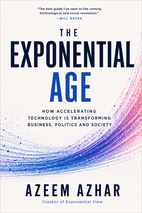
Azeem Azhar's The Exponential Age reveals how four simultaneous exponential technologies in computing, energy, biology, and manufacturing are creating an "exponential gap" between rapid innovation and slow human adaptation, reshaping business, politics, and society for leaders, policymakers, and engaged citizens.
Feature
Insta.Page
Blinkist
Shortform
Summary Depth
Full Chapter-by-Chapter
15-min overview
Section-by-section guides
Audio Narration
✓
✓
✓
Visual Mindmaps
✓
✕
✕
AI Q&A
✓
✕
✕
Quizzes
✓
✕
✕
PDF Downloads
✓
✕
✓
Price
$89.99/yr
$146/yr (PRO)
$199/yr
*Competitor data last verified July 2026.
1 Page Summary
Azeem Azhar's The Exponential Age presents a central thesis that we have entered a new era defined not by one, but by four simultaneous exponential technologies—computing, energy, biology, and manufacturing. These technologies improve at rates above 10 percent per year, driving costs down and capabilities up at a pace that human intuition, evolved for a linear world, is fundamentally unable to grasp. This creates an "exponential gap" between the speed of technological change and the slow, incremental adaptation of our companies, institutions, and societies. The book argues that this gap is the defining dynamic of our time, reshaping business, politics, and society in profound and often destabilizing ways.
The author, a technology investor and former journalist, grounds his analysis in vivid, concrete examples that span decades, from the cost collapse of solar power and genome sequencing to the rise of superstar tech firms like Google and Amazon. What distinguishes the book is its focus on how general purpose technologies (GPTs) are simultaneously rewiring the rules of entire systems. Azhar examines how these forces create winner-take-all markets through network effects and platform business models, reorder global supply chains toward localism, make labor markets more precarious via the gig economy, and even lower the cost of warfare and disinformation. Rather than offering a simple technological determinism, he shows how the same exponential tools that could lead to material abundance also concentrate power and sow instability.
The intended audience is broad, encompassing business leaders, policymakers, and engaged citizens who want to understand the structural forces reshaping their world. Readers will gain a clear framework for recognizing exponential trends, along with a sober assessment of the risks they pose—from monopolistic power and algorithmic control to cyber conflict and eroded social trust. The book does not prescribe easy answers but concludes by outlining three guiding principles—commonality, closure, and change—to help societies close the exponential gap and steer technology toward a more equitable and abundant future.
Chapter One - The Harbinger
Overview
The chapter begins with a personal memory from 1979: a seven-year-old in Lusaka, Zambia, watching a neighbor assemble a computer from a kit. That moment sparks a lifelong fascination. The story follows the author through increasingly powerful computers: the lightweight Sinclair ZX81, the Acorn BBC Master, and a clunky PC clone with a “Turbo” button. Each machine was dramatically more capable, illustrating Moore’s Law—the observation that transistor counts double roughly every two years. This wasn’t a law of physics but a self-fulfilling industry pledge. From 1971 to 2015, the cost per transistor fell from $150 to a few billionths of a dollar, and by 2014 humanity produced more transistors each year than stars in the Milky Way.
An exponential technology improves above 10 percent per year for decades, driving prices down and capabilities up. Not all technologies behave this way—the diesel engine stalled quickly. The S-curve model shows adoption: slow at first, then a steep exponential rise after an inflection point, followed by a plateau. Modern digital technologies climb that curve fast. Social media took eleven years to reach 70 percent of Americans; electricity took 62 percent of an average lifespan. Smartphones diffused 12.5 times faster than the original telephone. The author recalls joining SixDegrees, the first web-based social network, days after its 1997 launch.
That pace became the era’s hallmark. Facebook hit a million users in fifteen months; Lime did it in six months with physical scooters; TikTok exploded from obscurity to global dominance in months. This acceleration was the direct consequence of Moore’s Law. But by the early 2000s, engineers sensed the old magic fading. Transistors had shrunk to atoms wide, where quantum effects caused leakage and heat. Fabrication plants cost over $15 billion, and research efforts multiplied eighteen-fold, yet transistor density growth sputtered. Moore’s Law was hitting the limits of physics.
Enter Ray Kurzweil’s Law of Accelerating Returns, which argues that technological progress follows overlapping S-curves: as one technology plateaus, another enters its explosive phase. These technologies nourish each other, so overall innovation accelerates. The chapter demonstrates this with the AI revolution. Around 2010, as Moore’s Law flagged, data and computing power arrived in abundance. Fei-Fei Li’s ImageNet provided 14 million labeled images, and Alex Krizhevsky’s AlexNet shattered accuracy records in 2012. Deep learning swept through fields from translation to drug discovery, and computing power for the largest models increased 300,000-fold between 2012 and 2018—six times faster than Moore’s Law.
That hunger for compute couldn’t be satisfied by smaller transistors. The industry pivoted to specialized chips. GPUs, designed for video games, turned out to be brilliant at neural network math. Startups like Graphcore and Cerebras built chips optimized solely for AI. And when these might plateau, quantum computing looms: in 2019, a Google quantum computer performed a calculation in 200 seconds that would have taken a classical supercomputer 10,000 years—a billion-fold speedup. One paradigm hands off to another, and the exponential curve keeps climbing.
Personal Origins and Early Computing
The chapter opens with the author’s first encounter with a computer in 1979, when a neighbor in Lusaka, Zambia, assembled a build-it-yourself kit. At age seven, the author was captivated. Two years later, the family moved to England, and the author got a Sinclair ZX81. Within six years, it was obsolete, replaced by the Acorn BBC Master, which ran several times faster and had 128 times the memory. By the early 1990s, the author bought a PC clone with an Intel 80486 processor. The ten-year leap from the ZX81 to that clone reflected exponential change: the processor was thousands of times more powerful.
The Mechanics of Moore’s Law
The text explains how computers work, tracing from George Boole’s binary logic through Claude Shannon’s insight that electronic circuits could execute Boolean operations, to Alan Turing’s WWII computer. The transistor, developed at Bell Labs in 1947, replaced vacuum tubes. In 1960, Robert Noyce created the integrated circuit. Gordon Moore observed in 1965 that transistor counts doubled roughly every 18–24 months at the same cost. This became Moore’s Law—a “social fact” the industry worked to fulfill. From 1971 to 2015, transistors per chip multiplied nearly ten million times, and the cost per transistor plummeted from $150 to a few billionths of a dollar.
What Exponential Technology Really Means
An exponential technology improves at a rate exceeding 10 percent per year for decades. A 10 percent annual improvement yields a 2.5-fold gain per decade; rates of 20–50 percent produce sixfold to sixtyfold increases. This drives price drops and capability explosions. The smartphone in your pocket has abilities unavailable twenty years ago. The diesel engine, which stalled quickly, doesn’t qualify.
How Technologies Spread: The S-Curve
Horace Dediu analyzed over two hundred years of technology adoption data. Most innovations follow an S-curve: slow initial uptake, then a steep exponential rise after an inflection point, followed by a plateau. For exponential technologies, the acceleration is astonishing. Social media took eleven years to reach 70 percent of Americans—about 14 percent of an average lifespan. Electricity took 62 percent. Smartphones diffused 12.5 times faster than the original telephone. The author closes this section with his early encounter with SixDegrees in 1997.
The Blistering Pace of Digital Growth
Facebook took fifteen months to reach a million users. Lime needed six months to hit a million rides. TikTok rocketed from obscurity to the most downloaded app globally in months, with parent company ByteDance quintupling revenue in two years. This acceleration was the direct consequence of Moore’s Law: cheaper, more powerful chips made it economical to embed computers into everything.
When Moore's Law Hits a Wall
By the early 2000s, engineers sensed the old magic fading. Transistors had shrunk to atoms wide, where quantum effects caused leakage and heat. Fabrication plants cost over $15 billion, and research efforts multiplied eighteen-fold, yet transistor density growth sputtered. Moore’s Law was a social pledge, and even the most determined industry couldn’t outrun physics forever.
The Law of Accelerating Returns
Ray Kurzweil’s “Law of Accelerating Returns” describes a feedback loop: better chips let us compute more, which helps design even better chips. His real insight was about multiple technologies following overlapping S-curves. As one curve flattens, another enters its explosive phase. These technologies nourish each other, so overall progress accelerates.
The AI Revolution Rides In
Around 2010, as Moore’s Law flagged, data and computing power arrived in abundance. Fei-Fei Li’s ImageNet provided 14 million labeled images. In 2012, Alex Krizhevsky’s AlexNet crushed the ImageNet competition with 87 percent accuracy, up from 74 percent. Deep learning swept through everything. Between 2012 and 2018, computing power for the largest AI models increased 300,000-fold—six times faster than Moore’s Law.
New Chips, New Paradigms
This AI-driven hunger for compute couldn’t be satisfied by smaller transistors. The industry pivoted to specialized chips. GPUs, designed for video games, were surprisingly good at neural network math. Startups like Graphcore and Cerebras built chips optimized solely for AI, using larger components. And when these might plateau, quantum computing looms: in 2019, a Google quantum computer performed a calculation in 200 seconds that would have taken a classical supercomputer 10,000 years—a billion-fold speedup.
Key Takeaways
Digital platforms display accelerating growth: from Facebook's months to TikTok's weeks of reaching mass adoption, all enabled by cheap, powerful computing.
Moore's Law is slowing due to quantum effects and heat, but this isn't the end of exponential computing—it's a shift in paradigm.
Kurzweil's Law of Accelerating Returns explains how multiple S-curves of different technologies overlap and feed each other, maintaining overall acceleration.
AI, powered by deep learning and massive datasets like ImageNet, triggered a compute explosion that outpaced Moore's Law by a factor of six.
Specialized chips (GPUs, AI processors) and quantum computing are emerging to sustain exponential growth beyond the limits of classical transistor miniaturization.
Key concepts: Chapter One - The Harbinger
1. Chapter One - The Harbinger
Personal Origins and Early Computing
Author's first computer encounter in 1979 Lusaka, Zambia
Sinclair ZX81, Acorn BBC Master, and PC clone progression
Ten-year leap showed thousands-fold power increase
Moore's Law: Mechanics and Impact
Transistor counts double every 18-24 months at same cost
Cost per transistor fell from $150 to billionths of a dollar
Self-fulfilling industry pledge, not a physics law
Exponential Technology Defined
Improves above 10% per year for decades
10% annual gain yields 2.5-fold per decade
Drives dramatic price drops and capability explosions
Technology Adoption S-Curves
Slow start, steep exponential rise, then plateau
Social media reached 70% in 11 years vs electricity's 62%
Smartphones diffused 12.5 times faster than telephones
Accelerating Diffusion in Digital Era
Facebook hit million users in 15 months
TikTok exploded from obscurity to dominance in months
Moore's Law directly enabled this acceleration
Moore's Law Hits Physical Limits
Transistors shrank to atomic scale causing quantum leakage
Fabrication plants cost over $15 billion
Transistor density growth sputtered by early 2000s
ImageNet and AlexNet sparked deep learning in 2012
AI compute grew 300,000-fold, six times faster than Moore's Law
💡 Try clicking the AI chat button to ask questions about this book!
Chapter Two - The Exponential Age
Overview
The chapter opens with the story of solar power’s breathtaking cost collapse—from $100 per watt in 1975 to under 23 cents by 2019—using the fictional Solex Agitator from The Man with the Golden Gun as a playful entry point into a much larger reality. That solar trajectory isn’t an anomaly. Four broad domains—computing, energy, biology, and manufacturing—are all following exponential curves, with costs dropping by a factor of six or more each decade. Biology delivers the most jaw-dropping example: sequencing the first human genome cost $500 million in 2000; by 2020 a company promised a $100 genome, a millionfold improvement that far outpaces Moore’s Law. Manufacturing too is quietly transforming: additive manufacturing (3D printing) reverses two million years of subtractive production, building objects layer by layer with minimal waste and improving 16–38% per year.
But why do these four domains matter so much? Because they aren’t narrow inventions like stirrups or light bulbs. They are general purpose technologies (GPTs)—versatile innovations that reshape entire economies and societies, forcing new infrastructure, business models, and behaviors. The Exponential Age is special because multiple GPTs are emerging simultaneously. Yet GPTs take time to have full effect, following an installation phase and then a deployment phase, as economist Carlota Perez noted. Electricity needed decades before productivity gains arrived. Still, today’s GPTs roll out faster, thanks to cascading interactions: the PC led to the internet, which led to the smartphone, which transformed retail, photography, navigation, and social habits. The internet went from 16 million users in 1995 to over 5 billion by 2020. Cheap energy, bioengineering, and additive manufacturing are just beginning their cascade.
The real engine behind these exponential curves isn’t time—it’s human activity, captured by Wright’s Law. Theodore Wright observed in 1920s aircraft production that every doubling of cumulative output drives unit costs down by a constant percentage. Engineers and workers learn by doing, and that learning compounds. Crucially, progress is tied to volume, not calendar years. Lithium-ion battery prices fell nearly 90% from 2010 to 2020 as production surged. Limits historically appeared when markets saturated, but today’s global markets dwarf past ones—world trade grew from $318 billion to nearly $20 trillion between 1970 and 2020, fueling a self-reinforcing cycle of demand, learning, and lower costs.
The second force is combination—exponential technologies merge in unexpected ways. Bill Gross’s Energy Vault uses deep learning to control cranes that stack concrete blocks as gravity batteries, a blend of four conventional technologies plus software. Standardization makes this possible: AA batteries, USB ports, email protocols function like Lego bricks. CubeSats turned satellite launches into cheap, routine projects. On GitHub, developers stitch together pre-built components rather than writing everything from scratch. The story of sixteen-year-old Laura O’Sullivan illustrates the power: she used open-source code, free datasets, and publicly available tools to build a cervical cancer detection system that outpunched human doctors.
The third engine is networks of information and collaboration. Over the past fifty years, sending money, memes, or digital equipment across the globe has become effortless. Preprint servers like arXiv, launched in the early 1990s with a handful of physics papers, now host millions of freely accessible papers, accelerating discovery. During the coronavirus pandemic, the first paper on the virus appeared on a preprint server in January 2020, and within months over 84,000 COVID-19 papers were freely available. GitHub connects 56 million developers on 60 million projects. Wikipedia democratizes specialist knowledge. These information networks let ideas flow, combine, and mutate faster than ever.
Complementing them are physical networks, above all containerization. Before standardized shipping containers, moving goods from the US to Europe could take three months, with costs eating 20% of cargo value. By 1965 global standards were set; ships grew from carrying 226 containers to over 23,000. Port traffic tripled between 2000 and 2018 while shipping costs halved. Combined with digital ordering, these networks enabled just-in-time supply chains—Apple holds fewer than ten days of stock. Products launch worldwide on the same day, from one store in San Francisco for the first iPhone to hundreds of cities across thirty countries in 2019.
None of this happens in a vacuum. The political and economic context—the shift toward free-market economics in the 1970s and 1980s—mattered enormously. As stagflation and fuel crises eroded trust in government, Milton Friedman’s ideas gained traction. Deregulation, tax cuts, and profit-first policies unleashed entrepreneurialism and globalization. The mutual reinforcement is striking: Moore’s Law was announced in 1965, and the first international container ship sailed in 1966. Rarely acknowledged is how free-market economics helped kindle the Exponential Age.
So when did this age begin? It’s a smooth curve, not a sharp switch. The foundation was laid between 1969 and 1971 with the internet and the microprocessor. For decades it trundled along. The tipping point came around 2010: smartphone sales jumped from 300 million to 1.5 billion in five years, solar became cheaper than coal, and by 2016 six digital giants ranked among the world’s top ten most valuable companies. Exponential technologies now improve at over 10% annually, combining and spreading across every domain. The real disruption lies not in the pace of the technology, but in how we choose to respond—because these forces are already remaking business, work, politics, and even our sense of self.
Key Takeaways
Information networks (preprint servers, GitHub, Wikipedia) accelerate idea diffusion and collaboration, enabling rapid technological breakthroughs.
Physical networks like containerization dramatically cut trade costs and speed product distribution, integrating with digital systems for just-in-time supply chains.
The political shift toward free-market economics in the 1970s–80s fueled globalization, which in turn catalyzed exponential technology growth.
The Exponential Age's start is ambiguous, but the tipping point occurred around 2010 when digital technologies began transforming business and society at scale.
Exponential technologies now improve at over 10% annually, combining and spreading across every domain—with our human response determining the real impact.
Key concepts: Chapter Two - The Exponential Age
2. Chapter Two - The Exponential Age
Four Exponential Domains
Computing costs drop by factor of six each decade
Solar power fell from $100/watt to under $0.23
Human genome sequencing: $500M to $100 in 20 years
3D printing reverses subtractive manufacturing, improving 16-38% yearly
General Purpose Technologies (GPTs)
GPTs reshape entire economies, not just narrow inventions
Multiple GPTs emerging simultaneously makes this age special
GPTs follow installation then deployment phases (Carlota Perez)
Cascading interactions: PC led to internet, then smartphone
Wright's Law: Learning by Doing
Every doubling of output cuts unit costs by constant percentage
Progress tied to volume, not calendar years
Lithium-ion battery prices fell 90% from 2010-2020
Global markets grew from $318B to $20T (1970-2020)
Energy Vault blends deep learning, cranes, and gravity batteries
16-year-old built cervical cancer detector using open-source tools
Networks of Information and Collaboration
arXiv hosts millions of free papers, accelerating discovery
84,000 COVID-19 papers shared freely within months
GitHub connects 56 million developers on 60 million projects
Wikipedia democratizes specialist knowledge globally
Physical Networks and Containerization
Shipping containers cut costs from 20% to negligible cargo value
Ships grew from 226 to 23,000+ container capacity
Port traffic tripled (2000-2018) while shipping costs halved
Apple holds fewer than ten days of stock via just-in-time supply
Political Context and Tipping Point
1970s free-market shift unleashed entrepreneurialism and globalization
Moore's Law (1965) and first container ship (1966) aligned
Tipping point around 2010: smartphones, solar, digital giants
Exponential technologies now improve over 10% annually
Chapter Three - The Exponential Gap
Overview
The core argument of this chapter hinges on a simple but devastating reality: human intuition, designed for a linear world, is fundamentally ill-equipped to grasp the exponential pace of modern technology. The story opens with Amazon, which by 2020 had poured tens of billions into research and development, growing that budget by roughly 44% each year for a decade. This relentless investment created a chasm between itself and companies still operating on linear assumptions—a divergence defined here as the exponential gap. It’s the space between technologies that develop at a breathtaking pace and the companies, institutions, and communities that adapt only incrementally.
The primary cause of this gap is a deeply ingrained exponential growth bias. Our cognitive machinery evolved for hunter-gatherer rhythms and medieval seasons, not for the compounding spread of a pathogen or the deflation of computation. The chapter makes this visceral with vivid examples: McKinsey’s 1980s forecast that the US cell phone market would reach 900,000 subscribers by 2000 missed the actual figure of over 100 million. The International Energy Agency systematically underestimated solar capacity by factors of two or more. Even well-informed experts can overshoot, as with premature promises of robo-taxi fleets. The perils of this misjudgment are not abstract. Between 2007 and 2017, American chewing gum sales fell 15%—a direct, unforeseen consequence of smartphones capturing attention in checkout lines. The COVID-19 pandemic became the starkest illustration: given three weeks of real data, participants in early studies underestimated future infections by 46 percent one week out and 66 percent two weeks out.
If poor prediction is the primary cause, the secondary cause is institutional drag. Institutions—ranging from formal bodies like the Catholic Church to unwritten habits like waving a thank-you—are built for incremental change, not radical leaps. The chapter traces this pattern back to the Industrial Revolution’s “Engels’ pause,” where GDP exploded but workers’ wages stagnated for fifty years because political and regulatory systems were still designed for an agrarian aristocracy. The same dynamic plays out today, but faster. Kodak invented the digital camera in 1975 but could not pivot from film; Microsoft’s Steve Ballmer dismissed the iPhone using the logic of a previous era. Sociologists explain this stickiness with path dependence: early choices lock institutions into trajectories that are hard to escape. Adaptation happens through slow processes like layering new norms on top of old ones (the NHS still used pagers into the 2010s) or drifting as policies stay static while contexts change. Only war or crisis jolts rapid change.
In the early Exponential Age, a single company’s failure was a contained problem. Now, exponential technologies underpin everything—smartphones mediate interactions, AI governs services, 3D printing reshapes manufacturing. The gap between fast-moving technology and slow-moving institutions has become systemic, threatening to create a two-tier society. The path forward is not to slow technology (exponential tools are needed to tackle climate change and lift billions from poverty) but to make institutions adapt faster. The exponential gap is opening across business, the workplace, trade, geopolitics, and the relationship between citizens and markets, making radical thinking an urgent necessity.
Key Takeaways
Exponential growth bias leads to systematic underestimation of risks and impacts, from pandemics to market shifts.
Institutional inertia is a recurring historical pattern, as seen in the Industrial Revolution’s “Engels’ pause” and modern corporate failures like Kodak and Microsoft.
Institutions range from formal bodies to unwritten norms; all are prone to path dependence and slow adaptation.
In the Exponential Age, the gap between technology’s pace and institutional response has grown from a corporate inconvenience to an existential societal challenge.
Closing the gap requires accelerating institutional change, not slowing technological progress.
Key concepts: Chapter Three - The Exponential Gap
3. Chapter Three - The Exponential Gap
The Exponential Gap Defined
Human intuition is linear, not exponential
Amazon's 44% annual R&D growth exemplifies the gap
Gap between fast tech and slow institutions
Exponential Growth Bias
Cognitive machinery evolved for linear, slow change
McKinsey missed cell phone market by 100x
IEA underestimated solar capacity repeatedly
COVID-19 infection forecasts were 66% off
Institutional Drag
Institutions built for incremental, not radical change
Engels' pause: wages stagnated 50 years post-Industrial Revolution
Kodak invented digital camera but couldn't pivot
Path dependence locks institutions into old trajectories
Systemic Consequences
Smartphones caused 15% drop in gum sales
Exponential tech now underpins all society
Gap threatens a two-tier society
The Path Forward
Don't slow technology—accelerate institutions
Exponential tools needed for climate and poverty
Radical thinking is an urgent necessity
Chapter Four - The Unlimited Company
Overview
The traditional limits that once constrained corporate giants have vanished. For most of the twentieth century, companies hit natural ceilings around two-fifths market share—Exxon pumped oil, GM assembled cars, and even Coca-Cola wasn’t much larger than Pepsi. Economies of scale had a dark side: bureaucracy, slow decisions, and organizational drag. Monopolies like Standard Oil were broken up by the state. But the Exponential Age has rewritten those rules entirely. Today’s superstar companies shatter those old boundaries: Google commands nearly 80 percent of US search, Facebook and Google together capture over 90 percent of global online ad spending, and Amazon’s e-commerce share dwarfs Walmart’s offline slice. Roughly 10 percent of public companies now generate four-fifths of global profits, a winner-takes-all dynamic especially brutal in digitized industries.
What powers this shift? Three intertwined forces. First, network effects—the classic fax-machine logic supercharged by digital infrastructure. Everyone already carries a smartphone, so platforms scale at near-zero marginal cost. Microsoft’s dominance in operating systems and office software shows the cycle: a small lead attracted developers, which drew users, which attracted even more developers until switching became unthinkable. Second, platform business models replace linear value chains with matchmaking. eBay, Facebook, Uber, and Airbnb connect buyers and sellers without owning inventory, cars, or hotels, making them incredibly capital-efficient and unbounded by physical size. Third, the intangible economy has flipped valuation on its head. In 1975, 83 percent of S&P 500 market value came from physical stuff; by 2015, that had fallen to just 16 percent, and the five biggest tech giants sat at merely 6 percent. The real worth is in code, data, and design—knowledge that is expensive to create once but cheap to copy, amplifying winner-takes-all dynamics.
Data network effects take intangibles further: feed data into an AI, it improves, attracts more users, generates more data, and refines the AI again—a perpetual motion machine. Google wasn’t first to search, but every click taught its algorithm, building an unassailable lead. Netflix does the same with viewing habits. These superstar companies also achieve increasing returns to scale: the bigger they get, the higher their returns. Salesforce’s revenue per employee rose from $230,000 in 2005 to $350,000 in 2020, while Netflix’s nearly tripled to $2.7 million. Growth becomes an obsession, a survival instinct in a world where second place is a very distant second. This fuels three strategies: horizontal expansion into adjacent markets (Apple from computers to phones, media, health); vertical expansion bringing supply chains in-house (Google making its own chips); and inventing entirely new sectors through massive R&D (Alphabet’s X lab pursuing cold fusion and self-driving cars).
But this concentration raises the monopoly question—and old antitrust frameworks, shaped by Robert Bork’s focus on consumer prices, fail to catch the real problems. Customers aren’t being ripped off: Google is free, computers get cheaper, photography is nearly free. Instead, the damage appears in structural ways: Apple’s 30 percent App Store fee taxes developers, not users; Google’s ad business overcharges small businesses with no alternative. There’s a deeper loss of economic dynamism as big firms vacuum up young competitors (Instagram, WhatsApp, Android) and steer research toward safe, incremental paths. Tax codes designed for physical assets let intangible-rich companies slip profits into havens, paying effective rates far below official ones. Yet solutions are emerging. A new wave of antitrust thinking, led by scholars like Lina Khan, urges regulators to watch for conflicts of interest and infrastructure abuse rather than just prices. Practical tools include blocking acquisitions aggressively, forcing interoperability between platforms (so you could take your listings to a rival site), and treating the biggest digital platforms like utilities—holding them to higher standards, as the EU’s Digital Services Act does for platforms reaching 10 percent of Europeans. Closing the exponential gap means rewriting the rules for an era where the old limits no longer apply.
Key Takeaways
Modern monopolies harm producers and small businesses, not consumers, making old antitrust tests blind to real abuse.
The biggest tech firms stifle long-term dynamism by acquiring startups early and narrowing research toward commercial ends.
Tax codes designed for physical assets let intangible-rich companies minimize payments, draining public coffers.
Solutions include blocking acquisitions preemptively, mandating interoperability between platforms, and regulating dominant digital firms as essential utilities.
Closing the exponential gap requires updating industrial-age regulatory frameworks to match the reality of winner-takes-all markets.
Key concepts: Chapter Four - The Unlimited Company
4. Chapter Four - The Unlimited Company
The End of Traditional Limits
Old ceiling: ~40% market share due to bureaucracy
Exponential Age shatters boundaries for digital firms
Google, Facebook, Amazon dominate 80-90% of markets
10% of firms now capture 80% of global profits
Three Forces Driving Unlimited Growth
Network effects: near-zero marginal cost at scale
Platform models: matchmaking without owning assets
Intangible economy: code and data replace physical value
Data Network Effects and Increasing Returns
Data feedback loop: more users improve AI, attract more users
Google and Netflix build unassailable leads via learning
Revenue per employee soars with scale (Netflix: $2.7M)
Expansion Strategies of Superstar Firms
Horizontal expansion into adjacent markets (Apple)
Vertical integration of supply chains (Google chips)
Inventing new sectors via massive R&D (Alphabet X)
New Antitrust Challenges and Solutions
Old price-focused tests miss harm to producers
Big firms stifle dynamism by acquiring startups
Tax codes let intangible-rich firms avoid payments
Solutions: block acquisitions, mandate interoperability, regulate as utilities
You've reached the end of the free chapters
Next chapter: “The World is Spiky” is locked
Keep reading The Exponential Age — and unlock all 700+ book summaries with audio, mindmaps and AI Q&A.
$0.00 due today · 7 days free, then $89.99/year ($7.49/mo) · Cancel anytime before day 7
Azeem Azhar is a British author and technologist renowned for his expertise in exponential technologies and their societal impact. He is best known for his book *The Exponential Age*, which explores how accelerating technologies like AI and renewables are reshaping economies and industries, and he writes the influential newsletter *Exponential View*. Azhar previously worked as a journalist for the BBC and The Guardian and founded the peer-index startup PeerIndex.
Frequently Asked Questions about The Exponential Age
What is The Exponential Age about?
The book examines how four domains—computing, energy, biology, and manufacturing—are advancing at exponential rates, driving down costs by factors of six or more each decade. It explores the profound consequences of this acceleration, including the rise of winner-takes-all companies, the restructuring of labor markets, the shift toward localism, and new forms of conflict and misinformation. The analysis is grounded in the concept of an 'exponential gap' between fast-moving technologies and slow-adapting institutions, and concludes with principles for steering toward abundance and equity.
Who is the author of The Exponential Age?
Azeem Azhar is a British entrepreneur, journalist, and analyst who has been following exponential trends for decades. His perspective is informed by a personal encounter with a computer kit in Lusaka, Zambia, in 1979, which sparked a lifelong fascination with Moore's Law and accelerating change. He is the creator of the widely read Exponential View newsletter, which explores the intersection of technology and society.
Is The Exponential Age worth reading?
This book offers a lucid, evidence-based framework for understanding the most transformative forces reshaping our world today. It avoids both hype and doom, providing actionable insights on how to close the growing gap between technological potential and institutional readiness. Anyone seeking to navigate the next decade—whether as a leader, investor, or engaged citizen—will find it indispensable.
What are the key lessons from The Exponential Age?
Human intuition is wired for linear change, creating a dangerous 'exponential gap' that leads to systematic underestimation of technological impacts. Multiple general-purpose technologies are emerging simultaneously, compounding their effects and opening up winner-takes-all dynamics in markets. While automation can increase total employment, it also fuels the gig economy and concentrates power in superstar firms. To steer toward a future of abundance and equity, societies must embrace regulatory reforms, worker bargaining power, and cooperative principles like interoperability and intergovernmental coordination.
📚 Explore Our Book Summary Library
Discover more insightful book summaries from our collection