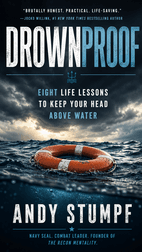
Andy Stumpf's Drownproof teaches readers to navigate life's worst moments by controlling what they can and releasing what they cannot, using tools like the Concern vs. Influence exercise and After Action Reviews. Drawing from his experience as a Navy SEAL and record-setting wingsuit pilot, this book is for anyone facing career setbacks, life transitions, or overwhelming challenges.
Feature
Insta.Page
Blinkist
Shortform
Summary Depth
Full Chapter-by-Chapter
15-min overview
Section-by-section guides
Audio Narration
✓
✓
✓
Visual Mindmaps
✓
✕
✕
AI Q&A
✓
✕
✕
Quizzes
✓
✕
✕
PDF Downloads
✓
✕
✓
Price
$89.99/yr
$146/yr (PRO)
$199/yr
*Competitor data last verified July 2026.
1 Page Summary
Drawing on his experience as a Navy SEAL and a Record-setting wingsuit pilot, Andy Stumpf's Drownproof offers a framework for navigating life's most turbulent moments by learning to control what you can and let go of what you cannot. The central thesis is that true resilience isn't about eliminating fear or avoiding failure, but about choosing how to respond when the wave hits. Stumpf introduces the concept of the "Concern vs. Influence" exercise—a simple paper-and-pen tool to separate what worries you from what you can actually affect—and reframes fear not as a stop sign, but as a compass that signals you are paying attention. The book's title is a direct metaphor for BUD/S, the Navy SEAL training pipeline where a 75-85% attrition rate is a feature, not a bug, teaching that the moment you fixate on how much time remains, you have already started quitting.
The book is highly distinctive for its raw, personal storytelling and refusal to offer tidy victories. Stumpf recounts specific "tsunamis" from his own life, including a combat injury that left him with drop foot and permanent nerve damage, a near-fatal intestinal blockage, and the corrosive self-doubt that nearly prevented him from writing the book. Rather than offering quick-fix motivation, he argues that discipline is the structure that carries you when motivation ebbs, and that failure is a universal certainty which must be dissected—not dwelled upon—using a modified version of the military's After Action Review (AAR) process. A recurring theme is the danger of letting your identity become swallowed by your job, a trap he experienced firsthand when a hospital stay forced him to confront the question: If I can’t be a SEAL, who am I going to be?
The intended audience is broad, appealing to anyone feeling knocked flat by a life transition, career setback, or overwhelming challenge—whether a veteran transitioning to civilian life, a professional facing burnout, or an individual struggling with self-doubt. Readers will gain a practical, unsentimental toolkit for distinguishing concern from influence, embracing failure as a starting point rather than an end, and building the kind of discipline that outlasts fleeting motivation. Ultimately, Drownproof promises not a life without struggle, but the ability to stay afloat and keep moving forward through the worst of it.
Foreword by Jocko Willink
Overview
Jocko Willink first noticed Andy Stumpf while reviewing candidates—and his credentials immediately stood out. Even though they’d never worked together, Andy’s career spoke volumes. He started as a SEAL at Team Five, earned a strong reputation, and was recommended for Naval Special Warfare’s Special Mission Unit, part of Joint Special Operations Command. That unit had its own brutal assessment and selection process, and Andy passed it, qualifying him as one of the world’s top operators. Over the years at that command, he kept sharpening his skills, becoming a lead climber, free-fall jump master, and tandem jumper, among other high-level proficiencies. He also had combat deployments—and he’d been wounded, taking an AK-47 round to the hip that caused muscle, bone, and nerve damage. The injury was severe enough that his ability to function normally, let alone operate as a SEAL again, seemed unlikely. But Andy was relentless. It took him over a year to recover, and his goal throughout was to get back to a SEAL Team and back in the fight. During that recovery, he was also commissioned as an officer—a clear sign that senior leaders in the SEAL community and the broader Navy saw both his desire and his potential to lead. By any measure, it was an extremely impressive résumé.
Key Takeaways
Grit in recovery: Andy’s determination to heal from a severe combat wound and return to active duty shows the kind of resilience that defines top-tier operators.
Continuous growth: Even while rehabilitating, he earned a commission as an officer, demonstrating that personal development doesn’t stop when circumstances get hard.
Holistic excellence: His skill set wasn’t narrow—lead climbing, free-fall jumping, tandem jumping, combat experience, and leadership potential—all of which made him stand out even among elite peers.
Key concepts: Foreword by Jocko Willink
1. Foreword by Jocko Willink
Andy Stumpf's Elite Credentials
Started as SEAL at Team Five
Passed brutal Special Mission Unit selection
Became lead climber, free-fall jump master
Multiple combat deployments
Resilience Through Severe Injury
Took AK-47 round to the hip
Suffered muscle, bone, and nerve damage
Over a year of relentless recovery
Returned to SEAL Team and combat
Continuous Growth Under Pressure
Earned officer commission during rehab
Senior leaders recognized his leadership potential
Personal development didn't stop despite hardship
Holistic excellence across diverse skills
💡 Try clicking the AI chat button to ask questions about this book!
1. Sink or Swim
Overview
The author stands on a street corner in Virginia Beach, watching a police cruiser disappear with one of his teammates, and suddenly the bottom drops out. He realizes that the life he’d built, the career he’d chased for nearly a decade, could be gone in an instant. And the worst part? He had seen it coming but hadn’t known how to stop it.
He had spent years believing he was untouchable, unstoppable, unbreakable. That belief, he learns, is the most dangerous kind of armor—because it makes you ignore the cracks until the whole thing shatters.
The Night Everything Changed
The story centers on a bar fight. One of the author’s platoonmates gets into a scuffle with bouncers, ends up in the back of a cop car, and the platoon tries to smooth things over by playing the SEAL card. Pre-9/11, that card didn’t carry much weight. The cops let the guy go on the condition they take him straight back to their lodging. They agreed. They didn’t follow through. Within minutes, the same teammate was picking another fight around the corner.
What follows is the kind of bureaucratic nightmare that feels both petty and world-ending: an investigation, a call to the commanding officer, a formal inquiry. The author watches the freight train coming down the tracks and realizes he has no idea how to get off the rails.
The Real Problem Wasn’t the Fight
The author is careful to say that this wasn’t about one bad night or one bad decision. It was about a pattern of deference that had become toxic. He describes a young man who would follow his teammates anywhere—bank robbing, walking on hot coals, whatever—because he didn’t feel he had the right to say no. He hadn’t earned that right, he thought. He hadn’t paid the dues. So he stayed silent when silence was the wrong answer.
The crucial insight here is that this wasn’t the Navy’s fault, or the training, or the culture. It was his fault. He had outsourced his own integrity. He had let his self-worth be determined by the approval of others, and that made him vulnerable to every bad decision the group might make. The bar fight wasn’t the problem; it was just the symptom.
The Moment of Reckoning
When the investigation finally came, the author stood before his commanding officer and told the truth. He admitted his role, his failure to intervene, his complicity by silence. The CO asked a pointed question about what he had learned. The author answered: that if a similar situation ever arose again, no matter how senior the person involved, he would step up and do the right thing. The CO simply said, “Good answer,” and that was the end of it.
But the lesson wasn’t about getting off the hook. It was about seeing yourself as the author of your own life. Until you do, you’re not a participant—you’re a passenger. And passengers don’t get to choose where the car goes.
A Foundation for What Follows
The author makes a point that will echo through the rest of the book: you can have the perfect plan, but if the foundation of how you view yourself is cracked, everything you build on top will crumble. The chapter is not just a confession; it’s a ground floor. The rest of the book will be architecture, but this is the concrete slab. Get it wrong, and the whole house shifts.
The closing pages pivot sharply. The author reflects on men who later died in places most people can’t find on a map, fighting an enemy that doesn’t care about your politics or your identity. He apologizes that you’ve never smelled the breath of a man who wants to kill you, never tasted your own tears at a flag-draped coffin. He wishes you had those experiences—not to traumatize you, but to change the way you value things. It’s a sobering reminder that the stakes of personal integrity aren’t just about saving your own career. They’re about what you’re willing to sacrifice for others.
Key Takeaways
Your self-perception is the foundation. If you see yourself as unable to speak up, you won’t. That’s not a character flaw; it’s a structural weakness.
Integrity cannot be outsourced. You can’t rely on the group to be your moral compass. You have to own your decisions, even when they’re hard.
Failure is inevitable, but it should happen in the micro, not the macro. Small mistakes teach you; catastrophic ones can derail your entire life.
The cost of silence is high. The author’s failure wasn’t in what he did, but in what he didn’t do—and that nearly cost him everything.
True awakening comes when you stop being a passenger. You are the author of your life, or you are its victim. There is no middle ground.
Key concepts: 1. Sink or Swim
2. 1. Sink or Swim
The Night Everything Changed
Bar fight leads to police involvement
SEAL card fails pre-9/11
Teammate released but starts another fight
Bureaucratic investigation begins
The Real Problem: Toxic Deference
Pattern of following teammates blindly
Feeling unworthy to say no
Outsourced integrity to the group
Bar fight was a symptom, not the cause
The Moment of Reckoning
Author tells the truth to commanding officer
Admits failure to intervene
Promises to step up in future
CO accepts with 'Good answer'
Foundation for the Book
Self-perception is the concrete slab
Cracked foundation makes everything crumble
Rest of book is architecture on this base
Integrity cannot be outsourced
The Stakes of Personal Integrity
Reflects on comrades who died in combat
Wishes readers understood real sacrifice
Silence nearly cost author everything
Stop being a passenger; author your life
2. Get Into the Water
Overview
You're thrown straight into the deep end of decision-making under pressure, using the visceral reality of an ambush as a starting point. The core message is counterintuitive: fear isn't your enemy—it's your compass. The real battle is not about being fearless, but about deciding, in the split second after fear hits, whether you'll let it freeze you or fuel you. From there, the chapter expands into two other critical terrains: how to handle people who drain your energy (the tug-of-war players) and the dangerous allure of chasing titles instead of purpose. Each section builds on the same principle—control what you can, subtract what you can't, and always know why you're moving forward.
Fear as a Signal, Not a Stop Sign
Most people misunderstand fear. They see it as a weakness to eliminate, but the author argues that its presence is proof you're paying attention. The example of being ambushed makes this brutally clear: no rational person feels calm when caught in a kill zone. The difference between survival and collapse isn't the absence of fear—it's whether you let that fear hijack your ability to act. The question shifts from “Am I afraid?” to “Am I in control?” This reframing is powerful because it normalizes the emotion while stripping away its authority over your choices. Fear can inform your decisions, but it should never make them for you.
The Art of Subtraction: Letting Go of the Rope
A significant portion of the chapter addresses toxic people—those who refuse to engage with facts, drain your energy, and make every interaction a tug-of-war. The insight here is elegant: you can keep pulling, exhausting yourself, or you can simply drop your end of the rope. Subtraction, the author notes, is often more powerful than addition. Recognizing these individuals early is a gift—they show you who they are so you can act accordingly. The hard part is accepting that the situation will not improve with time; it will only age poorly. Letting go isn't defeat; it's a strategic choice to unburden yourself for the challenges that actually matter.
Don’t Chase a Title, Chase a Purpose
The chapter culminates with a distinction that frames everything before it: being a SEAL (a title) versus being a Team Guy (a purpose). A title can be earned through technical achievement, but a Team Guy is defined by how they treat others. They are willing to step into the spotlight, but not on the heads of those around them. They arrive together, share the reward, and build something unstoppable. The takeaway is clear—purpose outlasts prestige. If your goal is merely the badge, you'll find yourself alone at the top. If your goal is the mission and the people beside you, you'll build something that endures.
Key Takeaways
Fear is natural and informative; the critical skill is deciding whether to let it control you or to control it.
Toxic individuals who refuse to engage rationally are like a tug-of-war—you can choose to drop your end of the rope rather than exhaust yourself.
Subtraction—removing negative influences—is often more valuable than adding more effort to a lost cause.
Titles are hollow without purpose; the most powerful people are those who lift others as they rise.
Always prioritize why you do something over what label you earn from it.
Key concepts: 2. Get Into the Water
3. 2. Get Into the Water
Fear as a Signal, Not a Stop Sign
Fear proves you're paying attention, not weak
Survival depends on controlling fear, not eliminating it
Shift from 'Am I afraid?' to 'Am I in control?'
Fear informs decisions but should never make them
The Art of Subtraction: Letting Go of the Rope
Toxic people drain energy in a tug-of-war
Drop your end of the rope instead of exhausting yourself
Recognize early that situations won't improve with time
Letting go is a strategic choice, not defeat
Don't Chase a Title, Chase a Purpose
A title is earned by achievement; purpose by how you treat others
Team Guys share rewards and lift others as they rise
Purpose outlasts prestige and builds enduring bonds
Chasing only the badge leaves you alone at the top
Control What You Can, Subtract What You Can't
Focus energy on what you can influence directly
Removing negative influences is more powerful than adding effort
Always know why you're moving forward
Unburden yourself for challenges that truly matter
3. The Deep End
Overview
Nine years into his SEAL career, the author lay in a hospital bed, grappling with the possibility of never returning to active duty. He confronted a question that had never crossed his mind: What am I going to become when this is over? That moment of stillness cracked open a new way of thinking—one that would eventually lead him out of the uniform and into the unknown. The chapter connects two threads: the danger of letting your identity get swallowed by your job, and the discovery of a strange, silent clarity found only on the edge of a wingsuit jump. It’s not a tidy story of triumph; it’s a raw look at the psychological currents that pull beneath the surface of a life defined by intensity.
The Hospital Bed Revelation
The author had been charging forward for nearly a decade without looking up. Then 2005 brought a stretch of hospital stays, forcing him to stop and think. The immediate question was whether he could heal and keep doing his job—but that quickly led to a deeper, more uncomfortable one: If I can’t be a SEAL, who am I going to be? For the first time, he realized the community would move on without him eventually, injury or not. This was a black-and-white moment that reshaped his thinking. He began to see that the most insidious dangers in Special Operations aren’t physical—they’re psychological. If you let the uniform define you, you’re setting yourself up for a crash when it’s time to hang it up.
Saying Yes to Opportunities
That shift in mentality opened a door to a series of “yeses.” He started flying Gulfstream G-IVs and Citations for charter companies—a role that came with incredible views but unstable income. Then a friend offered an opportunity to teach skydiving to military members, and he said yes again. That led to becoming a sponsored athlete in skydiving and BASE jumping, which eventually connected him to Joe Rogan, which sparked his podcast, which pushed him into public speaking. The author is quick to admit he’s only describing the peaks here, skipping the valley floors. Every yes came with costs, risks, and sacrifices. Nothing was free, but each step was a bridge—unstable, but better than staying in place.
Finding Silence in the Edge
The real thread through this chapter is the search for silence. In the SEAL teams, the static of stress, worry, and noise was constant. On a wingsuit exit point, that static vanished. There was only the thumping of his heart and the absolute necessity of living in the present moment. Hikes to exit points were filled with arguments, bad news, and heavy conversations—but as he geared up, the noise faded. Those moments of focus and clarity didn’t just stay with him for the jump; they lingered for weeks or months, often illuminating solutions to problems that had seemed unsolvable. The author isn’t suggesting everyone take up BASE jumping—he’ll explain why soon—but he makes the case that everyone needs a mechanism to dial down the static, to find a way back to the present.
The Weight of Responsibility
The chapter closes with a sobering story. A close friend named Seth, whom the author had introduced to the skydiving and BASE jumping world, died in an accident. The author was thousands of miles away at the time, but he can’t shake the feeling that he has a fingerprint on Seth’s death—he gave him the suit, connected him to the right people, and encouraged his progression. He asks himself if Seth would still be alive without his involvement. Though he suspects the outcome might have been the same, the guilt lingers. It’s a reminder that every yes, every leap, carries consequences beyond what you can foresee.
Key Takeaways
Letting your identity be completely defined by your role—whether SEAL, pilot, or anything else—is a setup for crisis when that role ends.
Saying yes to unexpected opportunities can open new pathways, but each comes with its own costs and risks.
Finding a mechanism to quiet mental noise is crucial; for the author, wingsuit BASE jumping provided that clarity, but the method must be personal and safe.
The decisions we make can have unintended impacts on others, and responsibility is not always easy to live with.
Key concepts: 3. The Deep End
4. 3. The Deep End
Identity Crisis in the Hospital
Forced stillness after nine years of charging forward
Realized the community would move on without him
Questioned who he'd be if not a SEAL
Psychological dangers are more insidious than physical
Saying Yes to New Paths
Started flying Gulfstreams and Citations
Taught skydiving to military members
Became sponsored athlete in BASE jumping
Each yes came with costs and sacrifices
Silence Found on the Edge
Wingsuit exit point silenced mental static
Only heart thumping and present moment remained
Clarity from jumps lasted weeks or months
Everyone needs a mechanism to dial down noise
The Weight of Responsibility
Friend Seth died in BASE jumping accident
Author feels fingerprint on Seth's death
Gave him suit and connected him to people
Every leap carries unforeseen consequences
Key Takeaways from the Chapter
Don't let your role define your identity
Opportunities come with costs and risks
Find a personal way to quiet mental noise
Decisions can have unintended impacts on others
You've reached the end of the free chapters
Next chapter: “Tread Water” is locked
Keep reading Drownproof — and unlock all 600+ book summaries with audio, mindmaps and AI Q&A.
$0.00 due today · 7 days free, then $89.99/year ($7.49/mo) · Cancel anytime before day 7
Andy Stumpf is a retired U.S. Navy SEAL and former CIA paramilitary contractor, best known as the author of "The Pillars of Leadership" and a prominent speaker on high-performance leadership, resilience, and tactical decision-making. His expertise stems from over a decade of service in elite special operations, including combat deployments and as a skydiving instructor. Stumpf also hosts the "Cleared Hot" podcast, where he explores leadership and personal growth through stories from military and civilian life.
Frequently Asked Questions about Drownproof
What is Drownproof about?
This book is a raw exploration of resilience, mindset, and transformation drawn from the author's experiences as a Navy SEAL and beyond. It challenges readers to confront fear, failure, and identity by offering practical frameworks like the concern-versus-influence exercise and the After Action Review. Through gripping personal stories of combat injuries, hospital stays, and the grueling BUD/S selection, it shows how to navigate life's overwhelming 'tsunamis' by focusing on small, controllable actions. Ultimately, it’s a guide to building discipline and purpose when the water rises.
Who is the author of Drownproof?
Andy Stumpf is a former Navy SEAL and officer who served in the elite Special Mission Unit of Joint Special Operations Command. He earned a reputation as a top operator, survived a severe combat wound from an AK-47 round, and spent over a year recovering to return to active duty. The book’s foreword is written by Jocko Willink, a respected former SEAL commander who attests to Stumpf’s relentless drive and credibility.
Is Drownproof worth reading?
Absolutely—this isn’t just another military memoir; it’s a practical manual for anyone facing adversity or seeking to redefine their purpose. The author’s candid breakdown of fear, failure, and identity—paired with actionable tools like the concern-versus-influence exercise—gives readers a concrete way to regain control when life feels overwhelming. Jocko Willink’s foreword alone underscores the book’s authenticity and depth, making it a compelling read for leaders, athletes, or anyone navigating a major transition.
What are the key lessons from Drownproof?
One crucial takeaway is that fear is not an enemy but a signal—the real battle is deciding whether it freezes you or fuels you. The concern-versus-influence exercise proves that most anxiety comes from things you can’t change, so the focus should shift to what you can actually affect. Failure is inevitable, but the After Action Review method teaches you to dissect mistakes without ego, turning them into stepping stones. Finally, discipline—not motivation—carries you when the tide goes out, and you must guard against letting your identity become consumed by your job or social media highlight reels.
📚 Explore Our Book Summary Library
Discover more insightful book summaries from our collection