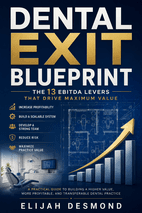
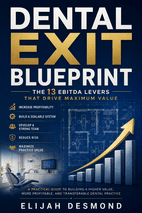
Elijah Desmond's DENTAL EXIT BLUEPRINT reveals the 13 EBITDA levers that determine a dental practice's sale price, showing owners how to transform their practice into an owner-independent business that commands premium multiples from sophisticated buyers. Written for dentists planning an exit one to ten years away.
Feature
Insta.Page
Blinkist
Shortform
DENTAL EXIT BLUEPRINT
✓
✕
✕
Summary Depth
Full Chapter-by-Chapter
15-min overview
Section-by-section guides
Audio Narration
✓
✓
✓
Visual Mindmaps
✓
✕
✕
AI Q&A
✓
✕
✕
Quizzes
✓
✕
✕
PDF Downloads
✓
✕
✓
Price
$89.99/yr
$146/yr (PRO)
$199/yr
*Competitor data last verified July 2026.
1 Page Summary
Thank you for providing the detailed chapter content. Based only on the information given, here is a concise 3-paragraph summary of the book "DENTAL EXIT BLUEPRINT: The 13 EBITDA Levers That Drive Maximum Value" by Elijah Desmond.
Central Thesis and Key Concepts
The book's central argument is that a dental practice's sale price is determined not by clinical skill or the owner's gut feeling, but by a single, strategic metric: EBITDA. The authors, Elijah Desmond and Matt Ornstein, establish that most dentists leave significant money on the table because they prepare for their exit using the wrong numbers. The book introduces the "13 EBITDA Levers™," a framework of specific, repeatable adjustments that directly influence a practice’s earnings before interest, taxes, depreciation, and amortization. These levers are grouped into three categories—revenue enhancement, cost optimization, and efficiency acceleration—and the authors emphasize that improving EBITDA creates a compounding effect, as a higher EBITDA also earns a higher multiple from sophisticated buyers.
Author’s Approach and Distinctive Qualities
Elijah Desmond brings a unique perspective as a former dental hygienist who built, scaled, and exited seven dental companies, giving him firsthand knowledge of the process from both sides of the transaction. The book sources its authority from the "Backstage Dentistry Expert Collective," a network of twenty-six specialists who each contribute a chapter on a specific lever, ensuring practical, actionable advice grounded in daily operational experience. This is not a theoretical guide but a working tool designed to be used immediately. The book is structured in three parts: a foundational course on how sales work and common mistakes, a technical handbook on understanding and using EBITDA, and the core action plan detailing the 13 levers. The authors argue that preparation and strategic positioning are far more important than aggressive marketing, and that exit planning is a strategic preparation that must begin years before the practice goes to market.
Intended Audience and Value Proposition
The primary audience is the dental practice owner—whether their exit is one year or ten years away—who wants to maximize the financial outcome of their life's work. Readers will gain a clear understanding of the hidden costs of mistakes like selling too late, not understanding earn-outs, or failing to attract competitive offers. The book provides a roadmap for transforming a practice from a job that depends on the founding doctor into an owner-independent business that commands a premium valuation. The ultimate takeaway is that the final sale price is not a negotiation but a reflection of everything that was done—or left undone—years in advance. As a next step, the book offers a confidential "Dental Exit Readiness Score" assessment to give owners a data-backed snapshot of their current position and the specific levers they need to pull first.
What Industry Leaders Are Saying
Overview
Dental industry leaders who have walked the path themselves share their voices in this section. Instead of presenting the author's credentials directly, these endorsements build credibility through the respected reputations of those who vouch for the work. Dr. Brett Kessler, the 161st President of the American Dental Association, emphasizes the importance of examining practice efficiency and profitability before any transition—framing this book as a resource born from decades of collective experience.
The endorsements reveal a consistent theme: trust. Dr. Gerald Botko, past president of the Academy of General Dentistry, highlights the author's integrity and meticulous approach, noting that the team assembled ensures "a true win-win" for both buyers and sellers. This addresses a common fear—that practice transitions are inherently adversarial. When both sides benefit, the process becomes sustainable rather than transactional.
Dr. Glenn Vo of Nifty Thrifty Dentists adds another layer, focusing not just on strategy but on mindset and generosity. He points to the author's journey from dental hygienist to entrepreneur as proof that vision and courage can build something bigger than clinical practice alone. This reinforces the book's deeper message: your practice is not just a business—it's an asset requiring care, attention, and the right blueprint.
Key Takeaways
Industry validation from multiple respected leaders establishes the book's credibility beyond the author's own claims.
Trust and mutual benefit are emphasized as foundational to successful practice transitions.
The author's personal journey from clinician to entrepreneur illustrates the mindset required for maximizing value.
Dental professionals need clear, understandable guidance to handle current market challenges.
Key concepts: What Industry Leaders Are Saying
1. What Industry Leaders Are Saying
Credibility Through Industry Leaders
Endorsements from respected leaders build trust
Dr. Brett Kessler highlights practice efficiency and profitability
Dr. Gerald Botko emphasizes integrity and mutual benefit
Trust and Mutual Benefit in Transitions
Practice transitions should be win-win for both sides
Trust addresses fear of adversarial processes
Sustainable transitions require shared benefits
Mindset and Vision Beyond Clinical Practice
Dr. Glenn Vo focuses on mindset and generosity
Author's journey from hygienist to entrepreneur inspires
Practice is an asset needing care and a clear blueprint
💡 Try clicking the AI chat button to ask questions about this book!
Foreword
Overview
The Foreword, penned by Matt Ornstein, establishes a foundational truth that runs throughout the entire book: the quality of your preparation determines the quality of your exit. Ornstein, who has spent his career inside hundreds of practice transitions, observes that the gap between an exceptional outcome and a disappointing one almost never comes down to clinical skill. It comes down to whether the dentist understood how to prepare for a sale years before it happened.
The Core Thesis: Preparation Over Quality in Practice Transitions
Ornstein shares that he first met Elijah Desmond while building Dental Pitch Advisory & Brokerage. From the beginning, he recognized that Desmond approached practice transitions differently. Coming from a background as a dental hygienist, entrepreneur, broker, and someone who had successfully exited multiple businesses, Desmond understood something many dentists miss: you can build a remarkable practice over decades and still receive far less than you deserve simply because no one taught you how to exit well.
This insight is what makes the book necessary. Ornstein's own work on EBITDA and deal-making addressed one piece of the valuation puzzle, but increasing value requires more than understanding a metric. It demands improvements in operations, leadership, hygiene optimization, overhead control, reducing owner dependency, and preparing a practice to withstand the scrutiny of sophisticated buyers.
A Guide Built on Expertise and Experience
Ornstein emphasizes that the contributing experts each bring deep experience in their fields. But what Desmond has done that feels different is organizing that knowledge into a practical framework with one clear objective: helping dentists maximize both the value of their practice and the wealth they ultimately get to keep.
Small operational improvements compound over time. They increase profitability, strengthen buyer confidence, and can even improve valuation multiples. The cumulative effect can be a dramatically different financial outcome when the sale happens.
What makes Desmond especially qualified for this work, according to Ornstein, is his perspective. He has been inside hundreds of transactions and understands both the financial mechanics and the personal emotions involved in transitioning out of a practice. He knows selling a dental practice is more than a transaction; it is often the culmination of a lifetime of work.
This is not a book to read once and place on a shelf. It is a roadmap meant to guide decisions years before a sale ever takes place, whether the transition is two years away or ten.
The Acknowledgments: A Personal Foundation
The extended acknowledgments reveal the personal origins of Desmond's mindset. His father, a self-made man who built multiple businesses and earned recognition as NAACP Businessman of the Year in Canton, Ohio, modeled what it meant to pour back into community. The image of his father organizing Brick City Reunion events, feeding thousands out of his own pocket and bringing the whole city together, shaped Desmond's understanding that success is not just about what you build for yourself.
His mother, Kristina, gave him the belief that anything was possible combined with the discipline to work for it. Her lesson about killing people with kindness and taking the high road has become a guiding principle.
The acknowledgments also highlight key relationships that shaped the book. The partnership with Matt Ornstein, the support from his wife Catherine and daughters Chloe and Carly, the contributions from twenty-eight expert authors, and the guidance from figures like Dr. Catrise Austin and Dr. Anissa Broussard all contributed to making this project what it is.
Key Takeaways
The quality of preparation matters more than the quality of dentistry when it comes to selling a practice
Understanding EBITDA is only one piece of the valuation equation; operational improvements across multiple areas compound to increase value
Small changes made years before a sale can produce dramatically different financial outcomes
Selling a dental practice is both a financial transaction and an emotional transition
The people and experiences that shaped you professionally are worth acknowledging because they inform how you show up to the work
Key concepts: Foreword
2. Foreword
Core Thesis: Preparation Over Quality
Preparation quality determines exit quality
Gap between outcomes comes from preparation, not clinical skill
Building a great practice doesn't guarantee a great sale
No one teaches dentists how to exit well
Practical Framework for Value Maximization
EBITDA is only one piece of the valuation puzzle
Operational improvements compound over time
Small changes years before sale produce dramatically different outcomes
Framework covers operations, leadership, hygiene, overhead, and owner dependency
Expertise and Perspective of the Author
Desmond has experience as hygienist, entrepreneur, broker, and seller
He understands both financial mechanics and personal emotions
Selling is culmination of a lifetime of work
Book is a roadmap for decisions years before sale
Personal Foundation from Family
Father modeled pouring back into community
Mother taught belief in possibility and discipline
Lesson: kill people with kindness and take the high road
Success is not just about what you build for yourself
Key Relationships and Acknowledgments
Partnership with Matt Ornstein shaped the book
Support from wife Catherine and daughters Chloe and Carly
Contributions from twenty-eight expert authors
Guidance from Dr. Catrise Austin and Dr. Anissa Broussard
How to Use This Book
Overview
This book isn’t meant to gather dust on a shelf. It’s designed to be a working tool, something you can pick up and put into action immediately. The organization reflects that purpose: each section builds on the last, but you don’t have to read it cover to cover to get value. Part One lays the groundwork with the Dental Practice Exit Course—how sales actually work, the quiet mistakes that cost owners dearly, and what you need to do before ever going to market. Even if your exit is ten years away, start here; everything else assumes you’ve absorbed this foundation.
Part Two, the Dental EBITDA Handbook by Matt Ornstein, is short, technical, and absolutely critical. It zeroes in on the single metric that determines your practice’s worth, explains why buyers use it instead of the numbers most dentists track, and shows what happens to your enterprise value every time that number moves. The math in this section is the reason every lever in Part Three matters so much.
Part Three is the heart of the book: thirteen independent levers, each written by a specialist who does this work daily. You can open to any one lever, pull it, and improve your outcome. But the real magic comes from the compound effect—when EBITDA and your multiple rise together, your exit value multiplies. You don’t have to read them in order. You do have to act.
Throughout the book you’ll find references to the free Dental Exit Readiness Score at dentalexitscore.com. It lets you benchmark your practice against what a buyer’s diligence team will examine and tells you which levers will move your number the most. Take it before you start, and again as you work. Then go pull some levers.
Key Takeaways
The book is structured to be used piece by piece, not read linearly—start with Part One even if you’re years away from selling.
Part Two unpacks EBITDA, the key value driver; the math there makes the levers in Part Three work.
The thirteen levers in Part Three are independent but compound together—pulling one helps, pulling several multiplies your practice’s worth.
The free Dental Exit Readiness Score provides a personalized starting point and ongoing benchmark.
Key concepts: How to Use This Book
3. How to Use This Book
Book's Purpose & Structure
Designed as a working tool, not shelf decoration
Each section builds on the last but is usable independently
Part One: Foundation with the Dental Practice Exit Course
Part Three: Thirteen independent levers for immediate action
Part One: The Foundation
Covers how sales actually work and common mistakes
Essential even if your exit is ten years away
Prepares you before going to market
Part Two: EBITDA Handbook
Short, technical, and critical for practice valuation
Explains why buyers use EBITDA over other metrics
Shows how EBITDA changes affect enterprise value
Part Three: The Levers
Each lever written by a specialist for direct impact
Pulling one lever improves outcome
Compound effect multiplies exit value when used together
Dental Exit Readiness Score
Free online tool at dentalexitscore.com
Benchmarks practice against buyer diligence criteria
Identifies which levers will move your number most
Part One: Elijah’s Dental Practice Exit Course
Overview
Part One of Elijah’s Dental Practice Exit Course sets the stage for everything that follows. This isn’t a quick checklist or a generic “how to sell a business” tutorial. Instead, it’s a structured foundation course designed specifically for dental practice owners who are thinking about—or actively planning—their exit. The central premise is that most dentists leave significant money on the table simply because they don’t understand the process before they engage with buyers. This section aims to change that.
The course begins with a sobering truth: the moment you start treating patients and building a practice, you’re also building an asset that will one day be sold. But the sale price, terms, and even your ability to sell at all depend on decisions made years before the listing goes live. Part One unpacks why education matters more than aggressive marketing when it comes to maximizing value. It also introduces Elijah’s core philosophy: exit planning is not a transaction—it’s a strategic preparation that deserves dedicated attention, separate from clinical work.
Understanding Your Practice’s True Value
A major chunk of this part focuses on valuation, but not the dry, number-crunching kind. Instead, Elijah emphasizes the drivers of value. What do buyers actually look for? It’s rarely just revenue or profit. Factors like patient retention rates, hygiene conversion, facility condition, and even your local competition can swing the final price by 20–50%. The course walks through a framework that lets owners assess their own practice against market benchmarks, identifying strengths they can highlight and weaknesses they can address before a buyer’s due diligence.
A key insight here is the distinction between “cash flow” and “value”. Many owners assume that if the practice generates good income, it will fetch a high price. But buyers pay for predictable, transferable systems, not just current earnings. Part One drives home the need to separate yourself from daily operations—even if you plan to stay on after the sale. A practice that relies entirely on the doctor’s charisma has a ceiling on its value.
The Timing of an Exit
Another essential theme is timing. The course doesn’t just say “sell when you’re ready.” It offers a specific timeline for preparation, usually 12–24 months before going to market. This window allows for cleaning up financial records, recruiting and training key staff, updating equipment, and even smoothing out any volatile patient or production patterns. The biggest mistake? Waiting until you’re burned out or facing a forced exit, such as a health issue or partnership dispute. Part One covers how to recognize your own “optimal exit window” and start preparation while you still have leverage.
Preparing the Financial and Legal Foundation
Finally, Part One gets deeply practical about the documents needed before any buyer will take you seriously. This includes clean profit and loss statements adjusted for owner discretionary spending, lease analysis, equipment inventory, and a written operations manual. There’s also guidance on assembling a professional team—accountant, lawyer, broker, sometimes a business coach—who understand dental transitions specifically. The course warns that using a generalist can cost you tens of thousands of dollars in poor structuring or missed tax opportunities.
The tone throughout is direct, sometimes blunt, but never academic. Elijah speaks as someone who has seen hundreds of deals go right and wrong, and he shares those real-world examples to keep the lessons grounded.
Key Takeaways
Your practice’s value is determined by transferable systems, not just current cash flow.
Start exit preparations 12–24 months before listing to address financial, operational, and legal gaps.
Valuation drivers include patient retention, facility condition, staff stability, and how dependent the practice is on you.
The professionals you hire for the transition must specialize in dental practice sales, not just general business sales.
Education upfront prevents emotional, rushed decisions that cost you leverage and money.
Key concepts: Part One: Elijah’s Dental Practice Exit Course
4. Part One: Elijah’s Dental Practice Exit Course
Foundation & Philosophy
Exit planning is strategic preparation, not a transaction
Education matters more than aggressive marketing for value
Most dentists leave money on the table due to ignorance
Understanding Practice Value Drivers
Buyers pay for predictable, transferable systems, not cash flow
Patient retention, hygiene conversion, and facility condition matter
Practice reliant on doctor's charisma has a value ceiling
Separate yourself from daily operations before selling
Optimal Exit Timing
Start preparation 12–24 months before going to market
Avoid waiting until burned out or facing forced exit
Prepare while you still have leverage and energy
Financial & Legal Preparation
Clean P&L statements adjusted for owner discretionary spending
Assemble team of specialists in dental transitions
Generalist advisors can cost tens of thousands in missed value
Prepare lease analysis, equipment inventory, and operations manual
Key Takeaways for Owners
Value depends on transferable systems, not current earnings
Start exit prep 12–24 months early to address gaps
Hire professionals who specialize in dental practice sales
Education prevents emotional, rushed decisions that cost leverage
You've reached the end of the free chapters
Next chapter: “How Much Is Your Practice Worth?” is locked
Keep reading DENTAL EXIT BLUEPRINT — and unlock all 700+ book summaries with audio, mindmaps and AI Q&A.
$0.00 due today · 7 days free, then $89.99/year ($7.49/mo) · Cancel anytime before day 7
Elijah Desmond is a speculative fiction author and environmental journalist known for his novel *The Last Canopy*, which explores themes of ecological collapse and human resilience. With a background in environmental science from the University of Cambridge, he frequently contributes to publications like *National Geographic* and *The Guardian*. His work often blends rigorous research with imaginative storytelling to highlight pressing climate issues.
Frequently Asked Questions about DENTAL EXIT BLUEPRINT
What is DENTAL EXIT BLUEPRINT about?
This book provides a comprehensive framework for dental practice owners to maximize their exit value, covering everything from valuation and EBITDA to buyer types and sale structures. It reveals the common mistakes that quietly erode practice worth and introduces 13 specific EBITDA levers—operational adjustments in revenue, cost, and efficiency—that directly influence what buyers will pay. Written by a team of industry experts, it transforms exit planning from a last-minute transaction into a strategic, multi-year preparation that can add hundreds of thousands or even millions to the final sale price.
Who is the author of DENTAL EXIT BLUEPRINT?
Elijah Desmond is a former dental hygienist who built, scaled, and exited seven dental companies, learning valuable lessons about value, timing, and walking away. He now runs Dental Pitch Advisory & Brokerage and DSO Pricing, drawing on decades of collective experience to help dentists avoid costly mistakes. The book also features contributions from 26 specialists, including Matt Ornstein, who helped scale a DSO from 20 to over 70 locations, and Dr. Brett Kessler, 161st President of the American Dental Association.
Is DENTAL EXIT BLUEPRINT worth reading?
This book is essential reading for any dentist planning to sell their practice, as it systematically reveals how preparation—not clinical skill—determines the final payout. It goes beyond generic advice to provide a structured playbook of 13 operational levers, explains the critical metric of EBITDA that buyers actually use, and shows how to avoid the five common mistakes that silently erode value. Whether your exit is two years or ten years away, the frameworks here will turn your practice into a premium asset rather than leaving money on the table.
What are the key lessons from DENTAL EXIT BLUEPRINT?
The most important lesson is that exit planning must begin years in advance, not months before selling, and requires understanding how buyers actually value a practice—primarily through EBITDA, not collections or net income. There are three ways to increase EBITDA: reduce costs, increase high-margin revenue, or acquire another practice, and improving each dollar of EBITDA compounds because the multiple applied rises as EBITDA grows. A successful exit depends on building owner-independent systems across 13 levers (like hygiene production, team stability, and automation) that prove the practice can thrive without the founding doctor. Finally, having a broker who creates competitive tension and understanding the six distinct exit structures can mean the difference between a good offer and a great one.
📚 Explore Our Book Summary Library
Discover more insightful book summaries from our collection