DENTAL EXIT BLUEPRINT Quotes
by Elijah Desmond
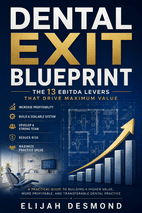
This collection pulls the most memorable lines from a book that cuts through the noise around selling a dental practice. You will find blunt truths, counterintuitive insights, and practical warnings that stick with you long after you close the page.
What makes this book quotable is its refusal to sugarcoat. The author distills years of deal experience into sharp, actionable statements. Every line earns its place by challenging what dentists typically assume about exit planning, from timing to valuation to the real drivers of a successful sale.
Top Quotes from DENTAL EXIT BLUEPRINT
“The biggest difference between an exceptional outcome and a disappointing one is not the quality of the dentistry, it is the quality of the preparation.”
Matt Ornstein, co-founder of Dental Pitch Advisory & Brokerage, in the foreword.
This line captures the core thesis of the book—that preparation matters more than clinical skill—and immediately resonates with dentists who want to maximize their practice's exit value.
“There is no Zillow for dental practices.”
The author explains that practice owners often mistakenly think they can easily find their practice's market value.
This line is memorable because it uses a universally understood analogy to highlight the lack of transparency in dental practice valuations, making the concept instantly relatable.
“You pushed yourself harder before the sale to justify a higher price, and now you have to push yourself harder for another three to five years to actually receive it. That is not a strategy. That is a sentence.”
The author warns against the common mistake of ramping up production right before selling a practice.
The stark contrast between 'strategy' and 'sentence' crystallizes the painful long-term consequences of short-term thinking, making it unforgettable for any practice owner.
“The goal is not to produce more before you sell. The goal is to keep more of what you already produce, and at a seven-times multiple, the difference between those two strategies is enormous.”
The author explains the core principle of maximizing practice value before an exit.
This simple reframing shifts the reader's focus from burnout-inducing production to smart efficiency, a message that resonates because it promises both financial gain and a better lifestyle.
“Six months is not a sale timeline. Six months is a crisis.”
From the discussion of Mistake One: Calling Too Late.
The stark contrast between a timeline and a crisis sticks in the reader's mind. It instantly reframes the urgency of early planning.
“You are not the expert in selling dental practices. You are the expert in practicing dentistry.”
In Mistake Two: Going Direct to the Buyer, when explaining why dentists should not negotiate alone.
The clear role separation is both humble and empowering, reminding dentists to stay in their lane and hire professionals.
“Competition is the broker's most powerful tool.”
From Mistake Three: One-Buyer Syndrome, describing why multiple buyers improve outcomes.
This short, declarative sentence captures the core leverage in any sale. It is memorable and actionable.
Themes Behind the Quotes
One central theme is that preparation matters far more than clinical skill when it comes to maximizing practice value. The book argues that dentists often focus on producing more, when the real leverage lies in keeping more of what they already produce through operational efficiency. Another theme is the importance of being perpetually sell ready, not just when a sale is imminent. This mindset transforms how a practice is run day to day, making it more attractive to buyers and more resilient for the owner.
The quotes also emphasize that a practice is a business first. Understanding metrics like EBITDA and the quality of earnings is not optional. Small changes in overhead or team stability compound into massive differences in final payout. Finally, the book warns against common traps: mistaking a short timeline for a plan, overvaluing heroics, and treating the market as a monolith. The underlying thread is that a successful exit is engineered, not stumbled into.
Quotes by Chapter
What Industry Leaders Are Saying
“It's so important to look at every aspect of your practice for efficiency and profitability before you consider transitioning your practice.”
Dr. Brett Kessler, 161st President of the American Dental Association, emphasizes the need for thorough preparation before selling a practice.
This line captures a universal truth about business transitions—maximizing value starts long before the sale. It resonates because it reframes exit planning as an ongoing discipline, not a last-minute task.
“Elijah has built several successful businesses and assembled a team of subject matter experts who help ensure a smooth, successful transition for both buyers and sellers, creating a true win-win.”
Dr. Gerald Botko, Past President of the Academy of General Dentistry, endorses the author's expertise and approach.
The promise of a 'true win-win' is compelling in a field where transactions often feel adversarial. This quote reassures readers that a fair, expert-guided process is achievable.
“It's a blueprint for maximizing the value of one of the biggest assets you'll ever own.”
Dr. Glenn Vo, Founder of Nifty Thrifty Dentists, describes the book's core promise.
The metaphor of a 'blueprint' gives readers a sense of clarity and actionability. Combined with the emotional weight of a life's biggest asset, the line feels both urgent and empowering.
“The exit landscape has never been more dynamic or more confusing.”
Dr. Eric J. Roman, Founder of Dental Associate Growth, sets the stage for why guidance is needed.
This succinct observation validates the reader's own uncertainty and creates an immediate need for the book's insights. It taps into the anxiety many dentists feel about the changing market.
Foreword
“This book is not intended to be read once and placed on a shelf. It is a roadmap that should guide decisions years before a sale ever takes place.”
Matt Ornstein concluding the foreword.
It emphasizes the book's practical, long-term utility, urging readers to treat it as an actionable guide rather than a one-time read.
“You did not leave me empty. You left me full, full of everything you taught me, everything you modeled, everything you were.”
Elijah Desmond honoring his late father in the acknowledgments.
A poignant expression of legacy and gratitude that resonates with anyone who has lost a loved one, showing how character outlasts presence.
“You kill them with kindness. You take the high road every time, even when it costs you something, even when nobody is watching, even when it is the harder choice.”
Elijah Desmond recalling a lesson from his mother, Kristina.
Timeless advice on integrity and resilience that applies far beyond business, inspiring readers to choose kindness even when it is difficult.
How to Use This Book
“This book is built to be used, not just read.”
Opening line of the chapter.
It immediately establishes the book's practical, action-oriented ethos, challenging readers to move beyond passive consumption.
“But the real power is in how they compound, because EBITDA and your multiple rises together, and your exit is the product of those two numbers, not the sum.”
Explanation of how the thirteen levers work together in Part Three.
It reveals the multiplicative synergy between EBITDA and multiple, a counterintuitive insight that underscores why each lever matters more when combined.
“You do not have to read the levers in order. You do have to act on them.”
Instruction for using the independent levers in Part Three.
The contrast between flexibility and necessity delivers a crisp, memorable mandate: knowledge is worthless without execution.
“Wherever you are in your timeline, the best time to start building the practice a buyer competes for is now.”
Closing encouragement before introducing the Dental Exit Readiness Score.
It eliminates excuses about timing and instills urgency, motivating readers to begin immediately regardless of their current stage.
How Much Is Your Practice Worth?
“The quality of earnings is the document that determines what your practice is actually worth, not a valuation, not a guess, not your accountant’s estimate.”
The author distinguishes between a valuation and a quality of earnings.
It emphasizes the critical importance of forensic accounting over guesswork, giving readers a clear actionable takeaway.
“EBITDA is your net profit. It is what remains after your team is paid, your rent is covered, your supplies and overhead are settled, and your own normalized compensation, a reasonable market-rate salary for a working dentist, has been accounted for.”
The author explains EBITDA in simple terms.
This clear, relatable definition demystifies a financial term and shows why it is the key metric for practice value.
“Protect yourself. Know the real number before you go to market.”
The author warns sellers to know their true practice value before negotiating with buyers.
This short, imperative statement is a powerful call to action that empowers readers to avoid being undervalued.
Understanding Earn-Outs
“Four changes. The math on those four alone is over one point seven million dollars in additional enterprise value. Not from working harder. From being efficient with what you are already doing.”
The author summarizes the impact of four specific cost-saving changes on a three-million-dollar practice.
The concrete dollar figure astonishes readers and proves that small operational tweaks can yield massive returns, motivating immediate action.
“The earn-out is simply their way of making sure that EBITDA continues to be generated during the transition. That is a reasonable ask, and once you understand it that way, the earn-out stops feeling like a constraint and starts feeling like what it actually is: the back half of your sale price.”
The author demystifies the earn-out mechanism for practice sellers.
This reframing transforms a dreaded concept into a fair, logical part of the deal, reducing anxiety and helping dentists see the earn-out as an opportunity rather than a burden.
The Five Common Mistakes Dentists Make When Selling
“Being sell-ready is not about planning to sell tomorrow. It is about being prepared for the moment when you have to, whatever the circumstances.”
Following the story of Mary, whose husband died suddenly without a sell-ready practice.
This elevates sell-readiness from a transaction tactic to a universal safety net. It resonates because it applies to any unforeseen life event.
Attracting the Right Buyers
“I do not care if you have to convert the break room. I do not care if you have to reconfigure your waiting area.”
The author stresses the non-negotiable need for five operatories to attract top buyers.
This blunt, commanding language forces sellers to prioritize structural capacity over comfort, making it a memorable call to action.
“Flexibility is worth real money in a transaction.”
The author explains why seller flexibility on timeline and terms directly improves deal value.
It distills a complex negotiation principle into a simple, persuasive truth that resonates with sellers clinging to rigid expectations.
“A fully staffed, stable team signals the opposite: that the practice is well-managed, that people want to work there, and that the buyer is inheriting a functioning organization rather than a problem to solve.”
The author contrasts the risk of staffing gaps with the value of a stable team.
This line reframes staffing from a cost to a strategic asset, giving sellers a clear, motivating vision of what buyers truly want.
“A twenty percent EBITDA margin signals operational discipline. It signals that overhead is managed intentionally, not just accepted. It signals a business that does not rely entirely on the owner's personal heroics to generate its income.”
The author defines the benchmark profit margin that positions a practice for a competitive sale.
The triplet structure hammers home the broader meaning of a number, transforming a metric into a badge of professional management.
Buyer Types and Sale Structures
“If you have seen one DSO, you have seen one DSO.”
Author's key advice to sellers about DSO diversity.
This memorable phrase challenges the misconception that all DSOs are alike, encouraging sellers to evaluate each buyer individually.
“The dental acquisition market is not a monolith.”
Opening of the chapter explaining the market.
It succinctly dismantles the assumption of a homogeneous market, setting a critical mindset for the reader.