DENTAL EXIT BLUEPRINT Key Takeaways
by Elijah Desmond
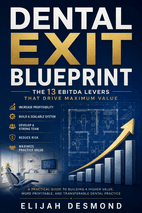
5 Main Takeaways from DENTAL EXIT BLUEPRINT
EBITDA is the single number that determines your sale price.
Buyers value your practice on adjusted EBITDA, not collections or net income. Every dollar you add to EBITDA is multiplied by 5-10x at closing, meaning a $100,000 cost cut could add $700,000+ to your final check.
Start exit preparation 12-36 months before you plan to sell.
Small operational improvements compound dramatically over time. Fixing your collection percentage, reducing owner dependency, and automating workflows takes months, and buyers pay a premium for practices that run without the selling doctor.
Use the 13 EBITDA Levers systematically, not as a checklist.
Instead of chasing one magic bullet, pull two to three levers at a time over 90-day sprints. Even a 5% boost in case acceptance or a 2% reduction in supply waste, when multiplied by your EBITDA multiple, can add hundreds of thousands in value.
Create competition among buyers to get your best offer.
Negotiating with a single buyer leaves money on the table. A competitive process routinely adds 20-40% to the deal, and a broker who aligns with your price—not their commission speed—is essential to run that process.
Your exit is a beginning—plan for life after the sale before you close.
The most expensive mistake isn't a bad deal term; it's having no answer to 'Now what?' Separate your identity from dentistry, design your purpose across seven pillars, and involve your spouse and advisors early to avoid a devastating post-transition void.
Executive Analysis
These five takeaways form a unified thesis: the value of a dental practice is not determined by clinical skill or current cash flow, but by systematic preparation, financial literacy, and intentional exit planning. EBITDA is the universal valuation language, but understanding it is useless without pulling the 13 levers that improve it—and then creating a competitive sale process that forces buyers to pay for that improvement. The book argues that preparation, not negotiation, is where real leverage comes from.
This book matters because it bridges two worlds: the nuts-and-bolts financial mechanics of a dental practice sale (EBITDA, earn-outs, QofE) and the emotional, identity-shaking reality of leaving a career you built. Unlike generic business exit guides, DENTAL EXIT BLUEPRINT is laser-focused on dentistry’s unique valuation thresholds, buyer types (DSOs, JVs), and owner-dependency traps. It gives burnt-out or retirement-ready dentists a concrete, step-by-step system to maximize both their sale price and their post-exit life. In the crowded field of practice transition books, it stands out for its actionable levers and its refusal to ignore the human side of the wire transfer.
Chapter-by-Chapter Key Takeaways
What Industry Leaders Are Saying (Chapter 1)
Industry validation from multiple respected leaders establishes the book's credibility beyond the author's own claims.
Trust and mutual benefit are emphasized as foundational to successful practice transitions.
The author's personal journey from clinician to entrepreneur illustrates the mindset required for maximizing value.
Dental professionals need clear, understandable guidance to handle current market challenges.
Try this: Leverage the endorsements in Chapter 1 to build confidence that exit preparation is a proven path, not a guess.
Foreword (Foreword)
The quality of preparation matters more than the quality of dentistry when it comes to selling a practice
Understanding EBITDA is only one piece of the valuation equation; operational improvements across multiple areas compound to increase value
Small changes made years before a sale can produce dramatically different financial outcomes
Selling a dental practice is both a financial transaction and an emotional transition
The people and experiences that shaped you professionally are worth acknowledging because they inform how you show up to the work
Try this: Assess your practice's transferable systems today—the quality of your preparation matters more than the quality of your dentistry.
How to Use This Book (Chapter 2)
The book is structured to be used piece by piece, not read linearly—start with Part One even if you’re years away from selling.
Part Two unpacks EBITDA, the key value driver; the math there makes the levers in Part Three work.
The thirteen levers in Part Three are independent but compound together—pulling one helps, pulling several multiplies your practice’s worth.
The free Dental Exit Readiness Score provides a personalized starting point and ongoing benchmark.
Try this: Take the Dental Exit Readiness Score immediately to get a personalized benchmark before reading further.
Part One: Elijah’s Dental Practice Exit Course (Chapter 3)
Your practice’s value is determined by transferable systems, not just current cash flow.
Start exit preparations 12–24 months before listing to address financial, operational, and legal gaps.
Valuation drivers include patient retention, facility condition, staff stability, and how dependent the practice is on you.
The professionals you hire for the transition must specialize in dental practice sales, not just general business sales.
Education upfront prevents emotional, rushed decisions that cost you leverage and money.
Try this: Start exit preparations 12–24 months before listing by identifying gaps in financials, operations, and legal setup.
How Much Is Your Practice Worth? (Chapter 4)
Don’t rely on a valuation. It’s just an estimate. A quality of earnings (QofE) is the only document that matters.
EBITDA is your net profit after normalized owner salary. Multiplied by 5–9x, it gives your practice enterprise value.
Adjusted EBITDA adds back personal expenses and one-time costs—these can significantly increase your sale price.
Target a 20% EBITDA margin before going to market. A small delay to improve margin is a high-return investment.
Never ask a general CPA to run your QofE. Use a firm that specializes in forensic dental accounting.
Pull your last three years of P&Ls, tax returns, and production reports now. Disorganized records signal risk to buyers.
Try this: Pull your last three years of P&Ls, tax returns, and production reports now; disorganized records signal risk to buyers.
Understanding Earn-Outs (Chapter 5)
Don’t ramp up production before the sale. You’ll just lock yourself into a higher pace you must sustain for years to collect the earn-out. Focus on efficiency instead.
Four efficiency levers—credit card fees, aligner switching, supply distribution, lab fees—can add over $1.7M in enterprise value on a $3M practice without extra work.
The earn-out period is not a punishment; it’s the back half of your sale price. Use it to practice dentistry without administrative burden.
Run the earn-out math on your current pace before you go to market. If sustaining that pace for three to five years isn’t realistic, renegotiate the terms before you sign.
Try this: Run the earn-out math on your current production pace before going to market; if sustaining it for 3–5 years isn't realistic, renegotiate terms early.
The Five Common Mistakes Dentists Make When Selling (Chapter 6)
Start early. Even if you are years away, sell-readiness protects you against the unexpected and gives you time to maximize value.
Never go direct. Have a broker or M&A attorney review every document a buyer sends. A letter of intent is a binding contract.
Create competition. Do not negotiate with a single buyer. A competitive process routinely adds twenty to forty percent to the deal.
Fix associate comp. Keep general dentists in the twenty-five to thirty-five percent range. Overpayment compresses your EBITDA and weakens your offer.
Clean your AR. Engage a revenue cycle management firm before going to market. The recovered cash is yours, and the clean balance sheet strengthens your negotiating position.
Try this: Engage a broker or M&A attorney before signing any document—a letter of intent is a binding contract.
Attracting the Right Buyers (Chapter 7)
Five operatories is the minimum to attract serious buyer interest; if you’re below, consider reconfiguring space before listing.
Flexibility on timeline and terms directly increases the multiple you’ll receive; treat your preferences as negotiable, not fixed.
Fill every vacancy before going to market to avoid signaling instability; stabilize your team for at least six months.
A twenty percent EBITDA margin is a threshold that signals operational discipline and unlocks competitive offers.
Try this: Fill every operator vacancy and stabilize your team for at least six months before listing to avoid signaling instability.
Buyer Types and Sale Structures (Chapter 8)
Know your priority first. Is it buyer type, deal structure, earn-out terms, or check size? That clarity drives every conversation.
Research specific buyers. Don’t judge a DSO by what you’ve heard about DSOs. Look at their culture and how they treat sellers still in their earn-out.
Explore a JV if your practice has growth ahead. Retained equity at a higher future multiple can be far more lucrative than a full payout today. Ask your broker to model it out.
Try this: Clarify your priority (check size, earn-out terms, buyer type) before exploring specific buyer options.
Why You Need a Broker and How the Process Works (Chapter 9)
Engage a broker early, even if you’re not ready to sell. A serious broker will tell you where you stand and how to get market-ready.
Never sign or respond to any buyer communication before you have representation in place.
Ask every broker directly: Do you accept payment from buyers? If yes, understand the conflict of interest.
Start talking to a wealth advisor now—before the sale process—to calculate the wealth gap: what you need after taxes and deal structure to fund the life you want.
When the wire hits, expect relief, not euphoria. Have a plan for what comes next, and know which door you’re walking through before you open it.
Try this: Interview brokers and ask directly if they accept payment from buyers—understand any conflict of interest.
Part Two: The Dental EBITDA Handbook (Chapter 10)
EBITDA is the universal language of dental practice valuation, not profit or collections.
Buyers use EBITDA to compare practices on equal footing, ignoring owner-specific financial choices.
Small EBITDA improvements compound dramatically through valuation multiples—Chapter 4 will prove this.
Without understanding the math, sellers can underestimate how much each operational tweak is really worth.
Try this: Treat EBITDA as the universal language of valuation; stop focusing on collections or net income alone.
What Does EBITDA Stand For, and Really Mean? (Chapter 11)
EBITDA strips away interest, taxes, depreciation, and amortization to show pure operating earnings.
Amortization is simply the annual principal repayment on a loan, not an opaque accounting concept.
Buyers value practices based on EBITDA, not net income, because debt loads vary.
Valuation multiples (like 6x) are applied to EBITDA, making it the single most important number for sellers.
Try this: Memorize that valuation multiples are applied to EBITDA, making it the single most important number for sellers.
How Is EBITDA Different from Net Income? (Chapter 12)
EBITDA and net income can tell completely different stories for the same practice. Net income is shaped by personal financing and tax choices; EBITDA reveals the business’s core earning power.
Two practices with identical EBITDA will be valued the same by buyers, regardless of how their net incomes differ. Debt is stripped out because buyers bring their own capital.
To prepare for a sale, invest in a CPA who specializes in dental practices. An accurate, verified EBITDA is the foundation of any credible valuation.
Try this: Invest in a CPA who specializes in dental practices to produce an accurate, verified EBITDA.
Why EBITDA Matters If You Want to Sell (Chapter 13)
Buyers value smaller practices (under $3M collections) by a simple 1x collections multiple.
Once collections exceed $3M and EBITDA surpasses $600K, valuation shifts to EBITDA multiples.
EBITDA multiples increase with practice size—larger profits earn higher multipliers, compounding your sale price.
For practices near the threshold, strategic decisions about expenses and operations directly impact which valuation method applies—and how much you ultimately walk away with.
Try this: If your collections are under $3M, focus on crossing the EBITDA threshold of $600K to shift from a 1x collections multiple to a 6x+ EBITDA multiple.
How EBITDA Affects the Value of Your Practice (Chapter 14)
EBITDA multiples aren’t fixed; they rise as your EBITDA scales, starting around 6x for $600k EBITDA and reaching 10x for $10M+ EBITDA.
The double‑growth effect (higher EBITDA and a higher multiple) means every dollar of EBITDA improvement compounds at closing.
Focus on boosting both profitability and practice size to unlock the upper tiers of valuation.
Try this: Target both higher EBITDA and larger practice size to unlock the double‑growth effect of a higher multiple.
The Three Ways to Increase EBITDA (Chapter 15)
There are exactly three pathways to higher EBITDA: reduce costs, increase collected revenue, or acquire another practice.
Cost reductions are fully additive with no margin dilution—dollars saved go straight to the bottom line.
Revenue matters only when collected and when it carries healthy margins; production without collection is just activity.
Acquisitions can unlock multiple expansion, creating outsized value beyond the EBITDA gain alone.
Every improvement compounds: $100k in cost cuts at 7x is worth $700k in sale price.
Try this: Pick one of the three pathways—cost reduction, revenue growth, or acquisition—and run the math on how a $100K improvement multiplies into sale price.
Part Three: The 13 EBITDA Levers™ (Chapter 16)
EBITDA improvement is not about finding one magic bullet; it’s about systematically pulling a series of connected levers.
The 13 levers are grouped by influence area—revenue, cost, and efficiency—but they must be addressed as a system, not a checklist.
Small, precise adjustments (e.g., a 5% increase in case acceptance or a 2% reduction in supply waste) compound into significant bottom-line gains.
The framework is designed to be practiced: measure your current state, choose two levers to focus on over 90 days, and track the impact before moving to the next pair.
Every lever has a “danger zone” where over-optimization (e.g., cutting too deep on lab costs) undermines quality or patient experience—balance is non-negotiable.
Try this: Measure your current state on two EBITDA levers today, commit to improving them over 90 days, and track the impact before moving on.
EBITDA LEVER 01: What Buyers Actually Pay For (Chapter 17)
Buyers pay for adjusted EBITDA, not collections or revenue. Know your real number before any offer arrives.
Your accountant's adjusted EBITDA will almost certainly differ from a buyer's. The gap between them is where trust and money get lost.
Owner dependency kills multiples. A practice that runs without its selling doctor is worth significantly more than one that can't.
Competition is your single most powerful tool. One buyer with no competition has no reason to give you their best offer.
The gap between what you think your practice is worth and what a buyer will pay is almost never about clinical quality. It's about the quality of your preparation, your financials, your documentation, your transferability, and the process you run to go to market.
Try this: Calculate your adjusted EBITDA using a buyer’s lens—especially by reducing owner dependency and creating competition.
EBITDA LEVER 02: Collect More From Insurance (Chapter 18)
Your collection percentage (CPR) is the ratio of cash collected to total production—knowing it is non-negotiable.
Without this number, you can’t target inefficiencies or demonstrate financial health to a buyer.
A buyer will find your collection gaps during due diligence and use them to lower their offer. Fix the CPR before you list.
Try this: Compute your collection percentage (CPR) right now; a buyer will find gaps during due diligence and use them to lower their offer.
EBITDA LEVER 04: Fill Your Chairs With Ideal Patients (Chapter 20)
Fund marketing as a fixed cost: Budget four to six percent of collections monthly, just like lab and payroll, and track return to scale up as long as ROI stays positive.
Lead with data, not instinct: Use census demographics, competitor ad intelligence, and AI search visibility to decide where and how to spend—guesswork is leaving money on the table.
Content is the asset; ads are the amplifier: Real videos of the doctor speaking authentically build trust that converts. Ads simply put that trust in front of more of the right people.
Claim your AI search visibility now: With 93% of practices invisible to AI, consistent posting across platforms (including LinkedIn) and a well-structured website are the cheapest, most durable pipeline you can build.
Fix your website’s first impression: Put a real video above the fold and automate lead response within minutes to turn traffic into booked appointments, not missed opportunities.
Remember what a buyer actually pays for: Certainty that patients keep coming without you. A data-driven, AI-visible, content-powered acquisition system is the only thing that guarantees that certainty—and the only thing that commands top multiple at exit.
Try this: Budget 4–6% of collections for marketing as a fixed cost, and invest in AI-visible content that builds a patient pipeline independent of you.
EBITDA LEVER 05: Make Hygiene Your Profit Engine (Chapter 21)
Salivary diagnostics turns hygiene from a maintenance cost center into a revenue-driving diagnostic engine, without adding chairs or patients.
The revenue layers: billable diagnostics, higher treatment acceptance, and organic household referrals from shared pathogen risk.
Physician referral networks become a tangible asset when your data is clinically relevant to systemic conditions they manage.
DSOs gain an enterprise-level data moat that positions them for value-based payer models and higher multiples.
A documented diagnostic protocol signals to buyers that recurring revenue will outlast the seller—and that premium is worth seven dollars for every extra dollar of EBITDA.
Try this: Implement salivary diagnostics in hygiene to turn it from a cost center into a diagnostic engine that produces recurring revenue.
EBITDA LEVER 07: Know Your Numbers (Chapter 23)
The hygiene department holds a massive recoverable EBITDA pool when you close the gap between detection and capture.
Own the diagnostic loop: one person responsible for ensuring what the chair finds reaches the chart and schedule.
Track leading indicators (exam completion, prebook rate, periodontal percentage) to predict future production.
Every year‑old unscheduled treatment or dead referral is revenue permanently lost.
Data discipline, not belief or adjectives, determines your negotiating power at exit.
Try this: Assign one person to own the diagnostic loop—from what the chair finds to charting and scheduling—to close the gap between detection and capture.
EBITDA LEVER 08: Automate What Kills Your Day (Chapter 24)
AI voice agents convert missed calls into booked appointments around the clock, providing hard evidence of owner-independent operation for buyers.
A four-workflow automation stack (AI phone, claim scrubbing, sequenced recall, waitlist backfill) can recover $4,200/month in missed-call revenue and reclaim 15 hours/week of front-desk time.
Every automation should be documented with its trigger and measurable output—this becomes proof for a buyer that the practice runs without its owner.
The EBITDA impact is roughly $60,000/year per typical practice, which at a 7x multiple adds $420,000 in enterprise value. The gap between owner-dependent and owner-independent practices can be $2–3 million on a $500K EBITDA practice.
Automation isn't about replacing people—it's about freeing them to do the human work you actually hired them for.
Try this: Deploy a four-workflow automation stack (AI phone, claim scrubbing, recall, waitlist) and document each trigger and output to prove owner-independence.
EBITDA LEVER 10: Save Thousands on Everything (Chapter 26)
Expense reduction is the cleanest EBITDA lever—recovered dollars need no justification or sustainability debate.
A single payment processing fix and supply audit can yield over $1.1 million in enterprise value at 7x.
Buyers scrutinize production growth but accept documented cost savings without question.
No new patients or staff changes required; the savings are already baked into your existing revenue.
Action steps: review your statements, run a supply audit, and benchmark with a resource like DSO Pricing.
Try this: Conduct a payment processing audit and a supply audit now—a single fix can yield over $1.1M in enterprise value at 7x.
EBITDA LEVER 12: Know Your Exit Options (Chapter 28)
Preparation before marketing: Thoughtful decisions on six exit options and structural changes reduce owner dependency and justify a premium.
Exits are built, not bargained: Each operational improvement lever adds to a compelling story for future buyers.
Start now: The buyer who eventually sits across from you — and you yourself — will be grateful for the foresight.
Try this: Review the six exit options and start reducing owner dependency before you need a buyer.
EBITDA LEVER 13: What Comes Next (Chapter 29)
Identity must be separated from profession before the sale. Without that separation, the post-transition void can be devastating—no amount of money fills it.
Purpose is chosen, not found. It has to be intentionally designed, or life will design a default that rarely serves you.
The seven pillars—health, relationships, purpose, growth, contribution, adventure, legacy—are the framework for a fulfilling next chapter. Neglect any of them, and the others feel hollow.
The retirement conversation must happen early, with spouses and advisors. The most dangerous retirement plan is having no plan at all for after.
Legacy operates on four levels: financial, family, professional, and impact. Addressing all four before the transition gives the exit meaning beyond the wire.
The most expensive retirement mistake is not getting the wrong deal terms. It is arriving at the closing table with no answer to “Now what?”
Try this: Separate your identity from dentistry before the sale; design your next chapter using the seven pillars framework.
Epilogue (Epilogue)
The highest-multiple sales come from practices where exit preparation began years in advance, not from the most talented clinician.
Buyers’ valuations reflect your prior decisions, not your negotiating skills at the table.
You now have the information to act—some levers can be pulled this week, others over six months, but all of them compound.
Use the free Dental Exit Readiness Score to get an objective benchmark and identify your first priority.
The exit is a beginning, not a finish—proof that you built something big enough to release.
Try this: Use the free Dental Exit Readiness Score to get an objective benchmark and identify your first priority today.
Meet Elijah (Chapter 30)
Elijah’s foundation comes from two seemingly opposite lessons: how to build from nothing, and how to lead with kindness.
His experience scaling and exiting seven dental companies gives him real insight into the financial and emotional side of practice ownership.
Motivational speaking isn’t a hobby—it’s a practiced craft that has saved lives, including six teenagers at one event alone.
The book is written directly for dentists who are burnt out, struggling silently, or ready to close a chapter without losing what they’ve built.
Elijah lives this dual life: builder and speaker, advisor and catalyst. His greatest asset isn’t in his resume—it’s in his ability to see a future for others that they can’t yet see for themselves.
Try this: Elijah’s story shows that building from nothing and leading with kindness are the foundation for a lucrative exit.
Meet the Experts (Chapter 31)
System integration is a value driver. Disconnected workflows create hidden inefficiencies that erode both daily performance and long-term practice value.
Tax strategy requires a multi-year lens. Proactive planning, not reactive filing, separates wealth builders from those who leave money on the table.
Transition readiness is built, not discovered. Practices that maximize sale price invest in valuation, operational improvements, and succession planning well before a deal is on the table.
Culture can be operationalized. Giving teams clear systems for ownership, performance, and accountability frees the doctor from being the center of every decision.
Talent and supply chains are leverage points. Strategic hiring and smart purchasing directly impact profitability and practice strength.
Insurance negotiation is a data-driven discipline. Understanding how fee schedules are constructed and how claims are routed can unlock significant revenue recovery.
Hygiene is a growth engine, not a cost center. When protocols, people, and performance are aligned, hygiene production directly feeds practice valuation.
Try this: Integrate your workflows with system consultants to eliminate hidden inefficiencies that erode practice value.
Trusted Resources (Chapter 32)
Start with the three core resources: the Readiness Assessment, DSO Pricing, and Dental Pitch Brokerage—they cover valuation, cost savings, and exit strategy.
Dr. Glenn Vo and Dr. Eric Roman are the book’s lead authors; their communities and advisory work provide ongoing support beyond the page.
The full roster of contributing authors represents a trusted ecosystem: each one was chosen for their proven track record in a specific area of dental business.
Instead of Googling and hoping, bookmark these resources as your first line of defense for any practice challenge or transition.
Try this: Bookmark the core resources—Readiness Assessment, DSO Pricing, Dental Pitch Brokerage—as your first line of defense.
Dental Exit Readiness Score (Chapter 33)
The Dental Exit Readiness Score is a confidential, quick assessment covering all thirteen EBITDA Levers.
It highlights both hidden value and value leakage in your practice.
Free and instant—scan the code or visit dentalexitscore.com to get started today.
Try this: Take the Dental Exit Readiness Score instantly at dentalexitscore.com to see hidden value and leakage.
Ready for Your Exit? (Chapter 34)
Start early: The readiness score identifies gaps in clinical, compliance, operational, cultural, and financial pillars that take 12–36 months to close.
The broker is your advocate: Selling without a sell-side representative means negotiating against buyers who do this every day. A broker’s alignment is with your price, not their commission speed.
EBITDA is table stakes; transferability is the multiplier: Buyers discount owner-dependent practices heavily. Building a practice that runs without you lifts both the multiple and the confidence of the buyer.
Tax strategy is part of the sale strategy: When you close, how you close, and what entity you close from can swing the after-tax proceeds by hundreds of thousands.
The best time to have a readiness conversation is before you think you need one. Twelve months out is better than six; three years out is better than one. The work you do now is what the final number reflects.
Try this: Start a readiness conversation now, even if you’re 3 years out—the work you do today is what the final number reflects.