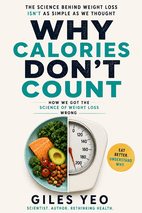
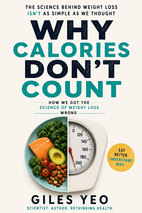
Giles Yeo's Why Calories Don't Count dismantles the myth that a calorie is a calorie, explaining how food structure, processing, and digestion alter energy extraction. Written for anyone frustrated by failed diets or conflicting nutrition advice, it offers a practical framework—focusing on protein, fibre, and free sugars—over restrictive counting.
Feature
Insta.Page
Blinkist
Shortform
Why Calories Don't Count
✓
✕
✕
Summary Depth
Full Chapter-by-Chapter
15-min overview
Section-by-section guides
Audio Narration
✓
✓
✓
Visual Mindmaps
✓
✕
✕
AI Q&A
✓
✕
✕
Quizzes
✓
✕
✕
PDF Downloads
✓
✕
✓
Price
$89.99/yr
$146/yr (PRO)
$199/yr
*Competitor data last verified July 2026.
1 Page Summary
Calorie counts printed on food labels have long promised a simple guide to healthy eating, but geneticist Giles Yeo argues this foundation is fundamentally flawed. The book begins by exposing the absurdity of the system—a 1,400-calorie hot dog versus a 10,000-calorie burger—and then traces the historical roots of this science. The calorie as we know it was derived from the bomb calorimeter, a 19th-century device that burns food in pure oxygen to measure its total energy. However, as Yeo explains, the body does not work like that machine. Digestion is gentle and incomplete, meaning food structure and processing drastically alter how many calories we actually extract. The Atwater factor, which assumes protein, fat, and carbohydrate calories are interchangeable, ignores that sugar yields over 95% of its energy while sweetcorn yields far less. The very premise that "a calorie is a calorie" is shown to be a shaky, oversimplified assumption.
Yeo builds his case through a detailed exploration of human metabolism, distinguishing between digestion (mouth to bloodstream) and intermediary metabolism (burn or store). He covers how the body’s energy budget splits into basal metabolic rate, physical activity, and diet-induced thermogenesis, using a personal story of "the knock" during a grueling mountain bike ride to illustrate why carbohydrate fuel behaves differently from fat fuel. The book then examines specific food components: protein’s power to signal satiety through gut hormones, fibre’s role in feeding gut bacteria and managing cholesterol, and the murky territory of ultra-processed foods, where the NOVA classification system is scrutinized. Yeo challenges the reader to understand that not all vegan food is healthy and that "plant-based" versus "vegan" is a crucial distinction. He also addresses food insecurity and the privilege of cooking well, noting that weight is not a simple choice but the result of biology, environment, and access.
The book's final chapters pivot toward practical guidance, directly replacing "calorie counting" with "nutritional content counting." Yeo offers four concrete targets: protein around 16% of daily energy, fibre above 30 grams a day, free sugars below 5% of daily energy, and one to two meat-free days per week. Rather than handing a diet plan, he provides a framework for eating based on the science he has laid out, with appendix tables offering Atwater factors for specific foods. The intended audience is anyone frustrated by failed diets or confused by conflicting nutrition advice—from the general reader to the health-conscious cook. What readers gain is not another restrictive meal plan but a clearer understanding of why some diets work and others fail, and a scientifically grounded, flexible approach to everyday eating that acknowledges the body’s complexity.
Chapter 1: Calories, Calories Everywhere
Overview
Amid endless food options and equally endless advice about them, the simplest question remains unresolved: what makes a calorie count? The difficulty is not finding numbers but deciding which ones are real, and that uncertainty shapes every meal.
San Francisco occupies barely seven miles north to south and seven east to west. Oracle Park, home of the Giants, sits a few blocks from the Bay Bridge. The author grew up in the area, attending St Ignatius High School and UC Berkeley, and remains a devoted 49ers fan.
American football's violence explains its short sixteen-game season, where every contest matters. Baseball runs roughly 180 games, each less crucial and lasting over three hours, so attention wanders to beer and food. What spectators eat in the stands therefore becomes the story.
Key Takeaways
Football's violence makes its games scarce and therefore decisive, while baseball's marathon season drains individual games of consequence.
A game that lasts over three hours across 180 contests inevitably turns spectating into an occasion for eating and drinking.
Ballpark food emerges less as a sideline indulgence and more as the natural centerpiece of the baseball fan's experience.
The Giants and their stadium matter in this account because the author's own San Francisco history is the lens through which the baseball/food dynamic is seen.
Baseball's 180-game season drains individual importance
Long baseball games turn spectating into eating occasions
Ballpark food becomes the natural centerpiece of fan experience
The Author's San Francisco Lens
San Francisco spans just seven miles each way
Author grew up in the city, attending St Ignatius and UC Berkeley
Oracle Park and the Giants anchor the narrative
Personal history frames the baseball/food dynamic
💡 Try clicking the AI chat button to ask questions about this book!
Introduction
Overview
Calorie counts promise to rank foods from good to bad, yet a 1,400-calorie hot dog and a 10,000-calorie burger make a nonsense of that. The numbers are supposed to guide choice, but they leave a deeper question unanswered: what do they actually measure, and does that even matter?
Ballpark food
Ballpark fare moved from hot dogs and burgers to nachos in the 1980s and 90s. At PNC Park in Pittsburgh, the Brunch Burger is a beef burger with bacon, fried egg and cheddar between a doughnut with sprinkles, 900 calories. At the Great American Ballpark in Cincinnati, the Meat-lover's Hotdog is a deep-fried bacon-wrapped sausage with beef chilli, cheese and fried salami, 1,400 calories. Does a lower number mean better, and are all calories equal?
What a calorie is
A calorie is a unit of energy: the small-c version heats 1 ml of water by 1°C. Food labels use the capital-C Calorie, the energy to heat 1 litre, called a kilocalorie or kcal; a Mars bar label says 228 kcal. A joule is the energy to accelerate 1 kg at 1 m/s² over one metre. One calorie equals 4.184 joules. In ordinary speech “calorie” means kcal, and this book follows that usage.
Nutrition labels
Nutrition labelling is compulsory on nearly all pre-packed food in North America, the UK, Europe and Australasia, including packaged meat but not the butcher counter. UK and EU labels must state energy in kJ and kcal, fat, saturated fat, carbohydrates, sugars, protein and salt. Front-of-pack traffic lights are voluntary, with red over 25% of reference intake per 100g or 30% per portion. US labels list sodium rather than salt, since 1g salt contains 0.4g sodium, require trans fats, which raise heart-disease risk, and separate added sugars from naturally occurring ones.
Serving sizes and eating out
Serving sizes distort the numbers: 30g of cereal and 75g of pasta are less than most people eat. US FDA rules have required chains with twenty or more locations to provide calorie information since May 2018, including the note that 2000 calories a day is general advice. UK menu labelling is voluntary. In January 2019, Deliveroo got 500 restaurants to list calories and urged all 17,000 on its platform to do the same; a poll of 2,200 British adults found 54% wanted more. Restaurants argue independents can't easily comply; measuring calories is difficult.
Lavoisier's discoveries
Burning wood in a sealed container leaves total mass unchanged; ash only seems to lose weight because gases escape. Lavoisier vaporised a diamond with sunlight focused through a huge magnifying glass and found it weighed the same as a gas, and when charcoal burned to the same gas, he identified both as forms of one element, carbon. This defined the conservation of mass: matter is neither created nor destroyed in any operation. He named oxygen and hydrogen, proved water is not an element, and showed that combustion requires oxygen: phosphorus and sulphur gain weight when burnt because they combine with air. After Joseph Priestley described the gas from heated mercury oxide, Lavoisier concluded air is 21% breathable oxygen and 79% unbreathable, mostly nitrogen.
The first calorimeter
Lavoisier's further leap: respiration is combustion. He built the proof on latent heat, Joseph Black's discovery that melting ice absorbs heat without rising above 0°C. With Pierre-Simon Laplace he made a calorimeter holding a guinea pig in an ice-filled, snow-insulated chamber with air piped through. Melt-water was the measure, 80 kcal per kilogram; in ten hours the guinea pig melted 0.37 kg, about 29.6 kcal, matching the heat from burning carbon to the same carbon dioxide it exhaled. So respiration is slow combustion, and the instrument's name joins Latin for heat with Greek for measure.
The bomb calorimeter
Lavoisier never used the word calorie; Nicolas Clément first defined the big-C Calorie, the kilocalorie, in 1824. The bomb calorimeter, developed by Paul Vieille in 1878 for measuring explosive heat, was soon applied to food. Platinum wires ignite a sample inside a vessel pressurised with pure oxygen at about thirty times atmospheric pressure; the heat warms a water jacket, and the temperature rise gives the count. Soups are dried first, as water carries no calories. According to the book, the bomb answers only the first of three distinct numbers:
A: the calories actually in the food
B: the number printed on the pack
C: the calories the body can actually extract
Getting from A to B requires Wilbur O. Atwater.
Key Takeaways
A food label's "Calorie" is a kilocalorie, the energy needed to warm a litre of water by one degree, so everyday calorie counts are a thousand times larger than the physicist's calorie.
Serving sizes written on packaging and menus are often far smaller than typical portions, and many restaurant chains still list calories voluntarily or not at all, so the printed number is a weak guide to what you actually eat.
Lavoisier's calorimetry proved that animal respiration is a slow form of combustion, generating the same heat as burning the carbon that the animal exhales as carbon dioxide.
The calorie count from a bomb calorimeter is only the first of three different numbers: the energy actually in the food, the figure printed on the packet, and the energy your body can extract, and only the last one matters for weight.
Asking whether a 1,400-calorie hotdog is worse than a 900-calorie burger presumes all calories are interchangeable, a presumption the rest of the book puts in question.
Key concepts: Introduction
Introduction
The Calorie Paradox
Calorie counts promise to rank foods from good to bad
A 1,400-calorie hot dog vs 900-calorie burger raises questions
Do lower numbers mean better, and are all calories equal?
Defining the Calorie
Small-c calorie heats 1 ml of water by 1°C
Food labels use kilocalories (kcal), 1,000 times larger
One calorie equals 4.184 joules
Book uses 'calorie' to mean kilocalorie
Nutrition Labels and Serving Sizes
Labelling compulsory in many regions, but not all foods
UK/EU list energy, fat, carbs, protein, salt; US adds trans fats
Serving sizes often smaller than typical portions
Menu labelling voluntary in UK; US requires chains with 20+ locations
Lavoisier and the Birth of Calorimetry
Conservation of mass: matter neither created nor destroyed
Respiration is slow combustion, proven with guinea pig calorimeter
First calorimeter measured heat via melted ice
Bomb calorimeter developed in 1878 for food energy
Three Different Calorie Numbers
A: energy actually in the food
B: number printed on the pack
C: energy the body can extract
Only C matters for weight; getting from A to B requires Atwater
Chapter 2: The Atwater Factor
Overview
The calorie count printed on food describes what burns in a machine, not what happens in a body. If a calorie is not a calorie, then every label, diet plan and nutrition guideline rests on a shaky foundation.
Friday nights in Bottisham end with a pint at The Bell pub, where a pack of pork scratchings declared 440 calories, almost all from 32.6 grams of fat and 34.2 grams of protein. Such labels do not reflect what the body actually extracts.
Rubner, the bomb and caloric availability
The bomb calorimeter, invented in France in 1878, was developed for nutritional science by Germans studying farm animals, not humans. Max Rubner, trained under Carl Voit, adapted it for food energy and built the first self-recording whole-body calorimeter. A dog trial balanced intake against heat and waste, proving the first law of thermodynamics applies to life. Rubner's isodynamic law made protein, fat and carbohydrate calories interchangeable: "a calorie is a calorie."
The bomb burns food in pure oxygen at thirty times sea-level pressure, extracting every calorie. Digestion is gentler, so food structure and processing change availability: sugar yields over 95 per cent of its energy, sweetcorn far less, and tortillas or cornbread far more than raw kernels.
Atwater's method
Wilbur Olin Atwater (1844-1907), a Connecticut chemist, imported the German Agricultural Experiment Station model and ran the Storrs station. His method had three stages:
Collate typical foods and their components.
Burn each in a bomb calorimeter for gross energy.
Feed each to humans, analyse the waste, and subtract.
Atwater treated food as five components: water, ash (minerals), protein, fat and carbohydrates. He named the extracted value metabolisable energy.
The numbers
Animal fat burned at 9.4 calories per gram, plant fat at 9.3. Faecal losses ran 5 per cent for animal fat and 10 per cent for plant fat. Weighting for the animal-dominated diet of the era, Atwater settled on 8.9, rounded to 9 calories per gram.
Total carbohydrate was calculated by difference. Animal carbs, chiefly lactose and glycogen, burned at 3.9 calories per gram and plant carbs at 4.15. With 95 per cent of intake plant-based, Atwater settled on 4 calories per gram.
Protein, the most complex, contains nitrogen. Unused protein converts to fat. The nitrogen leaves as urea, uric acid and creatinine, feeding the nitrogen cycle.
Protein and nitrogen
Protein content was inferred from nitrogen, even though the body holds an estimated 80,000 to 400,000 distinct proteins. Atwater assumed meat averaged 16 per cent nitrogen, giving 6.25 grams of protein per gram of nitrogen. Urinary losses ran about 1.25 calories per gram of protein eaten, and faecal losses 3 per cent for animal protein, 15 per cent for plant. Since protein burned at 5.65 calories per gram, and 61 per cent of the average family's protein came from animals, Atwater settled on 4 calories per gram.
The Atwater general factors
His system set fat at 9, carbohydrate and protein at 4, and alcohol at 7 calories per gram. Rubner's rival figures of 9.3, 4.1 and 4.1 lost out because he ignored faecal losses and assumed nitrogen at 15.5 per cent, a 6.45 factor that overestimated protein. Atwater's general factor system stuck.
The human body as a machine
Atwater extended Rubner's dog work to humans, building the Atwater-Rosa calorimeter, then testing four men on varied diets and exercise from 1898 to 1900. Intake matched output as heat and waste, so the first law of thermodynamics and the isodynamic law both held in people, and mental effort burned no measurable calories. Alcohol's 7 calories per gram fuelled work identically, to the liquor trade's delight and his Methodist-backed employer's displeasure.
Lulu Hunt Peters
Lulu Hunt Peters, a California doctor, weighed 220 pounds after medical school and lost 70 by strict calorie counting. Her 1918 Diet and Health with Key to the Calories, spun from a syndicated column, was the first popular diet book. It reached middle-class American women as wartime metal shortages ended corset use. Her rules:
Ideal weight: multiply inches over five feet by 5½, add 110.
Maintenance: 15 to 20 calories per pound of ideal weight.
Weight loss: cut 500 to 1000 calories a day, using 100-calorie portions from Atwater's tables.
She sold slimming as patriotic rationing. The book sold two million copies, became the first diet bestseller, and turned the calorie into a weapon.
What the factors missed
Over a century on, most food-label calories still rest on Atwater's factors, despite his protein arithmetic's approximations and his dismissal of Rubner's data.
Jones factors
The first flaw in Atwater's numbers sits in his protein estimate. He derived total protein from nitrogen content using a 6.25 conversion factor, based on meat's average nitrogen share of 16 per cent. But protein nitrogen actually ranges from 13 to 19 per cent, which implies conversion factors anywhere from 5.26 to 7.69, and materially different calorie counts. In 1931, D.B. Jones proposed abandoning the universal 6.25 and replacing it with food-specific factors. The resulting Jones factors have been widely adopted, though for the most common protein sources the spread is narrow: meat keeps 6.25, cereals and legumes sit between 5.7 and 6.25, and dairy sits at 6.38.
Carbohydrate by difference
Atwater's second weakness was computing carbohydrate by subtracting everything else from total weight and calling the remainder carbohydrate. That lumps simple sugars, starch and indigestible fibre together. To correct it, a factor of 3.75 calories per gram for simple sugar arrived in 1970, and 2 calories per gram for dietary fibre in 1998. Combined with Atwater's original factors, these additions form the extensive general factor system.
The specific factor system
Because the proportions of macronutrients within a food shift their individual heats of combustion, a third system, really a series of tables, was created. Under it, fuel values vary noticeably by food:
Eggs: 9.02 fat, 3.68 carbohydrate, 4.36 protein
Meat and fish: 9.02 fat, 4.27 protein
Dairy: 8.79 fat, 3.87 carbohydrate, 4.27 protein
White rice: 8.37 fat, 4.16 carbohydrate, 3.82 protein
Potatoes: 8.37 fat, 4.03 carbohydrate, 2.78 protein
Soybeans: 8.37 fat, 4.07 carbohydrate, 3.47 protein
Rice protein, for instance, burns about 20 per cent hotter than potato protein, and digestibility differences such as wholewheat versus finely milled flour change available energy further. A selected list appears in the book's appendix.
What the label still says
The specific system is more accurate but unwieldy, so Atwater's original 9-4-4 general factors still dominate the calorie counts on packaged food. Yet none of these systems, Atwater's or Rubner's, accounts for energy lost as heat while macronutrients are chemically dismantled to drive metabolism. That missing step, the gap between labelled calories and usable calories, requires understanding how food becomes energy in the first place.
Key Takeaways
Label calories come from bomb calorimetry, which burns food completely, so the stated figure overstates what digestion actually extracts; food structure and processing can shift that availability significantly.
Atwater’s 9-4-4 factors were a compromise tuned to late-19th-century American diets, and his protein estimate rested on a nitrogen-to-protein ratio that does not hold across food types.
Later corrections, from food-specific nitrogen factors to separate values for sugar and fibre, make the system more accurate, but none captures the energy lost as heat when the body dismantles macronutrients.
Lulu Hunt Peters’s 1918 bestseller turned Atwater’s tables into 100-calorie portions, making the calorie a portable tool for weight control and launching the modern diet-book market.
Key concepts: Chapter 2: The Atwater Factor
Chapter 2: The Atwater Factor
The Calorie Myth
Labels measure machine burning, not body digestion
Food structure and processing change calorie availability
Sugar yields 95% energy, sweetcorn far less
Atwater's Method
Three stages: collate, burn, feed and subtract
Five components: water, ash, protein, fat, carbs
Named extracted value 'metabolisable energy'
The Atwater General Factors
Fat set at 9, carbs and protein at 4, alcohol 7
Beat Rubner's rival figures by including faecal losses
System stuck for over a century
Protein and Nitrogen Arithmetic
Protein inferred from nitrogen using 6.25 factor
Actual nitrogen ranges 13-19%, factors 5.26-7.69
Jones factors replaced universal 6.25 in 1931
Carbohydrate by Difference Flaw
Remainder lumps sugars, starch and fibre together
1970: simple sugar factor set at 3.75
1998: dietary fibre factor set at 2 calories
Human Body as Machine
Atwater-Rosa calorimeter tested four men 1898-1900
First law of thermodynamics held in humans
Alcohol fuelled work identically, angering Methodist backers
Lulu Hunt Peters and Diet Culture
Lost 70 pounds by strict calorie counting
1918 book sold two million copies
Turned calorie counting into patriotic rationing
Chapter 3: How Do We Turn Food into Energy?
Overview
A day’s food contains enough energy to bring many litres of water to a boil, yet the body that stores it never catches fire. The puzzle is not where the energy goes, but how it is tamed into something a living cell can actually use. What allows such violent potential to be released safely at body temperature?
Boiling a litre of tap water takes just 85 calories, while a day's 2,000 to 2,500 calories could boil 25 litres. We don't boil because, as Rubner and Atwater showed, living creatures obey the first law of thermodynamics: food energy cannot be destroyed, only converted. The body converts it into transportable units in two steps:
digestion, from mouth to bloodstream
intermediary metabolism, deciding whether they are burned or stored
From mouth to stomach
Digestion is mechanical and chemical: chewing grinds while salivary amylase attacks starch, forming a bolus. In the stomach, at pH 1.5, hydrochloric acid kills bacteria and activates pepsin, fragmenting protein; peristalsis churns the meal into chyme, and the pyloric sphincter releases it.
The small intestine
The small intestine, six to seven metres long, runs duodenum to jejunum to ileum; its villi give a thirty-square-metre absorbing surface, one cell thick. Bicarbonate neutralises the acidic chyme; bile from the liver and gallbladder emulsifies fat into micelles, and pancreatic enzymes finish the chemical breakdown. Glucose and amino acids absorb here; fat, which cannot dissolve in blood, is reassembled into triglycerides and carried in chylomicrons.
Lactose
According to the book, most humans lose lactase in adulthood when a protein switches off the gene, making lactose intolerance the mammalian default. A mutation blocking that switch spread with European dairy herds 7,500 years ago; 85 per cent of Northern Europeans drink milk.
The large intestine
The large intestine produces no digestive enzymes; most nutrients and 90 per cent of water are already absorbed, and the leftover fibre and bacteria solidify into faeces.
Lactose intolerance
According to the book, undigested lactose in the colon limits water absorption and ferments into gas, causing bloating, pain, diarrhoea and nausea thirty minutes to two hours, with severity dose-dependent.
ATP, the energy currency
Glucose, fatty acids and amino acids are transportable intermediates, not energy. The universal currency is adenosine triphosphate (ATP), a molecular rechargeable battery: energy sits in the bond between the second and third phosphates, and splitting off the third releases a burst, returning it to ADP. People cycle 50 to 75 kg of ATP daily, each molecule recycled 500 to 750 times.
The mitochondrial pathway
Metabolism, as Lavoisier's calorimetry showed, is carbon burning in oxygen made gentle, with energy parceled into ATP rather than heat. All nutrients funnel into acetyl-CoA, their common midpoint. Mitochondria, in all cells except red blood cells, run beta-oxidation, the Krebs cycle and oxidative phosphorylation.
Krebs discovered his cycle in 1937 (Nobel, 1953): acetyl-CoA joins oxaloacetate to form citrate, shedding two carbons as CO2 each turn while loading three NADH and one FADH2 with electrons.
Electrons travel through complexes I to IV on the inner membrane, pumping protons to build an electrical gradient like pumped hydro storage. Protons then spin ATP synthase, a turbine producing three ATP per turn; oxygen receives the electrons, forming water.
Carbohydrate metabolism
Carbohydrates are digested to monosaccharides, chiefly glucose, which yields 30 ATP per molecule. Glycolysis splits glucose anaerobically into two pyruvate molecules, spending 2 ATP and earning 4 (net two), plus 2 NADH. Without oxygen, pyruvate becomes lactate, recycling NADH for short bursts like sprinting.
Oxygen and the full yield
Glycolysis powers short, intense bursts; its lactate becomes lactic acid, the burning muscle sensation. Lactic acid clears slowly; past a minute oxygen takes over. Oxygen converts pyruvate to acetyl-CoA, entering the Krebs cycle and oxidative phosphorylation, for 28 ATP. Each glucose yields thirty ATP, fifteen times glycolysis's net two.
Gluconeogenesis and the Cori cycle
The liver and kidneys can rebuild pyruvate into glucose, gluconeogenesis, costing four ATP and two NADH. The liver's central job is holding blood glucose between 4 and 7 millimolar: insulin clears excess, gluconeogenesis restores deficit. Muscle lactate travels to the liver and returns as glucose: the Cori cycle. Once pyruvate becomes acetyl-CoA, the path back to glucose closes.
Fat, protein and storage
Beta-oxidation removes two carbons at a time from fatty acids; complete oxidation of palmitic acid yields 106 ATP. Protein sheds its amino group as urea; its carbon skeleton then feeds the Krebs cycle or forms ketones. Glycogen stores cover a day; fat stores of 10-20 kg hold 90,000-180,000 calories, enough for 72-90 days. Amino acids cannot be stored, so all surplus fuel becomes fat.
Starvation, ketones and type 1 diabetes
In starvation, muscle burns fat to spare glucose for the brain, which cannot use fatty acids. After forty hours, nearly all liver glucose comes from gluconeogenesis. With oxaloacetate diverted there, acetyl-CoA accumulates and liver converts it to ketones for muscles, heart and brain. Type 1 diabetes, according to the book, destroys insulin production, so glucose cannot enter muscle or fat and protein breaks down unchecked: 'starvation in the midst of plenty.'
Uncontrolled diabetes also brings diabetic ketoacidosis. When no glucose reaches the cells, fatty acids and amino acids break down rapidly, and the bloodstream is flooded with ketone bodies. The danger is not the ketones themselves but their acidity. According to the book, blood pH normally holds between 7.35 and 7.45 on a scale where 7 is neutral, making blood slightly alkaline; a sudden load of ketones pushes it acidic. Drowsiness begins at pH 7.0 to 7.25, coma sets in below 7.0, and without rapid correction death follows.
Before 1922, type 1 diabetes was invariably fatal. Hospitals ran wards where diabetics, many of them children, wasted away as though starving; food passed straight through their bodies, and most died comatose. That year, Banting and Best, working in J.J.R. Macleod's Toronto lab, discovered insulin. The historian Michael Bliss called watching the first starved, comatose patients revived by it one of the genuine miracles of modern medicine. Banting and Macleod received the 1923 Nobel Prize in Physiology or Medicine.
What the energy is for
Digestion breaks food into its constituents, and the body painstakingly uses those intermediates to build ATP. The final term in the calorie equation, usable calories, still needs defining, because extracting energy from food is not the same as being able to use it. That depends on what the body actually spends energy on, which is the next topic.
Key Takeaways
Food energy obeys the first law of thermodynamics, so a day's calories are never lost; digestion and intermediary metabolism simply convert them, ending in ATP, the phosphate bond all cells can spend.
Digested glucose, fatty acids and amino acids are not yet usable energy; they converge on acetyl-CoA and mitochondrial respiration, where a proton gradient drives ATP synthase and oxygen receives the electrons.
Anaerobic glycolysis buys quick speed at a cost: it nets only 2 ATP per glucose and leaves lactate, but the liver recycles lactate into glucose, while full aerobic oxidation of glucose returns 30 ATP, roughly fifteen times as much.
Fat is the largest fuel reservoir, with palmitic acid yielding 106 ATP, while amino acids cannot be stored; once glycogen runs out, the body spares glucose for the brain by burning fat and making ketones.
Herman Pontzer notes that before 1922 type 1 diabetes was invariably fatal; in uncontrolled diabetes the body starves even when well fed, and ketoacidosis kills through acidity, with coma setting in as blood pH drops below 7.0.
Key concepts: Chapter 3: How Do We Turn Food into Energy?
Chapter 3: How Do We Turn Food into Energy?
The Energy Puzzle
Food energy obeys first law of thermodynamics
Body converts energy safely at body temperature
Two steps: digestion and intermediary metabolism
Digestion: From Mouth to Bloodstream
Chewing and salivary amylase start starch breakdown
Stomach acid and pepsin fragment proteins
Small intestine absorbs nutrients via villi
Fat travels as chylomicrons, not dissolved in blood
ATP: The Energy Currency
ATP is a rechargeable molecular battery
Energy released by splitting third phosphate
People cycle 50-75 kg ATP daily
The Mitochondrial Pathway
All nutrients funnel into acetyl-CoA
Krebs cycle loads electrons onto NADH and FADH2
Electron transport chain builds proton gradient
ATP synthase turbine produces three ATP per turn
Carbohydrate Metabolism
Glycolysis yields net two ATP anaerobically
Without oxygen, pyruvate becomes lactate
Full glucose oxidation yields thirty ATP
Oxygen powers sustained energy past one minute
Gluconeogenesis and the Cori Cycle
Liver rebuilds glucose from pyruvate
Liver maintains blood glucose between 4-7 mM
Muscle lactate returns to liver as glucose
Acetyl-CoA cannot be converted back to glucose
Fat, Protein, and Starvation
Fat oxidation yields 106 ATP per palmitic acid
Glycogen stores last a day; fat lasts months
Surplus amino acids become fat
Starvation produces ketones to fuel brain
You've reached the end of the free chapters
Next chapter: “What Do We Use Energy For?” is locked
Keep reading Why Calories Don't Count — and unlock all 600+ book summaries with audio, mindmaps and AI Q&A.
$0.00 due today · 7 days free, then $89.99/year ($7.49/mo) · Cancel anytime before day 7
Giles Yeo is a British geneticist and author specializing in the biology of obesity, appetite, and nutrition, currently serving as a professor at the University of Cambridge. He is widely known for his popular science books, including *Gene Eating* and *Why Calories Don't Count*, which demystify the science of dieting and food. His public engagement work, including appearances on BBC documentaries, has made him a leading voice in evidence-based nutrition.
Frequently Asked Questions about Why Calories Don't Count
What is Why Calories Don't Count about?
The book challenges the conventional wisdom that a calorie is a simple, fixed unit, explaining that the numbers on labels measure what burns in a machine, not what the body actually extracts. It explores the science of digestion, metabolism, protein, fibre, ultra-processed foods, and food privilege, arguing that food quality and processing matter more than counting calories. It ultimately proposes practical dietary targets—protein, fibre, free sugars, and meat-free days—instead of obsessive calorie tracking.
Who is the author of Why Calories Don't Count?
Giles Yeo is a Cambridge-based researcher who studies how the brain controls food intake, giving him expertise in the biology of appetite and metabolism. He is also a science communicator who has worked on BBC health programmes, including Trust Me, I'm a Doctor, and he draws on personal experience with diets and food insecurity to ground the science.
Is Why Calories Don't Count worth reading?
Yes—this is a refreshing, science-backed take that explains why calorie labels are misleading and why body weight is not simply a matter of willpower. It gives readers practical, evidence-based targets to replace futile calorie counting, and it does so in a vivid, personal style that makes complex biology accessible.
What are the key lessons from Why Calories Don't Count?
A calorie is not a calorie: food structure, processing, and digestion affect how much energy your body actually absorbs. Counting calories is less effective than focusing on nutritional quality—prioritising protein, fibre, and reducing free sugars, plus eating more plant-based meals. Weight loss still requires a deficit, but it is better achieved by changing what you eat, not by obsessing over numbers. And food insecurity means many people do not have the privilege of choice, so diet advice must account for inequality.
📚 Explore Our Book Summary Library
Discover more insightful book summaries from our collection