Why Calories Don't Count Quotes
by Giles Yeo
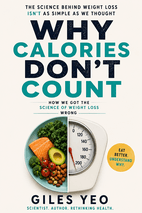
This page collects the most quotable lines from Giles Yeo's Why Calories Don't Count. The book takes a sharp look at the science behind food, digestion, and diet culture. You will find funny outbursts, stubborn questions, and some hard truths about how we eat and why we struggle to change it.
Yeo writes like someone who has spent years in the lab and at the dinner table. He is not afraid to call out bad science or lazy thinking. He also has sympathy for anyone who has felt judged for their weight. These quotes capture that mix of irritation, curiosity, and compassion.
Top Quotes from Why Calories Don't Count
“I require calorie information for the whole damn pack... Don’t make me do maths under duress!”
The author is complaining about portion-size labels that do not match how people actually eat.
It is a funny, relatable demand that captures the absurdity of needing arithmetic to eat a snack.
“We live not upon what we eat, but upon what we digest.”
Opening epigraph of the chapter, attributed to Wilbur Olin Atwater in his 1906 Principles of Nutrition and Nutritive Value of Food.
It distills the chapter’s core argument that digestion, not just ingestion, determines the energy we get from food. It is a memorable, almost proverbial challenge to the simplistic calorie-counting mindset.
“Living beings, however, are not bomb calorimeters.”
After describing the high-pressure, oxygen-rich bomb calorimeter used to measure the gross energy in food.
It is a crisp, vivid shorthand for why the energy locked in food is not the same as the energy our bodies can extract. The contrast sticks with readers and frames everything that follows.
“It is interesting that while racism and sexism are no longer tolerated in large sectors of society (although I acknowledge we have a lot further to go), overtly judging someone's bodyweight is still considered acceptable by many, even amongst those who consider themselves ‘socially enlightened’.”
Giles Yeo, an obesity researcher, reflects on bodyweight stigma.
It exposes a cultural double standard with startling clarity. The comparison to racism and sexism makes the line impossible to ignore.
“People who are overweight or are living with obesity are neither bad nor lazy; rather, they are fighting their biology.”
He argues that people with obesity are fighting their biology.
It is a powerful antidote to weight stigma and blame. The phrase 'fighting their biology' reframes the issue with empathy.
“People say 95 per cent of diets don’t work, but the truth is probably closer to the fact that 95 per cent of diets are impossible to stick to!”
Yeo responds to the common claim that diets do not work.
It reframes diet failure as a mismatch between plans and human behavior. This is a memorable, relatable twist on a common statistic.
“How did fibre go from being something that took a lot of chewing and that you pooped out, to become this apparent panacea for health?”
The author is introducing the question of what dietary fibre actually is.
It turns a scientific pivot into a playful, plainspoken question, and makes the mystery of fibre feel both funny and worth solving.
Themes Behind the Quotes
One major theme is that counting calories gives a false sense of control. The energy listed on packages does not match what your body can actually use. Digestion, metabolism, and the structure of food all affect how much energy you extract. Yeo wants us to stop treating nutrition as a simple maths problem and pay attention to how real bodies respond.
Another theme is the moral weight we attach to eating. Some foods are treated as virtuous or natural while others are condemned, and people who struggle with weight are often blamed for being lazy. Yeo pushes back by showing that biology makes weight loss harder than diet culture admits. He also questions whether vegan automatically means healthy, because processed foods can hide behind a label.
Quotes by Chapter
Chapter 1: Calories, Calories Everywhere
“American football is brutal and violent, and hence only sixteen games are played in a season.”
The author explains why he loves watching American football.
It captures the intensity and scarcity that make each football game matter.
“Baseball is almost the diametric opposite of violence and brutality.”
The author contrasts baseball with American football.
This is a clean, memorable one-liner about baseball's relaxed character.
“In fact, it is only slightly less sedate than cricket (apologies to cricket fans... but Test cricket does take five days to play... five days!).”
The author jokes about how slow baseball is compared with football.
The aside about Test cricket is witty and relatable for sports fans.
“So what do people do with all that time in the hot sunshine? Well, there is beer to be consumed of course... but there are also many food choices to be made.”
The author wonders how baseball spectators fill the long summer hours.
It turns the scene toward food and builds the setup for the book's calorie discussion.
Introduction
“Is the 1400 calorie Meat-lovers Hotdog worse for you than the Brunch Burger, which only comes in at a slender 900 calories? If you are someone who counts calories, then the answer is, of course, yes! Five hundred calories worse for you, clearly! But is it though?”
After listing outrageously unhealthy stadium foods, the author questions whether calorie counts really distinguish them.
It turns a seemingly obvious arithmetic comparison into a provocative doubt, making readers question whether calorie counts actually measure healthfulness.
“If there are more calories in one than another, does that mean it is worse for you? Are foods with fewer calories automatically better for you? Are all calories equal?”
These are the central questions posed just before the author begins explaining what a calorie actually is.
They crystallize the book's thesis and invite readers to rethink one of the most basic assumptions in diet culture.
“So in practice, the nutritional info for a serving of whatever, including the all-important calorie-count, is next to useless. It is not what most people would eat on a day-to-day basis.”
The author has just shown how unrealistic official serving sizes are for cereal and pasta.
It exposes a hidden flaw in nutrition labels and validates anyone who has ever ignored a prescribed serving size.
Chapter 2: The Atwater Factor
“Caloric availability is the amount of calories that can actually be extracted during the process of digestion and metabolism, as opposed to the total number of calories that are locked up in the food.”
The book introduces this definition while explaining why different foods yield different amounts of energy.
This is the key definition readers need to understand the entire book. It turns a complex biological idea into a clear, practical distinction.
“The whole subject is very complicated and the attempts which people have made to assess the energy value of human food can only be described as a comedy of errors.”
Elsie Widdowson, a leading figure in British nutrition, said this when reviewing the field in 1955.
It is a wonderfully candid and human admission from a scientific expert. The phrase ‘comedy of errors’ makes the long, messy history of calorie science both funny and humbling.
Chapter 3: How Do We Turn Food into Energy?
“Given that most of us consume more than 2000 to 2500 calories a day, that is theoretically enough energy to heat up to 25 litres of water from freezing to boiling!”
The author has just worked out how few calories it takes to boil a litre of water.
It makes abstract calorie numbers feel enormous and physical. The image of boiling 25 litres of water makes our daily intake visceral.
“Since we only have around 5 to 5.5 litres of blood flowing through us, how come we ourselves aren't literally boiling?”
The author applies the same energy calculation to the human body.
It turns a mundane biological fact into a surprising puzzle. The question pulls the reader forward to the explanation.
“The answer is that living creatures, including humans, as demonstrated by Max Rubner and then Wilbur Atwater, conform to the first law of thermodynamics: the energy that we take in cannot be destroyed, but can be transferred or changed to another form.”
The author answers the rhetorical question about why humans don’t boil alive.
It distills the chapter’s central science into a single law, and names the researchers behind it. Readers can grasp why food energy doesn’t simply incinerate us.
“Which is why I, mostly not a sucker for punishment, drink black americanos and not cappuccinos.”
The author, who is lactose-intolerant, has just listed the unpleasant symptoms of lactose intolerance.
It pairs science with self-deprecating humour, making the author instantly relatable. A simple coffee order becomes a memorable punchline for a biological condition.
Chapter 4: What Do We Use Energy For?
“When the spirits are low, when the day appears dark, when work becomes monotonous, when hope hardly seems worth having, just mount a bicycle and go out for a spin down the road, without thought on anything but the ride you are taking.”
The chapter opens with an epigraph from Sir Arthur Conan Doyle.
It is a beautiful argument for cycling as a cure for low moods and makes the chapter’s subject feel personal and hopeful.
“Very quickly, the peloton began to string out as riders found their ability; there is nowhere to hide on the side of a mountain.”
The author describes the start of the first big climb in the La Marmotte cycling race.
It captures the brutal honesty of a mountain climb, and the final clause is a powerful metaphor for any challenge where excuses disappear.
“A tiny, old-school Mini Cooper might seem zippy and fast compared to a large lumbering 4x4 SUV, but the SUV will always have a higher fuel consumption than the Mini. The same is true for humans and metabolism.”
The author is explaining why basal metabolic rate depends on body size.
The car analogy makes a dry metabolic fact instantly relatable. It also flips the common assumption that large bodies have slow metabolisms.
“The problem is, once you get ‘the knock’, it is very difficult to come back from it.”
The author is describing his own bonk during the La Marmotte cycling race.
It crystallizes the experience of ‘hitting the wall’ in one vivid phrase. Anyone who has ever run out of energy will recognize the warning.
Chapter 5: The Power of Protein
“Put simply, a calorie of protein makes you feel fuller than a calorie of fat, than a calorie of carb, in that order.”
Yeo summarizes the satiating effect of protein, fat and carbs.
It is an elegantly simple hierarchy that anyone can remember. This line captures the chapter’s core message about protein’s satiating power.
Chapter 6: The Wonder of Fibre
“What I realised was that a large percentage of these ultra-processed foods are certified to be vegan, hence vegan food, per se, was not necessarily ‘healthy’.”
The author is reflecting on his realization while investigating whether vegan food is automatically healthy.
It challenges a familiar assumption in a single, clear sentence, making it highly shareable.
“First of all, I didn't want to be that guy who went vegan for a month and gained weight, on camera to boot, that would have been seriously crap!”
The author explains why he opted for a whole-foods plant-based diet during his month-long experiment.
It is a rare moment of self-deprecating honesty, framing a health experiment around the very human fear of looking ridiculous on camera.
“But here is where the (vegan) meatballs meet the sauce.”
After reporting his improved health markers, the author pivots to ask why the diet worked.
It is a witty twist on a familiar idiom, signalling the caveat that plant-based health isn’t as simple as it first appears.
Chapter 7: The ‘Ultra’ in Processed
“Ultra-processed food is the opposite of ‘clean’, the antithesis of ‘real’.”
The author is explaining the paradox that ultra-processed plant-based milks are marketed as healthy.
It captures the central contradiction driving the chapter. Readers recognise how marketing can rebrand the same category of food.
“What makes one ultra-processed food item different from another? What makes some suited to be condemned and legislated against, while others remain respectable, eminently Instagrammable, even?”
The author asks this after noting that plant-based milks are ultra-processed yet marketed as healthy.
It frames the chapter's central question and challenges lazy assumptions about what 'ultra-processed' really means.