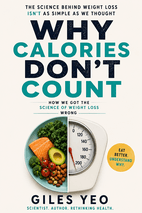
Why Calories Don't Count Key Takeaways
by Giles Yeo
5 Main Takeaways from Why Calories Don't Count
Stop trusting calorie labels — they overstate what your body uses.
Labels are produced by burning food in a bomb calorimeter, which measures all the energy released, but your digestion extracts less. Atwater's old 4-4-9 factors and unrealistic serving sizes make the gap wider; using net metabolizable energy — 9 for fat, 3.8 for sugar, 3.6 for complex carbs, and 3.2 for protein — can create a weekly gap of more than 1,100 calories.
Protein and fibre govern appetite more than calorie totals.
The gut sends satiety signals based on nutrient type, so protein ends a meal at a lower calorie load than carbohydrate, and fibre adds bulk, feeds gut bacteria, and lowers disease risk. That's why low-carb diets work: not because of ketosis alone, but because protein and fibre do the heavy lifting.
Ultra-processed food makes overeating metabolic, not a willpower failure.
In Kevin Hall's crossover trial, people ate about 500 extra kilocalories a day on ultra-processed diets, partly because the calories cost less to digest and partly because protein leverage keeps you eating until protein needs are met. No amount of willpower can easily overcome a metabolic push to overeat.
Body weight is biological and environmental, not a moral choice.
Bodyweight is highly heritable and heavily shaped by environment; a healthier home can halve the genetic susceptibility. Food insecurity, austerity, and income gaps create a ten-year life-expectancy difference, so blaming personal choice ignores the real levers of poverty and privilege.
Build meals around protein, fibre, and fewer free sugars—not calorie math.
Yeo's actionable targets are about 16% of energy from protein, at least 30g of fibre, under 5% free sugars, and one to two meat-free days a week. Recalculate your favourite meals with corrected calorie factors and treat the total as a check, not the scoreboard.
Executive Analysis
Taken together, the five takeaways make Yeo's central argument: the calorie is a useful but incomplete measure, and what a food does after it enters your body matters more than the number printed on the packet. Because food structure, macronutrient mix, processing, gut hormones, and the eater's biology all determine how many calories are actually extracted and how full you feel, weight control is less about arithmetic and more about food quality. That is why protein and fibre become the main levers, why ultra-processing breaks satiety, and why bodyweight cannot be separated from environments that make healthy food accessible.
This book matters because it gives readers a scientifically grounded exit from calorie-counting anxiety and diet shame. It distinguishes genuine nutrition science from fads by exposing the limits of bomb calorimetry, the history of Atwater factors, and the metabolic reasons processed foods drive overeating. In the popular-nutrition field, it sits alongside Michael Pollan and Tim Spector but with a sharper focus on genetics, gut hormones, and social inequality, offering practical rules — more protein, more fibre, less sugar, fewer meat-heavy days — without demanding perfection.
Chapter-by-Chapter Key Takeaways
Calories, Calories Everywhere (Chapter 1)
Football's violence makes its games scarce and therefore decisive, while baseball's marathon season drains individual games of consequence.
A game that lasts over three hours across 180 contests inevitably turns spectating into an occasion for eating and drinking.
Ballpark food emerges less as a sideline indulgence and more as the natural centerpiece of the baseball fan's experience.
The Giants and their stadium matter in this account because the author's own San Francisco history is the lens through which the baseball/food dynamic is seen.
Try this: Plan for long, food-saturated occasions the way you would a ballpark game: decide what you'll eat before you arrive, so the hours of grazing become a deliberate choice rather than the default centerpiece.
Introduction (Introduction)
A food label's "Calorie" is a kilocalorie, the energy needed to warm a litre of water by one degree, so everyday calorie counts are a thousand times larger than the physicist's calorie.
Serving sizes written on packaging and menus are often far smaller than typical portions, and many restaurant chains still list calories voluntarily or not at all, so the printed number is a weak guide to what you actually eat.
Lavoisier's calorimetry proved that animal respiration is a slow form of combustion, generating the same heat as burning the carbon that the animal exhales as carbon dioxide.
The calorie count from a bomb calorimeter is only the first of three different numbers: the energy actually in the food, the figure printed on the packet, and the energy your body can extract, and only the last one matters for weight.
Asking whether a 1,400-calorie hotdog is worse than a 900-calorie burger presumes all calories are interchangeable, a presumption the rest of the book puts in question.
Try this: Read every food label as an availability estimate, not a fact: scale serving sizes to your portion and remember the printed 'Calorie' is actually a kilocalorie.
The Atwater Factor (Chapter 2)
Label calories come from bomb calorimetry, which burns food completely, so the stated figure overstates what digestion actually extracts; food structure and processing can shift that availability significantly.
Atwater’s 9-4-4 factors were a compromise tuned to late-19th-century American diets, and his protein estimate rested on a nitrogen-to-protein ratio that does not hold across food types.
Later corrections, from food-specific nitrogen factors to separate values for sugar and fibre, make the system more accurate, but none captures the energy lost as heat when the body dismantles macronutrients.
Lulu Hunt Peters’s 1918 bestseller turned Atwater’s tables into 100-calorie portions, making the calorie a portable tool for weight control and launching the modern diet-book market.
Try this: Swap Atwater's outdated 4-4-9 factors for corrected net-energy values — about 9 for fat, 3.8 for sugar, 3.6 for complex carbs, and 3.2 for protein — when estimating what your body really uses.
How Do We Turn Food into Energy? (Chapter 3)
Food energy obeys the first law of thermodynamics, so a day's calories are never lost; digestion and intermediary metabolism simply convert them, ending in ATP, the phosphate bond all cells can spend.
Digested glucose, fatty acids and amino acids are not yet usable energy; they converge on acetyl-CoA and mitochondrial respiration, where a proton gradient drives ATP synthase and oxygen receives the electrons.
Anaerobic glycolysis buys quick speed at a cost: it nets only 2 ATP per glucose and leaves lactate, but the liver recycles lactate into glucose, while full aerobic oxidation of glucose returns 30 ATP, roughly fifteen times as much.
Fat is the largest fuel reservoir, with palmitic acid yielding 106 ATP, while amino acids cannot be stored; once glycogen runs out, the body spares glucose for the brain by burning fat and making ketones.
Herman Pontzer notes that before 1922 type 1 diabetes was invariably fatal; in uncontrolled diabetes the body starves even when well fed, and ketoacidosis kills through acidity, with coma setting in as blood pH drops below 7.0.
Try this: Match your fuel to the job: use glucose for quick anaerobic bursts but rely on fat and ketones for longer aerobic efforts, and don't let glycogen depletion make the brain desperate for sugar.
What Do We Use Energy For? (Chapter 4)
Daily energy expenditure is dominated by basal metabolic activity, so changing body size has a far larger effect on total energy use than adding or dropping a workout.
Doubly labelled water tracks total free-living energy use because deuterium leaves the body only as water while oxygen-18 also leaves as carbon dioxide, revealing CO2 output without a sealed chamber.
The body carries only about ninety minutes of usable carbohydrate but nearly three days of fat, so fatigue in endurance events comes from glycogen depletion, not from running out of fuel overall.
Fat can be oxidised only while carbohydrate-derived oxaloacetate is available to accept acetyl-CoA; when glycogen drops, gluconeogenesis drains oxaloacetate and the surplus acetyl-CoA becomes ketones.
Pontzer reports diet-induced thermogenesis at 15 to 30 percent of energy for protein, 5 to 10 percent for carbohydrate, and 0 to 3 percent for fat, so the net calories available from a food depend heavily on its macronutrient mix.
Try this: Base your weight-loss plan on basal metabolism and food intake, not exercise; use movement for health and longevity, and choose a macronutrient mix that raises diet-induced thermogenesis.
The Power of Protein (Chapter 5)
Overweight is a biological condition, not a chosen one, which makes the tolerance for commenting on other people's body weight a prejudice that society has already decided to reject in other forms.
The brain's appetite control reads a running hormonal account from the gut, so fullness tracks nutrient type rather than calorie count alone; protein's signal ends a meal at a calorie load where carbohydrate would still leave hunger.
As Giles Yeo reports, the Roux-en-Y bypass begins reversing type 2 diabetes before any weight loss and keeps appetite suppressed for years, so the gut hormone surge is the operative mechanism and the reason incretin-based drugs can reproduce the bypass without surgery.
Low-carb diets from Banting to Atkins to keto work, but not because the body switches to fat as fuel; the brain keeps demanding glucose, and the real levers are protein satiety, ketone signalling and the thermodynamics of calories.
The gluten-free, paleo and carnivore labels are historical costumes over one mechanism, low-carb high-fat eating, and only a moderate version that keeps fibre and unsaturated fat in the mix has a safety record extending past the short term.
Try this: Put protein at the centre of every meal to trigger earlier satiety and aim for about 16% of energy from protein before you restrict anything else.
The Wonder of Fibre (Chapter 6)
Fibre comes in three functionally distinct forms: soluble fibre forms a gel and ferments into short-chain fatty acids, insoluble fibre bulks stools, and resistant starch feeds gut bacteria; a high-fibre diet therefore needs variety, not a single supplement.
The author cites a 40% lower cancer risk when low-intake populations double their fibre, and a randomised trial showing Mediterranean diets with olive oil or nuts cut major cardiovascular events by 30% versus a low-fat control.
The glycaemic index is a useful ranking but not a complete diet: juice from an orange scores over 70 while the whole orange scores about 40, and frying can lower a food's score, so GI alone misses the effects of fibre and fat.
Short-term vegan eating can lower weight and cholesterol, but the effect comes from bulk and lower calorie density rather than veganism itself, and the pounds return quickly; the lasting pattern is flexitarian, such as weekday vegan lunches and two evening meals, which halves meat.
Raw, sirtfood, and alkaline diets are plant-based eating wrapped in extra rules: their enzyme and pH claims collapse under stomach acid and digestion, so the only active ingredient is the fibre and vegetables underneath.
Try this: Rotate soluble fibre, insoluble fibre, and resistant starch — beans, oats, vegetables, cooled potatoes — rather than chasing a single high-fibre supplement or glycaemic-index number.
The ‘Ultra’ in Processed (Chapter 7)
Preservation through salt, smoke, sun-drying, fermentation, and pasteurisation has shaped human diets for millennia; what is genuinely new and questionable is industrial formulation, not processing as such.
The calorie cost of digestion is lower for ultra-processed food, and Kevin Hall’s 2019 crossover trial found participants ate about 500 extra kilocalories per day on such diets, making weight gain a metabolic consequence rather than a simple lack of willpower.
The protein leverage hypothesis explains that pattern: people keep eating until protein needs are met, so diets diluted with fat and carbohydrate drive total energy intake upward.
Plant-based milks, cheeses, yogurts, and meat substitutes are industrial ultra-processed products, assembled from isolates, oils, emulsifiers, and fortifiers; their health halo is a marketing achievement, not a nutritional one, and they can be high in sugar, salt, and fat.
The NOVA label is too blunt to separate good from bad: a premium faux-meat burger escapes the scrutiny applied to cheaper ultra-processed staples, so the category is as much a social cudgel for food-shaming as a nutritional classification.
Try this: Judge ultra-processed foods by their protein and fibre content rather than their health halo, and treat plant-based milks and meat substitutes as formulated products, not automatic wins.
Privilege and Calories (Chapter 8)
Food insecurity is a graded lack of access to food that affects millions of children even in wealthy countries, not just the starving.
Bodyweight is heavily heritable, but a healthier home environment can cut that genetic susceptibility in half, making the environment the key intervention point.
Marmot's health-equity review shows that post-2008 austerity in England widened the gap to a ten-year difference in life expectancy between the richest and poorest areas.
Malnutrition today has three overlapping faces: undernutrition, hidden hunger, and overweight, and the last two often coexist when children eat too much of what they do not need and too little of what they do.
Because privilege runs in money, time, and knowledge, healthy eating and ethical diets like veganism are realistic only for the well-off, so ending obesity means ending poverty, not blaming personal choice.
Try this: Advocate for affordable food access and avoid weight stigma; remember that genes and environment interact, so improving home and community resources is the real intervention.
We Don’t Eat Calories, We Eat Food (Chapter 9)
Fat tissue is safe until its fixed storage capacity is exceeded; once fat spills into the liver and muscle, disease risk depends on the individual's capacity and where fat accumulates, not body weight alone.
Using net metabolisable energy rather than Atwater's 4-4-9 factors, Yeo finds that protein and complex carbohydrates deliver noticeably fewer usable calories than labels claim, creating a weekly gap of more than 1,100 calories in ordinary meals.
Exercise improves health and lowers mortality, yet it burns far less energy than food delivers, so weight loss depends on a sustained calorie deficit generated by an eating pattern that fits the person's biology, finances, family, and schedule.
Plant-based eating works only with deliberate protein and micronutrient planning; the flexitarian alternative of roughly halving meat intake has proved sustainable and effective at keeping weight off.
Since ultra-processed foods cannot realistically be avoided, the defensible approach is to compare products for protein and fibre, treating calories as an availability metric rather than a full measure of a food's physiological effect.
Try this: Recalculate your own regular meals with net metabolizable energy values to see the 5–10% gap, then create a sustainable calorie deficit from foods you can afford and enjoy rather than an extreme diet.
Epilogue (Epilogue)
Set your daily targets by protein, fibre, free sugars, and meat-free meals, and treat calorie totals as a check rather than the main scoreboard.
Aim for about 16% of energy from protein, at least 30 grams of fibre, under 5% of energy from free sugars, and one to two meat-free days a week.
Recalculate the calories in a meal with net metabolisable energy factors: 9 per gram of fat, 3.8 for sugar, 3.6 for complex carbs, and 3.2 for protein, because Atwater's older factors can overestimate what your body actually uses.
Use the corrected values on your own favourite meals, not just the book's example, to see where the 5 to 10 percent gap between raw and usable calories shows up.
Put the appendix's slow recipes for rendang, brisket, and crispy duck to work on weekends so the targets become meals rather than numbers.
Try this: Set weekly targets of 16% protein, 30g fibre, under 5% free sugars, and one to two meat-free days, then cook the book's slow weekend recipes to turn those numbers into meals.