Drownproof Quotes
by Andy Stumpf
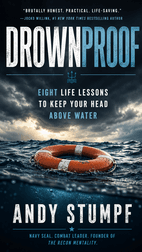
Here you will find quotes from Drownproof that capture the book's core lessons. They range from brutal truths about failure to quiet insights about focus and purpose. Stumpf writes with the authority of someone who has been tested and still chooses to share what he learned.
The reason these lines stay with you is that they strip away the usual platitudes. They speak directly to the part of you that knows when you're making excuses. Whether you are chasing a difficult goal or just trying to get through the day, these quotes offer a kind of clarity that is hard to ignore.
Top Quotes from Drownproof
“Until you view yourself as the author of your life, you will be the victim of it.”
The author reflects on the need to change his self-perception after a night of poor decisions.
This line encapsulates the central theme of the book—personal accountability—and reframes victimhood as a choice. It is both a challenge and an empowerment, urging readers to take control of their own narrative.
“I am sorry you have never tasted the salt from your own tears, as you stand at flag-draped coffins, burying men you were humbled to call your friends.”
The author addresses readers who have not experienced the profound sacrifice and loss of military service.
The visceral imagery of tears and flag-draped coffins conveys a grief and gratitude that transcends politics, reminding readers of the human cost of freedom. It demands respect for sacrifice, whether or not one shares the same opinions.
“If we can agree that fear will be present, it is no longer a question of whether or not you will be afraid; the question becomes whether you are going to allow it to control you or you are going to control it.”
Author discussing fear in ambush situations.
It reframes fear as a choice, empowering the reader to take control rather than be paralyzed.
“An organization of SEALs may sound impressive, but it’s the organization full of Team Guys that is unstoppable. Don't chase a title, chase a purpose.”
Author contrasting individual SEAL prowess with team cohesion.
It encapsulates the core lesson to prioritize collective purpose over personal title, inspiring selfless ambition.
“FAILURE If you are a human being, you are going to fail. You will fail personally, and you will fail professionally. There will be variations in both degree and kind, but I know of no single human walking the earth who is immune to failure.”
The author identifies failure as the one universal experience shared by all people.
It powerfully normalizes failure as an inevitable part of life, removing shame and setting up the chapter's central theme of learning from setbacks.
“We must all be very cautious with the stories that we tell ourselves: They are powerful, they can limit us, and they can lead us down paths that have horrible endings.”
The author explains why self-narratives matter after describing his own struggle with self-doubt about writing.
This warning about the inner narratives we construct speaks to the profound impact of mindset on life outcomes. It reminds readers that the stories they believe can either constrain or liberate them.
“What is the point of the experiences that I have had and the mistakes that I have made, if I am not able to pass them on to someone else?”
The author justifies his decision to write the book, feeling obligated to share his lessons.
This rhetorical question captures the fundamental human desire to find meaning through teaching and legacy. It resonates with anyone who has wondered whether their struggles can benefit others.
Themes Behind the Quotes
A central theme is taking full responsibility for your life. Many of the quotes emphasize that you are the author of your own story, not a victim of circumstances. This ownership extends to how you handle failure, which appears as a necessary and universal part of growth rather than something to avoid.
Another strong thread is the idea of subtraction and focus. The book argues that letting go of what weighs you down, whether it is attachments, titles, or excuses, frees you to move forward. Fear is acknowledged as constant, but the key is whether you control it or let it control you. Ultimately, the quotes point toward a life defined by purpose and the willingness to pass on hard earned wisdom.
Quotes by Chapter
Foreword by Jocko Willink
“He had become a lead climber, a free-fall jump master, and a tandem jumper, and had a plethora of other skills honed to the highest level.”
Describing Andy Stumpf's extensive training and skills as a SEAL operator.
This line showcases the extraordinary level of expertise required in special operations, inspiring respect for the dedication and versatility of elite warriors.
“He'd suffered an AK-47 round to the hip, which caused muscle, bone, and nerve damage.”
Describing the severe combat injury Andy Stumpf sustained.
It starkly illustrates the brutal reality of combat and the physical toll it takes, making his subsequent recovery and return all the more remarkable.
“His ability to function normally with the damage to his leg was in question—the thought that he might be able to operate again as a SEAL seemed like a stretch.”
Describing the doubt surrounding Andy Stumpf's ability to return to active duty after his injury.
This captures the immense challenge of overcoming a devastating wound, highlighting the resilience and determination demanded by the profession.
“It took him over a year to recover, and when he did recover, his goal was to get right back to a SEAL Team and get back in the fight.”
Describing Andy Stumpf's recovery and his determination to return to combat.
This demonstrates unwavering commitment and a warrior spirit, inspiring readers with the power of focused resolve in the face of adversity.
1. Sink or Swim
“It was the most powerful and concrete awakening of my life, as if there had been a catastrophic shaking of the tectonic plates and the earth had split open in front of me.”
The author describes the moment he realized he needed to change how he viewed himself.
The earthquake metaphor captures the violent, undeniable force of self-revelation. It makes an abstract internal shift feel tangible and monumental, resonating with anyone who has experienced a life-altering moment of clarity.
2. Get Into the Water
“For me, subtraction has become an infinitely more powerful tool than addition.”
Author advising to let go of toxic people and unnecessary burdens.
It offers a counterintuitive but liberating perspective on simplifying life by removing negative elements.
“You can either continue to keep pulling with all of your might to no avail, or you can take a deep breath and choose to let go of your end of the rope.”
Author uses a tug-of-war metaphor for dealing with stubborn, unreasonable individuals.
The vivid image of letting go powerfully illustrates the wisdom of disengagement over futile struggle.
3. The Deep End
“If you allow yourself to be defined by the uniform you wear, or the insignia that sits atop that uniform, you are going to be in a difficult place when the time comes to hang it up, and that time is coming for us all.”
The author reflects on the psychological dangers of identifying solely with one's military role.
This line resonates because it speaks to the universal challenge of deriving identity from a career, and serves as a stark warning about the need to prepare for life after professional service.
“I don't care who you are, or what you do, there is an expiration date to your usefulness.”
Continuation of the author's reflection on mortality and the inevitable end of one's professional relevance.
Its blunt, unflinching honesty cuts through denial and reminds readers of their own impermanence, making it both humbling and motivating.
“In that moment, life is measured in seconds.”
The author describes the intense focus before a BASE jump, where all noise fades.
This short phrase powerfully captures the essence of living fully in the present, a universal metaphor for mindfulness and clarity under pressure.
“Those moments of silence, of focus, and of clarity had impacts well beyond the jumps themselves.”
The author explains how the mental state achieved during BASE jumping persisted and influenced his daily life.
It highlights how peak experiences can transform perspective and help solve seemingly unsolvable problems, inspiring readers to seek their own moments of clarity.
4. Tread Water
“Service to this nation is a privilege. No one owes you anything.”
The author reflects on the nature of military service and the expectations that come with it.
This line cuts through entitlement and reminds readers that service is a gift, not a transaction—a humbling and grounding truth.
“Your service will open many doors, but it will not do the job for you. If you are not willing to start at the bottom and work your ass off, redefining who you are, you will fail, and the entire veteran community will suffer for it.”
The author warns veterans against relying on their service alone to succeed in civilian life.
It delivers a stark, no-excuses accountability: privilege must be paired with relentless effort, and individual failure can harm an entire group's reputation.
“I do not want the title of “SEAL” as the only thing that defines me. It should be what I did, not who I am.”
The author struggles with identity after leaving the Navy SEALs.
This is a profound statement on letting go of past roles and embracing a fuller sense of self—resonant for anyone grappling with legacy and reinvention.
5. Navigating the Tides
“There is only one place to begin, and in my opinion, it is the most painful portion of the journey—embracing your failures.”
The author states the necessary first step in dealing with failure.
The paradoxical pairing of 'embrace' and 'failure' challenges readers to shift from avoidance to acceptance, making the line both uncomfortable and unforgettable.
“It is hard to admit to being wrong, especially publicly and in front of your peers, but that is exactly what needs to occur.”
The author discusses the difficulty of admitting mistakes during after-action reviews.
It speaks to the universal human struggle with ego and vulnerability, encouraging honest accountability as a path to growth.
“You will find yourself feeding all the dogs, as opposed to identifying those that are weighing you down and monopolizing your time and energy, and then cutting them free.”
The author uses a metaphor to explain the importance of eliminating unproductive efforts.
The vivid imagery of 'feeding dead dogs' and 'cutting them free' makes the concept of strategic resource allocation both memorable and actionable.
6. Davy Jones’s Locker
“BUD/S, in addition to being a training pipeline, is a burial ground for dreams, and possibly the world’s best laboratory to study failure.”
The author describes the nature of SEAL training.
This line vividly captures the intense attrition of BUD/S and reframes failure as a central object of study, making it both stark and memorable.
“If I could slam the optic of time wide open and get a student to focus on how far away they were from their goal, how much time they had remaining, their likelihood of success diminished rapidly.”
The author, as an instructor, explains how he could cause students to quit.
It reveals the psychological mechanism of focusing on time as a weapon, offering a counterintuitive insight into mental resilience and the power of present-moment focus.
“Keeping your world small does not happen automatically, it takes focused effort. I started talking out loud to myself in that moment, and what I repeated was very simple: “One thing at a time.””
The author describes his mindset during a dangerous night jump after his GPS failed.
This quote encapsulates the core survival strategy of breaking down overwhelming challenges into manageable steps, a timeless lesson applicable to any high-pressure situation.
“I would stand in front of the bathroom mirror and all I could see was a failure. I would ask myself, “What is wrong with you?” I would literally stand in front of the mirror and ask myself if I was going to quit.”
The author reflects on staying in a failing marriage for ten years due to the SEAL mindset of never quitting.
It humanizes the warrior mentality by showing its dark side in personal life, offering a powerful caution about the cost of relentless drive when misapplied.
7. Surviving Tsunamis
“Put the excuses down and start putting one foot in front of the other. Everyone struggles with this, including myself. None of us are as unique as we may like to think. Start with inches and turn them into feet. Turn the feet into miles, and the miles into accomplishments that make people sit back and scratch their heads in amazement.”
The author reflects on overcoming physical and emotional setbacks, urging readers to take incremental action.
This passage distills perseverance into vivid, actionable imagery, making it universally relatable. It challenges the reader to confront their own excuses and inspires a step-by-step approach to achieving remarkable goals.
“Search for your weaknesses, look for your favorite excuses, and turn them into the fire that drives you forward.”
The author advises transforming personal shortcomings into motivational fuel.
This concise, metaphorical line reframes weakness and excuse-making as sources of strength, resonating with anyone seeking to channel adversity into purpose. Its directness makes it easy to remember and apply.