Drownproof Key Takeaways
by Andy Stumpf
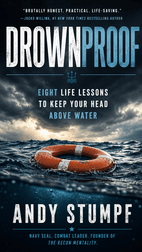
5 Main Takeaways from Drownproof
You are the author of your life, not its victim.
Your self-perception determines your actions. Andy's near-fatal failure came from silence, not action—proving that you must own your decisions and speak up. True awakening happens when you stop being a passenger and take responsibility for your own narrative.
Drop the rope: disengage from toxic people and lost causes.
Not every battle is worth fighting. Andy compares toxic individuals to a tug-of-war where you can simply let go. Subtraction—removing negative influences—is often more valuable than adding more effort to a hopeless situation.
Separate your identity from your role to avoid crisis.
Letting your identity be completely defined by a job or title sets you up for collapse when that role ends. Andy warns that loving what you did shouldn't cage who you are becoming. Instead, find purpose beyond labels.
Focus on what you can influence and take small steps.
Draw a clear line between concern and influence—invest energy only where it can make a difference. When overwhelmed, keep your world small: solve one problem at a time. Recovery and growth start with inches, not grand plans.
Learn from failure without letting it define you.
Failure is inevitable and necessary, but it should happen in the micro, not the macro. Conduct honest, phase-by-phase reviews without making it personal. The same drive that helps you succeed can become toxic; ask for help and adapt.
Executive Analysis
These five takeaways form a cohesive framework for resilience: own your narrative, cut what drains you, disentangle identity from roles, focus on controllable small steps, and treat failure as feedback. Together, they argue that survival—whether from combat wounds, career transitions, or personal tsunamis—is not about one heroic trait but a series of deliberate choices and actions.
This book matters because it translates elite military mindset into practical civilian life strategies. Andy Stumpf demystifies the SEAL ethos, showing that the principles aren't superhuman but universally applicable. It sits at the intersection of leadership, personal development, and trauma recovery, offering a no-nonsense guide for anyone navigating adversity without losing their humanity.
Chapter-by-Chapter Key Takeaways
Foreword by Jocko Willink (Foreword)
Grit in recovery: Andy’s determination to heal from a severe combat wound and return to active duty shows the kind of resilience that defines top-tier operators.
Continuous growth: Even while rehabilitating, he earned a commission as an officer, demonstrating that personal development doesn’t stop when circumstances get hard.
Holistic excellence: His skill set wasn’t narrow—lead climbing, free-fall jumping, tandem jumping, combat experience, and leadership potential—all of which made him stand out even among elite peers.
Try this: Embrace recovery as an opportunity for growth; even while healing, pursue new goals like earning a commission or developing complementary skills.
1. Sink or Swim (Chapter 1)
Your self-perception is the foundation. If you see yourself as unable to speak up, you won’t. That’s not a character flaw; it’s a structural weakness.
Integrity cannot be outsourced. You can’t rely on the group to be your moral compass. You have to own your decisions, even when they’re hard.
Failure is inevitable, but it should happen in the micro, not the macro. Small mistakes teach you; catastrophic ones can derail your entire life.
The cost of silence is high. The author’s failure wasn’t in what he did, but in what he didn’t do—and that nearly cost him everything.
True awakening comes when you stop being a passenger. You are the author of your life, or you are its victim. There is no middle ground.
Try this: Stop being a passenger in your own life by speaking up and owning your decisions, especially when silence has a high cost.
2. Get Into the Water (Chapter 2)
Fear is natural and informative; the critical skill is deciding whether to let it control you or to control it.
Toxic individuals who refuse to engage rationally are like a tug-of-war—you can choose to drop your end of the rope rather than exhaust yourself.
Subtraction—removing negative influences—is often more valuable than adding more effort to a lost cause.
Titles are hollow without purpose; the most powerful people are those who lift others as they rise.
Always prioritize why you do something over what label you earn from it.
Try this: Identify one toxic relationship or commitment in your life and consciously drop your end of the rope instead of exhausting yourself further.
3. The Deep End (Chapter 3)
Letting your identity be completely defined by your role—whether SEAL, pilot, or anything else—is a setup for crisis when that role ends.
Saying yes to unexpected opportunities can open new pathways, but each comes with its own costs and risks.
Finding a mechanism to quiet mental noise is crucial; for the author, wingsuit BASE jumping provided that clarity, but the method must be personal and safe.
The decisions we make can have unintended impacts on others, and responsibility is not always easy to live with.
Try this: Safely find a mechanism to quiet mental noise—whether meditation, sport, or a hobby—and use it to gain clarity without letting it define you.
Next chapter: “4. Tread Water” is locked
Keep learning from Drownproof — and unlock all 600+ book summaries with audio, mindmaps and AI Q&A.
$0.00 due today · 7 days free, then $89.99/year ($7.49/mo) · Cancel anytime before day 7
plus sales tax where applicable