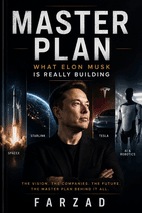
Farzad Mesbahi's Master Plan argues that Elon Musk's companies form a unified infrastructure foundation for the next century, driving energy, labor, and intelligence costs toward zero. Written for technology and investing readers seeking a framework to understand the long-term strategy behind Musk's ecosystem and navigate the waiting period between promise and delivery.
Feature
Insta.Page
Blinkist
Shortform
Summary Depth
Full Chapter-by-Chapter
15-min overview
Section-by-section guides
Audio Narration
✓
✓
✓
Visual Mindmaps
✓
✕
✕
AI Q&A
✓
✕
✕
Quizzes
✓
✕
✕
PDF Downloads
✓
✕
✓
Price
$89.99/yr
$146/yr (PRO)
$199/yr
*Competitor data last verified July 2026.
1 Page Summary
Based solely on the provided chapter content, Farzad Mesbahi's "Master Plan: What Elon Musk Is Really Building" argues that Elon Musk's various companies (Tesla, SpaceX, The Boring Company, xAI) are not a scattered collection of bets, but a single, layered foundation for the next century of civilization. The central thesis is that Musk is systematically assembling infrastructure for energy, transport, compute, robotics, networks, and off-world reach, with the unified goal of driving the cost of energy, labor, and intelligence toward zero. The author, a former Tesla executive who acknowledges a significant personal financial stake, contends that the real asset is the infrastructure beneath any single AI model, using the example of SpaceX renting its entire compute capacity to AI competitor Anthropic to validate this "infrastructure layer theory."
The book's distinctive approach is to connect granular engineering and economic details—from the physics of chip lithography and the cost-per-hour of a humanoid robot to the feedback loop of Tesla's real-world driving data—into a cohesive vision. It contrasts Musk's iterative, failure-tolerant engineering culture (e.g., SpaceX's rapid launch cycles) with traditional, risk-averse approaches. The narrative moves from the inevitable economics of robotics displacing labor to the structural shift of "local-first" AI, and finally to the second- and third-order effects on cities, real estate, and human purpose, such as how autonomous vehicles could invert the value of suburbs versus downtowns.
The intended audience appears to be readers interested in technology, futurism, and investing, who want a framework for understanding the long-term, interconnected strategy behind the Musk ecosystem. The book aims to provide a perspective for navigating the "waiting period" between a technological promise and its widespread delivery. Readers will gain a model for thinking beyond conventional sector-based analysis, learning to "think three moves ahead" by tracing how a drop in transportation costs or the payback period on a robot triggers cascading, world-altering shifts, ultimately imagining a future where advanced technology becomes a quiet, reliable, and integrated background to daily life.
PROLOGUE
Overview
This prologue sets the stage for an audacious claim: by 2050, most everyday objects people interact with will be directly created or heavily influenced by Elon Musk. The author, a former Tesla executive who worked there from 2017 to 2021, is not a neutral observer. He describes owning roughly 80% of his stock portfolio in Tesla—a bet he calls either “the smartest or the dumbest” he’s ever made. That personal stake isn’t a flaw; it’s a reason he’s thought harder about this than someone with nothing to lose. He’s read every quarterly transcript since 2016, lived through the chaos of “Production Hell” (where the company burned $6,500 per minute while Elon slept on the factory floor), and watched the impossible become routine. The Model Y is now the best-selling car in the world, not just the best-selling EV, and it drives itself for less than the average new car in America.
Yet living through the waiting period—the years between the promise and the delivery—is psychologically brutal. The author confesses to wondering if he’d lost his mind or joined a massive cult. Then the chapter pivots to a brief, seemingly disconnected scene: a child on a gurney, a woman named Naia, a whispered order to move to the OR. She tucks the child’s hand back under the blanket, a gesture no machine told her to make. It’s small, human, and the only thing that mattered. The juxtaposition hints that Musk’s future isn’t just about cars or rockets—it’s about the quiet, ordinary moments that technology might reshape or protect.
Key Takeaways
The author has 14 years of close observation of Musk and his companies, plus direct leadership experience at Tesla during critical growth phases.
Tesla’s survival and success (Model Y as global #1 car, self-driving capability, affordability) defied every conventional assumption, including near-bankruptcy in 2018.
Having a concentrated financial stake doesn’t cloud judgment—it forces deeper analysis and a higher tolerance for doubt.
The prologue hints at a larger narrative where Musk’s influence extends beyond consumer products into foundational human experiences, like healthcare and caring for the vulnerable.
That final vignette (Naia and the child) suggests the book will weave together cold technology with warm, irreplaceable human gestures—the kind of detail engineering alone can’t replicate.
Key concepts: PROLOGUE
1. PROLOGUE
Author's Credibility and Stake
Former Tesla executive from 2017 to 2021
Owns 80% of portfolio in Tesla stock
Read every quarterly transcript since 2016
Lived through Production Hell chaos
Tesla's Defiant Success
Model Y became world's best-selling car
Self-driving capability at affordable price
Survived near-bankruptcy in 2018
Burned $6,500 per minute during crisis
Psychological Toll of Waiting
Years between promise and delivery are brutal
Author wondered if he joined a cult
Doubt and uncertainty are constant companions
High tolerance for doubt required
Musk's Expanding Influence
By 2050, most objects will be Musk-influenced
Impact extends beyond cars and rockets
Technology reshapes ordinary human moments
Healthcare and caring for vulnerable included
Humanity Amid Technology
Naia tucks child's hand under blanket
Small gesture no machine could replicate
Cold tech meets warm human touch
Engineering alone can't replace humanity
💡 Try clicking the AI chat button to ask questions about this book!
CHAPTER 1
Overview
From the outside, Elon Musk’s empire looks like a scatterbrained collection of bets: a car company, a rocket builder, a tunneling venture, a social media platform, and an AI lab. Analysts slice them up by sector, investors track them by quarter, and the financial system has no box big enough to hold the whole thing. But that’s a mirage. What’s actually being built under one hyperactive founder is a single, layered foundation for the next century of civilization. Energy, transport, compute, robotics, networks, and off-world reach — every layer that future generations will run on is being assembled right now, and the driving force is that each piece lowers the cost of energy, labor, and intelligence toward zero.
Follow the data and the pattern emerges. The Boring Company’s Vegas Loop runs on Tesla’s self-driving tech — paying customers already ride through tunnels in autonomous Teslas. Those tunnels simplify driving environments, which means more training data flows back to Tesla’s neural networks. That data gets crunched by SpaceXAI’s compute infrastructure, improving the models that will someday run Optimus robots. Robots need to understand the real world, and there’s no better training ground than actual self-driving cars. Zoom out: Grok, the SpaceXAI model, already lives inside Tesla vehicles via software updates. Tesla Energy’s Megapacks power the data centers that train the models that improve Tesla products, which sell more cars and storage, which fund more compute capacity. X’s half-billion monthly users pump out real-time data that trains Grok. Even Elon’s own 200-million-plus follower base becomes a feedback loop. It’s not separate companies cooperating — it’s one system feeding itself.
That doesn’t mean the criticisms are hollow. The GPU allocation between SpaceXAI and Tesla raises legitimate governance questions. The earnings multiple assumes a future that hasn’t arrived. Missed deadlines are a tired but real complaint. And the structural objection is the sharpest: the current legal and financial framework wasn’t designed for companies that share resources, engineers, and strategic bets while having separate boards and fiduciary duties. Conflicts of interest are baked in. But here’s the uncomfortable truth — that structural mess is the cost of building a behemoth that encompasses every variable at the root of civilization’s foundation. Elon himself has said his companies “seem to be converging.” He likely always knew they were, even if he couldn’t say it out loud.
The biggest risk? The whole thing depends on one person’s strategic vision. Without Elon, Tesla remains a strong car company, SpaceX still has Gwynne Shotwell, but the cross-company integration and the ability to bet $200 billion on something that connects to a Mars colony three decades out — that disappears with the architect. Every year the system builds its own momentum, so the key-man risk shrinks, but it’s still the single greatest vulnerability in the history of business.
Then there’s the lesson from manufacturing hell. Motorola estimated the RAZR would sell 400,000 units; it sold 130 million. That’s a failure of imagination. But imagination alone doesn’t scale hardware. In late Q2 2018, Tesla’s Model 3 ramp was a knife-edge thriller — one bad quarter away from bankruptcy, or a capital raise that would have cratered reputation. The memory of standing in that parking lot, knowing the whole thesis could collapse into a cautionary tale, stays vivid. Those near-death experiences in supply chains and physical scaling taught lessons now being applied to Optimus, Megapacks, and everything else the system builds next. That hell was training data for the foundation.
Key Takeaways
What looks like a portfolio of disconnected companies is actually a single, integrated system where each business feeds data, compute, or energy to the others.
The convergence is real and structural: Boring Company tunnels train Tesla FSD, which feeds SpaceXAI, which powers Grok, which rides in Teslas — all running on Tesla Energy.
Criticisms about governance, missed deadlines, and key-man risk are valid, but they’re the price of building something the financial system wasn’t designed for.
The biggest single risk is Elon Musk himself as the sole strategic integrator, though that risk diminishes as the system gains its own momentum.
The Model 3 ramp nearly killed Tesla, but the manufacturing scars from that period are now the bedrock for scaling robots, energy storage, and everything else.
Key concepts: CHAPTER 1
2. CHAPTER 1
The Unified System
Empire looks scattered but is one integrated foundation
Each company feeds data, compute, or energy to others
Boring Company tunnels train Tesla FSD, which feeds SpaceXAI
Grok lives in Teslas; Megapacks power training data centers
Cross-Company Feedback Loops
Self-driving data improves neural networks for Optimus robots
X’s half-billion users generate real-time data for Grok
Tesla Energy powers compute for products that sell more storage
Elon’s 200M+ followers create a feedback loop for training
Valid Criticisms and Structural Risks
GPU allocation between SpaceXAI and Tesla raises governance issues
Legal framework not built for shared resources across companies
Conflicts of interest are baked into the system
Key-man risk: whole system depends on Elon’s strategic vision
Manufacturing Hell as Training Data
Model 3 ramp nearly killed Tesla in 2018
Near-death experiences taught lessons for scaling hardware
Those scars now applied to Optimus, Megapacks, and future builds
Physical scaling failures built resilience for the foundation
The Architect Dependency
Without Elon, cross-company integration disappears
Tesla and SpaceX survive but lose long-term Mars vision
System gains momentum yearly, reducing key-man risk
Single greatest vulnerability in business history
CHAPTER 2
Overview
Three massive forces are arriving simultaneously, and their collision makes today unlike any other moment in history. AI costs are plunging, labor is becoming effectively free through robotics, and energy is heading toward near-zero marginal cost. Together, they reshape everything, including the very concept of currency.
The First Convergence: Intelligence Gets Free
The numbers are staggering and worth sitting with. In early 2023, generating the equivalent of ChatGPT-4‑level intelligence cost about $36 per million tokens. A token is roughly a unit of reasoning; a single sentence might run you $0.00054. By 2025, that same capability had fallen to under $1 per million tokens—a 36‑fold drop in two years. And that’s just the headline model from one of the best‑funded labs. DeepSeek’s R1 model was trained for about $6 million, while American labs spent hundreds of millions for comparable performance. The benchmark ResNet‑50 model cost $1,000 to train in 2017; by 2019 it was $10; today it’s pennies. The logic is simple: once you have fully automated systems with AI orchestrating them, the only real constraints become mass and energy. The AI handles the rest.
Currency Follows Scarcity
Now the question becomes: what happens to money? Historically, currency always migrates to denominate the scarcest essential input of its era. Gold dominated for millennia because land and physical resources were the scarce things. Then in 1944, Bretton Woods pegged currencies to a dollar backed by gold. That evolved into the petrodollar. The pattern is clear—each shift reflects a new economic foundation. If the Three Convergences deliver free intelligence, free labor, and near‑free energy, then the only scarce inputs left are mass and energy. Elon Musk, who has been vocal about this thesis, said at Davos in early 2026 that ubiquitous AI and robotics will trigger an explosion in the global economy. Later that year, he went further: “The concept of currency itself may disappear when AI meets all material needs. If there is an ultimate equivalent, it will be energy.”
Proven in One Person’s Economics
Amina, a Rwandan clinic worker, retrieves medication from a building that was poured last year by a crew of eight humans and thirty‑two machines. The concrete came from local aggregate. The solar roof generates more electricity than the clinic uses, and the surplus powers streetlights and water pumps. Four years ago, the block was a dirt lot. Now it holds a 40‑bed clinic, classrooms, and a workshop where local women learn to maintain the machines. For Amina, the connection is personal: her aunt died of a treatable infection because medicine existed somewhere in Kigali but not where it was needed, when it was needed. Now the medicine is here—because the cost of everything fell below the threshold where it started to make sense. The mother receiving the pills says nothing. There’s nothing to say. The medicine is simply available, like air.
Key Takeaways
AI intelligence costs are dropping by factors of 30–100 every two years, approaching near‑zero marginal cost.
The historical pattern of currency shows it always shifts to track the era’s scarcest resource—likely mass and energy in the age of the Three Convergences.
Musk’s framing points to a world where currency itself may become obsolete, replaced by energy as the ultimate equivalent.
The story from Rwanda illustrates that this isn’t abstract theory—it’s already reshaping physical infrastructure and human lives where costs have fallen below the threshold of practicality.
Key concepts: CHAPTER 2
3. CHAPTER 2
Three Convergences Collide
AI costs plunging dramatically
Labor becoming free through robotics
Energy heading toward near-zero marginal cost
Their collision reshapes everything including currency
Intelligence Gets Free
ChatGPT-4 intelligence cost dropped 36-fold in two years
DeepSeek R1 trained for $6M vs US labs' hundreds of millions
ResNet-50 training cost fell from $1000 to pennies
Only constraints become mass and energy
Currency Follows Scarcity
Currency always tracks scarcest essential input of its era
Gold dominated for millennia, then Bretton Woods, then petrodollar
Free intelligence, labor, energy leave only mass and energy scarce
Musk: currency may disappear, energy becomes ultimate equivalent
Proven in Rwanda
Clinic built by 8 humans and 32 machines from local aggregate
Solar roof powers clinic, streetlights, and water pumps
Medicine now available where it was previously inaccessible
Costs fell below threshold where everything started to make sense
Key Takeaways
AI intelligence costs dropping 30-100x every two years
Currency shifts to track era's scarcest resource
Musk envisions currency obsolete, replaced by energy
Rwanda story shows theory already reshaping real lives
CHAPTER 3
Overview
Tesla's fleet is now over 9 million vehicles strong, and roughly 1.7 million new cars join every year as production ramps. That means the company is cycling through real-world driving data more than 2,000 times faster than its closest competitor, Waymo. While Waymo runs millions of simulated miles daily, Tesla's cars are out there encountering actual deer, real construction zones, and unpredictable human behavior across every state and climate. The fleet has already logged over 10 billion supervised miles of Full Self-Driving data. This isn't just a numbers game—it's a fundamental difference in how each company learns to drive.
The Data Divide: Real Miles vs. Simulated Miles
Simulations are useful for testing edge cases, but they remain virtual. Tesla's advantage is literal: millions of cars on real roads, driving through real fog, real potholes, real chaos. A cone placed in a weird pattern at a construction site in Ohio gets seen, recorded, and uploaded. Eighteen seconds later, another Tesla passes the same spot and makes the same adjustment, having already received the updated neural network weights. Every mile driven makes the system smarter, and that smarter system gets downloaded into every car. This feedback loop compounds over time, widening the gap with competitors who rely on smaller fleets and simulated environments.
Fleet Activation: The Invisible Scale
Most people don't notice Tesla's fleet for what it is because the cars look ordinary. They're not branded robotaxis with spinning sensors on the roof. They're just sedans and SUVs that happen to be learning the world every second they move. This is "fleet activation" rather than "fleet building"—the company didn't need to design a dedicated autonomous vehicle from scratch. Every Model 3, Model Y, and Cybertruck sold becomes a data-gathering node. The fleet scales with production, not with a separate robotaxi rollout. And the more cars Tesla sells, the faster the system improves, which in turn makes the eventual robotaxi service cheaper and more capable.
The Proof in the Desert
A scene near Deming, New Mexico, illustrates what this looks like in practice. A coyote stands on the shoulder. The car adjusts its line two feet to the left without changing speed, having learned from previous encounters. At a rest stop, a row of vehicles charges in silence—one just dropped off a sleeping college student in Las Cruces and is now repositioning to pick up an early-morning commuter. The fleet doesn't need a human awake to operate. It runs 24/7, repositioning, charging, and pinging for cargo. This isn't a hypothetical future; thousands of Teslas already navigate factory lots autonomously every day, and the same technology is expanding onto public roads.
The Economics of Ubiquity
At scale, the cost of a robotaxi ride drops below public transit in many cities. That changes everything. Transportation stops being an expense you minimize and becomes a tool you deploy at will. A retired couple takes an overnight robotaxi to visit grandchildren three states away because it's cheaper than a plane ticket. A small business sends an autonomous van to shuttle inventory between locations six times a day. A teenager without bus service gets driven to a part-time job for less than she earns in the first 15 minutes of her shift. When the cost per mile collapses, demand explodes—not just replacing ride-hailing, but eating into car ownership, public transit, and creating entirely new categories of movement. The fleet nobody sees today becomes the fleet that's everywhere tomorrow. And as Tesla builds more form factors—Semi trucks, vans, RVs, mobile offices—the same self-driving system scales across every vehicle type, all driven by AI neural networks.
Key Takeaways
Tesla's 9-million-car fleet generates real-world driving data at a rate over 2,000 times faster than Waymo's simulation-heavy approach.
The compounding feedback loop means every mile driven improves the system, which then improves every subsequent mile for every car.
Fleet activation (using existing consumer vehicles) scales far faster than building a dedicated robotaxi fleet from scratch.
The economics of cheap autonomous transport create entirely new use cases, from overnight intercity travel to on-demand cargo shuttling.
A single self-driving platform can eventually power multiple vehicle form factors, from passenger cars to semis and RVs.
Key concepts: CHAPTER 3
4. CHAPTER 3
The Data Advantage
9 million cars generate real-world driving data
2,000x faster data collection than Waymo
Real miles beat simulated miles for learning
10 billion supervised FSD miles logged
Compounding Feedback Loop
Every mile driven improves the neural network
Updates downloaded to all cars instantly
Real encounters like deer and construction zones
Widening gap with competitors over time
Fleet Activation Strategy
Consumer vehicles double as data-gathering nodes
No need for dedicated robotaxi fleet design
Scale tied to production, not separate rollout
More sales = faster system improvement
Real-World Proof of Concept
Coyote encounter shows learned avoidance behavior
Autonomous repositioning and charging 24/7
Thousands navigate factory lots daily
Technology expanding onto public roads
Economic Transformation at Scale
Robotaxi cost drops below public transit
New use cases: overnight trips, cargo shuttling
Demand explodes when cost per mile collapses
Single platform scales across all vehicle types
You've reached the end of the free chapters
Next chapter: “CHAPTER 4” is locked
Keep reading Master Plan — and unlock all 600+ book summaries with audio, mindmaps and AI Q&A.
$0.00 due today · 7 days free, then $89.99/year ($7.49/mo) · Cancel anytime before day 7
Farzad Mesbahi is an Iranian-American author and scholar whose work focuses on the intersection of spirituality, psychology, and self-development. He is best known for his book "The Art of Conscious Evolution," which explores practical pathways for personal and collective transformation. His expertise draws from a deep study of both Eastern wisdom traditions and Western psychology.
Frequently Asked Questions about Master Plan
What is Master Plan about?
This book presents a bold vision of how Elon Musk's interconnected companies—Tesla, SpaceX, xAI, and others—are systematically building the foundational layers for the next century of civilization. It argues that by 2050, most everyday objects will be directly created or heavily influenced by Musk's ventures, driven by converging trends in AI, robotics, and energy. Drawing on the author's insider experience at Tesla, the book analyzes the real-world data, economic logic, and technical milestones behind self-driving cars, humanoid robots, and space infrastructure. The narrative connects these seemingly disparate bets into a single, coherent 'master plan' that aims to drive the cost of energy, labor, and intelligence toward zero.
Who is the author of Master Plan?
Farzad Mesbahi is a former Tesla executive who worked at the company from 2017 to 2021, living through the chaos of 'Production Hell' and witnessing firsthand how the impossible became routine. He is not a neutral observer—he has roughly 80% of his personal stock portfolio invested in Tesla, a bet he calls either the smartest or dumbest he's ever made. That personal stake drives him to analyze the company and its ecosystem with uncommon depth, having read every quarterly transcript since 2016 and studied the patterns that others miss.
Is Master Plan worth reading?
Absolutely. This book offers a rare insider perspective from someone who was in the trenches during Tesla's most turbulent years, and it backs up its bold claims with concrete data and rigorous logic. It challenges conventional financial and technological thinking, showing how the pieces of Musk's empire fit together into a single, transformative vision. Whether you're an investor, a technologist, or simply curious about the future, this book will shift how you see the next few decades.
What are the key lessons from Master Plan?
The book's central lesson is that the convergence of plummeting AI costs, effectively free labor from robots, and near-zero marginal energy costs will reshape every industry and even the concept of currency. Tesla's real-world driving data gives it an insurmountable advantage in autonomous technology—its fleet already logs billions of supervised miles, creating a learning loop that simulations cannot match. The economic case for humanoid robots like Optimus is irresistible: at $2–4 per hour operating cost, any physically repetitive job becomes an instant hire. Finally, the book argues that the true moat is not the AI model itself but the underlying infrastructure—compute, energy, and launch capacity—that Musk is building to power everything else.
📚 Explore Our Book Summary Library
Discover more insightful book summaries from our collection