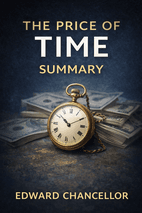
Edward Chancellor's The Price of Time presents a sweeping historical and economic argument that artificially low interest rates cause financial instability and inequality, tracing the concept from ancient Mesopotamia to modern central banking. It is intended for readers seeking to understand the root causes of contemporary economic fragility.
Feature
Insta.Page
Blinkist
Shortform
Summary Depth
Full Chapter-by-Chapter
15-min overview
Section-by-section guides
Audio Narration
✓
✓
✓
Visual Mindmaps
✓
✕
✕
AI Q&A
✓
✕
✕
Quizzes
✓
✕
✕
PDF Downloads
✓
✕
✓
Price
$89.99/yr
$146/yr (PRO)
$199/yr
*Competitor data last verified July 2026.
1 Page Summary
In The Price of Time, Edward Chancellor presents a sweeping historical and economic argument that the manipulation of interest rates to artificially low levels is a primary cause of financial instability, economic malaise, and social inequality. The book traces the concept of interest from its ancient Mesopotamian origins—where it emerged from lending productive assets and soon revealed the destructive power of compound debt—to the modern era of central banking. Chancellor contends that interest is not merely a technical tool but a vital price, the "time value of money," which balances present consumption against future investment and acts as a crucial governor for rationing capital and fostering healthy creative destruction. When this price is suppressed by policy, it distorts every facet of the economy.
Chancellor’s approach is distinguished by its deep historical grounding and its challenge to orthodox economic theory. He meticulously documents how, from John Law’s Mississippi Bubble to the Federal Reserve’s policies after the 2008 crisis, artificially cheap credit has repeatedly fueled speculative manias, misallocated capital, and sown the seeds for collapse. The book directly critiques the dominant "neutrality of money" doctrine, which blinds central bankers to the role of credit and asset bubbles, and dissects flawed modern diagnoses like "secular stagnation." Instead, Chancellor champions the prescient warnings of heterodox figures like the Bank for International Settlements’ Claudio Borio, arguing that finance actively shapes the real economy and that persistent low rates lead to "unnatural selection," fostering zombie companies, a finance curse, and catastrophic asset bubbles.
Intended for readers seeking to understand the root causes of contemporary economic fragility, the book offers a compelling narrative that connects ancient debt jubilees to today’s pension crises and soaring inequality. Readers will gain a critical perspective on how the long era of easy money has engineered a "Great Non-Compression" of wealth, a mounting retirement disaster, and a dangerous shift of power toward central banks and the state. Ultimately, The Price of Time issues a stark warning: the relentless suppression of interest rates, far from being a benign stimulus, is a form of financial repression that risks creating a new road to serfdom, undermining both market dynamism and democratic accountability.
1: Babylonian Birth
Overview
The idea of interest springs from the very soil and livestock of the ancient world, its roots in words for birth and increase. It began as a natural outcome of lending productive assets like seed or livestock, where the 'increase' became the profit. Our deepest understanding comes from Mesopotamian clay tablets, which reveal a surprisingly sophisticated financial world with a vast credit network, professional merchant-bankers, active female financiers, and standard interest rates.
Within this system, the Mesopotamians unlocked a powerful and perilous force: compound interest, which could make debts balloon to impossible sums. This led to the first debt crises and, in response, the first debt jubilees—royal cancellations meant to restore social order. Rulers like Hammurabi tried to tame finance through codes that capped rates, but lenders immediately crafted loopholes, starting the eternal game of regulatory evasion.
A central puzzle emerges: what determines interest rates? Custom and law created remarkable stability for centuries, but risk and market forces also played a role. Intriguingly, these rates acted as civilizational barometers, falling during periods of prosperity and spiking in times of decay.
The ancient evidence shows credit and interest predate coined money. This system was born from economic necessity and inequality—capital was scarce, and interest became the price for bridging time. It was the essential incentive to lend and became fundamentally linked to the value of real assets. Ultimately, thinkers from Böhm-Bawerk to Marx recognized interest as an organic, indispensable force woven into the fabric of any complex economy.
The Seed of Interest: Linguistic Roots in Nature
The concept of interest is ancient. Across early civilizations, words for interest are tied to fertility. Sumerian mas means a kid goat, Greek tokos means a calf, and Latin connects money (pecunia) to flock (pecus). This suggests interest likely began with productive loans of seeds or livestock, where the natural increase could be returned as profit.
Clay Tablets and Credit Networks in Mesopotamia
Mesopotamian clay tablets record detailed loan agreements, listing debtor, creditor, amount, term, and interest, often secured by collateral. Standard rates were 20% for silver and 33.33% for barley. Credit served diverse purposes, from agriculture to financing foreign trade.
A vibrant credit network existed with professional merchant-bankers (tankarum). Notably, women were active participants as both creditors and borrowers. Initially centered in temples and palaces, lending evolved into a private profession.
The Invention and Peril of Compound Interest
The Mesopotamians discovered compound interest, encapsulated in the Sumerian term mash mash. A dramatic example from around 2400 BC shows a barley debt compounding at 33.33% annually to an impossible, symbolic sum. This highlighted a fundamental problem: debts compounding geometrically can quickly become unpayable.
Debt Crises and the First Debt Jubilees
The burden of compounding debt led to recurring social crises. Rulers like Enmetena of Lagash proclaimed the first known debt cancellations. Debt jubilees became a tool for social stability, a pattern seen later in Athens under Solon, illustrating the perennial tension between credit and social order.
Hammurabi’s Code and Regulatory Evasion
The Code of Hammurabi represents an early attempt to regulate finance, setting maximum rates and outlawing abuses like compound interest. However, lenders immediately found loopholes, such as applying high monthly rates or disguising loans. The cat-and-mouse game between regulation and financial innovation began in antiquity.
The Enduring Mystery of Interest Rate Determination
Why do interest rates settle at certain levels? Ancient evidence provides contradictory clues. Babylonian and Greek rates were remarkably stable for centuries, suggesting a strong role for law and custom. Yet riskier ventures commanded higher premiums, and Roman emperors manipulating money supplies caused rates to fluctuate. Rates seem shaped by a complex blend of custom, law, market forces, and intervention—a puzzle that remains.
Interest Rates as Civilizational Barometers
A society's cultural vitality is reflected in its interest rates. Throughout antiquity, rates traced a U-shaped pattern over centuries. They declined as a civilization flourished, only to climb sharply during eras of decay. In Babylon, rates dipped during its prosperous peak but soared after its fall. This historical rhythm offers a sobering perspective: periods of exceptionally low interest often preceded great turmoil.
The Ancient Roots of Interest
Credit—and with it, interest—came before coined money. Ancient financial practices feel familiar, featuring diverse loans, complex calculations, credit networks, debt crises, and regulatory evasion. This system sprang from necessity and inequality. Capital was scarce, and those with surplus resources could charge for their use.
The Economic Necessity of Interest
Finance is about bridging time, and interest is the price of that bridge. Interest compensates for the productivity of capital over time and is the essential incentive that persuades people to lend. This creates a natural link between interest rates and the returns on productive assets.
This principle extends to durable assets like housing. From the first Mesopotamian cities, property values were tied to finance. When wealth was injected into Rome, interest rates fell and house prices rose. As the 17th-century thinker Nicholas Barbon put it, interest is simply the rent paid on capital.
Enduring Insights from Economists
Policymakers often treat interest rates as technical dials, but its origins reveal a deeper force. Earlier economists grasped this. For Böhm-Bawerk, interest was "an organic necessity." Irving Fisher considered it too omnipresent to eliminate. Even Karl Marx acknowledged its inescapable nature, writing that usury "lives in the pores of production."
Key Takeaways
Historically, interest rates serve as a barometer for civilizational health, with sustained low rates often warning of future instability.
Credit and interest predate coined money, with ancient financial systems displaying surprising sophistication.
Interest arises from economic scarcity, unequal wealth distribution, and the need to compensate for the time value of capital and risk.
The fundamental role of interest in valuing assets and incentivizing lending has remained constant from antiquity to today.
Leading economic thinkers across the ideological spectrum have affirmed interest as an indispensable element of any complex economy.
Key concepts: 1: Babylonian Birth
1: Babylonian Birth
Origins in Nature and Language
Words for interest tied to fertility and birth
Began with loans of productive assets like livestock
Natural increase from assets became the profit
Mesopotamian Financial System
Detailed loan contracts on clay tablets
Professional merchant-bankers (tankarum) operated
Women participated actively as financiers
Standard rates: 20% silver, 33.33% barley
Invention of Compound Interest
Sumerian term 'mash mash' described compounding
Debts could balloon to impossible sums geometrically
Created fundamental tension between lenders and borrowers
Debt Crises and Jubilees
Compounding debt led to social instability
Rulers proclaimed first debt cancellations
Jubilees became tool for restoring social order
Early Regulation and Evasion
Hammurabi's Code set maximum interest rates
Lenders immediately crafted loopholes
Began eternal game of regulatory evasion
Interest Rate Determination
Rates showed remarkable stability for centuries
Shaped by custom, law, and market forces
Acted as civilizational barometers of prosperity
Economic Necessity of Interest
Credit predates coined money
Interest is price for bridging time
Essential incentive to persuade people to lend
Linked to returns on productive assets
💡 Try clicking the AI chat button to ask questions about this book!
2: Selling Time
Overview
For thousands of years, lending money at interest was reviled as the sin of usury. Philosophers and theologians denounced it as an unnatural theft of time—something that belonged only to God. This moral view was based on a flawed idea that money itself was barren, ignoring its role as a store of value. The tide turned during the Renaissance, as people began to see time in a more secular way. Time became a merchant's valuable asset, to be managed for profit. Practical businessmen, who needed credit for complex international trade, became experts at evading the Church’s ban. They hid interest within instruments like bills of exchange.
Eventually, economic reality forced a change in thinking. People began to distinguish condemned usury from legitimate interest. They saw interest as fair payment for risk or for profit the lender gave up. This evolved into the core idea that time itself has a price. But why charge interest even for a loan used just to buy things? The answer is time preference—the common human tendency to value a present good more than the same good in the future. Interest became the market price for this impatience, the "time value of money."
This idea is the foundation of all financial value. It lets us calculate what a future stream of income is worth today. It also guides investment, where societies give up spending now for greater returns later. But there's a crucial danger. If interest rates are pushed artificially low—below the level that matches society's real time preference—it distorts decisions. This leads to malinvestment in unsound projects and too much debt, which plants the seeds for an economic crisis.
The Historical Condemnation of Usury
Lending money at interest has been condemned across cultures for millennia. From Aristotle and Plato to St. Augustine, Dante, and Shakespeare, thinkers and artists denounced the usurer. This criticism even united very different figures like Karl Marx and Adolf Hitler. The roots are ancient. The Old Testament forbade charging interest to fellow Israelites, calling usury (neschek in Hebrew, meaning "to bite") a predatory act. In ancient times, people feared that interest-bearing debt could lead directly to debt-slavery. This fear prompted legal reforms in cities like Athens and Rome.
The Scholastic Critique and Its Flaw
Medieval Christian scholars, called Scholastics, launched a strong intellectual attack on usury, influenced by Aristotle. They argued that money itself was "barren" and existed only for exchange. So, charging for its use was unnatural and unjust. They said it meant selling what didn't belong to the seller—the time the loan lasted. The 13th-century theologian Thomas of Cobham solidified this view. He called the usurer a "thief of time" because time belonged only to God.
But this critique had a basic economic flaw: it ignored money's role as a store of value. A loan is a transaction across time. The lender keeps a claim (the debt) but gives up the money's immediate use. Interest pays for that deferred use and for the risk involved.
The Secularization of Time and the Merchant's View
A major shift began in the Renaissance as time became more secular. The Stoic philosopher Seneca had called time man's most precious possession. Renaissance thinkers like Leon Battista Alberti revived this idea. He represented a new, business-minded view where time became "merchant's time"—a valuable, personal asset to be managed carefully for profit. This happened alongside advances like public clocks, which let people measure work and productivity more precisely.
For merchant-bankers like Francesco Datini of Prato, time was a real cost. His complex, multi-year international textile deals made slim profits. Using time and credit efficiently was essential. His business, run on bills of exchange and loans, showed a growing credit-dependent economy. In it, the cost of time, measured as interest, was a daily fact.
Evading and Evolving Beyond the Ban
Despite the Church's official ban, the demand for credit in the growing medieval economy was huge. Bankers and merchants became experts at creative evasion. They disguised interest by inflating the loan amount, charging penalties for late payment, setting up fake sales, and using polite terms like discrezione (a "gift"). The key instrument was the bill of exchange, where interest was hidden in foreign exchange rates. As trade expanded, the Church's enforcement became pointless. Clerics admitted the merchants' "clever practices" were too complex to control.
The Conceptual Rehabilitation of Interest
Legal and religious thought finally adapted to commercial reality. The word interest comes from the Roman legal idea id quod interest—payment for a loss suffered. Medieval scholars developed the idea of lucrum cessans (profit given up). This justified interest as payment for profit the lender could have made elsewhere with his money.
By the Renaissance, thinkers like Bernardino of Siena argued money had a "productive character" as capital, and deserved a return. A key difference emerged between condemned usury (exploitative loans for spending) and acceptable interest (a charge for productive business loans that involved risk). The Reformation saw figures like John Calvin accept interest on business loans. In England, the Statute of 1571 made it legal, capped at 10%. The Elizabethan writer Thomas Wilson, despite his own opposition, captured the new view when he called usury "the price of time." This recognition—that time has value and its use can be fairly priced—was the decisive shift that allowed modern finance to grow.
From Usury to Interest: The Moral Evolution of a Concept
The philosophical fight against usury slowly faded as economic thought changed. Classical economists like David Hume and Adam Smith redefined interest. It was not sinful exploitation, but a fair share of profits, a "derivative revenue" that naturally rose and fell with them. This was a deep change. "Interest" grew from a narrow financial charge into a broad idea about human action, from selfishness to kindness. Thinkers like Bernard Mandeville and Adam Smith built this into the foundation of capitalism. They argued that pursuing self-interest, through networks of credit, accidentally created public good. This new framework was vital. Capital itself came to be seen as a stream of future income, discounted to its value today. As historian Jacques Le Goff put it, the usurers—the "merchants of the future, sellers of time"—were actually the founders of the modern capitalist system.
The "Bird in the Hand": Time Preference Explained
A big puzzle remained: if interest on a business loan could be justified by potential profit, what justified interest on a loan just for spending? The 18th-century economist Turgot gave the classic answer with the saying "a bird in the hand is worth two in the bush." This is the principle of time preference—the universal human tendency to value present goods more than future goods. So, interest is the price of this preference. It's the "time value of money" that pays a lender for waiting.
Modern psychology supports this innate impatience. Walter Mischel's "Marshmallow Test" with children showed it clearly. Economists give reasons for this positive time preference: life's uncertainty, our natural short-sightedness, and the hope of making more money later (which makes current money more valuable). A person's time preference depends on their situation, age, and even culture. A hungry person or a young person with no cash has a very high time preference. That's why they might take a high-interest "payday" loan. On the other hand, aging populations, like Japan's, tend to have lower time preferences and lower interest rates.
Thinkers from Jeremy Bentham to Irving Fisher established this view. They defined interest as the market rate for human impatience. The economist Ludwig von Mises saw time preference as a basic part of all human action. He believed a natural interest rate must always be positive.
Valuation, Investment, and the Dangers of Distorted Time
The time value of money is the foundation of all financial value. We discount future cash flows—from rents, dividends, or profits—at an interest rate to find what any asset is worth today, from a bond to a piece of land. As Adam Smith noted, lower interest rates automatically mean higher land and asset prices.
This same logic applies to investment. Building a factory or developing new technology means giving up spending now for a bigger return later. As early economist John Rae said, a society's willingness to invest depends on how long its people will wait—how many "marshmallows" they'll pass up today for more tomorrow. Businesses will invest until the return on the last project just matches the interest rate, which reflects society's overall time preference.
Here lies a serious danger. Economists like Friedrich Hayek warned that if central banks or markets set interest rates below the natural rate set by real time preference, they warp the economy. Artificially cheap credit leads to malinvestment—long, complicated projects with unrealistic payoffs, like useless infrastructure or speculative bubbles. It also pushes households to borrow too much, pulling future spending into the present and creating debt problems later. Hayek argued these distortions always end in an economic crisis, a point the chapter says it will return to with the 2008 crash and the era of ultra-low rates.
Key Takeaways
Interest changed from the condemned sin of usury into a legitimate price for "time." This idea forms the foundation of capital and capitalism.
Time preference—our tendency to value satisfaction now more than later—is
Key concepts: 2: Selling Time
2: Selling Time
Historical Condemnation of Usury
Ancient and religious bans on lending at interest
Feared link between debt and debt-slavery
Viewed as unnatural theft of God's time
Scholastic Critique and Its Flaw
Argued money was barren, only for exchange
Called usury the theft of time from God
Flawed by ignoring money as a store of value
Secularization of Time
Renaissance shift to time as a merchant's asset
Time became 'merchant's time' for profit management
Linked to clocks measuring work and productivity
Practical Evasion of the Ban
Merchants used creative methods to hide interest
Key instrument was the bill of exchange
Church enforcement became impractical
Conceptual Rehabilitation of Interest
Interest justified as payment for risk or lost profit
Distinction made between usury and legitimate interest
Recognition that time has a fair market price
Foundation: Time Preference
Human tendency to value present goods more
Interest is the market price for this impatience
Forms the core 'time value of money' concept
Danger of Artificial Interest Rates
Rates below real time preference distort decisions
Leads to malinvestment in unsound projects
Creates excessive debt and seeds economic crisis
3: The Lowering of Interest
Overview
In the aftermath of national disasters and financial crisis in 1660s England, a fierce debate erupted over the very nature of economic health. Facing a “decay of trade,” figures like the merchant Sir Josiah Child championed a legally mandated lowering of interest rates as a cure-all, arguing it would revive commerce and raise land values. This view, rooted in earlier thinkers like Sir Francis Bacon, saw high interest as a parasite on the nation, discouraging enterprise and enriching creditors at the expense of the indebted gentry. Proponents pointed to the prosperous Dutch Republic as proof, believing its low rates were the cause of its wealth, and envisioned a virtuous cycle of cheaper money fueling greater national capital.
This push for state-controlled rates met immediate and formidable resistance. Critics argued that interest was a natural price, set by the market’s supply and demand for money, and that forcing it down would backfire, causing lenders to hoard their capital. The philosopher John Locke delivered the most systematic rebuttal, warning that artificially cheap credit would unjustly harm savers, enrich financial middlemen, encourage reckless borrowing, and fail to stimulate genuine trade. While the political battle was lost—a maximum rate of 5% was eventually set—Locke won the intellectual war by establishing that prosperity sets interest rates, not the other way around.
This defeat raised a deeper, enduring question: what, then, is the natural rate of interest? Thinkers from Locke to David Hume grappled with this ideal price that balances saving and investment. The critical insight, later formalized by Knut Wicksell, was that deviating from this unseen anchor has severe consequences: rates held too low spark inflation and asset bubbles, while rates too high cause stagnation and debt traps. Locke’s early warnings find stark validation in modern monetary policy after the 2008 crisis, where prolonged ultra-low rates penalized savers, inflated asset prices, and encouraged more debt without delivering robust growth, largely confirming his skepticism.
Yet, the historical debate wasn’t entirely one-sided. Proponents like Child were partially vindicated; lower rates did dramatically inflate land and asset prices, and his idea of low rates begetting lower rates materialized—though as a vicious cycle of stagnation and financial fragility, not the virtuous one he promised. This reflects his concept of interest as a causa causans, a cause that is also an effect, where low rates create conditions demanding even lower rates, dragging down the natural rate itself. The chapter ultimately reveals interest not as a simple lever to pull, but as a vital signal whose distortion, whether by 17th-century statute or 21st-century central banks, leads to profound and often unintended economic consequences.
The Historical Backdrop
The chapter opens in the 1660s, a period of profound crisis for England. A sequence of disasters—the Great Plague of London, the Great Fire, and a humiliating Dutch naval raid—crippled trade. Compounding this, the financial mismanagement of King Charles II led to a sovereign default in 1672. In this climate of national distress, the "decay of trade" and falling land rents became major parliamentary concerns.
The Case for Lower Interest
Amid this turmoil, merchant and future East India Company governor Sir Josiah Child emerged with a potent solution. In his 1668 pamphlet, he argued that a legally mandated reduction in interest rates would revive trade and increase land values. His ideas, though presented as a cure for the nation, were deeply self-interested, designed to maximize his profits from leveraged control of the East India Company.
Child’s advocacy was not new. He drew upon a long line of earlier thinkers, most notably Sir Francis Bacon. In 1612, Bacon had catalogued the "discommodities of usury," arguing high interest rates discouraged merchants, reduced tax revenue, concentrated wealth, depressed land prices, and stifled innovation. This view was later championed by Sir Thomas Culpeper and his son, who framed lower interest as essential for freeing the indebted landed gentry from "bondage" and reviving English manufacturing.
The Dutch Example and a Virtuous Circle
Proponents of lower interest pointed enviously to the Dutch Republic, where exceptionally low interest rates (as low as 1.75%) coincided with great commercial prosperity. Child and others mistakenly reversed causality, claiming that low rates were the cause of Dutch wealth. They envisioned a virtuous cycle: legally enforced lower interest would increase national capital ("stock"), which would then lead to even lower rates, diffusing wealth more widely and allowing England to compete with Holland.
Pushback from the Market
Child’s campaign provoked a robust defense of market-determined interest. Critics argued that interest was a natural price, akin to rent for land. Forcing it down would be counterproductive, encouraging hoarding rather than lending, as savers would refuse to part with their money for a paltry return. Some, like Sir Dudley North, even argued that higher rates were beneficial, as they drew money out of hoards and into trade. They saw attempts to control interest by law as an effort to "force nature."
John Locke's Formidable Opposition
The debate reignited in the 1690s, and the philosopher John Locke entered the fray with a powerful rebuttal. His 1691 pamphlet systematically dismantled the case for a forced rate reduction. He argued it would:
Unjustly impoverish savers, widows, and orphans.
Primarily benefit cunning financial middlemen ("scriveners") and heavily indebted merchants like Child, not the broader economy.
Encourage reckless borrowing and increase the number of "feckless" debtors.
Fail to boost trade, as the reduced return would discourage the necessary risk-taking by lenders.
Locke correctly identified that Dutch prosperity caused low interest rates (due to plentiful capital), not the other way around. He maintained that the interest rate, like any price, should be set by the supply and demand for money. While the political battle was lost—the rate was eventually set at 5% in 1713—Locke’s intellectual framework was victorious, establishing the principle that interest cannot be arbitrarily dictated by law.
The Elusive "Natural Rate"
This led to the central economic puzzle: what is the natural rate of interest? Locke defined it as a level that neither consumes all business profit nor is so low it discourages lending. Later, John Massie linked it to trade profits, suggesting competition naturally lowers both. David Hume separated monetary from real factors, arguing that increasing the money supply affects prices but not the underlying natural rate.
The critical problem arises when the market rate diverges from this unobservable natural rate. Henry Thornton, observing an early 19th-century boom with artificially low rates, warned this created financial instability. This idea was formalized a century later by Knut Wicksell, who theorized that a market rate below the natural rate causes inflation, and a rate above it causes deflation—a core tenet of modern monetary policy.
The chapter concludes by framing the natural rate as a vital abstraction: the ideal price that balances saving and borrowing, values assets accurately, and uses capital efficiently. We may not know its exact level, but we recognize the pathologies of its absence—stagnation and debt traps when rates are too high, and inflationary asset bubbles when they are too low.
Locke's early warnings about artificially low interest rates ring true in the modern era. He argued that forcing rates below their natural level leads to a host of problems: financiers profit at the expense of vulnerable savers like 'widows and orphans,' wealth shifts from creditors to borrowers, risk is underpriced, and banks may hoard money, slowing circulation and causing deflation. Excessive borrowing and asset price inflation further distort the economy, all without reviving stagnant industry.
Modern Parallels and Outcomes
After the 2008 financial crisis, central bankers embraced low interest rates with aims reminiscent of seventeenth-century easy money advocates. However, the results have largely validated Locke's foresight. Savers were penalized while financiers and corporate executives reaped windfalls, as borrowing costs fell below profitability. Paper wealth ballooned, but genuine economic growth stagnated. The predicted hoarding occurred, contributing to deflationary pressures, and instead of reducing debt, ultra-low rates encouraged more borrowing. The promised robust recovery failed to materialize, echoing Locke's skepticism about laws raising riches from waste.
Reevaluating Historical Claims
While Locke's warnings proved prescient, some aspects of the easy money proponents' views were partially vindicated. Josiah Child, for instance, correctly anticipated that lower rates would inflate land prices—a phenomenon seen in global house price bubbles post-2008. His idea that 'love begets love'—low rates begetting lower rates—also came true, but not as a virtuous cycle. Instead, it manifested as a vicious cycle where declining rates led to stagnation, productivity declines, asset bubbles, rising debt, inequality, and financial fragility, all pulling the natural rate of interest down further.
The Causa Causans of Interest
Child's notion that interest is both cause and effect—the causa causans—finds eerie resonance today. The interplay of low rates inducing conditions that demand even lower rates has created a gravitational drag on the natural interest rate. This self-reinforcing dynamic underscores the complexity of monetary policy and its unintended consequences.
Key Takeaways
Artificially low interest rates, as warned by John Locke, tend to benefit financiers over savers, encourage excessive borrowing, and fail to stimulate genuine economic growth.
Modern monetary policies after 2008 have mirrored historical debates, with outcomes largely confirming Locke's critiques while partially validating some easy money claims.
Ultra-low rates can lead to vicious cycles of stagnation, asset bubbles, and deflationary pressures, further depressing the natural rate of interest.
Interest rates function as both a cause and effect in economic systems, highlighting the need for careful alignment with natural economic rhythms.
Key concepts: 3: The Lowering of Interest
3: The Lowering of Interest
The Historical Context & Crisis
1660s England faced plague, fire, and financial crisis
Sovereign default and 'decay of trade' created urgency
Falling land rents became a major parliamentary concern
Proponents: The Case for Lower Interest
Championed by Sir Josiah Child to revive trade
Rooted in earlier thinkers like Sir Francis Bacon
Aimed to free indebted gentry and raise land values
The Dutch Example & Virtuous Cycle Theory
Low Dutch interest rates seen as cause of prosperity
Believed legally low rates would increase national capital
Envisioned a self-reinforcing cycle of wealth creation
Critics: Interest as a Natural Price
Argued interest is set by supply and demand for money
Forced lower rates would cause hoarding, not lending
Saw control attempts as an effort to 'force nature'
Argued it fails to stimulate genuine, productive trade
The Core Concept: The Natural Rate
The ideal price balancing saving and investment
Deviations cause inflation or stagnation
Prosperity sets the rate, not the other way around
Enduring Consequences & Modern Parallels
Artificially low rates inflate asset prices, not growth
Creates a vicious cycle (causa causans) demanding lower rates
Distorting this vital signal leads to unintended consequences
5: John Bull Cannot Stand Two Per Cent
Overview
A fugitive opens the story. In 1694, the charismatic Scotsman John Law kills a man in a duel and flees England. Decades later, this same man would become the architect of a radical financial experiment in France, arguing that money was not gold but a tool of state policy. His opportunity came when a bankrupt France, drowning in debt after the death of Louis XIV, turned to him for salvation. Law’s integrated "System"—a central bank that could print paper money and a mega-corporation that absorbed the national debt—unleashed a torrent of credit. This artificially created abundance of money drove interest rates down and ignited a wild speculative frenzy in the shares of his Mississippi Company, briefly creating an illusion of universal prosperity before the inevitable, catastrophic collapse.
This pattern of boom and bust, driven by the ebb and flow of credit, became a defining feature of modern finance. In England, a recognizable credit cycle emerged, where periods of cheap money and low rates spurred reckless investment. The Victorian sage Walter Bagehot analyzed this cycle, pinpointing its core: a dangerous dance between the supply of loanable capital and the psychology of trust. His famous observation, "John Bull can stand many things, but he cannot stand two per cent," became the chapter’s central thesis. Persistently low returns on safe investments, Bagehot argued, force investors to "rush into anything" promising higher yields, inevitably breeding manias.
History proved him right, time and again. From the Tulip Mania in 1630s Amsterdam to the South Sea Bubble and the Railway Mania of the 1840s, each speculative explosion was preceded by a dramatic fall in interest rates. The catastrophic failure of the mighty discount house Overend, Gurney & Company in 1866 was a direct result of such a cycle, where easy money had fueled reckless lending into dubious long-term projects. This crisis led Bagehot to formally articulate his famous rule for central banks: in a panic, they must lend freely against good collateral, but at a high rate of interest—becoming the "lender of last resort."
Yet, the chapter reveals a profound irony. While modern central bankers revere Bagehot’s doctrine, they routinely ignore his strict conditions designed to punish recklessness and curb moral hazard, preferring to lend cheaply and against weaker collateral. Furthermore, the problem of "two per cent" had another, global consequence. When domestic rates were stuck at rock bottom, British savings flooded into risky foreign loans, from Latin America to Egypt, chasing high yields and leading to waves of default. This dynamic culminated in the Barings crisis of 1890, when the venerable bank nearly collapsed from overexposure to Argentine debt, perfectly illustrating the enduring and dangerous link between artificially low interest rates, speculative frenzy, and financial collapse.
From Duellist to Economic Visionary
A fatal duel in 1694 starts this section. The victor, John Law, flees England. A quarter-century later, this fugitive would become France's Controller-General of Finances and the architect of history's first great central banking experiment.
Law's economic philosophy was radical. He rejected the idea that money's value was inherent in precious metals. Instead, he argued money was merely a "yardstick of value"—a tool for exchange. This meant money did not need to be backed by gold; its value could be managed by the state. He believed trade thrived on credit, and that a scarcity of money stifled economic activity. His proposed solution was a national bank issuing paper currency backed by land, which could expand the money supply at will.
A Kingdom in Crisis and a Projector's Opportunity
Law's moment arrived with the death of Louis XIV in 1715. France was bankrupt, crippled by war debt. The new Regent, the Duke of Orléans, was desperate.
Law presented a plan to solve France's twin problems of excessive debt and high borrowing costs. He proposed a national bank that would increase the money supply, which he argued would automatically lower interest rates. This "easy money" policy, he promised, would revive commerce and drastically reduce the state's debt burden.
The "System" Takes Shape
Initially, the Regent only permitted a private bank. Launched in 1716, the General Bank was successful. But this was merely Law's foothold. His next move was to take control of the Company of the West, which held the trading rights to French Louisiana. He rapidly merged it with France's other major trading monopolies, creating the colossal Mississippi Company. He then arranged for this company to take over the entire French national debt. Government creditors were offered shares in the Company in exchange for their bonds.
Law had created an integrated "System": a central bank (the Royal Bank) that could print money, and a mega-corporation that held the nation's debt and its key commercial monopolies. The bank's notes were now denominated in the official livre tournois, allowing unlimited issuance.
Igniting the Speculative Frenzy
With the monetary spigots open, the Mississippi Company's share price began a meteoric rise in 1719. Law fueled this through clever financial engineering: shares could be purchased with depreciated government debt, and purchases required only small down payments, creating massive leverage.
The Royal Bank printed furiously to support the scheme, flooding the economy with paper money. As Law had predicted, interest rates collapsed. The government debt now yielded only 2-3%. A speculative mania engulfed France and then Europe. Paris's rue Quincampoix became a chaotic open-air stock exchange.
The Illusion of Prosperity
For a brief period, Law's System seemed to work miracles. Economic activity surged, land prices soared, and unemployment vanished. Law became phenomenally wealthy. He had, it appeared, delivered on his promise of universal prosperity through abundant credit and low interest rates. The bubble, however, was inflating at a terrifying speed, with the share price completely detached from any realistic assessment of the Company's prospects. The stage was set for a catastrophic collapse.
The Emergence of the Credit Cycle
The story shifts to England, where commerce began exhibiting a pattern of regular fluctuations from the early 18th century. These cyclical downturns gradually became dominated by monetary factors, evolving into a recognizable credit cycle. Periods of abundant credit and low interest rates spurred reckless banking and investment. A major building surge in the mid-1760s, for instance, coincided with mortgage rates hitting an abnormally low 3.5%.
Bagehot's Psychological Analysis
Victorian banker Walter Bagehot provided a deep analysis of this cycle's causes. He identified its root in the varying supply of "loanable capital." Crucially, Bagehot highlighted a psychological element: credit is "singularly varying." Interest rates act as a barometer of trust. He warned that euphoric "good times" breed credulity and fraud, and emphasized that the Bank of England must act promptly to raise rates and curb bad lending to prevent a full-blown crisis.
The Anatomy of the 1825 Panic
The 1825 crisis was preceded by a speculative boom fueled by exceptionally low interest rates. Massive gold inflows had reduced rates. The government converted old debt into new bonds with lower yields, mirroring John Law's approach.
As yields on safe investments like Consols fell to around 3%, investors desperately sought higher returns. They stampeded into risky foreign bonds from newly independent Latin American republics. The crisis erupted when the respectable firm Pole, Thornton & Company failed, having invested in poor-quality, long-term securities in its "anxiety" to profit from low rates.
Key Takeaways
A modern credit cycle, sensitive to interest rates and capital flows, became entrenched in England from the 18th century onward.
Walter Bagehot identified the cycle's core as fluctuations in loanable capital, driven by both material factors and the psychology of trust, with interest rates as its key indicator.
The catastrophic 1825 panic was a direct result of artificially low interest rates, which depressed returns on safe assets and forced a reckless hunt for yield into speculative foreign ventures.
The crisis underscored the dangerous link between prolonged low rates, speculative excess, and eventual financial collapse, establishing a pattern repeated throughout financial history.
The Collapse of Overend Gurney
This section focuses on the catastrophic failure of the discount house Overend, Gurney & Company on May 10, 1866. Known as "the greatest instrument of credit in the Kingdom," the firm had disastrously strayed from its core business. It had locked up its capital in illiquid, long-term, and speculative ventures like loss-making railways. This made it vulnerable when calls for cash arose. Its collapse was a "national calamity" that revealed a wider system infected by reckless lending, a mania fueled by the very conditions Walter Bagehot had long warned about.
The "Two Per Cent" Theory of Manias
At the heart of this section is Bagehot’s famous aphorism: "John Bull can stand many things, but he cannot stand two per cent." He argued that persistently low interest rates were the primary catalyst for speculative bubbles. When the customary return on safe investments vanished, investors would "rush into anything that promises speciously" in a desperate chase for yield. Bagehot repeatedly connected historical manias to periods of easy money, asserting that the specific object of speculation mattered less than the underlying financial conditions that made such
Key concepts: 5: John Bull Cannot Stand Two Per Cent
4. 5: John Bull Cannot Stand Two Per Cent
John Law's Radical Financial System
Law argued money was a state tool, not gold
Created central bank and mega-corporation in France
System absorbed national debt and printed paper money
The Credit Cycle & Bagehot's Thesis
Low interest rates drive speculative manias
"John Bull cannot stand two per cent" observation
Investors chase yield when safe returns are too low
Historical Speculative Manias
Tulip Mania, South Sea Bubble, Railway Mania
Each preceded by dramatic fall in interest rates
Overend, Gurney failure resulted from easy money
Bagehot's Lender of Last Resort Doctrine
Central banks must lend freely in panics
But only against good collateral at high rates
Designed to punish recklessness, curb moral hazard
Global Consequences of Low Rates
British savings flooded into risky foreign loans
Led to waves of defaults in Latin America, Egypt
Barings crisis of 1890 from Argentine debt exposure
The Mississippi Company Frenzy
Share price rose meteorically with easy credit
Purchases required small down payments, creating leverage
Royal Bank printed furiously to support the scheme
Modern Central Banking Irony
Bankers revere Bagehot's doctrine but ignore conditions
Now lend cheaply against weaker collateral
Creates persistent moral hazard in financial systems
You've reached the end of the free chapters
Next chapter: “Un Petit Coup de Whisky” is locked
Keep reading The Price of Time — and unlock all 600+ book summaries with audio, mindmaps and AI Q&A.
$0.00 due today · 7 days free, then $89.99/year ($7.49/mo) · Cancel anytime before day 7
Edward Chancellor is a financial historian and investment strategist known for his expertise in market bubbles and financial crises. He is the author of the acclaimed book "Devil Take the Hindmost: A History of Financial Speculation" and has served as a columnist for the *Financial Times*. Chancellor's work often examines the psychological and historical patterns driving speculative manias.
📚 Explore Our Book Summary Library
Discover more insightful book summaries from our collection