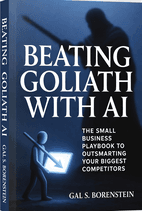
Gal S. Borenstein's BEATING GOLIATH WITH AI provides a practical playbook for small and medium-sized businesses to deploy affordable AI tools for marketing, customer insights, and operational efficiency, turning agility into a competitive advantage.
Feature
Insta.Page
Blinkist
Shortform
Summary Depth
Full Chapter-by-Chapter
15-min overview
Section-by-section guides
Audio Narration
✓
✓
✓
Visual Mindmaps
✓
✕
✕
AI Q&A
✓
✕
✕
Quizzes
✓
✕
✕
PDF Downloads
✓
✕
✓
Price
$89.99/yr
$146/yr (PRO)
$199/yr
*Competitor data last verified July 2026.
1 Page Summary
Gal S. Borenstein's Beating Goliath with AI presents a strategic playbook for small and medium-sized enterprises (SMBs) to leverage artificial intelligence as a great equalizer in an increasingly competitive landscape. The central premise is that the historical barriers of high cost and complexity for advanced technology have crumbled, allowing agile SMBs to deploy AI for customer insights, marketing personalization, and operational efficiency. Borenstein argues that by adopting a "David vs. Goliath" mindset, smaller businesses can use their inherent flexibility to implement targeted AI solutions—such as chatbots, predictive analytics, and automated content creation—faster than larger, bureaucratic rivals, turning data into a decisive strategic asset.
The book is grounded in the contemporary context of the post-2020 digital acceleration, where cloud-based, affordable AI tools have become democratized. Borenstein moves beyond theoretical discussion to provide a practical framework, often structured around core business functions like sales, marketing, and customer service. He emphasizes a methodical approach: identifying precise pain points, selecting the right off-the-shelf or lightly customized AI tools, and focusing on incremental implementation that delivers quick, measurable returns on investment without requiring vast technical teams or budgets.
The lasting impact of the book's thesis lies in its empowerment of small business owners. It demystifies AI, framing it not as a futuristic threat but as an accessible suite of tools for immediate competitive advantage. By providing a clear roadmap, Borenstein aims to shift the narrative from one of disruption and fear to one of opportunity and confidence, enabling SMBs to compete on intelligence and speed rather than just scale. The work serves as a timely manifesto for leveling the playing field in the modern digital economy.
INTRODUCTION
Overview
The introduction serves as both a welcoming handshake and a practical guidebook, immediately acknowledging the reader's limited time and offering a flexible, actionable roadmap. It establishes the book's core philosophy: that progress through small, immediate actions is more valuable than seeking perfection through linear study.
Addressing the Reader's Urgency
The chapter directly speaks to the common anxieties of a small business owner, providing a curated reading list based on their most pressing concern. It segments these concerns into clear personas:
The Overwhelmed Beginner is guided to foundational chapters to build understanding.
The Marketing-Strapped Owner is pointed to sections offering quick social media and reputation wins.
The Task-Drowned Operator is shown where to find systems for automating repetitive work.
The Structured Planner is directed to the step-by-step 90-day blueprint.
This approach reframes the book from a traditional narrative into a tactical toolkit, empowering the reader to start solving problems from page one.
The Philosophy of the Quick Win
A central, unifying theme is introduced: every chapter concludes with a "Quick Win"—a concrete action designed to take fifteen minutes or less. These are framed not as chores, but as immediate proofs of concept. The goal is to build confidence and demonstrate tangible value, reinforcing the message that the effective use of AI is accessible and can yield instant results, no matter where one starts in the book.
Key Takeaways
Non-Linear Design: The book is intentionally structured to be consumed based on your current business pain point, not from front to back.
Action Over Theory: The primary aim is to deliver immediately applicable strategies, with a strong emphasis on starting small.
The Quick Win Principle: Measurable, fifteen-minute actions at the end of each chapter are designed to build momentum and prove value quickly, combating procrastination and overwhelm.
Empathetic Tone: The writing immediately connects with the reader's real-world stresses (being busy, overwhelmed, unsure), establishing a supportive, partner-like relationship.
Key concepts: INTRODUCTION
1. INTRODUCTION
Purpose and Philosophy of the Book
Serves as a welcoming guide and practical roadmap for time-limited readers
Establishes core philosophy: progress through small, immediate actions over perfection through linear study
Reframes the book from traditional narrative into tactical toolkit
Empowers readers to start solving problems immediately from page one
Reader-Centric Approach to Content Navigation
Directly addresses common anxieties of small business owners
Provides curated reading paths based on specific business personas and pain points
Segments readers into four key personas: Overwhelmed Beginner, Marketing-Strapped Owner, Task-Drowned Operator, and Structured Planner
Offers targeted guidance for each persona to relevant chapters and sections
The Quick Win Methodology
Every chapter concludes with a concrete 'Quick Win' action taking 15 minutes or less
Actions are framed as immediate proofs of concept, not chores
Builds confidence and demonstrates tangible value quickly
Reinforces that effective AI use is accessible and yields instant results
Combats procrastination and overwhelm through small, measurable steps
Core Design Principles
Non-linear structure designed for consumption based on business pain points
Emphasis on action over theory with immediately applicable strategies
Supportive, empathetic tone connecting with real-world business stresses
Establishes partner-like relationship between book and reader
💡 Try clicking the AI chat button to ask questions about this book!
CHAPTER 1: THE PANIC PROBLEM
Overview
This chapter opens by exploring the specific anxiety felt by small business owners when confronted with the hype surrounding artificial intelligence. It reframes the conversation away from technical intimidation and toward practical utility, arguing that AI's true value lies in eliminating tedious tasks, not in replacing human judgment or business acumen.
The Source of the Panic
The chapter begins not with theory, but with a relatable story: a late-night voicemail from a frustrated business owner who felt defeated by AI. This moment is presented as emblematic of a widespread "panic problem." The author argues this panic is manufactured, stemming from an industry that sells fear, complexity, and a "disruption" narrative aimed at large corporations with big budgets. This messaging intentionally leaves out small businesses—the bakeries, HVAC companies, and yoga studios—making them feel like they're failing a test they never signed up for.
Resetting Expectations: From Magic Bullet to Trusty Tool
The core of the chapter dismantles common myths to present a more useful truth. It asserts that AI is not coming for your business; it's coming for your busywork. The technology is framed not as a mysterious intelligence, but as a fast, tireless assistant capable of drafting, summarizing, reformatting, and generating ideas. Crucially, the author lists what AI cannot do: replace judgment, understand customers, guarantee success, or care about your reputation. The recommended mental model is to treat AI like an eager intern who types quickly but needs clear direction, training, and oversight.
Practical Application Over Perfection
This theory is brought to life through two case studies. First, Marci, a cheese shop owner, initially found AI's generic, pretentious output useless. Success came only when she shifted her approach: she fed the tool examples of her own writing ("teaching" it her style) and iteratively refined its drafts. Her time spent on product descriptions dropped dramatically. Second, Marcus, a lawyer, overcame fears of errors and impersonality by using AI only for low-risk, repetitive tasks like drafting intake forms, with strict human review before any client saw the work. In both cases, AI removed friction but never replaced the owner's control or judgment.
The Real Failure Point
The chapter concludes that most AI "failures" for small businesses stem from unrealistic expectations, not a lack of technical skill. Owners expect a perfect voice match or deep understanding on the first try, leading to disappointment. The solution is to adopt more realistic expectations: view AI output as a solid first draft that requires refinement, expect to provide clear examples and guidance, and plan for several iterations. The panic subsides when you stop treating AI as a finished product and start treating it as a starting point.
Key Takeaways
The panic is understandable but unnecessary. The intimidating AI narrative is built for enterprises, not entrepreneurs.
AI is a tool for eliminating busywork, not a replacement for strategy or judgment. Think of it as a tireless assistant, not a genius.
Success requires resetting expectations. You will not get perfection on the first prompt. The process involves teaching the tool your style and iterating on its drafts.
Start small, stay in control. Apply AI to repetitive, low-risk tasks first. Always maintain human oversight for quality, accuracy, and brand voice.
You are not the problem. You don't need a technical background or a big budget—you need a simple framework and permission to experiment.
Key concepts: CHAPTER 1: THE PANIC PROBLEM
2. CHAPTER 1: THE PANIC PROBLEM
The Source of the Panic
Panic stems from industry hype selling fear and complexity to large corporations
Small businesses feel excluded and like they're failing a test they never signed up for
The intimidating narrative is manufactured and not designed for entrepreneurs
Resetting Expectations: AI as Tool, Not Magic
AI is coming for your busywork, not your business
Think of AI as a fast, tireless assistant for drafting and formatting
AI cannot replace human judgment, understand customers, or care about reputation
Treat AI like an eager intern who needs clear direction and oversight
Practical Application Through Case Studies
Success requires teaching AI your style with examples of your own work
Apply AI to low-risk, repetitive tasks first with strict human review
AI removes friction but never replaces owner control or judgment
Iterative refinement is essential—output improves with guidance
The Real Failure Point: Unrealistic Expectations
Most failures come from expecting perfection on the first try
View AI output as a solid first draft requiring refinement
Panic subsides when treating AI as a starting point, not a finished product
Success requires clear examples, guidance, and multiple iterations
Core Mindset Shifts for Success
You don't need technical background or big budget—just a simple framework
Start small and maintain human oversight for quality and accuracy
Focus on eliminating tedious tasks rather than replacing strategy
Give yourself permission to experiment without pressure for perfection
CHAPTER 2: H.U.S.T.L.E. FRAMEWORK
Overview
This chapter introduces a structured, practical method for small business owners to implement artificial intelligence without falling into the traps of overwhelm or disappointment. It argues that competing with larger companies isn't about matching their resources, but about leveraging your unique agility and direct customer relationships. The H.U.S.T.L.E. Framework is presented as a six-step "slingshot"—a disciplined plan to use AI effectively at your scale, turning it from a source of panic into a reliable tool for growth.
H — Harness: Understand What AI Can Actually Do
The first step is about setting realistic expectations. AI is not a strategic partner; it's a tactical assistant. It excels at tasks like drafting text, summarizing information, reorganizing content, and creating variations—essentially, it's brilliant at generating usable first drafts. However, it fails at tasks requiring human judgment: owning your strategy, understanding nuanced brand voice, or interpreting values without clear examples. Success begins by respecting these boundaries, using AI for what it's good at and reserving the strategic, final decisions for yourself.
U — Understand: Know Your Audience and Your Voice
Generic, bland AI output is almost always a symptom of insufficient context. AI doesn't know your customers' fears, desires, or the specific language that earns their trust. This step requires you to get crystal clear on your audience and your brand's voice before you write a single prompt. You must answer questions like: Who is this for? What problem does it solve for them? What tone builds trust? When you provide this clarity, AI transforms from a generic content mill into a useful amplifier of your unique perspective.
S — Simplify: Start With One Small Task
Resist the urge to overhaul your entire business at once. The fastest path to failure is attempting to automate everything immediately. Instead, identify one specific, repetitive task that currently consumes your time. Examples include drafting a weekly social media post format, summarizing meeting notes, or generating email subject lines. By starting small with a defined, measurable task, you build confidence through a quick win, creating a solid foundation for sustainable expansion.
T — Test: Try Before You Commit
Treat every new AI application as a controlled experiment, not a permanent policy shift. If you want to use AI for customer service, don't connect it to your entire inbox. Instead, select a handful of common questions, use AI to draft responses, review and edit each one, and then observe the results. This testing phase protects you from costly mistakes and replaces anxiety with evidence, allowing you to ask critical questions about time saved, customer reaction, and quality maintenance.
L — Learn: Measure What Worked (and What Didn't)
The difference between a one-off experiment and a valuable business process is deliberate reflection. This doesn't require complex data dashboards. It simply means keeping a basic log: What did I change? Did it save time? Did quality improve? Would I do it again? Businesses that succeed with AI are those that pay close attention to outcomes and are willing to honestly assess what’s delivering value and what’s merely adding steps.
E — Evolve: Scale What Works. Kill What Doesn't.
The final step is about decisive action based on what you learned. If a workflow genuinely saves time or improves quality, systematically expand it. If it creates friction, confusion, or mediocre results, stop immediately. There’s no obligation to continue using a tool or process that isn’t serving your business. Evolution means having the judgment to invest in what works and the courage to abandon what doesn’t.
A Practical Example
The framework is illustrated through Sarah, who runs a boutique marketing agency. She applied H.U.S.T.L.E. to her weekly client reports: she Harnessed AI for drafting, Understood her clients' need for plain-language metrics, Simplified by starting with one report, Tested the drafts with careful editing, Learned it cut her drafting time from 45 to 15 minutes, and Evolved by scaling the process. This reclaimed 5-6 hours per week, which she used to grow her client base.
Why This Approach Fits Your Reality
This framework was specifically designed for the constraints of a small business owner: limited technical staff, no time for long planning cycles, and zero tolerance for expensive, risky bets. It prioritizes clarity, brand voice, and quick, iterative results over technical complexity.
Key Takeaways
AI is a tool, not a strategist. Its core strength is in execution and drafting, not in making high-level decisions for your business.
Context is everything. AI output is only as good as the guidance you provide about your audience and brand voice.
Start impossibly small. Begin with one, well-defined task to build confidence and prove value before expanding.
Adopt an experimental mindset. Test, measure, and learn from every application before making it a permanent workflow.
You are the final authority. Success requires your ongoing judgment to review, edit, and decide what to scale or stop. "Smart" use of AI is about high judgment, not high tech.
Key concepts: CHAPTER 2: H.U.S.T.L.E. FRAMEWORK
3. CHAPTER 2: H.U.S.T.L.E. FRAMEWORK
H — Harness: Understand What AI Can Actually Do
AI is a tactical assistant, not a strategic partner
Excels at generating first drafts, summarizing, and reorganizing content
Fails at tasks requiring human judgment, strategy, or nuanced brand voice
Success comes from respecting AI's boundaries and reserving final decisions for yourself
U — Understand: Know Your Audience and Your Voice
Generic AI output results from insufficient context about your audience
You must clarify your audience's fears, desires, and trust-building language first
AI transforms from generic content mill to amplifier of your unique perspective with proper guidance
Essential questions: Who is this for? What problem does it solve? What tone builds trust?
S — Simplify: Start With One Small Task
Resist overhauling your entire business at once
Identify one specific, repetitive task that consumes your time
Examples: drafting social media posts, summarizing notes, generating email subject lines
Build confidence through quick wins to create foundation for sustainable expansion
T — Test: Try Before You Commit
Treat every AI application as a controlled experiment, not permanent policy
Test with limited scope before full implementation (e.g., select customer questions)
Review and edit AI outputs before observing results
Protects from costly mistakes and replaces anxiety with evidence
L — Learn: Measure What Worked (and What Didn't)
Deliberate reflection turns experiments into valuable business processes
Keep basic log: What changed? Time saved? Quality improved? Would I do it again?
No complex dashboards needed—just honest assessment of outcomes
Successful businesses pay close attention to what delivers value versus what adds steps
E — Evolve: Scale What Works. Kill What Doesn't.
Take decisive action based on learning from experiments
Systematically expand workflows that save time or improve quality
Immediately stop processes that create friction, confusion, or mediocre results
Evolution requires judgment to invest in what works and courage to abandon what doesn't
Designed for small business constraints: limited staff, no time for long planning, zero tolerance for risky bets
Prioritizes clarity, brand voice, and quick iterative results over technical complexity
Turns AI from source of panic into reliable tool for growth through disciplined implementation
CHAPTER 3: MINDSET RESET
Overview
This chapter challenges the notion that technical skill is the primary hurdle for using AI in business. Instead, it identifies the real barrier as self-permission—the freedom to experiment, make mistakes, and start small. Through relatable stories and practical advice, it guides you to shift your mindset from doubt to curiosity, emphasizing that your existing business knowledge is your greatest asset when leveraging AI.
The Perfectionism Trap in Action
Many business owners, like Jake from the graphic design studio, freeze up because they fear AI will compromise quality. The breakthrough comes when they reframe AI as a rough-draft engine, not a replacement for their expertise. By using AI to handle repetitive drafting—such as client proposals or case studies—they save significant time while maintaining control over the final output. This approach reduces tasks from hours to minutes without sacrificing the personal touch that clients value.
Transforming Mistakes into Feedback
A common pitfall is viewing poor AI outputs as personal failure. A healthier perspective sees them as valuable feedback on your instructions, examples, or the task's suitability. For instance, if an AI-generated draft misses the mark, it’s not a sign you’re bad at technology; it’s a cue to refine your prompt or reconsider the application. This mindset treats AI like any other tool in your arsenal, where trial and error lead to mastery.
Debunking the Technical Skill Myth
The belief that AI requires coding or deep technical knowledge is a myth that often masks fear. Tools like ChatGPT operate on simple text-based interfaces—you type, and they respond. What truly matters are your business skills: understanding your goals, audience, and standards for quality. When you say, “I am not technical,” you might really be admitting that the newness feels awkward, but that discomfort is temporary and surmountable.
Strategies for Solo Entrepreneurs
If you’re a team of one, AI adoption doesn’t need complex systems. Focus on lean, focused experiments: batch weekly one-hour tests, use voice-to-text for documentation, and rely on templates. The key is momentum through small, consistent actions rather than waiting for resources you don’t have. Your agility becomes an advantage, allowing you to integrate AI without overhead.
The Power of Starting Small
Ambition can backfire when owners try to automate entire processes overnight. Success comes from embarrassingly small steps, like generating email subject lines or rewriting a single product description. These minor wins build confidence and create a ripple effect. Priya’s wellness studio example illustrates this: by starting with three Instagram captions, she gradually built a sustainable social media system that felt manageable and effective.
Knowing When to Step Back
Not every AI experiment will yield value, and that’s okay. Permission to quit—such as abandoning AI for summarizing client calls when it misses emotional nuance—is crucial. The goal isn’t to force AI into every task but to identify where it clearly saves time or enhances quality. This selective approach prevents burnout and ensures you invest energy where it counts.
Essential Human Checkpoints
Some areas always require human judgment, regardless of AI’s capabilities. These include legal documents, content about specific people, financial claims, crisis communications, final brand voice approval, and health or safety information. AI can draft confidently but inaccurately, so a final human review is non-negotiable to protect your reputation and relationships.
Cultivating a New Mindset
By the end of this chapter, the shift is clear: move from needing perfect understanding to embracing iterative learning. Replace “I cannot do this” with “Let’s see what happens if I try.” Your business acumen—not technical prowess—becomes the driving force, enabling you to leverage AI as a precision tool against larger competitors.
Key Takeaways
The biggest barrier to AI is often self-permission, not technical skill.
View AI as a draft-generating tool, not a replacement for your judgment.
Treat disappointing AI outputs as feedback to refine your approach.
You don’t need technical expertise; your business knowledge is sufficient.
Start with small, manageable experiments to build confidence and momentum.
It’s okay to abandon AI for tasks where it doesn’t add value.
Always apply human review to high-stakes content to ensure accuracy and tone.
Embrace a mindset of curiosity and iteration over perfectionism.
Key concepts: CHAPTER 3: MINDSET RESET
4. CHAPTER 3: MINDSET RESET
The Core Barrier: Self-Permission vs. Technical Skill
The primary hurdle for AI adoption is not technical skill but the freedom to experiment and start small.
Business owners often freeze due to fear of compromising quality or making mistakes.
Your existing business knowledge is your greatest asset when leveraging AI tools.
Reframing AI as a Tool, Not a Replacement
View AI as a rough-draft engine that handles repetitive tasks, not a substitute for expertise.
Use AI for drafting (e.g., proposals, case studies) to save time while maintaining control over final output.
Maintain the personal touch clients value by using AI for initial drafts only.
Transforming Mistakes into Learning Opportunities
Treat poor AI outputs as feedback on instructions or task suitability, not personal failure.
Refine prompts or reconsider applications when AI misses the mark.
Approach AI with trial-and-error mindset similar to mastering any business tool.
Debunking the Technical Expertise Myth
AI tools like ChatGPT require no coding—just simple text-based interaction.
What matters most are business skills: understanding goals, audience, and quality standards.
Discomfort with new technology is temporary and surmountable.
Practical Strategies for Solo Entrepreneurs
Focus on lean experiments rather than complex systems.
Batch weekly one-hour tests and use voice-to-text for documentation.
Leverage templates and maintain momentum through small, consistent actions.
The Power of Starting Small
Begin with embarrassingly small steps like email subject lines or single product descriptions.
Minor wins build confidence and create ripple effects for broader adoption.
Example: Starting with three Instagram captions led to sustainable social media system.
Knowing When to Step Back
Permission to quit unsuccessful AI applications is crucial.
Don't force AI into tasks where it doesn't add clear value (e.g., summarizing emotional client calls).
Selective approach prevents burnout and focuses energy where AI truly helps.
Essential Human Checkpoints
Always apply human judgment to legal documents, financial claims, and crisis communications.
Review content about specific people, health/safety information, and final brand voice.
Human review is non-negotiable to protect reputation and relationships.
Cultivating the New Mindset
Shift from needing perfect understanding to embracing iterative learning.
Replace "I cannot do this" with "Let's see what happens if I try."
Leverage business acumen as driving force, using AI as precision tool against competitors.
You've reached the end of the free chapters
Next chapter: “SOCIAL MEDIA WITHOUT THE BURNOUT” is locked
Keep reading BEATING GOLIATH WITH AI — and unlock all 600+ book summaries with audio, mindmaps and AI Q&A.
$0.00 due today · 7 days free, then $89.99/year ($7.49/mo) · Cancel anytime before day 7
Gal S. Borenstein is a strategic communications expert and author known for his work on business reputation and crisis management. His notable book, *The Case for Corporate Character*, explores how companies can build trust and resilience. His expertise is drawn from a background as a CEO and advisor to global corporations and government agencies.
📚 Explore Our Book Summary Library
Discover more insightful book summaries from our collection