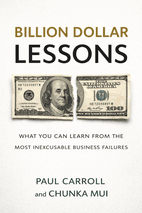
Paul B. Carroll's Billion Dollar Lessons identifies seven catastrophic strategic patterns that cause corporate failures, based on an analysis of over 2,500 cases. It provides a framework for managers and executives to recognize these danger zones and implement safeguards like devil's advocate reviews to avoid costly errors.
Feature
Insta.Page
Blinkist
Shortform
Summary Depth
Full Chapter-by-Chapter
15-min overview
Section-by-section guides
Audio Narration
✓
✓
✓
Visual Mindmaps
✓
✕
✕
AI Q&A
✓
✕
✕
Quizzes
✓
✕
✕
PDF Downloads
✓
✕
✓
Price
$89.99/yr
$146/yr (PRO)
$199/yr
*Competitor data last verified July 2026.
1 Page Summary
Based on an analysis of over 2,500 major corporate failures, 'Billion Dollar Lessons' argues that businesses waste trillions by repeating the same catastrophic strategic errors, not due to poor execution, but because of fundamentally flawed strategies. The book identifies seven high-risk strategic "danger zones" where failures consistently cluster, including the overestimated promise of Synergy, the slippery slope of Financial Engineering, the stubbornness of Staying the Course, and the misguided logic of Adjacencies. The authors contend that to avoid these expensive mistakes, companies must adopt rigorous after-action analysis, learning from failures as industries like aviation and medicine do.
What makes this book distinctive is its forensic, pattern-based approach to business failure, moving beyond anecdotal case studies to systematic analysis. It reveals that deep-seated psychological biases and organizational dynamics—such as confirmation bias, groupthink, and pressures from Wall Street—consistently suppress the dissent needed to spot fatal flaws. To counter this, the authors provide a pragmatic framework for building resilient systems, advocating for tools like a Pre-Mortem mindset, institutionalized dissent through a formal Devil's Advocate review, and a blameless culture that learns from setbacks.
The book is aimed at managers, executives, and board members who seek to improve strategic decision-making and avoid costly blunders. Readers will gain a clear understanding of the most common strategic pitfalls, the cognitive and corporate forces that enable them, and practical, actionable safeguards to integrate into their planning and review processes. The goal is to help leaders learn from the "bad judgment of otherwise talented executives" without having to pay the "tuition" of their own multi-billion dollar mistakes.
Introduction
Overview
The chapter opens with a story about IBM's Tom Watson Jr., who saw a costly error as tuition for a vital lesson. This highlights a central problem: businesses waste billions on failures but rarely learn from them, so the same strategic disasters happen again. The authors suggest borrowing a practice from aviation and medicine: rigorous after-action analysis to learn from expensive mistakes.
To understand the problem, they built a database of over 2,500 major corporate failures. The scale is staggering—hundreds of bankruptcies and write-offs representing trillions in assets. Their research revealed a crucial insight: the root cause of many big failures isn't poor execution, but flawed strategy. Once a bad strategy is set, even perfect execution can't save it.
Their analysis found seven strategic patterns where failures consistently cluster. These are high-risk danger zones that demand extreme caution: the overestimated promise of Synergy, the slippery slope of Financial Engineering, the operational nightmares of Rollups, the stubbornness of Staying the Course, the misguided logic of Adjacencies, the miscalibrated bet of Riding Technology, and the poorly timed gambit of Consolidation.
But knowing the risks isn't enough. Deep-seated psychological and organizational biases often suppress the critical dissent needed to spot fatal flaws. The solution is to build systems that force hard questions, like a formal Devil's Advocate review, to act as a form of failure insurance.
The final point is a direct challenge. The goal isn't to eliminate all error, which is impossible, but to stop making the same old mistakes. There's no honor in repeating well-documented blunders. Leaders must innovate in failure—to venture into new territory and find new, instructive mistakes to make. True progress requires learning from history so the organization can move forward, not in circles.
Key Takeaways
The biggest corporate failures are usually caused by flawed strategy, not poor execution.
Seven strategic patterns, or "danger zones," account for most major business disasters.
Organizational biases often silence the dissent needed to spot fatal strategic flaws.
Companies need formal systems, like a Devil's Advocate review, to force critical questioning.
The goal is not to avoid all failure, but to stop repeating old mistakes and learn from new ones.
Key concepts: Introduction
1. Introduction
The Core Problem: Failure to Learn
Businesses waste billions but rarely learn from failures
Same strategic disasters happen repeatedly
Need rigorous after-action analysis like aviation/medicine
Research Findings on Corporate Failure
Database of 2,500+ major corporate failures analyzed
Root cause is often flawed strategy, not poor execution
Bad strategy dooms even perfect execution
Seven Strategic Danger Zones
Synergy: Overestimated promise
Financial Engineering: Slippery slope
Adjacencies: Misguided logic
Staying the Course: Stubbornness
Organizational Barriers to Learning
Psychological biases suppress critical dissent
Need formal Devil's Advocate review systems
Failure insurance through forced questioning
The Goal: Innovate in Failure
Not eliminating all error (impossible)
Stop repeating old, documented mistakes
Make new, instructive mistakes and learn
💡 Try clicking the AI chat button to ask questions about this book!
ONE - Illusions of Synergy
Overview
Imagine a corporate world where the allure of the perfect merger is as stubbornly romantic as a Hollywood star convinced this union will be the one. Despite overwhelming evidence that most mergers fail to deliver their promised synergies, executives remain undeterred. Research paints a bleak picture: the majority of mergers miss their revenue targets, and even expected cost savings often vanish. The dream of combined value, however, remains irresistible, promising legacy-defining leaps rather than incremental gains.
This pattern is vividly illustrated by the disastrous merger of Unum and Provident. On paper, combining leaders in group and individual disability insurance seemed a masterpiece of strategic logic, promising cross-selling and efficiency. In reality, it was a swift collapse. Incompatible systems, clashing sales cultures, and customers who rejected the new bundled approach created chaos. A desperate push for profit led to scandalous claims-denial practices, massive fines, and a 90% stock plunge. Ultimately, the merger had to be painfully unwound.
The UnumProvident saga crystallizes the core reasons why these synergy strategies so often fail. First, customers don't care about the synergies; the benefits imagined by strategists often hold no value for them. Second, the excitement over hypothetical gains leads to overpayment, with acquirers bidding a premium for assets that never deliver. Third, plans are derailed by integration catastrophes, where cultural friction and operational incompatibilities make seamless combination impossible.
Given this track record, any pursuit of synergy demands rigorous, even pessimistic, evaluation. For cost synergies, one must account for shifting expenses and the real cost of overcoming employee resistance. For revenue synergies, skepticism is paramount: can this be achieved through a simple partnership instead of a full acquisition? Will customers actually change their behavior? Companies must discount projected benefits heavily and set a firm price limit based on a severely discounted valuation. The discipline lies in walking away when the math, stripped of optimism, doesn't justify the gamble.
The Persistent Allure of Failed Synergies
The chapter compares executives pursuing mergers for synergy to someone entering a new marriage—convinced this time will be different, despite all prior evidence. Data underscores this stubborn optimism: while most executives acknowledge the high historical failure rate of M&A, almost none are deterred from future deals.
Studies Reveal a Systematic Problem
Research consistently exposes the gap between synergy promises and reality. Studies show only a minority of mergers achieve their predicted revenue synergies, and even cost synergies are often missed, sometimes by vast margins. The root cause is that most companies fail to do the detailed pre-acquisition work needed to test if theoretical synergies are practically achievable, often overlooking critical factors like competitor responses and technological integration.
The Seduction and the Stakes
Synergies remain seductive because they promise dramatic, legacy-defining gains. They appeal to a CEO’s desire to make a "bold move" beyond mere operational improvement. This narrative of allure shifts to a dominant pattern of failure, epitomized by the disastrous merger of Unum and Provident.
A Case Study in Synergy Failure: UnumProvident
The 1999 merger between Unum (group disability) and Provident (individual disability) was hailed as a masterpiece of strategic logic. The combined entity promised a full spectrum of coverage, with synergies in cross-selling, innovation, and cost savings.
The Rapid Unraveling
The collapse was swift. A massive unexpected charge related to legacy problems and merger costs destroyed the CEO's credibility. Integration became a nightmare. The plan to create hyper-efficient, specialized departments crashed against the reality of nine disparate divisions. Dozens of incompatible information systems stifled efficiency.
Cultural and Operational Friction
The anticipated synergies proved illusory:
Sales forces did not cooperate, as specialists and generalists had completely different skills and cultures.
Customers resisted cross-selling and rejected price increases, fleeing to competitors.
The businesses were fundamentally different in their core operations.
A Descent into Scandal
In a desperate bid for profit, UnumProvident aggressively applied Provident’s claims-management techniques across the board. This spawned thousands of lawsuits and a regulatory scandal. The company was accused of setting denial quotas and holding "roundtables" to create claim "hit lists." Major exposés, a large fine, and court opinions citing practices "border[ing] on outright fraud" decimated its reputation.
The Aftermath
By 2003, the stock had fallen 90%. A new CEO effectively dismantled the merger, taking a billion-dollar write-off and dropping "Provident" from the name. While the company eventually returned to profitability, its stock price remained a fraction of its pre-merger value.
Why Synergy Strategies Fail: Emerging Red Flags
The UnumProvident story crystallizes three critical reasons synergy strategies fail:
Customers Don't Care About the Synergies. Strategists often imagine customer benefits that customers themselves do not value. UnumProvident’s cross-selling benefits were for the company, not the client.
Overpayment. Excitement over hypothetical synergies leads companies to pay premium prices for assets that never deliver the expected value.
Integration Catastrophes. The assumption that 1+1=3 ignores how clashes in culture, skills, and systems can make synergy impossible.
Historical Precedents of Customer Misreading
This misunderstanding is a recurring error. United Airlines' 1970s acquisition of Hertz and Westin believed travelers wanted one-stop trip planning, but customers valued choice and price. Sears' purchase of Dean Witter and Coldwell Banker assumed customers wanted "financial tools" where they bought power tools, a synergy that never materialized.
Overpaying in Pursuit of Synergy
A well-documented trap is overpaying when synergies are envisioned. In competitive bidding, potential synergies inflate the price. Unum paid a premium for Provident despite warnings about its aggressive claims denial. Quaker Oats paid $1.7 billion for Snapple, convinced it could leverage distribution networks, but ignored Snapple's quirky, relationship-driven system. Quaker sold Snapple for a $1.4 billion loss just three years later. Even without a direct overpayment, synergy strategies can incur excessive opportunity costs, as companies focus on integration and miss other critical problems.
The Challenge of Integration
Often, the anticipated collaboration simply doesn't materialize due to ingrained cultures or operational mismatches. At UnumProvident, sales teams had no reason to work together. The AOL Time Warner merger collapsed because Time Warner's established divisions saw no need to partner with AOL, resisting combined efforts. Safelite Glass found it couldn't transfer its efficient processes to an acquired company that relied on independent shops. IBM's attempt to inject entrepreneurial spirit by buying software startups backfired; the small companies were smothered by bureaucracy.
Rigorous Evaluation of Synergies
Given these failures, any synergy strategy must be subjected to severe, realistic questioning.
For cost synergies, anticipate that some costs will simply shift or persist, and recognize that employees may resist changes. The expenses of overcoming this resistance must be subtracted from expected benefits.
For revenue synergies, skepticism is even more critical. Ask: Can this be achieved through a partnership rather than an acquisition? Test assumptions about customer behavior; don't assume they will embrace new bundled services. Consider what competitors might do during a disruptive integration.
Furthermore, quantify the risks. Since studies show most revenue synergies fail to materialize, and cost synergies are often overestimated, projected benefits must be heavily discounted. Calculate three values: the target's stand-alone worth, its value with full synergies, and, most importantly, its value with synergies discounted for likely failure. Set a firm price limit based on this discounted estimate. Scrutinize the acquisition for hidden problems. If the margin for error is slim, the strategy should be abandoned.
Key Takeaways
The promise of synergy frequently leads to overpayment for acquisitions, as emotional bidding overlooks target flaws and integration costs.
Cultural resistance and operational incompatibilities often prevent merged entities from collaborating, making theoretical synergies unattainable in practice.
A disciplined evaluation must discount projected synergy benefits significantly, account for implementation costs and customer pushback, and prefer partnerships over acquisitions where possible.
Setting a strict acquisition price based on pessimistic, reality-tested synergy estimates is crucial to avoiding catastrophic losses.
Key concepts: ONE - Illusions of Synergy
2. ONE - Illusions of Synergy
The Persistent Allure of Synergies
Executives pursue mergers despite high failure rates
Synergies promise legacy-defining leaps over incremental gains
Research shows most mergers miss revenue and cost targets
UnumProvident Case Study
Merger hailed as strategic masterpiece but collapsed swiftly
Incompatible systems and clashing sales cultures created chaos
Desperate profit push led to scandal, fines, and 90% stock plunge
Why Synergy Strategies Fail
Customers don't value the imagined synergies
Overpayment for assets that never deliver expected value
Integration catastrophes from cultural and operational friction
Cost Synergy Challenges
Must account for shifting expenses and employee resistance
Real integration costs often exceed projected savings
Requires rigorous, pessimistic evaluation before acquisition
Revenue Synergy Skepticism
Question if partnership could achieve same results
Customers often resist changing their behavior
Must heavily discount projected benefits in valuation
Required Evaluation Discipline
Set firm price limits based on severely discounted valuation
Walk away when math doesn't justify the gamble
Test if theoretical synergies are practically achievable
Overlook competitor responses and technological integration
Excitement over hypothetical gains overrides rational analysis
TWO - Faulty Financial Engineering
Overview
Financial engineering was supposed to manage risk, but it often leads to disaster. The story starts with Green Tree Financial Corporation, which set the stage for the subprime mortgage crisis. Green Tree made 30-year mortgages for trailer homes that lose value quickly. Its huge growth came from securitization and "gain-on-sale" accounting. This let Green Tree book all its expected future loan profits right away. That created a feedback loop: high reported profits demanded more and more risky lending. Everyone from dealers to executives had an incentive to push volume over quality, thinking "I'll be gone, you'll be gone." The model collapsed when interest rates fell and defaults soared, forcing huge write-offs. Then insurer Conseco bought Green Tree at a high price, ignoring the obvious problems. Conseco tried to expand the same broken model, which led to one of the largest bankruptcies in U.S. history.
This pattern of faulty financial engineering repeats. Heilig-Meyers collapsed when it strayed from its core strategy and lent to risky customers. The leveraged buyout of Revco Drug Stores failed because it used too much debt based on unrealistic hopes. These cases show that creative accounting, even if legal, hides true financial health. Amerco, U-Haul's parent, went bankrupt after it was forced to put hidden debt back on its books. And Tyco International fell into a vicious cycle of buying companies, using aggressive accounting to make each deal look good, which then demanded even more growth until the whole scheme fell apart.
The results of these failures—bankruptcy, ruin, jail—show we need a better approach. We must shift from asking "Is this legal?" to "Is this reasonable and ethical if everyone knew about it?" Today, any strategy must hold up under public scrutiny. It also must survive not just everyday problems, but extreme, rare events—the "hundred-year flood." As Warren Buffett warns, even a 1% chance of catastrophe is too high. So, any complex financial strategy must pass three tests: it must produce real cash flow, not just paper profits; it must make basic common sense; and there must be a clear exit strategy to get off the treadmill of ever-more aggressive engineering.
The Perils of Financial Alchemy
Financial engineering turned from a tool into a trap. The prime example is Green Tree Financial Corporation.
Green Tree's Addictive Business Model
Green Tree made 30-year mortgages for trailer homes. This had a fatal flaw: trailers lose value fast, so borrowers soon owed more than their home was worth, making defaults likely.
The Engine of Illusory Profits
Two things fueled Green Tree's growth:
Securitization: It bundled loans and sold them as bonds, getting fresh cash to make more loans.
"Gain-on-Sale" Accounting: It booked all the estimated future profit from a loan pool immediately. Profits came from optimistic guesses, not real results.
Toxic Incentives and Systemic Collapse
This setup created a feedback loop with bad incentives. People operated with an "I'll be gone, you'll be gone" mindset. The system broke when interest rates fell, triggering refinancing and a wave of defaults, forcing huge write-offs.
The Conseco Catastrophe
Insurer Conseco bought the struggling Green Tree at a high price. It ignored the warnings and made even riskier loans. The result was the loss of nearly all profits Green Tree had ever claimed and a massive bankruptcy.
The Flawed Financing Pattern
The Green Tree story shows clear warning signs:
Flawed Products: Products that work in the short-term but carry huge long-term risk.
Too Much Debt & Over-Optimism: Relying on heavy borrowing and unrealistic forecasts.
Aggressive Accounting: Using accounting that can't last.
Self-Reinforcing Loops: Systems that reward more bad behavior to keep up appearances.
We see this same pattern at Spiegel, which lent to risky customers to hide its failing retail business, leading to bankruptcy.
Heilig-Meyers: The Credit Engine Backfires
Heilig-Meyers fell apart after it ran out of room to grow in its reliable markets. It made two fatal mistakes: moving into big cities it didn't know and lending to even riskier customers. At the same time, personal bankruptcy laws eased, causing a jump in defaults. Buried in debt, the company went bankrupt in 2000.
The Perils of Excessive Leverage
Debt magnifies both gains and losses. The 1986 buyout of Revco Drug Stores shows this. The deal used extremely optimistic numbers to justify the price. Reality set in fast as Revco missed its targets. Crushed by debt payments, it ran out of cash and filed for bankruptcy just nineteen months later.
When Accounting Becomes Too Clever
Clever accounting can distort the truth. Amerco, U-Haul's parent, learned this the hard way. On its auditor's advice, it used off-balance-sheet entities to hide debt. Years later, the auditor changed its mind, forcing Amerco to put the debt back on its books. Lenders cut its credit, leading to default and bankruptcy in 2003.
Self-Reinforcing Feedback Loops
Financial engineering often creates a cycle that's hard to stop.
Green Tree’s Loop: Booking huge upfront profits drove its stock price up, which demanded more growth, requiring riskier lending until it collapsed.
Tyco’s Acquisition Addiction: Tyco grew by constantly buying companies, using aggressive accounting to make each deal instantly profitable. This created a hunger for more deals. The cycle ended when its accounting was investigated, and its stock crashed.
Tough Questions for Resilience
To avoid these traps, ask two basic questions:
Can the strategy withstand sunshine? How would it look if the public knew all the details?
Can the strategy withstand storms? Can it survive a major, unexpected crisis?
Changing the Yardstick: From Legal Compliance to Ethical Scrutiny
We need to change how we judge business practices. The main question should not just be "Is this legal?" but "Is this reasonable and ethical if everyone saw it?" Today, any plan must survive public scrutiny.
Anticipating the "Hundred-Year Flood"
Strong strategies must survive extreme, rare events. Many engineering failures happen because designers didn't plan for an outside shock. Green Tree didn't expect falling interest rates. Revco's designers didn't foresee losing market share in a recession. Planners must test their designs under worst-case conditions.
This echoes Warren Buffett’s rule: even a 1% chance of disaster is unacceptable, no matter the potential reward.
Three Critical Questions for Any Strategy
Finally, ask these three practical questions about any complex financial strategy:
The Cash Flow Reality Check: Will this create real cash, or just make the profits look good on paper?
The Common Sense Test: Does the basic idea make sense? For example, does a 30-year loan on an asset that lasts 15 years make sense?
The Exit Strategy Question: How does it end? If a strategy needs ever more aggressive moves to keep going, how do you get off that treadmill? Not having an answer is a major warning sign.
Key Takeaways
Judge decisions by ethics and public scrutiny, not just legality.
A good strategy must survive extreme, unlikely events.
Warren Buffett advises against any strategy with even a small chance of catastrophe.
Any financial strategy must pass three filters: real cash flow, common sense, and a clear end point.
Key concepts: TWO - Faulty Financial Engineering
3. TWO - Faulty Financial Engineering
Green Tree Financial Case Study
Made 30-year mortgages on depreciating trailer homes
Used securitization and gain-on-sale accounting
Created a feedback loop demanding risky lending
Collapsed when defaults soared and write-offs hit
Consequences of Faulty Engineering
Leads to systemic collapse and bankruptcy
Destroys value and ruins companies
Results from legal but unreasonable practices
Common Failure Patterns
Flawed products with hidden long-term risk
Excessive debt based on over-optimism
Aggressive accounting that cannot last
Self-reinforcing loops of bad behavior
Other Corporate Examples
Heilig-Meyers: Lending to risky customers backfired
Revco: Leveraged buyout failed from unrealistic forecasts
"I'll be gone, you'll be gone" short-term thinking
Volume prioritized over quality
Everyone from dealers to executives compromised
Essential Resilience Tests
Must produce real cash flow, not paper profits
Must make basic common sense
Requires clear exit strategy from aggressive cycles
Needed Mindset Shift
From "Is this legal?" to "Is this reasonable?"
Must withstand public scrutiny
Must survive extreme "hundred-year flood" events
THREE - Deflated Rollups
Overview
The idea behind rollups sounds deceptively simple: bundle together lots of small businesses to create a powerful, efficient giant. The promise is one of immense advantage—purchasing power, lower capital costs, and streamlined operations. Yet the brutal truth is that most rollups fail, often spectacularly, with studies showing over two-thirds destroy value. This failure isn't accidental; it's baked into the model's misaligned incentives, where executives can profit from the deal-making frenzy while long-term investors are left holding the bag when the music stops.
The cautionary tale of the Loewen Group, a funeral home empire, lays bare the mechanics of this failure. It grew rapidly by buying family-owned homes, fueled by a cycle of using its rising stock price to fund more acquisitions. But beneath the impressive growth, it generated no meaningful national efficiencies. Its profits relied on aggressive price hikes and manipulative sales tactics, which eventually sparked a consumer backlash and a catastrophic lawsuit. Burdened by debt and a clumsy patchwork of over 1,300 entities, it collapsed into bankruptcy, a stark lesson in how rollups often amass disconnected parts rather than building a superior whole.
This story exemplifies broader patterns of broken promises. The anticipated back-office synergies often vanish in the face of operational complexity. In some cases, scale backfires, creating diseconomies of scale, where a company becomes too bloated and slow to compete. The assumed pricing and purchasing power frequently proves illusory in fragmented markets, and the hope for a permanently lower cost of capital can evaporate with a single debt downgrade.
Underpinning these flaws is a tyranny of growth that makes integration impossible. To feed investor expectations, rollups chase hypergrowth, buying companies at a breakneck pace. Management becomes entirely focused on the next deal, leaving no time for the hard work of merging operations. This haste leads to poor due diligence, management overload, inflated acquisition prices, and an inescapable momentum where stopping the acquisition train would crash the stock price.
A central, unresolved tension is the integration trade-off. Strategists dream of centralizing for efficiency while keeping all the local charm that customers love. But in reality, you can't have both. Centralizing back-office functions risks alienating customers, while decentralizing sacrifices the very economies of scale that justified the rollup. Competitors eagerly exploit this confusion.
Therefore, any executive or investor considering a rollup must begin with the assumption that it will fail, and then rigorously stress-test the strategy with tough questions. Success requires not optimism, but brutal, pre-emptive honesty about every point of potential failure.
The Alluring Yet Perilous Promise of Rollups
At their core, rollups are built on a compelling premise: combining many small, fragmented businesses into one large entity should create something greater. The theory promises significant advantages—increased purchasing power, lower capital costs, and efficient spreading of corporate overhead.
However, the stark reality is that most rollups fail to deliver value. Research indicates over two-thirds are unsuccessful. The rare successes are overshadowed by far more frequent disasters.
A critical insight is the misalignment of incentives. Executives can profit handsomely from orchestrating rollups and cashing out early, while long-term investors often bear the losses when the unsustainable growth model unravels.
A Cautionary Tale: The Rise and Fall of Loewen Group
The story of Loewen Group Inc., a Canadian funeral home rollup, perfectly illustrates the strategic flaws. It grew from a single home into an empire through rapid acquisition.
Fueled by its IPO, Loewen embarked on an acquisition treadmill. The cycle was simple: use rising stock to buy more homes, which boosted earnings and justified a higher stock price, enabling more purchases.
Beneath the impressive growth, however, lay fundamental weaknesses. Loewen could not generate meaningful operational efficiencies on a national scale. Its primary tactic, regional "clustering" of homes, offered only modest benefits.
Instead, Loewen's profitability relied heavily on two unsustainable practices: drastic price increases and psychologically manipulative sales tactics. This sparked a consumer backlash and made the company a target for litigation.
The Lawsuit That Exposed the Cracks
A business dispute in Biloxi, Mississippi, escalated into a catastrophic legal battle. Competitor Jeremiah O’Keefe sued Loewen over a broken deal. At trial, the case was framed as a patriotic struggle against a foreign corporate Goliath.
The result was a staggering $500 million jury verdict against Loewen. Forced to settle for $240 million, the company was severely wounded. Yet, driven by relentless expansion, it continued its acquisition spree, rejecting a lucrative buyout offer.
The Inevitable Collapse
The fall was swift. A slight decline in the death rate in 1997 exposed Loewen's lack of organic growth. The company’s structure—a poorly integrated patchwork of over 1,300 corporate entities—was too clumsy to adapt. Burdened by $2.3 billion in debt, even a minor dip in cash flow proved fatal.
Loewen Group filed for bankruptcy in 1999 and was eventually acquired by a rival. The rollup had not built a better orchestra; it had merely amassed a disconnected collection of rock bands.
The Illusion of Back-Office Synergies
A common justification for rollups was the promise of massive back-office savings. Reality proved far messier. At Loewen Group, each funeral home operated almost as a stand-alone business, with efficiencies only appearing in small local clusters, not across the empire.
The anticipated administrative savings often vanished upon contact with operational complexity and resistance to new corporate procedures.
When Scale Creates Diseconomies
In some cases, rollups didn't just miss promised efficiencies; they actively created inefficiencies, or diseconomies of scale. Solectron Corporation’s aggressive expansion in contract manufacturing made it less nimble in a fast-paced industry. Its global supply chain became a bloated, complex burden.
Similarly, Northwestern Corporation’s foray into telecom and HVAC—areas it knew nothing about—led to a billing system catastrophe that left it unable to generate accurate invoices for months.
The Fallacy of Purchasing & Pricing Power
Rollups often claimed greater size would yield bargaining power. This assumption was frequently flawed. Loewen never exceeded 5% of the North American funeral market, leaving its purchasing power negligible.
Pricing power also proved elusive. When Maxicare Health Plans, the nation’s largest for-profit HMO, tried to push through sharp price increases, customers departed en masse. Loewen’s attempt to raise prices sparked a backlash and costly litigation.
Capital Costs and Strategic Overreach
The assumption that a larger entity would enjoy a permanently lower cost of capital was another dangerous myth. Maxicare saw its debt downgraded mid-spree, eliminating that advantage. Companies compounded problems by rolling up related—but not closely related—markets without sufficient expertise, leading to massive losses from overpayment.
The Tyranny of Growth at Any Cost
Rollup strategies created an environment inherently hostile to integration. To captivate investors, these companies often pursued growth rates of 100% to 1,000% annually. This relentless focus on the next deal meant senior management spent little time on operational integration. Profitability took a backseat to revenue growth.
Integration Lost in the Frenzy
The unsustainable pace meant some companies never seriously attempted integration. Tyco spent $63 billion on over a thousand acquisitions but maintained a tiny corporate staff. There was no deep integration. This lack of execution ultimately led to massive losses.
The Consequences of Haste
The breakneck speed led to critical errors:
Inadequate Due Diligence: Companies bought assets with hidden problems that nearly bankrupted them.
Management Overload: Managerial skill doesn't scale instantly. A manager capable of running a 1,000-person operation cannot immediately run a 5,000-person one.
Inflated Acquisition Prices: Public rollup ambitions signaled deep pockets to sellers, driving up prices to unsustainable levels.
The Inescapable Momentum: Once a rollup promised Wall Street hypergrowth, stopping was not an option. Even a prudent pause for integration would crater the stock.
The Inherent Fragility of the Model
Rollups are fundamentally precarious financial structures. Whether funded by debt or stock, they are acutely sensitive to small disruptions. A minor decline in the death rate unraveled Loewen. A 30% drop in asset values pushed another firm into bankruptcy. This underscores that rollups are vulnerable to broader economic shifts, not just industry-specific problems.
The Centralization Dilemma
A critical operational tension is the trade-off between centralizing for efficiency and decentralizing to preserve revenue. Theoretically, centralizing back-office functions is essential for achieving economies of scale. However, in practice, it can alienate customers attached to local service. Competitors actively exploit this transition.
Strategists often fall into the trap of assuming they can have it all—full efficiency gains with zero customer loss. Loewen’s experience serves as a cautionary tale: it sacrificed potential efficiencies by leaving local operators in place, yet still faced aggressive competitive attacks.
A Skeleton of Tough Questions
For operating executives or investors, the core requirement is a rigorous series of questions to stress-test a rollup strategy. The underlying assumption must be that the rollup will fail unless proven otherwise.
Scale & Complexity: Will your systems break under the new scale?
Competitive Response: How will competitors attack during the confusing transition?
Key concepts: THREE - Deflated Rollups
4. THREE - Deflated Rollups
The Rollup Promise & Failure Rate
Most rollups fail, destroying value
Misaligned incentives between executives and investors
Promised advantages often prove illusory
Loewen Group: A Cautionary Tale
Grew via acquisition treadmill using stock
Relied on price hikes and manipulative sales
Collapsed under debt and poor integration
The Tyranny of Growth
Hypergrowth focus prevents integration
Management overloaded by deal-making
Stopping acquisitions crashes stock price
The Integration Trade-Off
Cannot centralize efficiency and keep local charm
Centralization risks alienating customers
Decentralization sacrifices economies of scale
Illusion of Operational Synergies
Back-office savings often vanish
Scale can create diseconomies of scale
Fragmented markets limit pricing power
Financial Vulnerabilities
Lower cost of capital can evaporate
Debt burden becomes fatal in downturns
Structure becomes clumsy patchwork
Path Forward: Stress-Testing Strategy
Assume the rollup will fail initially
Requires brutal pre-emptive honesty
Rigorously question every point of failure
You've reached the end of the free chapters
Next chapter: “FOUR - Staying the (Misguided) Course” is locked
Keep reading Billion Dollar Lessons — and unlock all 600+ book summaries with audio, mindmaps and AI Q&A.
$0.00 due today · 7 days free, then $89.99/year ($7.49/mo) · Cancel anytime before day 7
Paul B. Carroll is a former Wall Street Journal editor and technology journalist, best known for his influential book "Big Blues: The Unmaking of IBM," which critically examined the company's struggles in the early 1990s. His expertise lies in analyzing the intersection of technology, business strategy, and corporate transformation.
📚 Explore Our Book Summary Library
Discover more insightful book summaries from our collection