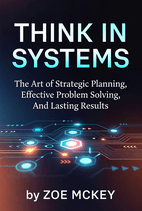
Zoe McKey's Think in Systems introduces a practical, step-by-step approach to systems thinking, teaching you to identify hidden feedback loops and high-leverage points to solve recurring problems in your life, work, and relationships. Written for anyone feeling stuck by persistent issues, from personal finances to workplace conflicts.
Feature
Insta.Page
Blinkist
Shortform
Summary Depth
Full Chapter-by-Chapter
15-min overview
Section-by-section guides
Audio Narration
✓
✓
✓
Visual Mindmaps
✓
✕
✕
AI Q&A
✓
✕
✕
Quizzes
✓
✕
✕
PDF Downloads
✓
✕
✓
Price
$89.99/yr
$146/yr (PRO)
$199/yr
*Competitor data last verified July 2026.
1 Page Summary
This book introduces systems thinking as a practical lens for understanding and improving your life, work, and the world around you. The central thesis is that your life is a system—a dynamic network of interconnected elements, relationships, and purposes. Author Zoe McKey argues that most problems persist not because of isolated events, but because of the hidden feedback loops and underlying structures that keep those problems in place. The goal is to move beyond linear, symptom-based fixes to find the high-leverage points where a small, well-placed shift can create outsized, lasting results.
What makes this book distinctive is its highly practical, step-by-step approach. It breaks down complex concepts into digestible tools—such as the iceberg model, the three components of any system (elements, interconnections, function), and the Theory of Constraints for identifying bottlenecks. Each chapter is grounded in concrete, everyday examples, from a mismanaged snowstorm in Hungary to a company’s waste-reduction initiative, showing exactly how to apply the thinking in real situations. The author emphasizes that the most powerful changes come not from swapping visible parts, but from changing the “invisible wiring” of interconnections or rethinking a system’s purpose.
The intended audience is anyone feeling stuck by recurring problems—whether in their personal finances, relationships, career, or social issues like homelessness or workplace conflict. Readers will gain a set of mental models to see the larger patterns at work in their lives, learn how to differentiate symptoms from root causes, and develop the habit of thinking in terms of loops and delays rather than one-off events. Ultimately, this book equips readers to become more effective problem-solvers and strategic planners by learning how to redesign the systems they live in.
1. The Beginning
Overview
The chapter opens with a simple exercise: picture your life. First, you see yourself, then the things around you—your toothbrush, laptop, coffee mug. But as you zoom out, the image expands to include the people who made those objects, the systems that deliver your news, the global supply chains that put food on your table. Suddenly, you're not just a person in a room; you're a node in an infinitely complex network. This is the central idea of the chapter: your life is a system, and learning to see it that way is the first step toward meaningful change.
Most of us don't think in systems. We treat problems as isolated events—fix the finances, improve the relationship, get healthier—without noticing how each piece affects the others. But your money shapes your health, your health shapes your energy, your energy shapes your relationships, and your relationships shape your mood (which circles back to your spending habits). Nothing sits still. Systems thinking gives you a set of tools to break down this tangle, not to feel overwhelmed, but to find the levers that actually move things.
The Scrambled Eggs Principle
Systems are everywhere, but we rarely notice them because they're so familiar. The chapter uses a disarmingly simple example: scrambled eggs. The recipe itself is a system—eggs, salt, pan, heat. Input: raw ingredients. Output: breakfast. But here's the key insight: you don't have to invent the system. Someone already did. Your job is to use it, and then to improve it.
Add cheese, peppers, onions—you've changed the input, which changes the output. The same logic applies to brushing your teeth: toothbrush + toothpaste + motion = clean teeth. Add flossing and mouthwash, and you've upgraded the system. These micro-systems fill our days, and each one can be tweaked. The chapter argues that practicing on these small, low-stakes systems trains your brain to spot more complex ones later—in your career, your finances, your relationships.
Borrowing Existing Systems
One of the most practical ideas introduced here is that you can take a well-designed system from one domain and apply it to another. The classic supply-and-demand model from economics becomes a lens for understanding job hunting.
Imagine you're an actor desperate to play Romeo. The local theater has one role, and 99 other actors want it. High demand, low supply—the odds are terrible. But now you realize: this isn't a personal failing; it's a structural imbalance. So you have two options: compete harder (improve your skills, get in shape, study Shakespeare) or change the supply side (apply to multiple theaters that are staging Romeo and Juliet). Suddenly, the same model gives you a strategic roadmap instead of a reason to feel defeated.
This is the power of borrowing systems. You don't need to reinvent the wheel. You just need to recognize which wheel you're dealing with and whether you're the supply or the demand in any given situation.
The Romeo Question
The chapter coins a simple diagnostic that you can carry with you: am I trying to win in a market where I'm the supply? If so, is the smarter move to compete harder or to find a market with less competition in the first place? It's a question that cuts through the noise, whether you're job hunting, dating, or negotiating for a meeting with someone whose calendar is overflowing.
This isn't about cynicism—it's about clarity. Systems thinking doesn't remove the work; it removes the guesswork. You still have to practice your lines, but you no longer waste energy on a theater that's set against you from the start.
Small Inputs, Big Leverage
Toward the end, the chapter introduces a crucial idea that will echo throughout the book: small, repeated inputs are often where the real leverage hides. Your waking time, first-hour routine, self-talk when you make a mistake—these aren't trivial details. They're inputs that shape outputs like your energy, mood, and relationships just as surely as the food in your fridge.
The good news: you don't have to overhaul everything at once. The big system of your life can be broken into smaller sub-systems, and those can be improved one at a time, from the bottom up. The chapter closes with an exercise to map your own life-system—list a handful of elements, draw arrows between them, and pick one small input to change this week. Not to act on yet, just to notice that it's there. That noticing is where change begins.
Key Takeaways
Your life is an open system of interconnected parts; improving one piece in isolation rarely fixes the whole.
Small, repeated inputs (habits, routines, self-talk) often hold hidden leverage over big outcomes.
You can borrow existing systems (like supply and demand) to understand and improve different areas of your life—job hunting, relationships, even getting a meeting.
When stuck in a competitive situation, ask the "Romeo question": am I the supply? If so, should I compete harder or find a market with less competition?
Systems thinking is a skill you build from the bottom up, starting with simple everyday systems (scrambled eggs, brushing teeth) before tackling the complex ones.
Key concepts: 1. The Beginning
1. The Beginning
Your Life as a System
Picture your life expanding into an infinite network
Problems are interconnected, not isolated events
Systems thinking reveals levers that actually move things
The Scrambled Eggs Principle
Everyday routines are small systems you can tweak
You don't need to invent systems, just improve them
Practice on small systems to spot complex ones later
Borrowing Existing Systems
Apply proven models from one domain to another
Supply-and-demand explains job hunting dynamics
Structural imbalances, not personal failings, cause stuckness
Two options: compete harder or change the supply side
The Romeo Question
Ask: Am I trying to win as the supply?
Decide between competing harder or finding less competition
Cuts through noise in job hunting, dating, or negotiations
Removes guesswork, not the work itself
Small Inputs, Big Leverage
Small repeated inputs hide leverage over big outcomes
Waking routine and self-talk shape energy and mood
Break your life into smaller sub-systems to improve
Start by noticing one small input to change this week
💡 Try clicking the AI chat button to ask questions about this book!
2. Elements of Systems Thinking
Overview
Systems thinking starts with three components that make up any system—elements, interconnections, and function (or purpose for human systems). From there come the core concepts that give systems thinking its power: interconnectedness, synthesis, feedback loops, causality, emergence, and systems mapping. Finally, you get your hands on one of the field’s most practical tools—the iceberg model—which reveals why surface-level fixes often fail and how to dig into the deeper patterns, structures, and mental models driving events.
The Three Components of Any System
Every system, whether natural or human-made, can be broken into three parts. Elements are the actors—the people, objects, or even intangible qualities like pride or loyalty that make up the system. They’re the easiest to spot because you can often see or touch them, from the roots of a flower to the players on a basketball team. Interconnections are harder to see but just as crucial; they’re the flows of information, signals, and physical processes that link elements together. Think of a flower’s roots taking in water based on signals from its leaves, or a colleague’s LinkedIn profile shaping how you approach a meeting. The third component is function for nonhuman systems (e.g., a flower’s function is to reproduce) and purpose for human systems. This is the least obvious part—you can’t read it on a sign, but you can deduce it by watching what the system actually does, not what it says it does. A person who claims to prioritize family but spends every weekend working reveals their real purpose through behavior.
Key Concepts That Build the Vocabulary
Systems thinking flips our usual linear mindset into something circular. Interconnectedness is the bedrock: everything relies on something else, from your laptop needing electricity to a chicken laying the egg for your breakfast. Synthesis complements analysis by looking at the whole instead of the parts—a car’s parts laid out on the floor can’t take you anywhere, but connected they create transportation. Feedback loops describe how actions ripple back on themselves: reinforcing loops amplify a behavior (spouses getting meaner, population growth), while balancing loops keep things in check (predator-prey dynamics). Causality reminds us not to mistake correlation for cause—ice cream sales don’t cause drownings, but hot weather drives both. And emergence is the surprising property that arises when components combine, like a cake from flour, eggs, and heat, or a frog from a tadpole.
Mapping Systems: The Iceberg Model
The iceberg model is one of systems thinking’s most accessible tools because it explains why quick fixes so often backfire. At the event level you see the tip—the visible problem, like a riot. Below the surface, patterns reveal that similar events have been building (protests, social media campaigns). Digging deeper, structure uncovers the physical things, organizations, policies, or rituals causing those patterns—maybe a government consistently ignoring grievances. At the bottom, mental models are the beliefs and values that sustain the structure, such as a sense of powerlessness or cultural conflict. The chapter closes with an exercise that invites you to apply both the iceberg model and the three-component framework to a real event, giving you a richer, layered view of any system you want to understand or change.
Key Takeaways
Every system has two or three components: elements (actors), interconnections (flows), and function/purpose (what it does, not just what it says).
Interconnectedness means no actor exists in isolation; systems thinking requires a circular, not linear, perspective.
Feedback loops—reinforcing (amplifying) and balancing (stabilizing)—are the engines of system dynamics.
The iceberg model provides a four-level depth finder: events, patterns, structure, and mental models.
Pairing the iceberg with the parts framework gives you both vertical depth and horizontal structure for a complete system diagnosis.
Key concepts: 2. Elements of Systems Thinking
2. Elements of Systems Thinking
Three Components of Any System
Elements: visible actors like people or objects
Interconnections: flows of information and signals
Function/purpose: deduced from behavior, not claims
Key Concepts for Systems Vocabulary
Interconnectedness: everything relies on something else
Causality vs. correlation: avoid mistaking one for other
Emergence and Circular Thinking
Emergence: new properties arise from component combinations
Systems thinking shifts from linear to circular perspective
Examples: cake from ingredients, frog from tadpole
Iceberg Model for Deep Diagnosis
Event level: visible tip of the problem
Patterns: recurring events over time
Structure: policies, organizations, or rituals
Mental models: beliefs and values sustaining structure
Practical Application of Frameworks
Pair iceberg model with three-component framework
Gain vertical depth and horizontal structure
Reveals why surface-level fixes often fail
3. How Do Systems Work?
Overview
When you look at any system—a school, a company, a forest—the most dramatic changes don’t come from swapping out the parts you can see. They come from shifting the invisible wiring or, even more powerfully, rethinking the system’s whole reason for existing. This chapter walks through exactly why that’s true, then adds two essential building blocks—stocks and flows—and shows how feedback loops and delays shape the rhythm of change. By the end, you’ll start seeing your everyday world as a collection of stocks that rise and fall through flows you can actually influence, once you know where to look.
The Part That Shakes the Whole System
We already know a system has three parts: elements, interconnections, and a function or purpose. But which one matters most? The answer depends on how you ask the question. If you’re looking for the part that, when changed, causes the least ripple, that’s elements. Swap out all the students in a classroom and it’s still a classroom. Change the frosting on a cake and it’s still a cake. Elements are the most visible but the least powerful.
Interconnections are stickier. Keep the same students but flip the rules so they teach the teacher—you’ve got a completely different system on your hands. Change a soccer team’s rules to handball and the sport vanishes. Interconnections reshape behavior.
Purpose, though, is the heavyweight. Keep every student and every classroom rule but change the school’s goal from “learn and succeed” to “fail and avoid knowledge”—the whole system unravels and reconstructs itself around the new mission. Imagine a tree whose purpose shifted from surviving and reproducing to consuming everything in sight. One change in purpose, and the entire ecosystem around it bends. So when you’re trying to fix a broken system, start by checking its purpose, then its interconnections, then its elements. That’s the order of impact.
Stocks and Flows: The Invisible Engine
Now we zoom in on the small parts that make a system tick: stocks and flows. A stock is anything you can count or measure at a given moment—cash in your wallet, confidence in your gut, trees in a forest. A flow is the action that changes that stock over time. Money flows in (income) and out (spending). Confidence flows up (success) and down (failure). Water flows into a lake from rain and out through evaporation.
The key insight? Stocks are memory. They hold the history of all the flows that came before. When inflow exceeds outflow, the stock rises. When outflow wins, it falls. And stocks almost never change instantly. You can’t save $10,000 overnight or grow a forest in a week. That slowness is exactly why systems behave the way they do—the pace of stock change sets the rhythm for everything else.
Most people naturally focus on the stock (the bowl of flour) rather than the flow (the flour pouring in). And when they do focus on flows, they almost always think about increasing the inflow—earning more, working harder. But a stock can also grow by slowing the outflow—spending less, plugging the leak. That blind spot is where systems thinkers gain an edge.
Feedback Loops: The Hand That Steers the Flows
Stocks don’t rise and fall by accident. Something guides the flows, and that something is a feedback loop. A reinforcing loop drives growth or decay. Your savings account is a classic example: the more money you have, the more interest you earn, which makes the account grow even faster. Exponential growth. The loop feeds itself.
A balancing loop, by contrast, pushes the system back toward a target. A thermostat doesn’t let the room keep getting hotter forever—it kicks on cooling when the temperature drifts too high and heating when it drops too low. The digestive tract uses beneficial bacteria to keep harmful bacteria in check. Balancing loops create stability.
Systems often shift between the two. A wolf population grows through a reinforcing loop (more wolves, more pups, even more wolves) until mortality from hunting or relocation kicks in as a balancing loop. Which loop dominates at any moment determines whether the system is expanding, contracting, or holding steady.
But here’s the tricky part: feedback loops don’t operate in a vacuum. Before you trust any model of a system, Donella Meadows suggests asking three questions. Will the driving factors really play out the way I assume? Even if they do, will the system react as expected? And what’s influencing those driving factors themselves—are they being nudged by outside forces like the economy, climate, or human decisions? Those questions keep you honest.
Why Systems Oscillate: The Invisible Hand of Delays
There’s a reason systems rarely glide smoothly to their goal. Delays cause them to overshoot and then correct, creating a wobbly pattern. A thermostat set to 70°F will almost never hold exactly at 70 for long, because heat escapes faster in cold weather than the furnace can match. By the time the thermostat detects a problem, the overshoot has already happened.
Information delays are just as sneaky. Airlines overbook flights because some passengers don’t show up—usually a fine buffer. But once in a while, everyone shows and chaos erupts. The airline doesn’t react instantly to one bad flight because a single data point doesn’t signal a trend (perception delay). Even after they decide to fix it, they can’t adjust every flight at once (response delay). And even after fixing the policy, it takes time for the changes to play out (delivery delay). The result? Oscillation. The airline cuts back on overbooking, then ends up with too many empty seats, then overbooks again, chasing a sweet spot that keeps slipping away.
Understanding where the delays live is half the battle. If you can shorten a perception delay—for example, by checking your savings balance weekly instead of yearly—you can catch a problem before it compounds. If you can lengthen a response delay for a reinforcing loop you want to control, you buy time to make smarter decisions.
The chapter closes with a practical exercise: pick one stock in your own life—savings, fitness, trust in a relationship, a skill you care about. Identify the inflows and outflows. Notice the feedback loop at work. Find the delay between making a change and seeing a result. You don’t have to fix anything yet. Just see the shape of the system you’re already living inside.
Key Takeaways
Changing a system’s purpose has the most impact, then interconnections, then elements—the most visible parts are the least powerful when altered.
Stocks are measurable accumulations (money, relationships, fitness); flows are the actions that raise or lower them. Stocks change slowly, setting the system’s tempo.
A stock can grow by increasing inflow or by slowing outflow—most people only think about inflow.
Reinforcing feedback loops drive runaway growth or collapse; balancing loops push toward stability or a target.
Delays between action and visible effect cause systems to overshoot and oscillate—perception, response, and delivery delays all play a role.
To understand any system, ask: Are the driving factors realistic? Will the system react as expected? What external forces affect those driving factors?
Key concepts: 3. How Do Systems Work?
3. How Do Systems Work?
Order of Impact in Systems
Elements are most visible but least powerful
Interconnections reshape behavior when changed
Purpose is the heavyweight that transforms everything
Fix purpose first, then interconnections, then elements
Stocks and Flows
Stocks are measurable quantities at a given moment
Flows are actions that change stocks over time
Stocks act as memory, holding history of flows
Stocks change slowly, setting system's rhythm
The Systems Thinker's Blind Spot
People focus on stocks, not flows
Most think only about increasing inflow
Slowing outflow can also grow a stock
This blind spot is where systems thinkers gain edge
Reinforcing Feedback Loops
Reinforcing loops drive exponential growth or decay
Savings account interest is a classic example
The loop feeds itself and accelerates change
More wolves lead to more pups, then more wolves
Balancing Feedback Loops
Balancing loops push system toward a target
Thermostat maintains temperature via cooling/heating
Beneficial bacteria keep harmful bacteria in check
These loops create stability and equilibrium
Three Questions to Test Models
Will driving factors really play out as assumed?
Will the system react as expected if they do?
What outside forces nudge the driving factors?
These questions keep your model honest
Delays and Oscillation
Delays cause systems to overshoot and correct
Thermostat wobbles because heat escapes faster
Information delays include perception and response
Airlines oscillate chasing a slipping sweet spot
4. Bottlenecks, Leverage, and Feedback Loops
Overview
You feel stuck. Find the bottleneck, apply the highest-leverage change, and use feedback to measure and repeat. The Theory of Constraints forms the backbone—every system has one tightest constraint that limits everything else. If you don't identify that true bottleneck, you can throw effort at a dozen other areas and still go nowhere. The goal isn't to work harder on everything; it's to find the single place where effort actually pays off.
Leverage is the art of making that effort count. It's about knowing that not every task or problem requires maximum force—sometimes a small, well-placed shift produces outsized results. And feedback loops are what keep you honest: they tell you whether your leverage point is actually moving the bottleneck, or if you're just spinning your wheels.
The cycle goes like this: name the bottleneck (the real one, not just the symptom), apply one high-leverage change (changing a rule, building self-organization, or improving information flow), and set up a quick feedback signal to check if it's working. Then repeat as the bottleneck shifts. Each pass raises the whole system a notch.
Key Takeaways
Every system has one tightest constraint—the bottleneck. Fixing anything else won't move the needle until you address that.
Leverage means finding the 20% (or even 1%) of effort that produces most of the result. Not all hard work is equal.
Three high-leverage moves in daily life: change the rules of your system, build in self-organization (so improvement happens automatically), and improve information flow (shorter feedback loops).
The cycle: find the real bottleneck → apply one precise leverage point → measure with a fast feedback loop → repeat as new constraints emerge.
Don't confuse symptoms with bottlenecks. A pattern of lashing out might be a symptom; the bottleneck could be an old belief about relationships. Naming that changes where you aim your energy.
Key concepts: 4. Bottlenecks, Leverage, and Feedback Loops
4. Bottlenecks, Leverage, and Feedback Loops
The Bottleneck Principle
Every system has one tightest constraint
Fixing anything else won't move the needle
Don't confuse symptoms with bottlenecks
Old beliefs can be hidden bottlenecks
High-Leverage Moves
Find the 20% effort producing most results
Change the rules of your system
Build self-organization for automatic improvement
Improve information flow with shorter feedback loops
The Improvement Cycle
Name the real bottleneck, not just symptoms
Apply one precise leverage point
Set up a fast feedback signal to measure
Repeat as the bottleneck shifts
You've reached the end of the free chapters
Next chapter: “Hidden Obstacles” is locked
Keep reading Think in Systems — and unlock all 600+ book summaries with audio, mindmaps and AI Q&A.
$0.00 due today · 7 days free, then $89.99/year ($7.49/mo) · Cancel anytime before day 7
Zoe McKey is an author and communication expert specializing in social dynamics, confidence building, and personal development. She is best known for her book *Unboxed: Redefining the Art of Being a Woman*, along with other works that empower readers to overcome insecurity and improve their interpersonal skills. With a background in coaching and psychology, McKey's writing draws from her own experiences and professional expertise to help others navigate relationships and self-growth.
Frequently Asked Questions about Think in Systems
What is Think in Systems about?
This book is a practical guide to systems thinking, teaching readers how to see their lives and problems as interconnected systems rather than isolated events. It breaks down the core components of any system—elements, interconnections, and function—and introduces powerful tools like the iceberg model, feedback loops, and bottleneck analysis. Through real-world examples, from a snowstorm in Hungary to a company's waste diversion project, it shows how to identify leverage points and make changes that actually stick. The goal is to move beyond surface-level fixes and understand the deeper patterns that drive recurring issues in personal, professional, and social settings.
Who is the author of Think in Systems?
Zoe McKey is the author of this systems thinking guide, which draws on decades of theory and practical application to help individuals and organizations solve complex problems. She distills concepts from fields like cybernetics and organizational learning into actionable steps, using vivid case studies to illustrate each principle. McKey's writing emphasizes clarity and real-world usability, making systems thinking accessible to readers without a technical background.
Is Think in Systems worth reading?
Absolutely—this book stands out because it doesn't just explain systems thinking; it gives you a step-by-step process to apply it immediately. You'll learn to identify the real bottleneck in any situation, use feedback loops to measure progress, and avoid the trap of treating symptoms instead of root causes. Whether you're dealing with personal habits, workplace conflicts, or broader social issues, the tools here will change how you approach every problem.
What are the key lessons from Think in Systems?
First, every system has one tightest constraint—the bottleneck—and fixing anything else won't move the needle; you must find and address that single leverage point. Second, surface-level symptoms (like a blown-up argument over dish soap) often signal deeper structures or mental models; the iceberg model helps you dig down to patterns and root causes. Third, feedback loops and delays shape how systems behave—awareness of the two-month lag between effort and outcome, for example, can prevent you from mistaking a slow climb for failure. Finally, shifting to systems thinking requires noticing when linear explanations fail and learning to see interrelationships and patterns of change over time.
📚 Explore Our Book Summary Library
Discover more insightful book summaries from our collection