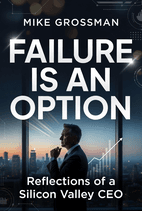
Mike Grossman's Failure Is An Option draws on twenty-five years of holiday letters to deliver an unconventional business memoir about running six venture-funded companies, where twelve of eighteen business models failed. Written for entrepreneurs and startup CEOs tired of sanitized success narratives, it offers raw honesty about the psychological toll of leadership, the primacy of timing, and why failure is an integral part of the journey.
Feature
Insta.Page
Blinkist
Shortform
Summary Depth
Full Chapter-by-Chapter
15-min overview
Section-by-section guides
Audio Narration
✓
✓
✓
Visual Mindmaps
✓
✕
✕
AI Q&A
✓
✕
✕
Quizzes
✓
✕
✕
PDF Downloads
✓
✕
✓
Price
$89.99/yr
$146/yr (PRO)
$199/yr
*Competitor data last verified July 2026.
1 Page Summary
Based strictly on the provided chapter content, the following summary can be made:
Mike Grossman's Failure Is An Option is an unconventional business memoir that draws on a quarter-century of holiday letters the author wrote, each a self-contained story that collectively form a "book written in slow motion." The book’s central thesis challenges the Silicon Valley mythology of unicorns and billionaires, arguing instead that the real Valley is defined by "relentless struggle, luck, and a 1% chance of raising venture capital." Grossman rejects the traditional prescriptive business book format, opting instead for short, honest anecdotes from his experience as CEO of six venture-funded companies, where he pursued 18 business models—12 of which failed. The book stresses concepts like the primacy of timing over a "tidy checklist," the importance of storytelling as a CEO's primary role, and the brutal lesson that "less is more" when narrowing strategic scope.
What makes this book distinctive is its raw honesty about the psychological toll of leadership, including the loneliness of the role, the agony of layoffs, and the tension between effort and outcome. Grossman explores unglamorous realities such as the paradox that "firing someone too slowly" is a common mistake, the need for CEOs to play "psychologist" and "storyteller," and the emotional difficulty of pivoting away from a cherished vision. The book is a mix of practical lessons—like the strategic use of silence in negotiations and the danger of "competitive noise"—and deeply personal stories, including the challenge of working with his father, the fear of losing employees in Ukraine during the Russian invasion, and the guilt of selling a company he loved for a "financial home run."
The intended audience is entrepreneurs, startup CEOs, and anyone fascinated by the inner workings of Silicon Valley who is tired of sanitized success narratives. Readers will gain a realistic, unvarnished view of what it truly means to build and run a company, from the "soul-crushing " grind to the moments of "cosmic" timing. They will find validation for their own struggles, a counterintuitive framework for decision-making based on "never too high, never too low," and permission to view failure not as a stigma but as an integral, instructive part of the journey.
Advance Praise
Overview
This opening chapter serves as both an invitation and a reality check. It begins with a collection of endorsements from an impressive range of leaders—CEOs, academics, and investors—who all praise the book for its raw honesty, humility, and willingness to talk about failure in a success-obsessed industry. Then, the author explains the book's unusual origin: twenty-five years of creative holiday letters that evolved into a template for telling true stories about running startups. Finally, he pulls back the curtain on the real Silicon Valley, a place defined not by unicorns and billionaires but by relentless struggle, luck, and a 1% chance of raising venture capital at all.
Endorsements from Leaders
The advance praise sets an unusual tone for a business book. Kelly Bayer Rosmarin calls it "an entertaining and authentic collection of highly engaging anecdotes" that imparts wisdom with humility and humor. KewSong Lee highlights the author's "honest reflections on luck, timing, and failure" as a refreshing departure from typical entrepreneurial memoirs. Carlos Rodriguez contrasts it directly with the usual narrative: "We go to graduate school, then work in consulting or investment banking… with a little luck and good timing some find success and then they write books about how smart they were. Failure Is an Option is a breath of fresh air." Brad Smith praises the book for stripping away the mythology of Silicon Valley and replacing it with truth. Amy Errett focuses on the empathy needed to navigate a startup's roller coaster. Jeffrey Sonnenfeld connects the book's message to the archetype of the heroic leader—one who is "better, stronger, and heroic" because of setbacks, not despite them. Christiana Smith Shi notes the book is "easy to read and hard to forget," while Greg Sands calls it "candid, insightful, and quietly reassuring."
The Author's Unconventional Approach
The introduction reveals how the book came to be. After getting married, the author wrote a conventional holiday letter one year, then another. The third year, he decided to make each year's letter a creative writing exercise with strict rules: each letter had to be distinct in voice and structure, and never conventional. He treated each letter as a "patch in a patchwork quilt," building a "book in slow motion." He wrote these letters for twenty-five years until he ran out of ideas. Decades later, wanting to share his perspective on running early-stage tech companies—something he'd done six times—he decided to apply the same philosophy to a book. The result is a collection of forty-four autobiographical short stories, each concise and self-contained, purposely non-chronological and undated. The author deliberately avoids offering a tactical playbook; instead, he focuses on the practical, ethical, and emotional dilemmas of being a Silicon Valley CEO. His three goals: be thought-provoking and entertaining, convey what the experience actually feels like, and be unlike any business book the reader has encountered before.
The Real Silicon Valley
The author then dismantles the popular image of Silicon Valley. When most people think of the region, they imagine billionaires and transformative companies—the exceptions, not the rule. The real Silicon Valley, he argues, is about failure. Fewer than 1% of startups raise venture capital, and of those, only 25% produce a positive ROI. Even most of those are only moderately successful. Companies that eventually have a great outcome typically endure years of adversity. Running a startup is described as "an enervating, emotionally draining, gut-wrenching experience"—a psychological roller coaster that goes down more than up. The author's own stats back this up: he has run six venture-funded companies, pursued eighteen different business models (twelve of which failed), five of the six had layoffs, only three exceeded $10 million in annual revenue, and one exceeded $50 million. All six were ultimately acquired, with outcomes ranging from a $400 million deal to a $250,000 fire sale.
Key Takeaways
The book is deliberately unconventional: a collection of short, non-chronological stories that prioritize emotional truth over linear narrative or tactical advice.
Success in Silicon Valley is the exception, not the rule; failure and struggle are the norm, even for companies that eventually succeed.
Honest reflection on luck, timing, and setbacks is rare in leadership literature, and this book aims to fill that gap.
The author's own journey—with far more failures than wins—provides credible, grounding perspective for anyone leading through uncertainty.
Key concepts: Advance Praise
1. Advance Praise
Endorsements from Leaders
Praised for raw honesty and humility
Refreshing focus on luck, timing, and failure
Strips away Silicon Valley mythology
Heroic leader archetype embraces setbacks
The Author's Unconventional Approach
Book evolved from 25 years of creative holiday letters
Each letter was a distinct, non-conventional patch
Result: 44 autobiographical, non-chronological short stories
Goals: thought-provoking, emotional, unlike any business book
The Real Silicon Valley
Less than 1% of startups raise venture capital
Only 25% of funded startups produce positive ROI
Startup life is an enervating, emotional roller coaster
Author's stats: 6 companies, 12 failed business models
Key Takeaways
Book prioritizes emotional truth over linear narrative
Failure and struggle are the norm, not exception
Honest reflection on luck and setbacks fills a gap
Author's journey offers credible perspective on uncertainty
💡 Try clicking the AI chat button to ask questions about this book!
Introduction
Overview
Most people write holiday letters that read like a polite highlight reel—vacations, kids' accomplishments, maybe a clever anecdote. Mike Grossman decided that wasn't nearly interesting enough. For twenty-five years, he turned his family's annual letter into a creative writing project with one hard rule: each year had to be completely different from every previous one. Different voice, different structure, different narrative trick. Some years he used allegory. Some years he hid the point until the final sentence. And he thought of each letter as a single patch in a quilt that, over decades, would add up to something larger—a book written in slow motion, one chapter per year.
That project eventually ran its course after a quarter-century. But when Grossman later decided to write a book about his experiences running six venture-funded technology companies, the old habit came back. He knew what he didn't want: a conventional business memoir, or a prescriptive how-to manual. He wanted something that felt alive, unpredictable, and honest. So he reached for the same structure that had served him all those holiday seasons—a collection of short, self-contained stories, each highlighting one lesson or theme, none in chronological order, and most without dates.
The result is a book built to be read in any order, by design. Grossman leaves the timeline vague on purpose—if sequence matters, he figures, you can check his LinkedIn profile. What he cares about is what running a startup feels like: the practical, ethical, and emotional weight of decisions made in uncertainty. He avoids laying out a tactical playbook because he doesn't believe there is one. Instead, he offers the mess, the luck, the failure, and the humanity that conventional business books tend to gloss over.
Three goals drive the whole thing: to make you think, to keep you entertained, and to leave you convinced you've never read a business book quite like this one.
Key Takeaways
Stories before timeline. The book's chapters are intentionally non-chronological and standalone; the sequence of events matters less than the lessons embedded in each moment.
Avoiding the usual playbook. Grossman deliberately sidesteps tactical prescriptions and rule-based advice, opting instead for reflection on the emotional and ethical dimensions of leading a startup.
Creativity as a discipline. The holiday letter experiment shows how constraints (never repeat a format, always surprise) can produce more authentic and memorable storytelling—a principle he applies to the entire book.
Honesty over polish. The book embraces failure, ambiguity, and luck as central forces in the entrepreneurial journey, rather than treating them as exceptions to the success narrative.
Key concepts: Introduction
2. Introduction
The Holiday Letter Experiment
25 years of creative annual letters
Each year had a completely different format
Letters were patches in a larger quilt
Constraints produced authentic storytelling
Book's Unconventional Structure
Non-chronological, standalone short stories
Designed to be read in any order
Timeline intentionally vague
Focus on feel, not sequence
Rejecting Conventional Business Books
Not a prescriptive how-to manual
Avoids tactical playbooks and rules
Embraces mess, luck, and failure
Honesty over polished success narratives
Core Themes of the Book
Practical, ethical, emotional weight of decisions
Leading a startup under uncertainty
Lessons embedded in each moment
Humanity often glossed over by others
Three Driving Goals
Make you think
Keep you entertained
Leave you convinced it's unlike any business book
The Real Silicon Valley
Overview
Most people picture billionaires and world-changing companies when they hear "Silicon Valley." Elon Musk, Mark Zuckerberg, Steve Jobs, Tesla, Meta, Apple—the names that define an era of tech dominance. It's an understandable reflex, and if I'd chosen a different career, I'd probably think the same. But here's the uncomfortable truth: those titans are the exception, not the rule. The real Silicon Valley is far more brutal, more uncertain, and far more defined by failure than by success.
The numbers tell the story bluntly. Fewer than 1 percent of startups ever raise venture capital, and of those that do, only a quarter end up with a positive return on investment. Most of that quarter are only moderately successful at best. Even the companies that eventually hit it big endure years—sometimes a decade or more—of near-constant struggle, grinding halts, and heartbreak. Running a company in Silicon Valley isn't glamorous; it's enervating, emotionally draining, and gut-wrenching. It's a psychological roller coaster that goes down more often than up, a kind of relentless self-delusion and masochism.
I've lived this reality for 30 years. I've been CEO of six early-stage, venture-funded companies. Collectively, we pursued 18 different business models—and 12 of them failed. Five of the six companies required layoffs; two needed multiple rounds. Only three ever crossed $10 million in annual revenue, and just one crossed $50 million. Through the decades, I raised money from 12 venture capital firms, three public corporations, one hedge fund, and dozens of angel investors. All six companies were eventually acquired—the largest deal for $400 million, the smallest a fire sale for $250,000.
Some of the failures weren't my fault. One company was days away from an IPO when COVID-19 hit. Another was about to be acquired by Mastercard when the Great Recession slammed the brakes. Three years later, Congress passed a law that effectively destroyed that same company's business model. At one point or another, all six faced an existential crisis. Three were in a state of perpetual existential crisis.
Do I have regrets? Plenty. You make decisions on limited information constantly, and you make a lot of mistakes—some of them huge. Strategy, execution, people—it's baked into the cake. But I don't regret the choice of career. It hasn't been easy, but it's always been interesting. It hasn't always been fun, but it's always been challenging. And I've learned an enormous amount about entrepreneurship, leadership, and myself along the way.
This book is an attempt to share some of those hard-won insights—the ones that don't make it onto magazine covers or TED stages.
Key Takeaways
The popular image of Silicon Valley as a land of billionaires and unicorns is misleading; the reality is defined by failure, struggle, and low odds of success.
Fewer than 1% of startups raise venture capital, and only 25% of those yield a positive return; most successes are modest, not massive.
Even successful companies endure years of hardship—existential threats, layoffs, and macroeconomic shocks are the norm, not the exception.
The author's personal track record (6 companies, 18 business models, 12 failures, multiple layoffs, one big exit) illustrates that perseverance is more common than glory.
Key concepts: The Real Silicon Valley
3. The Real Silicon Valley
The Myth vs. Reality of Silicon Valley
Popular image: billionaires and unicorns
Reality: defined by failure and struggle
Titans like Musk and Jobs are exceptions
The Brutal Statistics of Startup Failure
Fewer than 1% of startups raise VC
Only 25% of VC-funded startups yield positive ROI
Most successes are modest, not massive
The Emotional Toll of Entrepreneurship
Running a company is enervating and gut-wrenching
Psychological roller coaster with more downs than ups
Requires relentless self-delusion and masochism
The Author's 30-Year Track Record
CEO of 6 companies, 18 business models attempted
12 business models failed, 5 companies had layoffs
Only 3 companies crossed $10M in annual revenue
Hard-Won Lessons Beyond the Glamour
Decisions made on limited information lead to mistakes
Perseverance is more common than glory
Insights not found on magazine covers or TED stages
Unlearning the Wrong Lessons
Overview
Most of us carry a deeply ingrained belief from childhood: that effort and results are directly proportional. The author confesses that he entered entrepreneurship with this assumption firmly in place, convinced that sheer hard work would guarantee success. After all, it worked in school, in sports, and in early jobs. But running a company, he discovered, operates on entirely different rules.
The Mismatch Between Effort and Outcome
The author traces the origin of his miscalculation back to his early life. In academic settings, the system is designed to reward diligence. Practice more, study harder—you get better grades. That logic felt like a universal truth, and it gave him the audacity to quit his job and co-found LiveCapital with his wife nine months pregnant. He thought he was being humble about the risks, but deep down, he was certain success was inevitable. He was performing humility, not feeling it.
The Humbling Reality of Leadership
The realization came when he understood the difference between personal performance and company performance. As a CEO, your personal effort is a prerequisite, not a guarantee. The success of the business depends on a chaotic mix of factors—market timing, competition, team dynamics, luck—many of which are beyond your control. You can give everything you have, hire brilliantly, build a product that delights customers, and still fail. That revelation was jarring because it meant the old rules no longer applied.
Failure Is Definitely an Option
The chapter closes with a vivid cultural reference from the early days of LiveCapital. The author and his co-founder, Scott Belser, initially adopted the Apollo 13 mantra: “Failure is not an option.” But reality quickly taught them otherwise. They came to see that failure was, in fact, very much on the table. On the worst days, they even joked that “Success is not an option.” That dark humor became a coping mechanism for the uncomfortable truth they had to face: the wrong lesson had to be unlearned before they could move forward.
Key Takeaways
Effort and grit are necessary for a CEO but never sufficient—success depends on factors outside your control.
Academic and professional environments reward personal diligence, but company performance follows a different logic.
Unlearning the belief that hard work guarantees success is a painful but essential step for any entrepreneur.
“Failure is not an option” is a comforting fiction; acknowledging failure's real possibility is far more useful.
Key concepts: Unlearning the Wrong Lessons
4. Unlearning the Wrong Lessons
The Effort-Outcome Fallacy
Childhood belief: effort directly equals results
Academic system rewards personal diligence
Author entered entrepreneurship with this assumption
Running a company follows different rules
The Humbling Reality of Leadership
Personal effort is prerequisite, not guarantee
Success depends on chaotic mix of factors
Market timing, competition, luck beyond control
Can give everything and still fail
Failure Is Definitely an Option
Apollo 13 mantra 'Failure is not an option'
Reality taught failure is very much on table
Dark humor: 'Success is not an option'
Acknowledging failure's possibility is more useful
Unlearning the Wrong Lesson
Painful but essential step for entrepreneurs
Old rules of effort no longer apply
Must face uncomfortable truth to move forward
Performing humility vs. feeling it
Key Takeaways
Effort necessary but never sufficient for CEO
Company performance follows different logic
Hard work does not guarantee success
Acknowledge failure's real possibility
You've reached the end of the free chapters
Next chapter: “Timing Is Everything” is locked
Keep reading Failure Is An Option — and unlock all 600+ book summaries with audio, mindmaps and AI Q&A.
$0.00 due today · 7 days free, then $89.99/year ($7.49/mo) · Cancel anytime before day 7
Mike Grossman is an author and business strategist known for his expertise in corporate leadership and organizational change. He wrote the acclaimed business guide *The Blueprint for Breakthrough Leadership*, which outlines key principles for driving innovation and team performance. With over two decades of experience as a CEO and consultant, Grossman brings practical, real-world insights to his work.
Frequently Asked Questions about Failure Is An Option
What is Failure Is An Option about?
This book strips away the Silicon Valley myth of effortless unicorn success, revealing a world defined by relentless struggle, luck, and a brutal 1% chance of raising venture capital. Through a series of candid, self-contained stories from his three decades leading six startups, the author shares hard-won lessons on failure, timing, and the emotional rollercoaster of entrepreneurship. It's not a prescriptive manual but an authentic collection of anecdotes that impart wisdom with humility and humor, challenging the conventional narrative that effort alone guarantees success.
Who is the author of Failure Is An Option?
Mike Grossman is a serial entrepreneur who co-founded and served as CEO of six venture-funded technology companies over 30 years, including LiveCapital, Tempo, and Inflection. He is a Harvard Law graduate and former McKinsey consultant, and he conceived this book from twenty-five years of creative holiday letters that evolved into a template for telling honest startup stories. Grossman's work has earned praise from leaders like Kelly Bayer Rosmarin and Carlos Rodriguez for its raw honesty about luck and failure.
Is Failure Is An Option worth reading?
Absolutely—this book offers a desperately needed antidote to the typical Silicon Valley success narrative. Leaders and entrepreneurs praise its 'raw honesty, humility, and willingness to talk about failure in a success-obsessed industry.' Whether you're a founder, investor, or simply curious about what really happens behind the scenes, these authentic, often hilarious stories provide practical wisdom you won't find in conventional business memoirs.
What are the key lessons from Failure Is An Option?
One key lesson is that effort and results are not proportional in business—success depends on a chaotic mix of timing, market conditions, and luck. Another is that a CEO must play three roles: business leader, psychologist, and storyteller, with honest communication being paramount even when delivering bad news. The book also emphasizes that people are a company's true asset, that knowing when to abandon a failing strategy is as important as persistence, and that the greatest enemy is often internal dysfunction, not competition.
📚 Explore Our Book Summary Library
Discover more insightful book summaries from our collection