Failure Is An Option Key Takeaways
by Mike Grossman
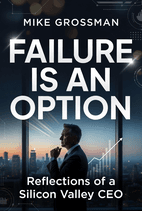
5 Main Takeaways from Failure Is An Option
Embrace Failure and Luck as Core to Entrepreneurship
Grossman dismantles the myth that success follows effort alone. He shows that fewer than 1% of startups raise venture capital, and even successful companies endure years of near-death experiences. His own track record—6 companies, 12 failures—proves that struggle is the norm. Acknowledging luck, timing, and the real possibility of failure is far more useful than pretending it's not an option.
Focus on What You Can Control, Not Outcomes
The CEO's job is defined by uncertainty, isolation, and limited data. Grossman applies the Serenity Prayer directly: accept uncontrollable forces (market, luck, timing), and act deliberately on what you can change—hiring, culture, process, and product-market fit. Fixating on results wastes energy; emotional balance and disciplined action are the only levers you truly have.
Truthful Storytelling Is a CEO's Superpower
A CEO must be a business leader, psychologist, and storyteller. Effective storytelling starts with a clear narrative written before any slides are built. Hiding bad news destroys trust; sharing it honestly, even when painful, builds credibility and enables real problem-solving. Grossman's mantra: bad news is good news because it gives you a chance to act.
People and Money Are Symbiotic—Neither Alone Suffices
A company is defined by its people, but financial survival is the foundation. Grossman argues that caring about people and caring about money are not opposites—they reinforce each other. Hire for values and motivation, not just skill; treat employees generously during layoffs; but never neglect cash flow. Bill Campbell proved that a people-first culture and rigorous financial discipline go hand in hand.
Timing, Luck, and Humility Often Trump Hard Work
Grossman's LiveCapital failed because the market wasn't ready; five years later, the same idea became a public company. Luck—a chance comment, a pandemic, a piece of legislation—can be decisive. He advises staying open to the unexpected, accepting that you cannot know whether an event is good or bad in the moment, and planning diligently while remaining humble about your ability to predict.
Executive Analysis
These five takeaways together form the book's central argument: successful leadership in startups requires abandoning the illusion of control and embracing a reality defined by luck, failure, and uncertainty. Grossman rejects the typical Silicon Valley success narrative, insisting that the only reliable path is to focus on what you can genuinely influence (honest communication, team building, financial discipline), accept what you cannot (timing, market forces, random events), and maintain emotional equilibrium through it all. The book is not a playbook of tactics but a collection of emotional truths that help leaders navigate the messy, nonlinear journey of building a company.
This book matters because it fills a glaring gap in business literature—most leadership books pretend failure is an exception or a stepping stone to inevitable victory. Grossman, with his track record of far more failures than wins, offers an honest, grounding perspective that is far more useful for anyone leading through uncertainty. It sits squarely in the genre of startup memoirs (like Ben Horowitz's 'The Hard Thing About Hard Things') but is deliberately more fragmented and story-driven, prioritizing emotional resonance over linear advice. For any founder or CEO wrestling with imposter syndrome, burnout, or the loneliness of leadership, this book provides both solace and practical wisdom.
Chapter-by-Chapter Key Takeaways
Advance Praise (Chapter 1)
The book is deliberately unconventional: a collection of short, non-chronological stories that prioritize emotional truth over linear narrative or tactical advice.
Success in Silicon Valley is the exception, not the rule; failure and struggle are the norm, even for companies that eventually succeed.
Honest reflection on luck, timing, and setbacks is rare in leadership literature, and this book aims to fill that gap.
The author's own journey—with far more failures than wins—provides credible, grounding perspective for anyone leading through uncertainty.
Try this: Read the book's chapters in any order—focus on the stories that resonate with your current challenge, not on following a timeline.
Introduction (Introduction)
Stories before timeline. The book's chapters are intentionally non-chronological and standalone; the sequence of events matters less than the lessons embedded in each moment.
Avoiding the usual playbook. Grossman deliberately sidesteps tactical prescriptions and rule-based advice, opting instead for reflection on the emotional and ethical dimensions of leading a startup.
Creativity as a discipline. The holiday letter experiment shows how constraints (never repeat a format, always surprise) can produce more authentic and memorable storytelling—a principle he applies to the entire book.
Honesty over polish. The book embraces failure, ambiguity, and luck as central forces in the entrepreneurial journey, rather than treating them as exceptions to the success narrative.
Try this: When writing to your team or stakeholders, start by defining the emotional truth you want to convey, not by listing facts or data.
The Real Silicon Valley (Chapter 2)
The popular image of Silicon Valley as a land of billionaires and unicorns is misleading; the reality is defined by failure, struggle, and low odds of success.
Fewer than 1% of startups raise venture capital, and only 25% of those yield a positive return; most successes are modest, not massive.
Even successful companies endure years of hardship—existential threats, layoffs, and macroeconomic shocks are the norm, not the exception.
The author's personal track record (6 companies, 18 business models, 12 failures, multiple layoffs, one big exit) illustrates that perseverance is more common than glory.
Try this: Re-evaluate your company's narrative by asking whether you've honestly accounted for luck, timing, and setbacks—not just your own effort.
Unlearning the Wrong Lessons (Chapter 3)
Effort and grit are necessary for a CEO but never sufficient—success depends on factors outside your control.
Academic and professional environments reward personal diligence, but company performance follows a different logic.
Unlearning the belief that hard work guarantees success is a painful but essential step for any entrepreneur.
“Failure is not an option” is a comforting fiction; acknowledging failure's real possibility is far more useful.
Try this: When you catch yourself thinking 'hard work must guarantee success,' step back and identify the factors outside your control that could still derail you.
Timing Is Everything (Chapter 4)
Traditional success factors—market, team, funding, execution—are necessary but not sufficient without the right timing.
LiveCapital had a sound concept and strong execution but failed because the market wasn't ready; small business owners weren't comfortable applying online in 2000.
Adverse selection in early markets can destroy a business model if the customer base skews toward the desperate and uncreditworthy.
A five-year difference turned the same idea from a failure into a public company success story (OnDeck Capital).
Timing is everything: being too early can be as fatal as being too late.
Try this: If your product or service isn't gaining traction despite strong execution, assess whether you're simply too early for the market—and consider waiting or pivoting.
Feeling Lucky? (Chapter 5)
Luck is real and often decisive. Hard work matters, but so do random events—a chance comment, a piece of legislation, a pandemic.
Don’t assume you know whether an event is good or bad in the moment. Time often flips the script, turning apparent setbacks into windfalls and vice versa.
Stay open to the unexpected. The author’s willingness to consider “crazy” ideas (like an Australian IPO) came from personal history, not analysis. Sometimes luck finds you because you’re ready to listen.
The only sure thing about luck is that it will change. Accepting that uncertainty can make you more resilient—and more alert to opportunity when it arrives.
Try this: When a random event (good or bad) occurs, write down three ways it might change your path in six months—resist the urge to immediately label it a win or loss.
What, Me Worry? (Chapter 6)
The stress of being a CEO is layered: responsibility, guesswork, constant scrutiny, and isolation accumulate over time.
Leaders must make decisions with limited data, knowing many will be wrong—this requires comfort with uncertainty.
The loneliness of the role is inherent; you protect your team by absorbing struggles privately.
Unpredictability is the norm in startups—emotional whiplash between highs and lows is part of the job.
Control is an illusion; you depend on others to execute, which adds another layer of vulnerability.
Try this: At the end of each week, spend five minutes naming one decision you made with incomplete data—and note how you managed the discomfort.
Keeping It Together (Chapter 7)
Emotional balance is a deliberate practice: Consciously avoid extremes of euphoria or despair; assume compensating swings are always ahead.
Outcome obsession is a trap: Results matter, but they’re not controllable—so fixating on them wastes energy and disrupts focus.
Focus on what you can actually change: Hire well, motivate the team, refine processes, nail product-market fit. That’s where your agency lives.
The Serenity Prayer applies directly to CEO life: Accept the uncontrollable, act on the controllable, and work daily on telling them apart.
Try this: Regularly practice the Serenity Prayer: list three things you cannot change and three things you can—then focus your energy on the latter.
What’s the Story? (Chapter 8)
A CEO’s job involves three equal roles: business leader, psychologist, and storyteller.
Effective storytelling is not about fiction; it’s about telling the truth in a way that connects both intellectually and emotionally.
The variables of audience, motivation, tone, and medium must all be considered when crafting a story.
Don’t start building slides until you have a clear story. Write the story first, then extract key sentences to guide each slide.
A coherent story makes your message easier to understand and far more persuasive.
Try this: Before your next investor pitch or all-hands meeting, write a one-page story that connects your mission, your team's struggles, and your vision—then extract only the key sentences for slides.
After All, We Are Not Communists (Chapter 9)
Founders often enter the game for reasons that have little to do with money: creativity, freedom, impact.
Silicon Valley is full of people who are genuinely motivated by these higher aspirations.
But the organizations they build are fundamentally capitalistic, driven by profit and market forces.
The author accepts this contradiction without apology, seeing it not as a failure of idealism but as a fact of life in business.
Try this: Acknowledge that your startup is a capitalist venture, even if you founded it for creative or impact reasons—let that clarity guide financial decisions without guilt.
It’s About the Money (Chapter 10)
Financial survival trumps all else. Revenue growth and cash reserves are not the CEO’s only job, but they are the foundation without which nothing else matters.
Avoid the “comfort zone trap.” CEOs naturally over-index on areas they know, often neglecting finance. Deliberately allocate attention to the money, even if it’s outside your expertise.
Crisis can blind you to the basics. When everything is falling apart, the most obvious metric—cash on hand—can be forgotten. Build regular reviews into your routine.
Caring about people and caring about money are not opposites. Bill Campbell proved that a people-first culture and rigorous financial discipline reinforce each other; the best leaders hold both tightly.
Try this: Schedule a monthly 'cash review' meeting with your finance lead, even if you hate numbers—knowing your runway and burn is non-negotiable.
It’s About the People (Chapter 11)
A company is not defined by its products or services, but by the people who create them.
Remove the people, and the organization becomes a hollow shell—no matter how successful it once was.
The relationship between money and people is not hierarchical; it’s symbiotic. You cannot prioritize one without the other.
Hiring and retaining talented people isn’t just an HR function—it’s the core strategic imperative of any business.
Try this: In every hiring conversation, explicitly ask: 'What does this person value beyond money?' and 'Would they stay through a crisis?'
The Two Golden Rules (Chapter 12)
The traditional Golden Rule (treat others as you wish to be treated) can collide with the investor’s version (those with money make the rules).
Staying loyal to a co-founder in the face of financial pressure may cost short‑term funding but preserves integrity and partnership trust.
Investors are not villains; they operate under a different incentive structure. Recognizing that helps you navigate negotiations without taking disagreements personally.
An early ethical test—especially when the stakes are high—can clarify your values and shape the culture of your future company.
Try this: When an investor pressures you to drop a co-founder, pause and ask yourself: 'Would violating my integrity for funding be worth the long-term cost to my culture?'
Lives over Livelihoods (Chapter 13)
Black swan events are inevitable; preparation and humility matter more than local confidence.
Great people rise to unimaginable challenges—trust their resilience, but don’t abdicate responsibility.
When lives hang in the balance, financial and operational support is secondary to human safety.
Sometimes the clearest perspective comes from distance, not proximity.
Try this: Create a crisis checklist that prioritizes human safety over financial or operational metrics—and rehearse it with your leadership team.
A Fool and Their Money Are Soon Parted (Chapter 14)
New funding creates a dangerous euphoria — resist the urge to say yes to everything.
“Treat company money like your own” is a nice slogan but rarely works — better to have clear, enforced limits.
Overhiring doesn’t scale linearly — doubling headcount might only yield a 30-40% productivity gain, and only with the right people.
Conspicuous spending (billboards, Vegas trips, etc.) feels good but delivers no ROI — ask yourself if the expense actually moves the business forward.
It’s easier to add costs than to cut them — so think twice before approving anything that isn’t essential.
Try this: Before signing any new expense, ask: 'Is this essential for our survival or growth?' If the answer is no, defer it for 30 days.
Hail a Taxi (Chapter 15)
Execution isn't always the problem. When a capable team and a well-funded effort yield minimal traction, the strategy itself is likely flawed.
Doubling down can be a trap. The natural response to failure is to work harder, but that only deepens the rut when the model is wrong.
Know when to pivot. Hailing a taxi isn't giving up—it's choosing a better path forward.
Let results speak. Surprising outcomes should be accepted, not rationalized away. A bad market with good results may be a hidden goldmine; a perfect market with bad results is a sign to move on.
Try this: When your team has worked hard but traction is flat, resist the urge to double down—schedule a formal 'pivot or persist' review within a week.
The Business Model Is Not the Business (Chapter 16)
Business model changes are systemic, not local. A shift in one element (like target customer) demands rethinking everything from hiring to pricing.
Emotional attachment is often the biggest blocker. Founders and teams can treat the original model as sacred, making strategic pivots feel like betrayals.
The business model serves the business, not the other way around. Preserving the company’s core value proposition may require sacrificing the original model entirely.
Hard data can force painful clarity. Tempo's network’s growth ceiling was undeniable—once the numbers spoke, the only viable path was to change sides.
Try this: If you're emotionally attached to your original business model, force yourself to list three hard data points that suggest it might be time to change sides or customers.
Less Is More (Chapter 17)
Narrowing strategic scope consistently accelerates progress; expanding it slows or derails momentum.
Startup culture attracts hyper-ambitious founders, which creates a natural bias toward doing too much.
The fear and uncertainty of entrepreneurship tempts founders to diversify—but this often backfires.
Adjacent opportunities often seem more related than they are; superficial overlap masks deep differences.
Feedback is vital, but acting on every suggestion leads to strategic confusion—be selective and disciplined.
Staying focused on one thing done exceptionally well beats juggling multiple average initiatives any day.
Try this: Identify the one initiative that contributes 80% of your results—and cut everything else that doesn't directly support it.
Plans Are Useless, Planning Is Indispensable (Chapter 18)
Predictions are essential for leadership but almost always imprecise; accept that you’ll be wrong often.
Plans become outdated quickly, but the process of planning forces prioritization and team alignment.
Use a disciplined quarterly rhythm with frequent check-ins (every 4–6 weeks) to adapt without losing focus.
Replace wishful thinking with structured planning—it costs the same energy but yields far better results.
Try this: Set a quarterly planning rhythm with 4-6 week check-ins, and accept that your plan will be wrong within a month—but the process of planning keeps you aligned.
A Little Knowledge Is a Dangerous Thing (Chapter 19)
Board members and advisors can be profoundly wrong, even when they're brilliant and experienced, because they lack the CEO's depth of situational knowledge.
The CEO's job isn't just to have the right strategy—it's to make the case so compelling and complete that others can see what you see.
Back-channel conversations among board members can undermine pre-meeting alignment; assume you don't know what's happening behind the scenes.
A little knowledge is dangerous because it creates overconfidence in partial information—both for the advisor and, if you're not careful, for yourself as a presenter.
Try this: Before a board meeting, map out every potential objection and prepare a counter-narrative that fills the gaps in their partial knowledge.
The Buck Stops Here (Chapter 20)
A CEO must be willing to act against the board’s wishes when the business requires it, especially when the board is emotionally tied to a failing strategy.
Defying the board increases personal risk, but that risk shouldn’t paralyze decision-making.
The hardest decisions often come with pushback from people who helped create the status quo—including those who just invested.
“Reality distortion” is not leadership; telling the truth, even when it’s unpopular, is.
When the team asks “What are we going to do?” after a rejection, the only honest answer is the one that prioritizes the company’s survival over consensus.
Try this: When the board pushes a strategy that you know is failing, prepare a data-backed alternative and present it as a survival imperative, not a personal opinion.
Hero Ball (Chapter 21)
Shift from star player to coach and general manager. Your value lies in designing the game plan, not in taking every last shot.
Hero ball has three hidden costs: limited personal bandwidth, high turnover of talented employees, and eventual burnout.
Pass the ball. Trusting your team and delegating critical decisions builds a stronger, more resilient organization.
If you feel you must intervene constantly, fix your team first. That doubt signals a hiring or development problem, not a need for more personal involvement.
The most powerful leadership act is to convince others that the hero lies within them.
Try this: Stop doing work that your team could do better—identify one critical decision per week that you will delegate completely and not revisit.
Beggars Must Be Choosers (Chapter 22)
Star talent multipliers are huge but unmeasurable; the gap is real in every function.
Hiring is inherently a gamble, even with experience—expect a 30-40% miss rate.
Great people are invisible and already employed; you must rely on networks and luck.
Accept the compromise: hire a team good enough to reach the next stage, then systematically raise the bar.
Try this: When hiring, accept a 30-40% miss rate—but use a structured interview process and always check references outside the candidate's provided list.
Mirror, Mirror on the Wall (Chapter 23)
Alignment on hiring criteria is as important as the criteria themselves. Even great teams can be paralyzed by competing definitions of a "great" candidate.
The "mirror, mirror" bias is natural but dangerous. Leaders often seek candidates who reflect their own strengths, which can create blind spots and internal conflict.
There is no perfect candidate. Chasing the "purple squirrel" (someone with both elite intelligence and elite experience) is usually a recipe for stagnation, especially in early-stage startups.
Compromise isn't weakness; it's pragmatism. When values clash, a collaborative, give-and-take approach often yields better results than unilateral decisions—even if the CEO has the authority to dictate.
Try this: Before making a final hiring decision, gather your team and explicitly discuss whether each person's definition of 'great' aligns—if not, compromise on a shared profile.
Remote Possibilities (Chapter 24)
Geographic diversity isn't a liability—it's a competitive advantage. Access to a national or global talent pool dramatically expands your hiring options beyond what any single location can offer.
Building culture and communication requires intentional effort remotely, but tools like Slack and Zoom can bridge the gap when used thoughtfully.
Early-stage companies, in particular, should prioritize remote-first strategies over expensive office footprints, as the benefits in talent acquisition and cost savings outweigh the challenges.
Traditional concerns about productivity and cohesion often don't hold up when teams are well-supported and aligned, as the pandemic experience proved.
Try this: Adopt a remote-first policy for hiring to access a national talent pool, but invest in intentional virtual culture-building (e.g., weekly all-hands, Slack rituals).
Home Is Where the Heart Is (Chapter 25)
Hiring for skill alone is a mistake; motivation and alignment with company values are what drive long-term retention.
Dreamers—employees who care about purpose and connection—are far more likely to stay loyal during tough times than Soldiers of Fortune.
To keep Dreamers, you must actively demonstrate that the company is worth fighting for through genuine, values-driven culture.
Operationalizing values requires concrete actions: screening candidates for value fit, tying performance reviews to values, and regularly surveying employees on how well the company lives up to its principles.
Without this effort, values become empty rhetoric, and you risk losing your best people when you need them most.
Try this: Screen every candidate for alignment with your stated values by asking: 'Tell me about a time you chose a long-term principle over a short-term gain.'
Behold the Lord High Executioner (Act 1) (Chapter 26)
Layoffs are usually the CEO’s fault, stemming from overhiring driven by overoptimism.
CEOs have a systemic bias to cut too few people; trust pattern recognition (like an external VC’s instinct) over your own pain-avoiding instincts.
A one-time, deeper cut is always better than two smaller rounds — the sequel is worse than the original.
Treat departing employees generously (severance, support), but prioritize the morale and trust of the survivors who will carry the company forward.
Try this: When you need to do layoffs, cut deeper than feels comfortable—a single larger round is always better than two smaller ones.
Behold the Lord High Executioner (Act 2) (Chapter 27)
Family and business mix beautifully at first, but cultural fit matters more than past credentials. Dave’s IBM experience didn’t prepare him for startup realities.
A clear, evolving role is essential. When a leader’s responsibilities become ambiguous, resentment and misalignment grow.
Difficult decisions aren’t always wrong—but they still cause real harm. The right business move can be a personal wound that never fully heals.
Try this: Before promoting a family member or longtime friend, write a clear job description with measurable outcomes and a 90-day review milestone.
Behold the Lord High Executioner (Act 3) (Chapter 28)
Delaying a firing almost never improves the outcome; in fact, it usually worsens it.
Common excuses (“they’ll improve,” “they’ll leave”) are just cover for conflict avoidance.
Keeping a poor performer is worse than having an empty seat—it drags down the team and demoralizes strong contributors.
Toxic high-performers (“home-wreckers”) must be removed urgently; their cultural damage outweighs their individual results.
The pain of firing is inevitable, but it’s a necessary cost of building a healthy, high-performance organization.
Try this: If you're avoiding a firing, ask yourself: 'Would I rather have an empty seat than this person?' If yes, act within 48 hours.
The Board Identity (Chapter 29)
A CEO rarely has full control over board composition; inherited boards are the norm for hired CEOs, and even founders face trade-offs.
Board members vary wildly in quality and professionalism; some add immense value, others are distractions, and a few are outright bizarre.
The CEO always works for the board, meaning that some control is always ceded in exchange for investment.
Swallowing frustration and picking battles carefully is a survival skill—reserve your political capital for fights that truly matter to the company’s future.
Try this: When dealing with a difficult board member, prioritize the company's future over your ego—pick only the fights that truly threaten survival.
The Truth Will Out (Chapter 30)
Hiding bad news from your team, even out of kindness, is a form of lying that destroys trust.
Problems don't disappear when ignored; they intensify and become harder to solve.
Honest communication, though painful in the short term, builds credibility and allows the team to focus on real solutions.
The truth always surfaces eventually; it's far better to be the one who delivers it.
Try this: Share bad news as soon as you know it, even if you don't have a solution yet—your team will trust you more for the honesty.
The Good News About Bad News (Chapter 31)
Avoidance of bad news is natural but counterproductive; it prevents real problem-solving.
A clear goal-tracking system (e.g., green/yellow/red) loses its value if people refuse to use red honestly.
Creating psychological safety for sharing bad news requires modeling calm, constructive responses, not blame.
The mantra to live by: Bad news is actually good news—because it gives you a chance to act.
Try this: Create a simple red/yellow/green dashboard for your top three goals and mandate that no one is punished for using 'red'—model calm response when it appears.
Who’s the Boss? (Chapter 32)
Passive-aggressive defiance—head nodding followed by refusal—is deeply dysfunctional and can stem from unspoken fears, resentment, or misaligned incentives.
When faced with defiance, assess the trade-off: firing someone may feel just but isn’t always smart if they’re hard to replace.
Not all defiance warrants termination; swallowing your ego can preserve a valuable employee.
CEOs rely more on persuasion than authority—real power is limited, and you must navigate resistance without losing the company’s momentum.
Try this: When an employee passive-aggressively defies a directive, first assess whether they are too valuable to lose—then decide whether to confront or redirect.
The Illusion of Good (Chapter 33)
People in Silicon Valley often overestimate their own performance, mistaking effort for impact.
Look for objective metrics, not just impressive-sounding numbers (e.g., free users vs. conversion rate).
Technical claims are especially hard to verify; bring in outside experts for an unbiased view.
The desire to believe you’re doing well can blind you—lean on experienced, honest advisors who’ve seen real excellence.
Try this: Verify self-reported progress with objective metrics, and bring in an outside expert to audit any technical claims that seem too good to be true.
The Illusion of Speed (Chapter 34)
The Silicon Valley obsession with speed often leads to technical debt and chaotic codebases, undermining long-term velocity.
Cutting corners on architecture and design turns a platform into a “Winchester Mystery House”—impossible to navigate or fix without breaking everything.
True speed requires discipline and deliberate planning; sometimes slowing down is the fastest path forward.
Try this: Slow down your engineering team's development pace to enforce architectural discipline—one week of planning can save months of rework.
The Speed Demon and the Consultant (Chapter 35)
Speed and analysis are both valuable, but most people are wired strongly toward one or the other.
You can’t fundamentally change someone’s temperament; the fault lies with the hiring decision, not the employee.
The ideal mix for most roles is roughly 50–70% Speed Demon and 30–50% Consultant—but people who naturally fit that profile are rare.
To hire better, first define the required speed/analysis balance for each role, then build a process that honestly assesses candidates against that profile.
Leaders must recognize their own biases—being a Speed Demon yourself makes it harder to evaluate Consultants, and vice versa.
Try this: For every role you hire, define the required speed-to-analysis ratio (e.g., 70% speed demon, 30% consultant) and design interview questions that test both.
General Specificity (Chapter 36)
Specific designs enable speed but reduce adaptability; general designs increase flexibility but slow initial progress.
The risk of being too specific is building something nobody wants; the risk of being too general is wasting time on unneeded capabilities.
Successful development requires balancing specificity and generality based on how well you understand customer needs.
The “how” you build—your architectural choices—deserves as much attention as the “what” you build.
Try this: When designing a new feature, explicitly decide whether you are building for a known customer need (specific) or for future unknowns (general)—and accept the trade-off.
A Fool for a Client (Chapter 37)
Cutting corners on legal review can backfire catastrophically—the author nearly lost a multimillion-dollar acquisition to save $5,000.
A board’s reassurance doesn’t always carry the weight of experienced, battle-tested advice (Bill Campbell saw what others missed).
Sometimes the boldest move—an honest, direct appeal—works when nothing else will.
Abraham Lincoln’s warning still rings true: “He who represents himself has a fool for a client.”
Try this: Never sign a legal document without independent counsel—even if it costs $5,000 and you're tempted to save money.
Hey Kool-Aid! (Chapter 38)
Serious acquisition offers are rare. When one comes—especially one that would make you and your stakeholders wealthy—don’t take it for granted. You might not get another.
When evaluating an offer, take your goddamn time. Don’t let emotions or ego dictate an instant response. Even if you ultimately reject, you’ll have given it proper consideration.
Ambition can blind you to the bigger picture: the well-being of your family, your team, and the real risks your business still faces. Drinking your own Kool-Aid tastes good, but it can lead to catastrophic decisions.
Try this: When a serious acquisition offer arrives, force yourself to wait at least two weeks before responding—use that time to assess the non-financial implications.
Let Them Eat Static (Chapter 39)
Don’t mistake silence for weakness – When a counterpart fabricates pretexts to lower a price, responding immediately cedes control. Silence forces them to reveal their true urgency.
Leverage is often invisible – You may have more power than you assume. The other side’s eagerness is a vulnerability you can exploit by refusing to engage on their terms.
Radio silence protects against emotional reactions – It buys time to assess whether the other side will blink, and it prevents you from making concessions you’ll later regret.
Use silence selectively, not habitually – It’s most effective in zero-sum moments when the other side has already shown a pattern of bad-faith negotiation. Know when to stop talking and let them eat static.
Try this: In a tense negotiation, stay silent for 30 seconds after the other side makes an unreasonable demand—let the awkwardness reveal their real urgency.
Embracing Your Inner Zeno (Chapter 40)
Big companies are structurally slow and bureaucratic—and that's precisely why startups can compete. But it's also a painful constraint when partnerships are necessary.
The more strategically important a deal is to a large company, the more slowly it moves. This is not a bug; it's an immutable feature.
The Zeno's paradox pattern is universal: you get perpetually closer without ever reaching the end zone. Prepare for infinite loops of hurry-up-and-wait.
Survival requires accepting this reality. Fighting it only leads to frustration. Embracing your inner Zeno means planning for glacial pace and constant obstacles—and deciding if the partnership is worth the agony.
Try this: When partnering with a large company, set expectations from day one that the deal will take at least twice as long as you think—and plan resources accordingly.
Selling Out (Chapter 41)
A financially exceptional deal can still feel morally ambiguous when employees and customers bear the cost.
Cultural alignment matters enormously in acquisitions; a mismatch can erode the very things that made a company great.
Acquirers often have hidden motivations—like eliminating competition—that explain seemingly irrational decisions.
For a founder-CEO, selling is an emotional ending, not just a financial transaction; the sense of loss can overshadow the windfall.
Try this: Before selling your company, ask yourself: 'Will this acquisition preserve the culture and mission that made us successful?' If not, consider walking away.
I Have Met the Enemy, and It Is Us (Chapter 42)
Competitive obsession is expensive. That $3 million boost in marketing? Pure waste. If it doesn’t improve customer delight or economic performance, it’s noise.
Run your own race. Awareness of competitors is fine; living in their shadow is fatal. Your team’s attention belongs to your customers and your numbers.
Self-inflicted wounds are the real threats. Market conditions may force a pivot, but the only enemy that can truly sink you is underperformance that you fail to address.
Try this: Redirect your team's energy from competitor obsession to customer delight—run your own race and ignore the noise.
What the Hell Is Going On? (Chapter 43)
Relying solely on direct reports leads to blind spots—they may hide issues intentionally, or simply not realize they exist.
Two flawed assumptions break this loop: that direct reports will share everything, and that skipping the chain of command is inappropriate.
The solution is building genuine relationships across all levels and departments, creating a coaching tree rather than a spy network.
Ongoing, informal communication with the whole team is essential for a CEO to stay truly informed.
Try this: Build informal relationships with employees at all levels—schedule monthly 'skip-level' coffees to hear what your direct reports might be hiding.
Never Give Up, Never Surrender (Chapter 44)
The temptation to quit is normal, even healthy to acknowledge, but giving in often leads to deeper regret than staying.
Emotional factors—completionism, sunk cost thinking, hope—are powerful drivers that can’t be dismissed as mere irrationality.
Practical consequences matter: investors, future opportunities, and your own professional reputation hinge on how you handle the worst moments.
The path forward isn’t about grand strategic pivots; it’s about the mundane, repetitive choice to lean forward and keep typing after the self-doubt hits.
Try this: When the temptation to quit hits, write down the concrete consequences of giving up (investors, reputation) and then commit to one more week of grinding before deciding.
No Regrets (Chapter 45)
Career choices rarely follow a straight line. The author’s childhood ambitions shifted repeatedly, and his CEO role emerged organically rather than by design.
Professional regret is normal; the key is which regrets you hold. He has many regrets about specific mistakes and events, but zero regret about the career path itself.
Running companies requires a touch of lunacy. Acknowledging the craziness—and owning it—is part of the job description.
Good things often start as casual suggestions. The book itself was born from a friend’s offhand remark, proving that the best opportunities sometimes come disguised as small talk.
Try this: End each year by listing three professional regrets—then ask yourself which ones you can still address and which you need to accept as part of the journey.
Continue Exploring
- Read the full chapter-by-chapter summary →
- Best quotes from Failure Is An Option → (coming soon)
- Explore more book summaries →