Failure Is An Option Quotes
by Mike Grossman
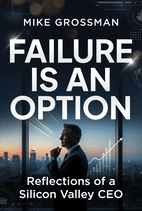
These quotes come straight from the trenches of Silicon Valley, where failure isn't a dirty word but a raw, inevitable part of the journey. Mike Grossman doesn't polish the truth; he gives you the gritty, emotional reality of leading a tech startup, from gut-wrenching lows to fleeting highs.
What makes this book so quotable is its brutal honesty. Every line feels earned, not borrowed from a self help manual. You'll find observations about luck, timing, and the loneliness of leadership that stick with you long after you read them.
Top Quotes from Failure Is An Option
“Leadership is not about avoiding failure; it's about navigating it with humility, integrity, and resilience.”
From a book blurb by Brad Smith, President of Marshall University and former Chairman and CEO of Intuit.
Redefines leadership in a powerful, actionable way, shifting focus from avoidance to courageous navigation.
“The real Silicon Valley is more about failure than success.”
From the author's section 'The Real Silicon Valley' where he challenges common perceptions.
Concise and counterintuitive, it sets the book's core theme and reframes the popular narrative.
“It's a psychological roller coaster that goes down more than up — a metaphorical Omaha Beach on D-Day -a relentless exercise in self-delusion and masochism.”
Grossman elaborates on the brutal psychological journey of running a startup.
The extreme metaphor of Omaha Beach and the mention of self-delusion and masochism powerfully capture the constant adversity and mental endurance required, leaving a lasting impression.
“I could do everything in my power in terms of effort, grit, focus, discipline, and perseverance - and fail.”
The author's realization that effort alone does not guarantee success as a CEO.
It powerfully conveys the humbling truth that even maximum effort can lead to failure, challenging the conventional wisdom that hard work always pays off.
“We came to understand that “Failure was most definitely an option.””
The author and his co-founder shifting from the Apollo 13 mantra to a more realistic view.
It subverts the iconic 'failure is not an option' line, embracing the reality that failure is always possible and must be accepted.
“At 10 a.m., you're on top of the world. At 2 p.m., you're facing existential peril.”
The author describing the unpredictable emotional swings of startup life.
This line vividly captures the extreme volatility that leaders face, making it instantly relatable to anyone who has experienced a sudden reversal of fortune.
“Whenever something good happens, I always assume that something bad is just around the corner. Whenever something bad happens, I always assume that something good is just around the corner.”
The author describes his first coping strategy for CEO stress: never getting too high or too low.
This balanced, stoic mindset resonates with anyone facing uncertainty, emphasizing emotional equilibrium in the face of volatility.
Themes Behind the Quotes
A central theme is that failure is not just possible but probable, and it's how you navigate it that defines your path. The quotes repeatedly underscore that success often hinges on factors outside your control, like timing and pure luck, rather than just effort or talent. Another major thread is the intense isolation and emotional strain of leadership, where you carry the weight of others' livelihoods while feeling powerless yourself.
There's also a strong emphasis on accepting unpredictability and focusing only on what you can change. The quotes balance a gritty realism about the grind with a persistent resilience, suggesting that the real skill is in staying steady when everything swings between triumph and disaster. Ultimately, the book strips away the myth of the heroic founder and replaces it with a more honest, human story.
Quotes by Chapter
Advance Praise
“If you're looking for a realistic portrayal of the entrepreneurial journey, this is it.”
From a praise blurb by Kewsong Lee, former CEO of The Carlyle Group.
Direct and compelling endorsement that promises authenticity, making readers trust the book's value.
“With a little luck and good timing some find success and then they write books about how smart or clever they were and how they had it all figured out from the start! Failure Is an Option is a breath of fresh air.”
From a praise blurb by Carlos Rodriguez, former CEO and Executive Chair of ADP.
Witty critique of typical success narratives that contrasts with the book's refreshing honesty about failure.
Introduction
“The one thing I (emphatically) knew was that if I was going to write a book, it needed to be original and unconventional.”
The author describes his determination before writing the book.
It reveals the author's commitment to breaking from traditional business books, setting reader expectations for a unique reading experience.
“I’m interested in examining the key issues faced by Silicon Valley CEOs and their practical, ethical, and emotional implications.”
The author explains the focus of his book.
This statement promises depth beyond tactical advice, addressing the human and moral dimensions of leadership that are often overlooked.
“First, I hope you find it thought- provoking and entertaining. Second, I hope it provides you with a better sense of what running an entrepreneurial technology company actually feels like. And third, I hope you conclude that it's unlike any business book you've ever read before.”
The author lists his three main goals for readers.
These goals clearly define the book's value proposition—blending entertainment, emotional authenticity, and originality. It directly invites the reader to expect something different.
The Real Silicon Valley
“Running a company in Silicon Valley is an enervating, emotionally draining, gut-wrenching experience.”
Grossman describes the harsh reality of being a CEO in the tech industry.
The stark, visceral language vividly conveys the emotional toll of entrepreneurship, making it relatable to founders and leaders who have faced similar struggles.
“I don't regret the choice of career. It hasn’t been easy, but it has always been interesting. It hasn't always been fun, but it has always been challenging.”
Grossman reflects on his decades-long career in Silicon Valley despite all the hardships.
This balanced, honest conclusion resonates with readers who value meaningful struggle over easy success, affirming that difficulty can coexist with fulfillment and growth.
Unlearning the Wrong Lessons
“The truth was that I was certain I would succeed because I had always succeeded before.”
The author reflects on his false confidence when starting his company.
It captures the dangerous assumption that past success guarantees future success, a common trap for entrepreneurs.
“Success isn’t defined by personal performance.”
The author explaining the difference between being a student or employee and being a CEO.
It succinctly distinguishes individual effort from organizational outcomes, a key lesson for leaders.
Timing Is Everything
“And one of the main things I've learned is that timing is everything.”
The author reflects on his Silicon Valley experience after listing traditional success factors.
This simple, direct statement encapsulates the chapter's central lesson, making it memorable and universally applicable.
“Our idea had been sound, and our execution was generally strong, but we were five years too early.”
The author summarizes the LiveCapital failure after learning of OnDeck Capital's successful IPO.
It highlights the painful irony that good ideas and strong execution can still fail if the market isn't ready, resonating with entrepreneurs who face similar timing challenges.
“Without a dramatic change in strategy, we were on the road to ruin.”
The author describes the moment he accepted the business model's fundamental flaw.
This line conveys the urgency and stark reality of a failing venture, capturing the tension between stubbornness and survival.
“It turned out that the vast majority of small business applicants on our site had been rejected for loans by their local banks. They weren't creditworthy, and desperation was their only reason for applying online.”
The author explains the adverse selection problem that doomed LiveCapital's original model.
This reveals a counterintuitive market truth—early adopters can be the worst customers—making it a cautionary tale for any data-driven startup.
Feeling Lucky?
“I leaned forward, jabbed my index finger down onto the table between us, and emphatically declared, “That's not bullshit.””
The author recounts his spontaneous reaction during a McKinsey interview after the interviewer gave him a funny look.
This vivid moment captures how a completely unplanned outburst can dramatically alter one's life trajectory, illustrating the role of luck.
“In other words, saying “bullshit” in an interview completely altered the trajectory of my life.”
The author summarizes the long-term impact of his interview comment.
It succinctly conveys the chapter's central theme that seemingly trivial random events can have profound and unforeseen consequences.
“But it wasn't planned. It didn’t reflect hard work or competence. It was a spontaneous reaction. It was random. It was luck.”
The author reflects on the nature of the event that led to his job at McKinsey.
This emphatic series of statements challenges the common belief that success is solely due to effort and skill, highlighting the power of chance.
“The only sure thing about luck is that it will change.”
The author quotes American short story writer Bret Harte at the end of the chapter.
This pithy saying encapsulates the chapter's message about the unpredictability of luck and its inevitable shifts over time.
What, Me Worry?
“You are part of a team yet isolated from it. You constantly communicate with people - employees, investors, customers — about a wide range of topics, but not about how you are doing personally.”
The author explaining the intense loneliness of the CEO role.
It resonates because it articulates a paradox many leaders feel: being surrounded yet alone, and the silent burden of always focusing on others.
“You may not have met most of your employees’ partners and kids, but you know they're out there, and they’re all depending on you to do a great job.”
The author reflecting on the immense responsibility of a CEO.
This line humanizes the weight of leadership by tying abstract decisions to real families, reminding readers that every choice has a human cost.
“Everyone thinks that I have a lot of power, but I really don’t. I’m entirely dependent on other people. I can’t make anybody do anything.”
Brad Smith, then CEO of Intuit, in a conversation with the author.
This quote powerfully challenges the stereotype of the all-powerful CEO, revealing the vulnerability and reliance on others that defines true leadership.
Keeping It Together
“The better approach is to focus 100 percent on the things you can actually control.”
The author explains his second coping strategy of focusing on input rather than outcome.
This is a powerful reminder to redirect energy toward controllable actions, reducing anxiety and increasing effectiveness.
“It's a real-life application of the Serenity Prayer. “God, grant me the serenity to accept the things I cannot change, the courage to change the things I can, and the wisdom to know the difference.””
The author sums up his input-focused approach by referencing the Serenity Prayer.
This classic prayer encapsulates the wisdom of focusing on what we can control, providing spiritual and practical guidance for resilience.
What’s the Story?
“When it comes to making movies, storytelling is the most important priority. If you can't tell a compelling story, then you can’t make a compelling movie.”
Author recounts his son's film education and what he learned from professors and Ron Howard.
This line encapsulates the central lesson that storytelling is the foundation of success in both film and business.