Introduction: The Girl Who Did a Month's Worth of Practice in Six Minutes
Chapter 1 of 4
0:000:00
EN
1x
Voice
PDF
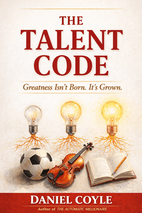
The Talent Code
by Daniel Coyle
What is the book The Talent Code about?
Daniel Coyle's The Talent Code reveals how skill is biologically built through deep practice, explaining the neuroscience of myelin for coaches, educators, and anyone seeking to master a craft.
Feature
Insta.Page
Blinkist
Shortform
Summary Depth
Full Chapter-by-Chapter
15-min overview
Section-by-section guides
Audio Narration
✓
✓
✓
Visual Mindmaps
✓
✕
✕
AI Q&A
✓
✕
✕
Quizzes
✓
✕
✕
PDF Downloads
✓
✕
✓
Price
$89.99/yr
$146/yr (PRO)
$199/yr
*Competitor data last verified July 2026.
1 Page Summary
The Talent Code by Daniel Coyle argues that extraordinary talent is not the result of innate genius but is instead built through a specific biological process he terms "deep practice." Coyle investigates "talent hotbeds" around the world—from a Russian tennis academy to a Brazilian soccer field and a classical music camp—and identifies a common, counterintuitive method of learning. This involves operating at the edge of one's ability, making mistakes, and correcting them in a slow, focused, and repetitive manner. This intense struggle physically alters the brain by wrapping neural circuits in a substance called myelin, which acts like insulation on a wire, making the signals faster, stronger, and more accurate. The book posits that skill is, quite literally, built into the circuitry of the brain through this targeted practice.
The concept is placed within a historical shift in understanding, moving from a vague belief in "natural gift" or sheer effort toward a neuroscience-based model of skill acquisition. Coyle supports his thesis with emerging research on myelin's role in neural function, framing it as the fundamental mechanism behind all skill development, from playing a violin to writing code. He further contextualizes talent by emphasizing the crucial roles of "ignition" (a deep, motivational spark) and "master coaching" (a specific, knowledge-driven teaching method) as the essential companions to deep practice, creating the ecosystem in which talent flourishes.
The book's lasting impact lies in its democratization of excellence. By demystifying talent as a biological process accessible through a specific type of effort, The Talent Code provides a practical and empowering framework for educators, coaches, parents, and learners. It shifted the conversation from "finding" talent to "building" it, influencing fields like education, sports training, and corporate development. The core idea that struggle and targeted error-correction are not signs of failure but the very engine of skill formation continues to reshape approaches to learning and mastery.
Introduction: The Girl Who Did a Month's Worth of Practice in Six Minutes
Overview
This introduction begins with a series of intriguing mysteries: why do certain unassuming places—a poor Russian tennis club, a Dallas music school, a remote British village—consistently produce extraordinary talent? It then reveals a unifying thread through the story of a seemingly average teenage clarinetist named Clarissa, whose brief, intense practice session demonstrates a universal principle of skill acquisition. The chapter introduces the core concept of the book: that all skill development is underpinned by a neural mechanism involving a substance called myelin, and that accessing this "talent code" requires a specific blend of deep practice, ignition, and master coaching.
The Mystery of Talent Hotbeds
The chapter opens by posing compelling questions about unlikely origins of world-class talent. From a single-court Russian tennis club outproducing the entire United States in top women players, to a Dallas storefront school birthing pop stars, to a poor British family producing three literary giants, these "talent hotbeds" appear to bloom without obvious cause. This pattern is historical, seen in the composers of Vienna, the playwrights of Elizabethan England, and the artists of Renaissance Florence. The central puzzle is always the same: where does this concentrated talent come from, and how does it develop?
Clarissa’s Six-Minute Transformation
The search for an answer focuses on a video study of a 13-year-old clarinet student named Clarissa, initially judged as having no particular musical gifts. Over five minutes and fifty-four seconds, she works on a new piece, "Golden Wedding." Her practice is not smooth or melodic; it is fragmented, full of stops, mistakes, and repetitions. She plays a few notes, stops to scrutinize the music, hums phrases, corrects errors, and slowly assembles the song piece by piece. Psychologist Gary McPherson, who conducted the study, observes that this clumsy, effortful process is precisely "how a professional musician would practice." Clarissa is building a mental blueprint, fixing errors, and scaffolding her skill to a higher level through intense, focused engagement. Immediately after, however, she reverts to playing a familiar tune mindlessly, "like she's on a moving sidewalk," demonstrating she is unaware of the powerful learning zone she just occupied.
The Neurological Holy Grail: Myelin
The chapter argues that Clarissa’s productive struggle and the phenomenon of talent hotbeds are linked by the same neural mechanism. The key is myelin, a fatty insulation that wraps around nerve fibers. Every human skill is created by chains of these nerve fibers carrying electrical signals. Myelin wraps and insulates these circuits, making the signals faster, stronger, and more accurate. Crucially, myelin grows in response to repeated and targeted use of a circuit—the right kind of practice. The more time spent firing a specific circuit correctly (like Clarissa did in her focused six minutes), the more myelin layers are added, and the more ingrained and skillful the action becomes. This process is universal, happening throughout life, and is the common foundation for acquiring any skill, whether physical, mental, or artistic.
A New Model for Skill
This discovery provides a radical new model: skill is myelin insulation that wraps neural circuits. Talent is not a preordained genetic gift but a physiological process accessible to anyone. All skills, languages, and movements are made of living circuits that grow according to the same rules. The "talent code" is the set of principles that optimally triggers this myelin growth. The book posits that by understanding and applying this code, we can access accelerated learning.
The Three Elements of the Code
The talent code consists of three core elements that work together to grow myelin and build skill:
Deep Practice: The targeted, error-focused, high-engagement process exemplified by Clarissa.
Ignition: The motivational fuel that provides the energy and commitment for long-term deep practice.
Master Coaching: The teaching and mentoring that effectively guides the deep practice process.
Alone, each element has value, but their powerful convergence is what creates and sustains extraordinary skill development, transforming average environments into talent hotbeds.
Key Takeaways
Extraordinary talent often emerges from unlikely places, suggesting universal principles at work rather than mere chance or isolated genius.
Deep practice—a struggle-filled, error-conscious, and intensely focused process—is a far more effective learning method than smooth, mindless repetition.
All skill acquisition is rooted in a neural process: the growth of myelin, which insulates neural circuits and makes them faster and more accurate.
Skill is myelin. The more you practice correctly, the more myelin you build, and the more skilled you become.
The talent code is a framework for accelerated learning, combining deep practice, ignition (motivation), and master coaching to optimally trigger myelin growth.
Key concepts: Introduction: The Girl Who Did a Month's Worth of Practice in Six Minutes
1. Introduction: The Girl Who Did a Month's Worth of Practice in Six Minutes
The Mystery of Talent Hotbeds
Unlikely places consistently produce extraordinary talent (e.g., a Russian tennis club, a Dallas music school)
Historical pattern seen in Vienna composers, Elizabethan playwrights, and Renaissance artists
Central puzzle: Where does concentrated talent come from and how does it develop?
Clarissa's Six-Minute Transformation
A 13-year-old clarinetist demonstrates powerful learning in under six minutes
Practice is fragmented, error-filled, and focused on building a mental blueprint
Shows how professionals practice: through intense, focused engagement with mistakes
Reverts to mindless play afterward, unaware of the learning zone she occupied
The Neurological Foundation: Myelin
Myelin is fatty insulation that wraps nerve fibers, making signals faster and more accurate
Grows in response to repeated, targeted use of neural circuits
Universal process underlying all skill acquisition (physical, mental, artistic)
Correct practice builds more myelin layers, ingraining skills
A New Model for Skill Development
Skill is myelin insulation wrapping neural circuits
Talent is not preordained genetic gift but accessible physiological process
All skills are made of living circuits that grow according to same rules
The 'talent code' provides principles for optimal myelin growth
The Three Elements of the Talent Code
Deep Practice: Targeted, error-focused, high-engagement learning process
Ignition: Motivational fuel providing energy for long-term commitment
Master Coaching: Effective teaching that guides deep practice
Powerful convergence of all three creates extraordinary skill development
💡 Try clicking the AI chat button to ask questions about this book!
Chapter 1 - The Sweet Spot
Overview
This chapter begins with a curious observation from the world's most fertile talent hotbeds: true expertise isn't born from constant displays of flawless genius. Instead, it's forged in moments of targeted, frustrating struggle, where individuals operate at the very edge of their ability. This struggle is the engine of deep practice, a concept illuminated by a simple psychological paradox: we remember things far better when we have to work for them, even for a microsecond. The core of learning is not passive absorption, but active, error-filled effort that builds skill in the brain by consistently targeting the sweet spot just beyond our current capabilities.
This principle becomes dramatically clear in high-stakes environments. When pilots kept crashing in bad weather, the invention of a flight simulator allowed them to safely inhabit that sweet spot, practicing disaster and recovery until their skills were second nature. Similarly, the mystery of Brazil's soccer dominance is unraveled not by climate or passion, but by a specific training tool: futsal. This fast-paced, small-court game acts as a perfect deep-practice machine. Its heavier ball and confined space demand superior control, quicker decisions, and constant problem-solving. In Brazil, futsal evolved from a pastime into a national institution, an "incubator" where virtually every legendary player spent their formative years. The sport's constraints—resulting in players touching the ball vastly more often—accelerate skill development, forging a signature style of improvisational brilliance. Moves famous worldwide can be traced directly to the futsal court.
The ultimate proof of futsal's power as a universal training method comes from an experiment far from Brazil. A coach in Leeds, England, built a program around its principles, immersing local kids in its intensive, repetitive environment. The stunning success of his teams, which began defeating national youth sides, demonstrated that the deep practice environment cultivated in Brazil's streets could be replicated anywhere to build extraordinary skill.
The Pattern of Struggle
The author's journey to what he calls "chicken-wire Harvards"—humble, extraordinarily productive talent hotbeds—revealed an unexpected pattern. While dazzling skill was on display about half the time, the other half was dominated by something else: moments of slow, deliberate struggle. Young athletes and musicians were seen operating at the very edge of their ability, breaking moves down into painfully slow parts, stopping and starting, and making frequent mistakes. Their faces showed intense, Clint Eastwood-like concentration. This wasn't effortless genius; it was a targeted, error-filled process.
The Paradox of Deep Practice
This observed struggle connects directly to the work of psychologist Robert Bjork. His simple word-pair experiment demonstrates a powerful paradox: people remember words with missing letters far better than complete ones because the microsecond of struggle to fill in the blank creates deeper learning. The same principle applies to recalling a name or trying on a life vest instead of just watching a demonstration. The core idea is that deep practice—operating at the edge of your ability, making mistakes, and correcting them—builds skill with remarkable efficiency. It's not about passive observation or effortless performance; it's about targeted reaching and productive struggle that builds "scaffolding" in the brain. The goal is to find the "sweet spot" just beyond your current capabilities.
Learning from (Simulated) Catastrophe: The Link Trainer
The life-or-death necessity for better training is starkly illustrated by the 1934 "Airmail Fiasco," where skilled U.S. Army Air Corps pilots kept crashing in bad weather. The solution came from an unlikely tinkerer, Edwin Link. His flight simulator, originally dismissed as a carnival amusement, allowed pilots to practice deeply in safety. They could stall, crash, and recover countless times, inhabiting the "sweet spot" of their abilities without risk. The half-million pilots trained in "The Blue Box" during WWII weren't inherently braver or smarter—they simply had the chance to make errors and learn from them in a compressed, high-feedback environment.
Brazil's Accelerator: Futsal
The global mystery of Brazil's disproportionate soccer talent finds its answer not in climate, passion, or poverty alone, but in a specific training method. As observed by coach Simon Clifford, Brazil's secret weapon is futsal, a fast, confined, small-ball version of soccer played on hard courts. This game functions as a deep-practice machine. The heavier, low-bounce ball demands better control. The small space forces quicker decisions and more touches. The non-stop action creates constant, pressurized problem-solving. Brazil's rise to soccer dominance in the late 1950s correlates with the widespread adoption of futsal, which essentially allows players to make more mistakes, face more challenges, and build more skill-scaffolding in a single session than a traditional grass-field practice ever could. It is their institutionalized sweet spot.
Brazil’s Futsal Obsession and Cultural Incubator
While other nations adopted the game, Brazil’s relationship with futsal became uniquely profound. In a country where grass fields were scarce, the game’s adaptability allowed it to flourish in crowded cities, capturing the imagination of youth much like pickup basketball does in American inner cities. This wasn’t just a pastime; it became a national institution. Brazil’s staggering dominance in organized international futsal—winning 35 of 38 competitions—hints at the deep cultural investment in the sport. Author Alex Bellos frames it as “the incubator of the Brazilian soul,” a notion borne out in the biographies of virtually every legendary Brazilian player, from Pelé to Ronaldinho. These stars often spent their formative years, ages seven to twelve, dedicating multiple days per week to futsal, accumulating thousands of hours of practice in the sport before ever regularly playing on a full-sized grass pitch.
The Futsal Signature in Brazilian Skills
The influence of futsal is visibly encoded in the signature moves of Brazilian soccer. Professor Dr. Emilio Miranda of the University of São Paulo can trace famous tricks directly back to the small court. The elastico, the toe-poke goal, and moves like the d’espero and vaselina all originated in futsal. Miranda dismisses the romanticized notion of skills born on the beach, stating plainly, “great players don’t come from the beach. They come from the futsal court.” This environment forges a distinctive style of play characterized by supreme comfort and control under intense pressure.
The Accelerating Math of the Small Court
The transformative power of futsal is rooted in its mathematical and spatial constraints. A Liverpool University study found futsal players touch the ball six times more often per minute than outdoor soccer players. The smaller, heavier ball discourages mindless clearing and demands precise handling and sharp, intelligent passing. Players constantly work for angles and quick combinations in tight spaces, which massively accelerates the development of ball control and visionary play. When these players graduate to the full-sized field, they operate with a perceived abundance of time and space. Dr. Miranda encapsulates the formula: “No time plus no space equals better skills. Futsal is our national laboratory of improvisation.” It acts as a deep practice machine, compressing soccer’s essential skills into a high-repetition, high-feedback loop where learning is dramatically accelerated.
Transplanting the Laboratory: An Experiment in Leeds
Simon Clifford recognized futsal as the critical lever in Brazil’s talent factory and conducted an audacious experiment to see if its magic could be transplanted. He quit his teaching job, founded a futsal organization, and started the Brazilian Soccer School in a rough area of Leeds. His program immersed local kids in futsal drills and even samba music, aiming to replicate the Brazilian incubator. To outsiders, the sight of Yorkshire kids practicing intricate tricks to a samba beat seemed ludicrous. However, the results proved Clifford correct. Within years, his youth teams were defeating Scottish and Irish national youth sides. A graduate, Micah Richards, went on to play for the English national team, and the school model expanded globally, demonstrating that the deep practice environment of futsal could indeed cultivate elite skills outside of Brazil.
Key Takeaways
Futsal is not merely a Brazilian pastime but the nation’s fundamental skill incubator, responsible for the distinctive, improvisational style of its greatest players.
The game’s constraints—less time, less space, more ball touches—create an ideal deep practice environment, forcing accelerated technical and cognitive development.
Famous Brazilian soccer moves and a signature comfort on the ball are directly traceable to futsal origins, not beach soccer.
The success of Simon Clifford’s experiment in Leeds proves futsal’s training effects are transferable and culturally universal, capable of building elite skills anywhere its intensive, repetitive practice is applied.
Key concepts: Chapter 1 - The Sweet Spot
2. Chapter 1 - The Sweet Spot
The Core Principle: Deep Practice
True expertise is forged through targeted struggle at the edge of one's ability, not flawless genius.
The 'sweet spot' for learning is just beyond current capabilities, where errors and corrections occur.
Deep practice is active, error-filled effort that builds skill scaffolding in the brain.
Memory and learning are enhanced by the microsecond of struggle required to retrieve or complete information.
The Pattern of Observed Struggle
Talent hotbeds show a pattern of slow, deliberate practice, not constant dazzling performance.
Learners operate at their edge, breaking skills into parts, stopping, starting, and making mistakes.
The process is characterized by intense, focused concentration during this struggle.
The Link Trainer: Learning from Simulated Failure
The 1934 Airmail Fiasco revealed the lethal cost of inadequate training for complex skills like flying.
Edwin Link's flight simulator created a safe 'sweet spot' for pilots to practice catastrophe and recovery.
It allowed for compressed, high-feedback deep practice without real-world risk, proving transformative for WWII pilot training.
Futsal: Brazil's Deep-Practice Machine
Brazil's soccer dominance is linked to the widespread adoption of futsal, not just climate or passion.
Futsal's constraints (small court, heavy ball) force more touches, quicker decisions, and constant problem-solving.
It acts as an accelerator, allowing players to make more mistakes and build more skill per session than traditional training.
The game evolved into a national cultural incubator where legendary players developed their signature improvisational style.
Universal Application of the Principle
The deep-practice environment is replicable, as shown by a coach in Leeds, England, using futsal principles.
Immersing learners in an intensive, repetitive, constrained environment can build extraordinary skill anywhere.
The core mechanism—targeted struggle in the sweet spot—is a universal engine for skill development.
Brazil's Unique Futsal Culture
Futsal flourished in Brazil due to scarce grass fields, becoming a national institution in crowded cities
Brazil's dominance in international futsal (35 of 38 competitions) reflects deep cultural investment
Alex Bellos describes futsal as 'the incubator of the Brazilian soul'
Legendary players like Pelé and Ronaldinho spent formative years (ages 7-12) primarily playing futsal
Technical Skills Forged in Futsal
Signature Brazilian moves like the elastico and toe-poke goal originated in futsal courts
Professor Emilio Miranda states great players come from futsal courts, not beaches
Futsal environment creates supreme comfort and ball control under intense pressure
The game's constraints forge a distinctive improvisational style of play
The Mathematical Advantage of Futsal
Futsal players touch the ball six times more per minute than outdoor soccer players
Smaller, heavier ball demands precise handling and intelligent passing
Constant work in tight spaces accelerates development of ball control and visionary play
Dr. Miranda's formula: 'No time plus no space equals better skills'
Futsal acts as a 'deep practice machine' compressing essential skills into high-repetition loops
Cross-Cultural Validation: The Leeds Experiment
Simon Clifford transplanted Brazilian futsal methodology to Leeds, England
Program combined futsal drills with samba music to replicate Brazilian incubator
Youth teams defeated Scottish and Irish national youth sides within years
Graduate Micah Richards reached English national team, proving method's effectiveness
Demonstrated futsal's training effects are transferable across cultures
Chapter 2 - The Deep Practice Cell
Overview
At the heart of skill acquisition lies a quiet biological revolution centered on myelin, the neural insulator that transforms sluggish brain circuits into lightning-fast highways. This "stuff of talent" grows each time we fire a neural pathway through effort, wrapping it in layers that boost signal speed and accuracy. That's why deep practice—the kind filled with struggle and focused error-correction—is so powerful: it directly signals the brain to add more myelin, optimizing performance bit by bit. This process follows core rules: myelin responds only to action, it's universal across all skills, it's a one-way street making habits durable, and it grows most readily in youth.
This understanding shifts the narrative from mere effort to precision. Talent hotbeds succeed not because people try harder, but because they practice correctly, leveraging deep practice to build superior neural skill. This idea finds its champion in researcher Anders Ericsson, whose obsession with expertise led him to challenge fixed notions of ability. Starting with memory training, he proved that limits like short-term memory capacity are malleable, paving the way for his odyssey into skilled performance. His work revealed that world-class expertise universally requires about ten thousand hours of deliberate practice, characterized by relentless focus on technique and feedback.
Naturally, this raises the genius objection—what about Mozarts or savants? The evidence shows that even prodigies accumulate massive early practice, with their "rage to master" driving intense deep practice. There's no unique biology at play; as Ericsson put it, “There's no cell type that geniuses have that the rest of us don't.” When combined, the myelin model and Ericsson's research form a universal framework: skill is built through dedicated deep practice that physically alters the brain, offering a lens to see connections across all domains of human achievement.
The Neurological Revolution: Myelin as the "Stuff of Talent"
Deep practice might seem magical, but its power is rooted in a tangible biological process centered on a humble neural insulator called myelin. For over a century, neuroscience focused on neurons and synapses as the seats of learning. However, a quiet revolution has shifted focus to myelin, the dense fatty insulation that wraps around nerve fibers. This "white matter" accounts for over half the brain's mass and is now understood to be the fundamental mechanism behind skill acquisition.
How Myelin Works: Installing Broadband in the Brain
Every human thought, feeling, or movement is a precisely timed electrical signal traveling along a circuit of nerve fibers. Myelin's role is to wrap that circuit, increasing the signal's strength, speed, and accuracy.
The Firing Circuit: Skills are not stored in our muscles but in neural circuits—chains of nerve fibers that fire in specific patterns. A simple tennis backhand involves a circuit of hundreds of thousands of fibers.
The Optimization Process: Each time a circuit is fired, specialized cells called oligodendrocytes sense the activity and respond by wrapping more myelin layers around the active nerve fibers.
The Result: This process is slow and incremental, but with repetition, it transforms a sluggish neural alley into a lightning-fast superhighway. Signal speeds can increase 100-fold, and overall information-processing capability can multiply by 3,000 times. Myelin also perfects timing, ensuring signals from different neurons arrive at synapses in perfect synchrony (within about 4 milliseconds), which is crucial for a fluid golf swing or a musical phrase.
The Deep Practice Connection
This biological mechanism directly explains why deep practice is so effective. When Clarissa struggles through "Golden Wedding," when a pilot trains in a simulator, or when young soccer stars play futsal, they are intensely firing specific neural circuits. Each targeted effort, each attention to error, signals the oligodendrocytes to add another wrap of myelin, optimizing that circuit bit by bit. Struggle is not an option for growth; it's a biological requirement. The old adage changes: practice doesn't make perfect; practice makes myelin, and myelin makes perfect.
Core Principles of Myelin
This universal skill mechanism operates by a few key rules:
It Responds to Action: Myelin doesn't care about thoughts or passive watching. It grows in response to the electrical impulse of doing—specifically, of firing a circuit.
It's Universal: The same myelin process underwrites every skill, from chess to violin to speaking Mandarin. It is meritocratic, insulating whatever circuits you fire most.
It's a One-Way Street: Myelin wraps but doesn't unwrap. This is why habits are hard to break; you must build and myelinate new circuits to override old ones.
Age Affects Its Growth: The brain is most receptive to myelination during critical developmental windows, especially in youth and young adulthood. While we can build myelin throughout life, it becomes harder and slower with age, which is why most world-class experts start their deep practice early.
The Myelin Frontier and a Maniacally Energetic Noah
The chapter shifts from the specific example of Brazil's soccer fields to address a broader misconception: that underdogs succeed merely because they "try harder." The myelin model reveals that true hotbeds of talent succeed because people are practicing in the right way—engaging in deep practice that builds more myelin and earns more skill. These places aren't underdogs; they've found the right leverage, like David against Goliath.
Anders Ericsson's Obsession
The narrative then introduces the man who would become the "maniacally energetic Noah" for the grand study of skill. Anders Ericsson, a Swedish boy who idolized explorer Sven Hedin, initially believed he was mostly without talent. A pivotal moment came when a chess-playing peer, after dedicated study, began to beat him consistently. This sparked Ericsson's lifelong obsession: "I gradually became more obsessed with studying experts than with being one."
As a psychology student during the cognitive revolution, Ericsson found his unexplored territory: the source of greatness. His first major challenge was to overturn the sacred psychological tenet of fixed short-term memory, famously limited to "seven, plus or minus two" digits. By training volunteers, he demonstrated that this "hardware" limit was malleable; one student memorized over 100 digits. This breakthrough led to his core insight: if memory isn't fixed, then perhaps no skill is. "Every skill was a form of memory."
The Odyssey Through the Kingdom of Talent
This launched Ericsson's decades-long research into skilled performance across countless domains. He and his colleagues established a foundational statistic: world-class expertise in any field requires roughly ten thousand hours of deliberate practice. This practice is defined by working on technique, seeking constant critical feedback, and focusing relentlessly on weaknesses.
His work validated concepts like the Ten-Year Rule, showing that a decade of committed practice is typically required. This framework applies universally, implying all skills are built using the same fundamental, physiological mechanism.
Addressing the Genius Objection
The chapter directly tackles the inevitable question: What about natural geniuses like Mozart or savants? The research responds with data, not mystery. Mozart, by age six, had accumulated an estimated 3,500 hours of rigorous musical training with his father. Savants excel in narrow, rule-based domains where they have had massive prior exposure. Their "genius" often resides in an obsessive, innate drive to engage in deep practice—a "rage to master." As Ericsson succinctly states, “There's no cell type that geniuses have that the rest of us don't.”
A Universal Theory of Skill
When Ericsson's psychological research is overlaid with the new myelin science, a powerful, unified framework emerges. While the equation deep practice x 10,000 hours = world-class skill is temptingly concise, the chapter suggests its greater value is as a lens. This lens allows us to see hidden connections and ask provocative questions, setting the stage for examining seemingly disparate worlds—from the Brontë sisters to skateboarders—through the same principle of deep, skill-building practice.
Key Takeaways
True talent hotbeds create success not just through effort, but through deep, correct practice that builds neural skill.
Anders Ericsson's research demonstrated that skills are not fixed "hardware" but can be radically improved through training.
The 10,000-Hour Rule and the Ten-Year Rule are robust findings showing world-class expertise requires a massive quantity of dedicated, deliberate practice.
So-called "natural genius" or savant ability is typically the product of extreme early exposure and obsessive deep practice, not a unique biological endowment.
Combining myelin science with Ericsson's work provides a universal framework for understanding skill acquisition, applicable to every domain of human achievement.
Key concepts: Chapter 2 - The Deep Practice Cell
3. Chapter 2 - The Deep Practice Cell
The Myelin Model: Biological Basis of Skill
Myelin is a neural insulator that wraps nerve fibers to increase signal speed, strength, and accuracy
Skill acquisition occurs through myelination—each time a neural circuit fires, oligodendrocytes add myelin layers
Myelin transforms slow neural pathways into fast, efficient circuits, improving performance up to 3,000 times
Deep practice works because struggle and error-correction signal the brain to add more myelin
Core Principles of Myelin Function
Myelin responds only to action—electrical impulses from doing, not thinking or watching
Universal across all skills—same process for chess, music, sports, and language
One-way street—myelin wraps but doesn't unwrap, explaining why habits are durable
Age affects growth—most receptive in youth, harder to build with age
Deep Practice: The Engine of Myelination
Practice makes myelin, and myelin makes perfect—not just 'practice makes perfect'
Struggle is a biological requirement for growth, not optional
Targeted effort and attention to errors signal myelination of specific circuits
Talent hotbeds succeed through correct practice methods, not just harder effort
Anders Ericsson's Research on Expertise
Challenged fixed notions of ability, showing skills are malleable through training
Established the 'ten thousand hours' principle for world-class expertise
Defined deliberate practice as focused, technique-oriented work with feedback
Proved even prodigies accumulate massive early practice with 'rage to master' drive
The Universal Framework of Skill Development
No unique biology for geniuses—'no cell type that geniuses have that the rest of us don't'
Skill is built through dedicated deep practice that physically alters the brain
Combines myelin model with Ericsson's research into comprehensive understanding
Applies across all domains of human achievement from sports to arts to intellectual skills
Anders Ericsson's Foundational Insight
Ericsson's obsession shifted from being an expert to studying the source of expertise itself.
His research overturned the fixed psychological limit of short-term memory, proving it was malleable through training.
The breakthrough led to his core hypothesis: if memory isn't fixed, perhaps no skill is, and 'every skill was a form of memory.'
The 10,000-Hour Framework of Expertise
World-class skill in any domain requires roughly ten thousand hours of deliberate practice.
Deliberate practice is defined by working on technique, seeking constant critical feedback, and focusing on weaknesses.
The Ten-Year Rule shows a decade of committed practice is typically a prerequisite for elite performance.
This framework applies universally, suggesting all skills are built using the same fundamental mechanism.
Deconstructing 'Natural Genius'
Case studies like Mozart reveal that prodigious output is preceded by massive, early, and rigorous training (e.g., 3,500 hours by age six).
Savants excel in narrow, rule-based domains where they have had obsessive, massive prior exposure and practice.
Their apparent genius often stems from an innate 'rage to master'—a drive to engage in deep practice.
Ericsson's conclusion: 'There's no cell type that geniuses have that the rest of us don't.'
A Unified Theory of Skill Acquisition
Ericsson's psychology and modern myelin science combine to form a powerful, universal framework for skill.
The equation 'deep practice x 10,000 hours = world-class skill' is a valuable lens, not just a formula.
This lens reveals hidden connections and allows provocative questions about skill development across disparate fields.
It sets the stage for examining all human achievement through the principle of deep, circuit-building practice.
Chapter 3 - The Brontës, the Z-Boys, and the Renaissance
Overview
The idea of "natural" talent is often a myth, as seen with the Brontë sisters, whose early writings were far from masterpieces—they were messy, imitative exercises. Yet, these childhood efforts were actually a form of collaborative deep practice, where hours of playful storytelling built the neural foundations for their later genius. This pattern repeats with the Z-Boys, skateboarding pioneers who honed their art in the constrained space of empty swimming pools. That environment served as a myelin accelerant, forcing rapid feedback and focused repetition to forge extraordinary skills. Scaling up, clusters of brilliance like the Italian Renaissance artists didn't arise from vague cultural magic but from the structured craft guilds, which created a "deep-practice hothouse" through years of apprenticeships. Underpinning these stories is the biology of skill, championed by neurologist George Bartzokis, who emphasizes that myelin—the insulation around neural circuits—is what makes us capable. His insight that "we are myelin beings" shifts the debate on talent, challenging the old nature versus nurture model. Instead, genes act as builders of a flexible system, not destiny; they provide myelin installers that wrap circuits based on how often they're fired through deep practice. This means skill isn't preloaded but earned by sending urgent signals to our brains, turning practice into the broadband of expertise. From individual effort to historical systems, the path to mastery is paved with focused, repetitive action that directs our innate biological machinery.
Demystifying "Natural" Talent
The narrative introduces a fundamental challenge to the common "Kid from Nowhere" myth of talent, using the Brontë sisters as a prime example. Elizabeth Gaskell's famous biography painted them as isolated, tragic geniuses, their childhood "little books" a sign of divine, preternatural gift. However, historian Juliet Barker's rigorous research dismantled this myth, revealing a more ordinary and instructive reality.
The Brontës' early writings were not flashes of genius but voluminous, sloppy imitations of popular literature of their day. Their spelling was poor, punctuation absent, and their stories derivative. This unexceptional start, however, is precisely the point. Their childhood was an extended session of collaborative deep practice. In the safe, private space of their tiny books, they spent countless hours firing the neural circuits involved in storytelling—constructing plots, developing characters, and navigating narrative rules—all while having fun. This process of constant, engaged repetition, making mistakes and iterating, is what built the myelin necessary for mastery. The mature elements of Wuthering Heights were not sudden inspirations but refined versions of characters and themes Emily Brontë had been practicing for years in her juvenilia.
The Accelerant of Constraint
A similar pattern emerges with the Z-Boys, the 1970s skateboarding revolutionaries from Venice, California. While they appeared as raw, spontaneous geniuses to the world, their skill was forged in a specific, high-stakes practice environment: empty backyard swimming pools.
The pool was a perfect myelin accelerant. Its steep, curved walls created a constrained space that demanded intense focus and whole-body coordination. There was no room for half-measures; a skater either made the connection with the concrete or fell spectacularly. This environment forced rapid, clear feedback on every attempt, constantly firing and honing precise neural circuits. Like the Brontës in their imaginative world, the Z-Boys used this unique tool for relentless, error-focused practice, transforming surfing movements into a new athletic art form.
The System Behind the Renaissance
The chapter then scales up the inquiry, asking how clusters of genius—like the artists of the Italian Renaissance—can appear. Traditional explanations (prosperity, peace, freedom) fall short when examined against the historically turbulent reality of 15th-century Florence. The answer, viewed through the prism of deep practice, lies not in mysterious cultural forces but in a tangible social system: the craft guilds.
The guilds operated a rigorous, multi-year apprenticeship system. Young boys lived with masters, learning through progressive, hands-on action—from grinding pigments to copying masterworks to eventually contributing to major commissions. This system created a "deep-practice hothouse," a structured environment where ordinary individuals spent thousands of hours solving problems, receiving immediate feedback, and competing within a hierarchy of skill. Figures like Michelangelo, who lamented how hard he worked for his mastery, were products of this systematic talent-building machine. Their genius was not a random gift but the architectural result of insulated circuits built over a decade or more of immersive practice.
The Biology of Skill
The science behind these narratives is passionately articulated by neurologist George Bartzokis, "Mr. Myelin." He frames myelin as the cornerstone of human capability and evolution. His insights connect the biological mechanism to observable phenomena:
Teenage impulsivity vs. adult wisdom is explained by the ongoing insulation of neural circuits, which only reaches full bandwidth in adulthood.
Human superiority over Neanderthals and other primates is linked to our greater myelin content, which allows for faster, more complex information processing—the "broadband" of the brain.
The benefits of breastfeeding, omega-3 fatty acids, and even Michael Jordan’s retirement are all tied to the building and eventual breakdown of myelin.
His central thesis is profound: "We are myelin beings." Talent and skill are not predetermined but are built through the signals we send our brains via deep practice. Myelin doesn’t care about identity or inspiration; it only cares about action—the repetitive, focused struggle that wraps circuits and creates skill.
The Myelin Alternative: Rethinking Nature vs. Nurture
The declaration that we are "myelin beings" presents a fundamental challenge to the classic nature/nurture paradigm. That model, while popular, is critiqued as being too vague to be useful for understanding talent—akin to saying cookies come from sugar and flour without providing a recipe. To move beyond it, we must first understand what genes actually do.
Genes as Builders, Not Destiny
Genes are not fateful cards dealt by cosmic chance. They are meticulous instruction manuals, written in nucleotides, for constructing the incredibly complex machines that are our bodies and minds. For most physical traits, the process is direct: genes instruct cells on how to build an eyelash or a toenail. But behavior and skill present a unique design challenge. The world is unpredictable, requiring fast adaptation. How can static genes help us navigate this?
The evolutionary solution was to prewire our brains with basic urges and instincts—like hunger, fear, or desire—that kick in when we encounter specific stimuli. This "if X, then Y" programming works beautifully for survival-oriented behaviors. However, it’s utterly impractical for complex, culturally specific higher skills like playing an instrument or writing software.
The Problem with Prewiring for Skill
Imagine if genes tried to prewire the exact neural circuits for a skill like chess or calculus. This strategy would be biologically expensive, consuming vast resources. More critically, it would be an evolutionary gamble. A gene prewiring for a genius app developer would have been worthless five hundred years ago, just as a gene for a master blacksmith is less useful today. Genes that survived natural selection are not in the business of making such wasteful, inflexible bets.
The Elegant Solution: Myelin Installers
Instead of prewiring specific skills, our genes adopted a brilliantly flexible strategy. They built the brain to include millions of universal "broadband installers"—the oligodendrocyte cells that produce myelin. These installers operate by a simple, powerful rule: whatever neural circuits are fired most often and most urgently get insulated with more myelin. Firing a circuit makes it faster, smoother, and more accurate. This system is most active in youth, works unconsciously (much like our immune system), and is standard equipment for all humans.
This means skill is not a preloaded gift but an earned adaptation. The "gift" from our genes is not talent itself, but the latent, universal capacity to build speed and skill in any circuit we diligently fire. When we deep-practice, we are sending urgent signals that direct these myelin installers to wrap the relevant neural pathways. The shared behaviors seen in talent hotbeds—intense practice, focused repetition—are the logical inputs to this shared biological system.
Implications and Evidence
This myelin model does not claim everyone has identical potential or that genes are irrelevant. It clarifies their role: genes build the adaptive system, but our actions direct it. Evidence can be found in the ten thousand hours of practice common to experts and even in physiological details like the unusual abundance of glial cells (which support myelin production) found in Albert Einstein’s brain—a finding that once seemed curious but now fits perfectly within this bandwidth-based understanding of skill.
We are not passive recipients of genetic destiny. We are active participants in shaping our own neural infrastructure. As the text concludes, we are all born with the opportunity to become "lords of our own Internet." The remaining challenge is learning how to most effectively send the signals that will build the skills we desire.
Key Takeaways
The traditional nature/nurture model is too vague to meaningfully explain skill acquisition.
Genes build our brains not with prewired talents, but with a flexible, adaptive system centered on myelin.
Myelin acts as "broadband insulation" for neural circuits; the more a circuit is fired through deep practice, the more myelin wraps it, increasing skill and speed.
This system is universal, unconscious, and efficient, allowing all humans the potential to develop high skill in areas they intensely practice.
Talent is not a pre-destined gift but the result of leveraging this innate, practice-driven adaptive mechanism.
Key concepts: Chapter 3 - The Brontës, the Z-Boys, and the Renaissance
4. Chapter 3 - The Brontës, the Z-Boys, and the Renaissance
Demystifying 'Natural' Talent
The Brontë sisters' early writings were messy, imitative exercises, not flashes of genius
Their childhood storytelling was a form of collaborative deep practice that built neural foundations
Mature works like Wuthering Heights emerged from years of refining practiced themes and characters
The 'Kid from Nowhere' myth of talent is dismantled by historical research into their actual development
The Accelerant of Constraint
The Z-Boys' skateboarding skills were forged in empty swimming pools as a myelin accelerant
Constrained environments force rapid feedback and intense, whole-body focus
This setting enabled error-focused practice that transformed surfing movements into new athletic art
Skill emerges from specific practice environments that demand precise neural circuit firing
The System Behind the Renaissance
Renaissance genius clusters emerged from structured craft guild apprenticeship systems
Guilds created a 'deep-practice hothouse' through multi-year, progressive hands-on learning
Artists like Michelangelo developed through thousands of hours of problem-solving with immediate feedback
Genius results from systematic talent-building machines rather than vague cultural forces
The Biology of Skill: Myelin
Myelin insulation around neural circuits is what makes skill and expertise possible
Genes provide 'myelin installers' that wrap circuits based on how often they're fired through practice
Human cognitive evolution and superiority are linked to greater myelin content enabling faster processing
Skill isn't preloaded but earned by sending urgent signals to our brains through deep practice
Core Framework: Deep Practice
Mastery is built through focused, repetitive action that directs biological machinery
Practice transforms into expertise by insulating neural pathways with myelin
The nature vs. nurture debate shifts: genes build flexible systems, not predetermined destinies
From individuals to historical systems, mastery follows patterns of structured, immersive practice
The Myelin Alternative: Rethinking Nature vs. Nurture
The 'myelin beings' thesis challenges the vague nature/nurture paradigm by offering a concrete biological mechanism for skill development.
Genes function as builders of adaptive systems rather than determiners of specific talents or destinies.
Complex skills cannot be biologically prewired due to evolutionary inefficiency and the changing demands of culture.
The brain's solution is universal 'myelin installers' (oligodendrocytes) that insulate circuits fired most often and urgently.
Skill is an earned adaptation directed by our actions, not a preloaded genetic gift.
Genes as Builders, Not Destiny
Genes are instruction manuals for constructing the body and mind, not fixed determinants of fate.
For survival behaviors, genes prewire basic 'if X, then Y' instincts (e.g., hunger, fear).
Complex, culturally specific skills (like chess or coding) cannot be practically prewired by genes.
The evolutionary challenge is creating adaptability in an unpredictable world.
The Problem with Prewiring for Skill
Prewiring specific skill circuits would be biologically expensive and resource-intensive.
It would be an evolutionary gamble—skills valuable in one era may be useless in another.
Genes that survived natural selection avoid wasteful, inflexible bets on particular talents.
The Elegant Solution: Myelin Installers
Genes build a flexible system: oligodendrocyte cells that act as universal 'broadband installers' for neural circuits.
The rule: circuits fired most often and urgently get insulated with more myelin, increasing speed and accuracy.
This system is most active in youth, operates unconsciously, and is standard in all humans.
The real genetic 'gift' is the latent capacity to build skill in any circuit through diligent firing (deep practice).
Talent hotbed behaviors (intense, focused repetition) are direct inputs to this shared biological system.
Implications and Evidence
The myelin model does not deny genetic variation but clarifies genes as builders of the adaptive system, which our actions direct.
Evidence includes the common '10,000 hours' of practice among experts across fields.
Physiological support is found in cases like Albert Einstein's brain, which showed an abundance of glial cells (supporting myelin production).
We are active participants in shaping our neural infrastructure, not passive recipients of genetic destiny.
The opportunity exists for everyone to become 'lords of our own Internet' by learning to send effective practice signals.
You've reached the end of the free chapters
Next chapter: “The Three Rules of Deep Practice” is locked
Keep reading The Talent Code — and unlock all 600+ book summaries with audio, mindmaps and AI Q&A.
$0.00 due today · 7 days free, then $89.99/year ($7.49/mo) · Cancel anytime before day 7
Daniel Coyle is an American author and journalist known for his expertise in exploring talent, skill development, and high-performance culture. His notable works include the bestselling books *The Talent Code* and *The Culture Code*, which investigate the science and systems behind building excellence. He has served as a contributing editor for *Outside* magazine and his writing often draws from extensive research and reporting from top-tier talent hotbeds around the world.
📚 Explore Our Book Summary Library
Discover more insightful book summaries from our collection



![The Explosive Child [Sixth Edition] by Ross W. Greene PhD - Book Summary](/_next/image?url=https%3A%2F%2Fapi.insta.page%2Fstorage%2Fv1%2Fobject%2Fpublic%2Fsmall_bookcovers2%2FB08NP52GTW.png&w=3840&q=75)