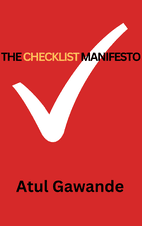
Atul Gawande's The Checklist Manifesto demonstrates how simple checklists prevent critical errors in complex fields like surgery and aviation, offering a practical tool for professionals in any high-stakes environment to improve consistency and teamwork.
Feature
Insta.Page
Blinkist
Shortform
Summary Depth
Full Chapter-by-Chapter
15-min overview
Section-by-section guides
Audio Narration
✓
✓
✓
Visual Mindmaps
✓
✕
✕
AI Q&A
✓
✕
✕
Quizzes
✓
✕
✕
PDF Downloads
✓
✕
✓
Price
$89.99/yr
$146/yr (PRO)
$199/yr
*Competitor data last verified July 2026.
1 Page Summary
In The Checklist Manifesto, Atul Gawande explores the power of simplicity in tackling complex tasks through the use of checklists. Drawing from diverse fields such as aviation, construction, and medicine, Gawande demonstrates how checklists can prevent errors, improve efficiency, and save lives. He argues that even experts, despite their knowledge and experience, are prone to oversight and failure, especially in high-stakes environments. Checklists serve as a cognitive safety net, ensuring that critical steps are not missed and that teams communicate effectively.
Gawande delves into the historical context of checklists, highlighting their origins in aviation during the 1930s, where they were developed to manage the increasing complexity of aircraft. He then applies this concept to modern medicine, sharing his own experiences as a surgeon and his involvement in a World Health Organization initiative to reduce surgical complications globally. The book emphasizes that checklists are not about dumbing down expertise but about enhancing it by creating a structured approach to problem-solving and teamwork.
The lasting impact of The Checklist Manifesto lies in its universal applicability. Gawande’s insights have influenced industries far beyond healthcare, encouraging professionals to adopt checklists as a tool for managing complexity and reducing errors. The book challenges the notion that success depends solely on individual skill, advocating instead for systematic processes that support collaboration and consistency. By blending compelling anecdotes with practical advice, Gawande makes a compelling case for the humble checklist as a transformative tool in the modern world.
Introduction
The Bayonet Incident: A Lesson in the Unexpected
A man arrives at a San Francisco hospital with a seemingly minor stab wound. Despite meticulous trauma protocols, the medical team overlooks asking about the weapon used—a bayonet, which caused a deep, life-threatening aortic injury. The patient nearly dies but survives after emergency surgery. This case underscores how routine assumptions (e.g., “no bayonets in San Francisco”) can blind even expert teams to critical details.
The Potassium Overdose: A Near-Fatal Error
During a stomach cancer surgery, a patient’s heart suddenly stops. The cause? A lethal potassium overdose due to a concentration error. The team initially misdiagnoses the issue, highlighting how cognitive biases (e.g., assuming bleeding or oxygen loss) can delay correct action. Only a senior anesthesiologist’s insistence on reviewing every step uncovers the mistake. The patient survives, but the incident reveals how easily protocol gaps and stress can derail even “routine” procedures.
The Philosophical Divide: Ignorance vs. Ineptitude
The chapter introduces philosophers Gorovitz and Macintyre’s framework for failure:
Ignorance: Limits imposed by incomplete scientific knowledge.
Ineptitude: Failures to apply existing knowledge correctly.
Historically, medicine grappled with ignorance (e.g., no treatments for heart attacks in the 1950s). Today, ineptitude dominates—like missing the 90-minute window for cardiac catheterization in 50% of cases—despite advanced technology and training.
The Modern Challenge: Complexity and Human Fallibility
The author argues that complexity itself is the core obstacle. Even with highly trained professionals, systems falter under:
Sheer volume of knowledge: Protocols for heart attacks now involve dozens of steps, from statins to surgical options.
Coordination demands: Timely execution requires seamless teamwork across roles (e.g., ER staff, lab techs, surgeons).
Cognitive overload: Stress and routine blindspots lead to errors, as seen in both medical cases.
Key Takeaways
Two types of failure: Ignorance (lack of knowledge) and ineptitude (flawed execution of known solutions).
The shift to ineptitude: Modern expertise has reduced ignorance, but complexity magnifies execution errors.
Human limits: Even experts struggle under pressure; training alone isn’t enough to navigate intricate systems.
A simple solution: The chapter hints at checklists as a tool to manage complexity—a theme explored in later sections.
Key concepts: Introduction
1. Introduction
The Bayonet Incident: A Lesson in the Unexpected
Routine assumptions can blind expert teams to critical details
Overlooking weapon specifics (a bayonet) led to a life-threatening oversight
Highlights the danger of cognitive shortcuts in high-stakes environments
The Potassium Overdose: A Near-Fatal Error
Cognitive biases (e.g., assuming common causes) delay correct diagnosis
Protocol gaps and stress contribute to execution errors
Senior expertise and systematic review uncovered the lethal mistake
The Philosophical Divide: Ignorance vs. Ineptitude
Ignorance: Failure due to incomplete scientific knowledge
Ineptitude: Failure to apply existing knowledge correctly
Modern medicine struggles more with ineptitude than ignorance
The Modern Challenge: Complexity and Human Fallibility
Sheer volume of knowledge overwhelms even trained professionals
Coordination demands across roles create execution bottlenecks
Cognitive overload and stress amplify errors in complex systems
Key Takeaways
Two types of failure: ignorance (lack of knowledge) and ineptitude (flawed execution)
Modern systems reduce ignorance but magnify ineptitude through complexity
Human cognitive limits make training insufficient for error-proof execution
Checklists emerge as a potential tool to manage complexity
💡 Try clicking the AI chat button to ask questions about this book!
1. The Problem of Extreme Complexity
Overview
The Problem of Extreme Complexity begins by dismantling the myth of modern medicine as a realm of straightforward cures, contrasting penicillin’s era of “magic bullets” with today’s labyrinth of 13,000+ diseases, 6,000+ drugs, and 4,000+ procedures. Gone are the days of one-size-fits-all solutions: saving a drowning victim now demands a symphony of hyper-specialized interventions—surgical precision, sterile protocols, real-time monitoring—all racing against the clock. This complexity isn’t theoretical. Clinics like Boston’s Harvard Vanguard grapple with 250+ primary diagnoses and 900+ secondary conditions annually, their electronic systems buckling under the weight of rare diseases labeled simply as “Other.”
At the heart of this struggle lies the ICU, where life hinges on orchestrating 178 daily actions per patient—ventilators, dialysis, antibiotic cocktails—with near-perfect accuracy. Yet even superspecialization, medicine’s answer to exploding knowledge, reveals cracks. Surgeons now spend years mastering niches like pediatric anesthesiology, driving mortality rates down but failing to prevent 150,000 annual postoperative deaths in the U.S. alone. The case of Anthony DeFilippo, whose survival teetered on managing infected lines and collapsing organs, epitomizes the razor’s edge: 50% of ICU patients suffer complications, not from incompetence, but from the sheer impossibility of flawless execution in chaos.
The chapter then unearths an unexpected beacon in aviation history: the Boeing 299 crash of 1935. When pilot error doomed the “too complex” bomber, engineers didn’t abandon the design—they invented the checklist. This humble tool transformed the plane into the WWII B-17, proving that systems, not just expertise, conquer complexity. Medicine’s parallel becomes clear: ICUs and operating rooms, like cockpits, demand protocols to bridge the gap between human limits and escalating demands. The takeaway isn’t despair but adaptation—acknowledging that superspecialization alone can’t tame the chaos, but combining it with rigorous checklists and teamwork might just keep the modern medical machine aloft.
Penicillin’s Legacy vs. Modern Realities
The chapter challenges the notion that medical progress would mirror penicillin’s straightforward efficacy. While antibiotics once promised a golden age of easy fixes, most conditions—even infections—now require nuanced, tailored approaches. Diseases like cancer, strokes, or organ failure defy universal solutions. Medicine has become a labyrinth of 13,000+ classified diseases, 6,000+ drugs, and 4,000+ procedures, each with unique risks and protocols. The drowning victim’s case exemplifies this shift: her survival depended on a cascade of highly specialized interventions, from surgical precision to sterile line management, all orchestrated under immense time pressure.
The Data Deluge: Diseases, Drugs, and Procedures
A single hospital’s statistics reveal the overwhelming scope of modern care. At Boston’s Harvard Vanguard clinic, physicians juggle 250+ primary diagnoses and 900+ secondary conditions annually, alongside 300+ medications and 40+ office procedures. Electronic health records struggle to keep pace, often labeling rare conditions as “Other” due to outdated databases. This explosion of knowledge isn’t just theoretical—it’s logistical. Clinics now sprawl across dozens of facilities, employing hundreds of specialists, yet even this division of labor strains under the weight of complexity.
When Specialization Isn’t Enough
The ICU emerges as a microcosm of medicine’s challenges. Here, patients depend on life support systems—ventilators, dialysis, arterial lines—each requiring flawless execution. A landmark study found ICU staff performing 178 daily actions per patient, with even a 1% error rate risking catastrophe. The story of Anthony DeFilippo, a patient battling cascading organ failure and infected lines, illustrates the fragility of this balance. His survival hinged on superspecialized intensivists managing countless variables: blood pressure, oxygen levels, antibiotic cocktails, and sterile protocols. Yet, as his case shows, ICUs walk a razor’s edge—50% of patients suffer complications, and a single misstep can prove fatal.
Mastering Complexity Through Superspecialization
To navigate this maze, medicine has turned to superspecialization. Where a 20th-century doctor might have relied on broad training, today’s practitioners spend up to a decade in fellowships mastering niches like critical care or pediatric metabolic disorders. This shift reflects necessity, not luxury: DeFilippo’s care required an intensivist’s expertise, not a general surgeon’s. Yet even this evolution has limits. As medicine’s frontiers expand—new genetic discoveries, cancer subtypes, technologies—the question remains: Can humans ever fully master such complexity, or will it outpace our ability to adapt?
Key Takeaways
Modern medicine’s triumphs rely on managing intricate, high-stakes processes—not simple “magic bullet” solutions.
The ICU exemplifies both the power and peril of complexity, where life-saving interventions carry inherent risks of error and infection.
Superspecialization is a response, not a cure-all, for the explosion of medical knowledge and procedural demands.
Survival often depends on systems, not just individual expertise—protocols, teamwork, and relentless attention to detail.
The gap between medical capability and human execution remains medicine’s greatest challenge, demanding constant innovation in both technology and training.
The Limits of Superspecialization
Modern medicine’s reliance on superspecialization has transformed fields like surgery, where clinicians dedicate years to mastering hyper-specific skills. Surgeons, anesthesiologists, and operating room nurses are divided into ever-narrower subspecialties—think pediatric anesthesiologists or endocrine cancer surgeons. This precision has driven remarkable progress: surgeries once deemed high-risk are now outpatient procedures, and mortality rates have plummeted. However, the sheer volume of surgeries—50 million annually in the U.S.—reveals a stark reality. Despite expertise, 150,000 postoperative deaths occur yearly, with half deemed preventable. Mistakes persist not from a lack of skill, but from the overwhelming complexity of coordinating countless steps in high-stakes environments.
The Boeing 299: A Case for Checklists
The chapter pivots to an unexpected analogy: aviation. In 1935, Boeing’s Model 299 bomber—a technological marvel—crashed during a routine test flight due to pilot error. The plane’s complexity overwhelmed the crew, leading the Army to initially reject it. Instead of abandoning the design, engineers developed a simple pilot’s checklist to ensure critical steps weren’t missed. This innovation turned the Model 299 into the WWII-era B-17 “Flying Fortress,” a backbone of Allied airpower. The story underscores a universal truth: even experts need systems to manage complexity.
Key Takeaways
Superspecialization improves outcomes but cannot eliminate human error in highly complex tasks.
Avoidable failures persist not from incompetence, but from the difficulty of executing countless interdependent steps flawlessly.
Checklists, born from aviation’s lessons, emerged as a counterintuitive yet powerful tool to bridge the gap between expertise and execution.
Key concepts: 1. The Problem of Extreme Complexity
2. 1. The Problem of Extreme Complexity
The Myth of Simple Cures in Modern Medicine
Contrasts penicillin's 'magic bullet' era with today's 13,000+ diseases, 6,000+ drugs, and 4,000+ procedures
Highlights the shift from universal solutions to hyper-specialized interventions (e.g., drowning victim case)
Emphasizes the logistical chaos of rare diseases and outdated diagnostic labeling ('Other')
The Overwhelming Scope of Medical Complexity
Reveals real-world data: 250+ primary diagnoses and 900+ secondary conditions annually at Harvard Vanguard
Electronic systems struggle with rare conditions and sprawling multi-specialty clinics
Illustrates the 'data deluge' with 300+ medications and 40+ office procedures per facility
The ICU as a Microcosm of Complexity
178 daily actions per ICU patient with near-zero margin for error
Case study: Anthony DeFilippo's survival hinged on managing infected lines and organ failure
50% of ICU patients suffer complications due to system fragility, not incompetence
Superspecialization: Necessity and Limits
Doctors now spend a decade mastering niches (e.g., pediatric metabolic disorders)
Reduces mortality but fails to prevent 150,000 annual postoperative deaths in the U.S.
Human limits remain—complexity may outpace adaptation despite deep expertise
Lessons from Aviation: Systems Over Heroics
Boeing 299 crash (1935) led to the checklist revolution, enabling the B-17's success
Parallel: ICUs need protocols, not just expertise, to bridge human limits
Key insight: Combining superspecialization with checklists/teamwork can tame chaos
Core Takeaways
Modern medicine thrives on systems, not just 'magic bullets'
ICU exemplifies the razor's edge between life-saving and error-prone complexity
Superspecialization is necessary but insufficient alone
Survival depends on protocols, teamwork, and relentless detail management
The execution gap (capability vs. human limits) demands continuous innovation
The Limits of Superspecialization
Superspecialization in medicine has led to remarkable progress, such as safer surgeries and lower mortality rates.
Despite expertise, 150,000 postoperative deaths occur annually in the U.S., with half deemed preventable.
Failures persist due to the overwhelming complexity of coordinating high-stakes procedures, not lack of skill.
The Boeing 299: A Case for Checklists
The 1935 crash of Boeing’s Model 299 bomber highlighted how complexity can overwhelm even skilled professionals.
A simple pilot’s checklist transformed the flawed design into the successful B-17 'Flying Fortress'.
The aviation example demonstrates that systems like checklists are essential to manage complexity, even for experts.
Key Takeaways
Superspecialization improves outcomes but cannot eliminate human error in highly complex tasks.
Avoidable failures often stem from the difficulty of executing interdependent steps flawlessly, not incompetence.
Checklists, inspired by aviation, are a powerful tool to bridge the gap between expertise and execution.
2. The Checklist
The B-17 and the Humble Origin of Checklists
After the fatal Model 299 crash (caused by a forgotten locking mechanism), test pilots created a brief, index-card checklist for takeoff, flight, and landing. This simple tool allowed pilots to flawlessly fly the plane 1.8 million miles, securing the B-17’s legacy. The lesson? Complexity demands systematization. Even experts can’t rely on memory alone.
Medicine’s “B-17 Moment”
By the 20th century, medicine faced its own complexity crisis. For instance, trauma patients presented 32,261 unique injury combinations in one study—akin to landing “32,261 kinds of airplane.” Yet checklists were dismissed as overly simplistic. Early adoption came from nurses, who institutionalized “vital signs” (temperature, pulse, blood pressure, respiration) as a baseline checklist in the 1960s. Still, doctors resisted, viewing checklists as beneath their expertise.
Peter Pronovost’s ICU Revolution
In 2001, Pronovost, a Johns Hopkins critical care specialist, designed a 5-step checklist for inserting central lines (e.g., handwashing, sterile drapes). Nurses were empowered to enforce it. Results were staggering: line infections dropped from 11% to 0%, saving 8 lives and $2 million in one hospital. Checklists for pain management and ventilators followed, cutting ICU stays by half. Yet skepticism persisted—many doctors saw checklists as “nursing stuff” or doubted their scalability.
The Michigan Keystone Initiative: Checklists at Scale
In 2003, Michigan hospitals adopted Pronovost’s checklist statewide. Challenges abounded: at Detroit’s Sinai-Grace Hospital, staff shortages and chaos made checklists seem impractical. But by involving hospital executives to solve systemic issues (e.g., stocking antiseptic soap), the program reduced infections by 66% in three months. Over 18 months, 1,500+ lives and $175 million were saved. The secret? Checklists plus cultural buy-in and leadership support.
Beyond Infections: Checklists for the Unthinkable
Markus Thalmann, an Austrian surgeon, tackled rare hypothermia cases where patients appeared dead but could be revived. After years of failed rescues, his team created a checklist for emergency responders and hospital staff to prep for rapid rewarming via heart-lung bypass. This protocol saved a drowned 3-year-old, a frozen suicide attempt survivor, and a teen trapped in an icy river—cases where preparation and precision turned impossibility into routine success.
Key Takeaways
Human fallibility is predictable: Even experts forget steps under pressure. Checklists guard against memory lapses and distractions.
Standardization enables excellence: Checklists create a “floor” of consistent performance, freeing professionals to focus on nuanced decisions.
Culture trumps complexity: Success requires buy-in at all levels—from nurses to CEOs—and systems to address systemic barriers (e.g., missing supplies).
Checklists are adaptable: From WWII bombers to ICU beds to Alpine rescues, they turn chaos into repeatable processes.
Small steps, monumental impact: A 5-item checklist saved thousands of lives. In complexity, simplicity isn’t just useful—it’s revolutionary.
Key concepts: 2. The Checklist
3. 2. The Checklist
The B-17 and the Humble Origin of Checklists
A fatal crash led to the creation of a simple index-card checklist for pilots.
The checklist enabled flawless operation of the B-17 over 1.8 million miles.
Key lesson: Complexity demands systematization; memory alone is unreliable.
Medicine’s “B-17 Moment”
Medicine faced overwhelming complexity (e.g., 32,261 unique injury combinations).
Checklists were initially dismissed as too simplistic for medical professionals.
Nurses pioneered early adoption with 'vital signs' as a baseline checklist.
Peter Pronovost’s ICU Revolution
Pronovost’s 5-step checklist reduced central line infections from 11% to 0%.
Nurses were empowered to enforce checklist compliance.
Despite success, skepticism persisted among doctors.
The Michigan Keystone Initiative: Checklists at Scale
Statewide adoption in Michigan hospitals reduced infections by 66% in three months.
1,500+ lives and $175 million were saved over 18 months.
Success required cultural buy-in and leadership support.
Beyond Infections: Checklists for the Unthinkable
Markus Thalmann’s checklist for hypothermia cases turned rare rescues into routine successes.
Preparation and precision enabled survival in seemingly impossible scenarios.
Human fallibility is predictable; checklists guard against memory lapses.
Standardization creates a performance floor, allowing focus on nuanced decisions.
Cultural buy-in and leadership are critical for checklist success.
Checklists are adaptable across fields, from aviation to medicine to rescue operations.
Simple checklists can have monumental impacts in complex environments.
3. The End of the Master Builder
Overview
The End of the Master Builder weaves together the messy realities of problem-solving across fields like medicine and construction, revealing how humility and collaboration triumph over individual brilliance. It starts by framing challenges on a spectrum: simple problems (like baking a cake) thrive on checklists, while complicated problems (launching a rocket) demand expertise and coordination. But complex problems (raising a child)—unpredictable and resistant to rules—require adaptability, a tension medicine grapples with as it juggles protocols and improvisation.
The chapter then pivots to construction, where childhood bookcase failures and soaring skyscrapers share a lesson: specialization and systems save the day. Unlike medicine’s stubborn attachment to the lone “Master Physician,” construction shed the Master Builder myth centuries ago, fracturing roles into architects, engineers, and subcontractors. This shift forced the industry to develop tools like dynamic schedules and collaborative checklists, as seen in projects like Russia Wharf. There, 500+ workers and 60 trades sync via color-coded plans and co-created protocols, turning chaos into precision. Yet even the best systems face curveballs—like tilted floors from uneven settling—that demand quick, collective fixes rather than solo heroics.
The Citicorp Tower’s near-collapse—a bolt substitution nearly toppling a skyscraper—drives home the stakes of skipping structured communication. Digital tools like Clash Detective and mandatory “submittal schedules” now force experts to talk, not assume, catching conflicts before they spiral. These innovations explain why modern construction rarely fails, despite soaring complexity: checklists act as cognitive safety nets, but it’s the marriage of technology, humility, and group accountability that truly safeguards progress.
Ultimately, the chapter argues that fields clinging to individualism—like medicine—could learn from construction’s evolution. Success in complexity isn’t about geniuses with all the answers, but systems that weave diverse expertise into a resilient whole. Whether averting tilted floors or medical errors, the message is clear: collaboration over control, adaptation over ego, and communication over silence turn potential disasters into triumphs.
The Spectrum of Problems
The chapter begins by categorizing challenges into three types:
Simple problems (e.g., baking a cake) follow clear, repeatable steps.
Complicated problems (e.g., launching a rocket) require multiple experts and coordination but can be broken into simpler tasks.
Complex problems (e.g., raising a child) involve unpredictable variables and resist standardized solutions.
Checklists thrive in simple and complicated realms—preventing central-line infections in hospitals or ensuring welding protocols in construction. However, complex problems demand flexibility and judgment beyond rote procedures. Medicine, which straddles all three categories, struggles to balance protocol with improvisation, often leading to errors in coordination.
Construction Insights: From Bookcases to Skyscrapers
The author’s childhood bookcase disaster—a collapse due to missing braces—mirrors the stakes of modern construction. When marveling at a hospital skyscraper, he questions: How do workers ensure such structures don’t fail? The answer lies in specialization and systems.
Structural engineer Joe Salvia, a veteran of projects like Fenway Park’s Green Monster, explains that buildings today require input from 16+ trades (plumbing, electrical, HVAC, etc.). Unlike medicine’s siloed specialists, these teams collaborate through rigorous planning and checklists. Salvia’s journey—from designing his first mall roof to inventing engineering solutions for Philip Johnson’s avant-garde skyscrapers—highlights how expertise must adapt to practical constraints like cost, aesthetics, and interdisciplinary conflicts.
The Demise of the Master Builder Model
Historically, Master Builders single-handedly oversaw projects from design to execution (e.g., Notre Dame). By the 20th century, specialization fractured this role into architects, engineers, and subcontractors. Construction embraced this shift, developing processes to manage complexity.
Medicine, by contrast, clings to the “Master Physician” ideal, where one doctor orchestrates care despite the reality of multi-specialist teams. The result? Duplicated efforts, communication gaps, and errors. Construction’s success—no collapsed buildings despite soaring complexity—stems from abandoning ego-driven individualism in favor of systems that integrate diverse expertise.
Checklists in Action: The Russia Wharf Project
A visit to the Russia Wharf construction site reveals how checklists operationalize coordination. Project executive Finn O’Sullivan oversees 500+ workers and 60 subcontractors using:
Dynamic schedules: Color-coded, day-by-day task lists updated in real time.
Collaborative planning: Checklists co-created by all trades to prevent oversights (e.g., plumbing clashes with structural beams).
Adaptability: Customized for each project’s unique demands, yet standardized enough to ensure reliability.
These tools transform chaos into order, proving that even in complicated endeavors, systematic collaboration outperforms individual genius.
Key Takeaways
Checklists are cognitive safety nets, effective for simple/complicated tasks but limited in complex, unpredictable scenarios.
Construction’s evolution from Master Builders to specialized collaboration offers a blueprint for fields like medicine to reduce errors.
Success in complexity requires humility: integrating diverse expertise, embracing systems over solo heroics, and adapting protocols to each challenge.
The Russia Wharf example demonstrates how dynamic checklists and interdisciplinary coordination turn overwhelming projects into manageable, error-resistant processes.
Unforeseen Challenges and Collaborative Solutions
The Tilted Floors Dilemma
During the Russia Wharf site tour, structural engineer Bernie Rouillard and the author observed water pooling against the inner concrete core on upper floors—a sign of unexpected tilting. Rouillard theorized that uneven settling between the concrete core and the still-unloaded steel frame caused the slope. While he predicted the floor would level once the steel frame bore more weight, the incident highlighted the unpredictability of complex projects. This unanticipated issue required immediate cleanup, schedule adjustments, and a critical question: Was this a minor hiccup or a structural flaw?
The Submittal Schedule: Communication as a Checklist
To address uncertainties, project manager Finn O’Sullivan introduced the “submittal schedule”—a checklist mandating structured communication between specialists. Instead of relying on individual judgment, teams were required to discuss specific issues by set deadlines. For example, after the tilted-floor discovery, structural engineers, contractors, and owners met to review data, agree on next steps, and sign off on the plan. This process ensured collective problem-solving rather than siloed decisions.
Digital Tools for Conflict Resolution
Ryan Walsh, a coordinator in the field office, demonstrated how 3D modeling software like Clash Detective identified design conflicts (e.g., beams blocking light fixtures). Flagged issues triggered automated emails to relevant teams, forcing collaboration. Similarly, a worker’s photo of a misaligned steel beam prompted a welded solution, with all stakeholders notified and given three days to confirm. These tools ensured transparency and accountability, embedding communication into every layer of construction.
The Citicorp Tower Near-Disaster
The Citicorp building’s flawed design—bolted joints instead of welded ones in critical braces—nearly caused catastrophic failure. A communication breakdown meant the change wasn’t reviewed by lead engineer William LeMessurier. When the error was later discovered, emergency repairs averted disaster. This case underscored a key lesson: skipping communication checkpoints risks catastrophe, while rigorous group review (as with the tuned mass damper) enhances safety.
Statistics and Success
Despite rising complexity, modern construction’s failure rate is staggeringly low (0.00002% annually). Innovations like checklists and collaborative tools have cut build times by a third since the 1970s, proving that structured communication—not individual genius—drives reliability.
Key Takeaways
Unpredictability is inevitable: Complex projects face unforeseen issues (e.g., settling floors, design clashes).
Communication over autonomy: Checklists that force experts to collaborate prevent errors siloed decision-making invites.
Technology as a bridge: Digital tools like Clash Detective ensure problems are flagged, assigned, and resolved collectively.
Learning from near-misses: The Citicorp crisis illustrates both the cost of skipped checkpoints and the lifesaving power of group accountability.
Key concepts: 3. The End of the Master Builder
4. 3. The End of the Master Builder
The Spectrum of Problems
Simple problems (e.g., baking a cake) follow clear, repeatable steps
Complicated problems (e.g., launching a rocket) require expertise and coordination
Complex problems (e.g., raising a child) resist standardization and demand adaptability
Medicine struggles to balance protocols with improvisation across all three problem types
Checklists work well for simple/complicated problems but fall short for complex ones
Construction's Evolution Through Specialization
Modern construction relies on 16+ specialized trades working collaboratively
Unlike medicine, construction abandoned the 'Master Builder' model centuries ago
Systems like dynamic schedules and checklists replace individual oversight
Projects like Russia Wharf demonstrate successful coordination of 500+ workers
Specialization forced the industry to develop tools for interdisciplinary communication
Atul Gawande is a renowned surgeon, writer, and public health researcher. He is a professor at the Harvard T.H. Chan School of Public Health and Harvard Medical School. Gawande is the author of four bestselling books: *Complications*, *Better*, *The Checklist Manifesto*, and *Being Mortal*, which have profoundly influenced discussions on medicine, performance, and end-of-life care. His work has earned him critical acclaim, including being a finalist for the National Book Award and receiving a MacArthur Fellowship. His insightful books on how we can improve systems and care in medicine and life are available on Amazon.
📚 Explore Our Book Summary Library
Discover more insightful book summaries from our collection