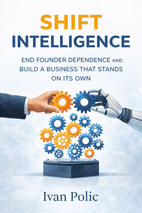
Ivan Polic's Shift Intelligence provides a practical methodology for founders to codify their critical knowledge into systems and processes, building a resilient, scalable organization that operates independently of its creator.
Feature
Insta.Page
Blinkist
Shortform
Summary Depth
Full Chapter-by-Chapter
15-min overview
Section-by-section guides
Audio Narration
✓
✓
✓
Visual Mindmaps
✓
✕
✕
AI Q&A
✓
✕
✕
Quizzes
✓
✕
✕
PDF Downloads
✓
✕
✓
Price
$89.99/yr
$146/yr (PRO)
$199/yr
*Competitor data last verified July 2026.
1 Page Summary
Shift Intelligence by Ivan Polic addresses a critical vulnerability in many businesses: over-reliance on the founder's personal knowledge and decision-making. Polic argues that this "founder dependence" creates a fragile, unscalable company that cannot function without its creator, ultimately trapping the founder and limiting growth. The book's central thesis is that sustainable success requires a systematic "shift" from this personal, intuitive intelligence to an embedded, organizational intelligence. This involves codifying the founder's critical knowledge—about strategy, operations, culture, and customer value—into clear processes, systems, and frameworks that the entire team can execute independently.
The concept is framed within the modern context of entrepreneurship, where visionary founders are often celebrated but their companies struggle with chaotic scaling and burnout. Polic provides a practical methodology for this transition, guiding leaders to deconstruct their unique "recipe" for success and rebuild it as a teachable and repeatable company operating system. Key steps include mapping the core Value Delivery System, implementing robust knowledge management, and designing roles and metrics that reinforce institutional rather than individual capability. This process is presented not as a loss of control, but as the essential path to building a truly valuable, transferable asset.
The lasting impact of Polic's framework is the empowerment it offers to founders seeking freedom and legacy. By building a business with "Shift Intelligence," founders can step back from day-to-day firefighting to focus on strategic vision, secure in the knowledge that the organization can run itself. This transforms the business from a job that owns the founder into an asset they own, increasing its market value and ensuring its resilience. Ultimately, the book provides a vital blueprint for moving from a personality-driven startup to a professionally managed, enduring enterprise.
Foreword
Overview
This foreword serves as both a powerful personal origin story and a direct address to the reader’s deepest leadership anxieties. It establishes the book's credibility through a trusted endorsement, immerses us in the authors' catastrophic business crisis, and then widens the lens to diagnose the systemic "trap" of founder-dependence that plagues most entrepreneurs. It frames the entire book as a practical guide to building a resilient, self-sustaining business.
An Endorsement of Character and Practicality
The foreword opens with a personal note from retired Navy SEAL Commander Rich Diviney, who vouches for the authors, Ivan and Mariana. He highlights their steady minds, strong standards, and genuine care, setting a tone of trusted guidance. He frames the book not as abstract inspiration but as a practical toolkit for leaders feeling the intense pressure of being their company's central nervous system. The promise is clear: you will find language for your unspoken problems and "sturdy" tools you can use immediately.
The 3 A.M. Crisis: A Personal Breaking Point
The narrative then plunges into the authors' own harrowing experience during the 2008 financial collapse. Ivan describes a sleepless night of panic, shame, and dread as their business revenue drops 93% in a month. He grapples with laying off employees, facing financial ruin, and feeling he has failed his family and father. The visceral details—counting ceiling cracks, feeling cold sweat—make the crisis palpable. Simultaneously, Mariana’s perspective is shared; lying awake beside him, she senses the danger but is kept in the dark, which propels her resolve to force a conversation and face the problem together. This moment of shared resolve marks the turning point, the "night everything changed."
Diagnosing the Founder-Dependence Trap
The chapter then transitions from personal story to universal diagnosis. It names the core problem: the "hidden trap" where a brilliant business still depends entirely on the founder to hold it together. What begins as a strength—the founder's control and vigilance—becomes a fatal design flaw. The book introduces a crucial neuroscience insight: under chronic stress, a leader's brain shifts to survival mode (amygdala hyperactivity), crippling strategic thought (prefrontal cortex going offline). This creates a vicious cycle where the founder's stress becomes the company's culture.
The argument builds to a stark truth: in a founder-dependent business, the founder is the single greatest point of risk, and over 70% of such businesses fail upon the founder's exit. This is framed not as a personal failure but as a design challenge. The promise of the book is to provide a "better roadmap" to redesign the business so it is transferable, durable, and independent—where trust is distributed, not centralized.
A Roadmap to Freedom
Finally, the foreword outlines the book's four-part structure, serving as a map for the journey ahead:
Part I: Operating System Shift – Rewiring the business to run on distributed trust, not the founder's nervous system.
Part II: Marketplace Shift – Transferring the brand's credibility from the founder to the organization.
Part III: Inner World Shift – Releasing the personal identities and habits that fuel dependence.
Part IV: Sustaining Momentum – Installing governance and rhythms to protect the newfound freedom.
The invitation is to start where the pain is sharpest and begin the work of ending founder dependence, not just for personal freedom, but to create a lasting legacy.
Key Takeaways
Founder-dependence is a design flaw, not a character flaw. The very control that builds a business eventually strangles it and its founder.
Chronic stress has a neurological cost that impairs leadership and radiates anxiety throughout the entire organization.
The ultimate risk to a business is its reliance on one person. Resilience requires designing systems where trust and operations are distributed.
The goal is a "transferable" business—one that can survive, thrive, and preserve its legacy independently of the founder's daily involvement.
Change begins with a single, honest question: "Where does my business still depend on me to survive?" Bringing this dependency into the light is the essential first step.
Key concepts: Foreword
1. Foreword
Endorsement of Character and Practicality
Personal endorsement from Navy SEAL Commander Rich Diviney vouching for the authors' steady minds and genuine care
Frames the book as a practical toolkit, not abstract inspiration, for leaders feeling intense pressure
Promises to provide language for unspoken problems and immediate, sturdy tools
The 3 A.M. Crisis: A Personal Breaking Point
Authors' business revenue dropped 93% during the 2008 financial collapse
Ivan's experience of panic, shame, and dread while facing layoffs and financial ruin
Mariana's resolve to force a conversation despite being kept in the dark
The shared turning point where 'everything changed' through facing the crisis together
Diagnosing the Founder-Dependence Trap
The 'hidden trap' where a business depends entirely on the founder to hold it together
Founder's control begins as a strength but becomes a fatal design flaw
Neuroscience insight: chronic stress shifts brain to survival mode, crippling strategic thought
Founder-dependent businesses have over 70% failure rate upon founder's exit
Frames the problem as a design challenge requiring a 'better roadmap'
Roadmap to Freedom: Book Structure
Part I: Operating System Shift - Rewiring business to run on distributed trust
Part II: Marketplace Shift - Transferring brand credibility from founder to organization
Part III: Inner World Shift - Releasing personal identities and habits fueling dependence
Part IV: Sustaining Momentum - Installing governance to protect newfound freedom
Core Principles and Invitation
Founder-dependence is a design flaw, not a character flaw
Chronic stress has neurological costs that impair leadership and radiate anxiety
Ultimate business risk is reliance on one person; resilience requires distributed systems
Goal is a 'transferable' business that thrives independently of founder's daily involvement
Change begins with asking: 'Where does my business still depend on me to survive?'
💡 Try clicking the AI chat button to ask questions about this book!
Chapter 1
Overview
This chapter introduces the core, often painful realization that many successful founders eventually face: a business can have impeccable systems, certifications, and financials, yet remain utterly dependent on its founder. This dependency becomes a ceiling for freedom, value, and true scalability. The narrative moves from a personal story of a failed acquisition to a broader exploration of why delegation and systems alone are insufficient, and concludes with a historical case study and practical exercises to identify this hidden reliance.
The Failed Deal: A Moment of Truth
The author recounts a pivotal moment where a promising acquisition deal collapsed during due diligence. Despite a decade of AS9100 aerospace certification, flawless compliance, and solid financials, the potential buyer reduced their offer, citing concerns about leadership depth and management. Externally, the business appeared "airtight," but internally, the founder was still the central nervous system—the glue holding everything together, the bottleneck for major decisions, and the daily firefighter. The emotional aftermath—anger, then profound sadness—culminated in a stark revelation: an owner-dependent business can never be sold for true freedom or full value. The goal shifted from selling the business to fundamentally rebuilding it into something that could survive and thrive independently.
Why Systems and Delegation Fall Short
The chapter challenges the common assumption that perfect systems and documented processes automatically create a transferable, scalable company. Systems manage tasks and ensure consistency, but they do not build the trust and independent judgment required for a business to stand alone. Many founders mistake smooth operations for scalability, and delegation for true empowerment. If a team hesitates when the founder is absent, or if decisions consistently require the founder's final nod, then the business still "runs through" the founder. This creates a culture of deference and organizational gravity, where the founder's presence is the signal to move. Real freedom comes not from removing tasks, but from removing this gravitational pull, allowing ownership and accountability to genuinely transfer to the team.
The Pandora Case Study: The Visionary Bottleneck
The principle of founder-dependency is illustrated through the story of Tim Westergren and Pandora. Westergren’s deep, personal vision for the Music Genome Project was the company's heart and soul, attracting employees, investors, and users. However, as Pandora grew, this strength became a weakness. Out of reverence, not fear, teams began to default to "What would Tim say?" Innovation slowed because the vision was so embodied in the founder that others felt unable to authentically lead or evolve it. By the time Westergren stepped back, Pandora had lost its adaptive edge to competitors like Spotify. The lesson is that even the most inspiring founder can inadvertently cap a company's growth by not systematically transferring conviction and strategic clarity to the leadership team.
Diagnostic Practices: Finding the Hidden Levers
Before attempting to fix founder-dependency, one must first see it clearly. The chapter provides three "Proof Practices" for diagnosis:
The Invisible Dependency Inventory: Review recent calendars and tasks to identify what stalled without your input, analyzing the cost and the learned dependence each instance reinforced.
People vs. Process Reflection: Examine a seemingly smooth operation to determine if it runs because of a robust system or because of specific people (including yourself), questioning what would happen if you vanished.
Emotional Ownership Scan: Honestly assess trust levels with each leader on your team, noting where you subtly re-check work or where they might filter their challenges to you. This reveals gaps between assigned responsibility and genuine empowerment.
Key Takeaways
Founder-Dependency is a Value and Freedom Ceiling: A business that needs its founder to function cannot be fully scaled, sold for maximum value, or grant the founder genuine freedom.
Systems Manage, But People Scale: Impeccable processes and certifications are necessary for operations, but they cannot replace the need for a deep leadership bench capable of independent judgment and action.
Delegation is Not Empowerment: Handing off tasks is not the same as transferring ownership. True empowerment is evident when the business progresses confidently in the founder's absence.
The Founder's Role Must Evolve: The goal is to shift from being the central "nervous system" and problem-solver to becoming the architect of an environment where others can lead. This often requires consciously practicing trust and resisting the urge to "rescue" or provide immediate answers.
Clarity Precedes Change: The first step is a brutally honest audit of where and how the business still depends on you, using practical diagnostics to move from vague feeling to specific, addressable patterns.
Key concepts: Chapter 1
2. Chapter 1
The Failed Deal: A Moment of Truth
A promising acquisition collapsed due to concerns about leadership depth despite impeccable systems and certifications
Externally airtight businesses can still have the founder as the central nervous system and bottleneck
Owner-dependent businesses cannot be sold for true freedom or full value
The revelation shifts the goal from selling to fundamentally rebuilding for independence
Why Systems and Delegation Fall Short
Systems manage tasks but don't build trust and independent judgment required for true scalability
Smooth operations are often mistaken for genuine scalability
Delegation of tasks is not the same as true empowerment and ownership transfer
Real freedom comes from removing the founder's gravitational pull on decision-making
The Pandora Case Study: The Visionary Bottleneck
Tim Westergren's personal vision for Pandora initially attracted employees and investors
Reverence for the founder led teams to default to 'What would Tim say?' instead of innovating
The founder's embodiment of vision prevented others from authentically leading or evolving the company
Founder-dependency caused Pandora to lose its adaptive edge to competitors like Spotify
Diagnostic Practices: Finding the Hidden Levers
Invisible Dependency Inventory: Review what stalls without founder input to identify learned dependence
People vs. Process Reflection: Determine if operations run on robust systems or specific people
Emotional Ownership Scan: Assess trust levels and identify gaps between assigned responsibility and genuine empowerment
Key Takeaways
Founder-dependency creates ceilings on business value, scalability, and founder freedom
Systems manage operations but people scale businesses through independent judgment
True empowerment requires ownership transfer, not just task delegation
Founders must evolve from central problem-solvers to architects of leadership environments
Honest diagnosis of dependency patterns must precede meaningful change
Chapter 2
Overview
This chapter introduces Daniel, a founder whose tight control over his advisory firm is breaking both the business and his health. Through his journey and other examples, it explores the costly myth that enforcement—clear systems, strict accountability, and constant oversight—is the path to a great company. Instead, it argues that sustainable success and well-being come from a fundamental shift: from enforcement to genuine engagement, where trust and shared ownership replace control and tension.
The High Cost of Control
Daniel’s story illustrates the physical and emotional toll of enforcement leadership. Despite having strong systems and documentation, his team was disengaged, and he was working 80-hour weeks, developing stress ulcers. His frustration (“What are these fucking people thinking?”) masked a deeper grief and fear. His “tight” ship was actually brittle, built on the unspoken belief that without his constant grip, everything would fall apart. This approach trained his team to focus on compliance rather than contribution, creating a culture that was technically sound but emotionally checked out.
The Shift: Interest Over Instinct
The transformation began when Daniel, desperate for another way, chose to experiment with engagement. He started small: relinquishing control over single meetings, decisions, and habits. He resisted the urge to interrupt or correct. When his team ran with ideas he would have done differently, he allowed it. Contrary to his fears, nothing broke. Instead, initiative emerged organically as team members began to own projects they believed in. The pivotal moment came when Daniel asked his team what they wanted—discovering unmet needs for responsibility, flexibility, and mentorship. By getting interested in them, he unlocked their investment in the business.
Why Clarity Isn't Connection
Many founders lead from enforcement out of a desire to protect what they’ve built, but this often stems from underlying fear. This fear becomes the company’s rhythm, training the team to stay small and safe. The result is a “quiet resignation,” where people fade rather than fight, not out of laziness but because they feel they are not full participants. The chapter posits that a leader’s grip is often the very limitation on the greatness they seek, as a culture of control inherently caps engagement and innovation.
From Managing Behavior to Building Belief
The essential shift for a leader is to stop asking “Why aren’t they stepping up?” and start asking “What have I made unsafe to care and speak about?” Engagement begins with interest in people’s potential, not management of their performance. It involves asking what they are playing for, what their standards are, and what success would unlock in their lives. People stay and fight for a future they believe includes them. Without that belief, they disengage, delivering only a fraction of their capability—a silent momentum killer more destructive than outright resistance.
Case Study: Whitney Wolfe Herd and Psychological Safety
The founder of Bumble, Whitney Wolfe Herd, initially carried the company’s weight alone, leading from a place of necessary control (“tight because she had to”). As Bumble grew, this approach led to hesitation and slowed decision-making. She realized that psychological safety was as crucial inside her company as it was for her app’s users. By intentionally designing for safety—encouraging cross-level feedback, celebrating smart risks even when they failed, and creating space for respectful conflict—she cultivated belief instead of controlling behavior. This allowed ownership to emerge, scaling the company’s capacity and culminating in a successful IPO. Her story proves that trust enables people to want excellence for themselves.
Proof Practices: Making the Shift Tangible
Culture change requires deliberate practice, not just intention. The chapter offers three starting points:
Build a Curiosity Map: Replace a performance review with a conversation. Ask about what’s important to a team member outside of work, what success at work would unlock for their life, and what part of the work makes them feel most alive.
Stop Answering First: In meetings, consciously withhold your voice for the first ten minutes. Let silence and discomfort create space for others to lead. If needed, gently invite someone in by simply saying their name as a question.
Give Away the Next Win: Identify a moment where you could take credit or lead, and deliberately give that opportunity to someone else. This act of pre-emptive trust communicates belief and invites people to rise to the occasion.
Key Takeaways
Enforcement is Exhausting: Leading through strict control, accountability, and systems may create short-term clarity but leads to long-term disengagement, stunted growth, and personal burnout.
Engagement is an Invitation: High performance and ownership are unlocked not by demanding them, but by creating the psychological safety and trust that invite people to fully participate.
The Shift is Internal: The move from enforcement to engagement begins with the leader’s mindset: choosing interest over instinct, trust over tension, and people over pressure.
Safety Precedes Initiative: Teams will only take risks, show initiative, and bring their full creativity when they feel safe from undue judgment or repercussion for well-intentioned efforts.
Start Small with Trust: Transformation can begin with simple, concrete actions: listening first, delegating meaningful opportunities, and getting genuinely curious about the people on your team.
Key concepts: Chapter 2
3. Chapter 2
The High Cost of Control
Enforcement leadership creates physical and emotional toll, including burnout and stress-related illness.
Tight control trains teams for compliance over contribution, leading to technical soundness but emotional disengagement.
The underlying belief is that without constant oversight, everything would fall apart, creating a brittle organizational culture.
Frustration with team performance often masks deeper grief and fear within the leader.
The Shift: Interest Over Instinct
Transformation begins with small experiments in relinquishing control over meetings, decisions, and habits.
When leaders resist the urge to interrupt or correct, initiative emerges organically from team members.
Asking team members what they want reveals unmet needs for responsibility, flexibility, and mentorship.
Getting genuinely interested in people unlocks their investment in the business and fosters ownership.
Why Clarity Isn't Connection
Enforcement leadership often stems from underlying fear that becomes the company's rhythm.
Control trains teams to stay small and safe, resulting in 'quiet resignation' rather than active participation.
A leader's grip becomes the limitation on the greatness they seek by capping engagement and innovation.
People fade rather than fight not from laziness but from feeling excluded from full participation.
From Managing Behavior to Building Belief
Essential shift: Stop asking 'Why aren't they stepping up?' and start asking 'What have I made unsafe to care and speak about?'
Engagement begins with interest in people's potential rather than management of their performance.
People stay and fight for a future they believe includes them; without that belief, they disengage.
Disengagement delivers only a fraction of capability and is more destructive than outright resistance.
Case Study: Whitney Wolfe Herd and Psychological Safety
Initial necessary control in Bumble's early days led to hesitation and slowed decision-making as the company grew.
Realization that psychological safety was as crucial inside the company as for the app's users.
Intentional design for safety through cross-level feedback, celebrating smart risks, and creating space for respectful conflict.
Cultivating belief instead of controlling behavior allowed ownership to emerge, scaling capacity and enabling successful IPO.
Proof Practices: Making the Shift Tangible
Build a Curiosity Map: Replace performance reviews with conversations about what's important outside work and what success would unlock.
Stop Answering First: Withhold your voice in meetings for the first ten minutes to create space for others to lead.
Give Away the Next Win: Deliberately give credit or leadership opportunities to others to communicate belief and invite growth.
Culture change requires deliberate practice, not just intention, starting with simple, concrete actions.
Key Takeaways
Enforcement creates short-term clarity but leads to long-term disengagement, stunted growth, and personal burnout.
High performance is unlocked by creating psychological safety and trust that invite full participation.
The shift begins with the leader's mindset: choosing interest over instinct, trust over tension, and people over pressure.
Teams only take risks and show initiative when they feel safe from undue judgment for well-intentioned efforts.
Transformation can begin with simple actions: listening first, delegating meaningful opportunities, and getting genuinely curious.
Chapter 3
Overview
This chapter explores the transformative power of intentional systems in moving a business from founder-dependent chaos to cohesive, self-sustaining operation. It begins with a raw, honest account of a tense "war room" meeting where department heads struggled to communicate, revealing a deeper coherence issue beneath surface-level structure. Through persistent effort, the team gradually shifts from defensive reporting to open collaboration, embodying the principle that systems don't create alignment but hold it. The narrative traces the author's journey from working 80 hours weekly to just two, culminating in a successful sale and personal freedom. By examining examples like Katia Beauchamp of Birchbox and offering practical "proof practices," the chapter illustrates how designing ecosystems that distribute trust allows leadership to become transferable, setting the stage for the brand to outgrow the founder.
The Initial Friction: A War Room Exposes Coherence Gaps
The chapter opens with a vivid scene: fifteen department heads gathered in a room, burdened by unspoken tensions and defensive communication. Despite having standard operating procedures and dashboards, the business suffered from a coherence issue—people reported upward rather than engaging with each other. The author intentionally allowed this friction to surface, recognizing that real trust requires facing discomfort together. Early meetings were protracted and guarded, filled with performance and deflection, but the commitment to show up laid the groundwork for change.
The Turning Point: From Dependency to Distributed Trust
A subtle shift occurred when a logistics lead asked a genuine question to the quality lead, sparking an open exchange that brought clarity instead of blame. This moment softened the room's dynamics, leading to voluntary data-sharing, trimmed airtime, and collaborative problem-solving. Within months, war room sessions streamlined to thirty minutes of focused coordination, with team members addressing misalignments directly without founder intervention. The author realized that by holding back, the team stepped forward, transitioning from dependency on a single leader to distributed trust across functions.
Systems as the Scaffolding for Trust
The narrative emphasizes that systems and roles are not about control but about reflecting and holding the trust already built. A quoted insight from Rich Diviney underscores that a system is the product of interactions, not just the sum of parts. The war room became a ritual that provided rhythm and muscle memory, allowing people to exercise judgment and resolve issues independently. This design enabled the business to thrive without the founder's constant oversight, proving that structure, when done right, makes leadership optional and distributes intelligence collectively.
A Personal Evolution: From 80 Hours to Two
The author shares a profound personal shift over three years, reducing their weekly involvement from 80 hours to just two. This wasn't an abrupt exit but a gradual redesign of environments where others could lead confidently. The outcome was not only a successful sale to a private equity firm but also the emotional freedom of knowing the business could stand on its own. Freedom is described as deep coherence—where major decisions unfold without founder input, and the team protects the culture autonomously.
Learning from Parallel Journeys: Katia Beauchamp’s Blueprint
The chapter highlights Katia Beauchamp, founder of Birchbox, who faced similar bottlenecks where her clarity bred caution in others. By mapping roles, decisions, and accountabilities through cross-functional sessions, she designed structure for ownership, not oversight. This allowed teams to move boldly without waiting for her sign-off, demonstrating that trust emerges from clear, shared maps rather than enforced playbooks. Her experience reinforces that design choices are never neutral; they either reinforce dependence or distribute coherence.
Proof Practices: Building Cohesive Ecosystems
To operationalize this shift, the chapter offers three foundational practices:
Run a Decision Rights Audit: Map recent stalled decisions to identify ownership confusion and clarify levels of involvement, creating a shared mental model for decision-making.
Establish Role Integrity Circles: Bring cross-functional leads together to compare role perceptions, surface overlaps, and build trust through precision, accelerating collaboration.
Install a Weekly Rhythm Reset: Implement a short, consistent reflection cadence—like a Friday huddle—to assess progress, identify sticking points, and redesign rhythms, fostering a culture of self-leadership.
These practices are presented as rituals that embed shared leadership into the company's architecture, moving from reliance on the founder to inherent rhythm.
Key Takeaways
Systems Hold, Don't Create: Effective systems sustain alignment and trust that already exist; they are products of healthy interactions, not mere control tools.
Trust Distributes Through Structure: Clear roles and rhythms allow teams to lead autonomously, transforming founder dependency into collective accountability.
Freedom is Coherence, Not Distance: Reducing involvement feels liberating when the business operates cohesively without constant oversight, enabling emotional and operational exit.
Design for Optional Presence: Intentional ecosystems—like decision audits and role circles—make the founder's presence unnecessary for daily operations, scaling leadership transferably.
Progress is Gradual but Transformative: Shifting from control to distributed trust requires patience, as seen in the war room's evolution and Beauchamp's structured empowerment.
Key concepts: Chapter 3
4. Chapter 3
The Initial Friction: A War Room Exposes Coherence Gaps
Department heads communicated defensively, reporting upward rather than collaborating across functions
Standard operating procedures existed but failed to address deeper coherence issues within the team
Intentional exposure of friction was necessary to build real trust through shared discomfort
Early meetings were guarded and protracted, focused on performance and deflection rather than problem-solving
The Turning Point: From Dependency to Distributed Trust
A genuine question between logistics and quality leads sparked open exchange instead of blame
Team dynamics softened, leading to voluntary data-sharing and collaborative problem-solving
War room sessions streamlined from lengthy meetings to 30-minute focused coordination
Founder's restraint allowed team members to address misalignments directly without intervention
Transition occurred from single-leader dependency to trust distributed across functions
Systems as the Scaffolding for Trust
Systems and roles reflect and hold existing trust rather than creating it through control
Systems are products of healthy interactions, not just the sum of their parts (Rich Diviney insight)
War room became a ritual providing rhythm and muscle memory for independent judgment
Proper structure makes leadership optional and distributes intelligence collectively
Structure enables business to thrive without founder's constant oversight
A Personal Evolution: From 80 Hours to Two
Author reduced weekly involvement from 80 hours to just 2 hours over three years
Gradual redesign of environments allowed others to lead confidently
Successful sale to private equity firm demonstrated business could stand independently
Freedom defined as deep coherence where major decisions unfold without founder input
Team autonomously protected culture without requiring founder oversight
Learning from Parallel Journeys: Katia Beauchamp's Blueprint
Birchbox founder faced bottlenecks where her clarity bred caution in team members
Mapping roles, decisions, and accountabilities through cross-functional sessions designed structure for ownership
Clear, shared maps allowed teams to move boldly without waiting for founder sign-off
Design choices are never neutral—they either reinforce dependence or distribute coherence
Trust emerges from shared understanding rather than enforced playbooks
Proof Practices: Building Cohesive Ecosystems
Decision Rights Audit: Map stalled decisions to identify ownership confusion and clarify involvement levels
Role Integrity Circles: Cross-functional leads compare role perceptions to surface overlaps and build precision trust
Weekly Rhythm Reset: Short, consistent reflection cadence to assess progress and redesign rhythms
Practices embed shared leadership into company architecture as rituals
Move from founder reliance to inherent organizational rhythm
Core Principles and Transformative Insights
Systems hold alignment rather than create it—they sustain existing trust
Clear structure distributes trust, transforming dependency into collective accountability
Freedom is operational coherence, not physical distance from the business
Intentional ecosystems make founder presence optional for daily operations
Progress from control to distributed trust requires patience but yields transformation
You've reached the end of the free chapters
Next chapter: “Chapter 4” is locked
Keep reading Shift Intelligence — and unlock all 600+ book summaries with audio, mindmaps and AI Q&A.
$0.00 due today · 7 days free, then $89.99/year ($7.49/mo) · Cancel anytime before day 7
Ivan Polic is a Croatian author and journalist known for his crime novels and thrillers, often exploring themes of corruption and social issues in the Balkans. His notable works include the popular "Zagreb Noir" series, and he has built a reputation for his sharp, investigative writing style drawn from his background in journalism.
📚 Explore Our Book Summary Library
Discover more insightful book summaries from our collection






![The Explosive Child [Sixth Edition] by Ross W. Greene PhD - Book Summary](/_next/image?url=https%3A%2F%2Fapi.insta.page%2Fstorage%2Fv1%2Fobject%2Fpublic%2Fsmall_bookcovers2%2FB08NP52GTW.png&w=3840&q=75)