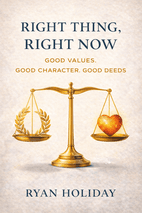
Ryan Holiday's Right Thing, Right Now explores the Stoic virtue of justice as a practical discipline for daily life, translating ancient philosophy into actionable principles for integrity and courageous action in our personal and professional spheres.
Feature
Insta.Page
Blinkist
Shortform
Summary Depth
Full Chapter-by-Chapter
15-min overview
Section-by-section guides
Audio Narration
✓
✓
✓
Visual Mindmaps
✓
✕
✕
AI Q&A
✓
✕
✕
Quizzes
✓
✕
✕
PDF Downloads
✓
✕
✓
Price
$89.99/yr
$146/yr (PRO)
$199/yr
*Competitor data last verified July 2026.
1 Page Summary
In "Right Thing, Right Now," Ryan Holiday explores the Stoic virtue of justice, framing it not merely as a legal concept but as the foundational principle for living a good and impactful life. He argues that for the Stoics, justice was the highest virtue—the active commitment to doing what is right for other people and for society, even when it is difficult or inconvenient. Holiday distills this ancient wisdom into a practical guide, emphasizing that justice is a daily practice of integrity, fairness, and courageous action in our personal relationships, workplaces, and communities.
The book is richly grounded in historical context, drawing on the lives and teachings of Stoic philosophers like Marcus Aurelius, who ruled an empire with a sense of duty, and Cato the Younger, who famously opposed Julius Caesar's tyranny. Holiday also expands beyond traditional Stoicism to include modern exemplars such as Dr. Martin Luther King Jr. and Florence Nightingale, demonstrating how the timeless principle of justice has driven moral courage and social progress across centuries. This historical tapestry illustrates that the call to do the right thing is a constant, challenging thread throughout human history.
The lasting impact of Holiday's work lies in its powerful demystification of justice as an attainable, active discipline. He moves it from an abstract ideal to a series of concrete choices: speaking up, taking responsibility, and aligning actions with values. By integrating Stoic philosophy with compelling narratives, "Right Thing, Right Now" provides a moral compass for modern readers, arguing that personal integrity and social responsibility are inseparable. The book ultimately serves as a call to action, empowering individuals to build character through just deeds and contribute to a better world, starting with their very next decision.
The Four Virtues
Overview
The chapter opens with the ancient parable of Hercules at the crossroads, where the hero must choose between a life of ease offered by Vice and a difficult path of excellence offered by Virtue. This timeless story frames a central human dilemma: the daily choice between what is easy and what is right. The text then introduces the four cardinal virtues—Courage, Temperance, Justice, and Wisdom—as the universal, interconnected components of a life of excellence, or arete. These virtues are presented not as abstract ideals but as a practical compass and a craft to be honed through continuous action. The narrative then transitions to a modern exemplar, President Harry S. Truman, using pivotal moments from his life and presidency to illustrate these virtues in action.
The Virtues as a Daily Practice
The text emphasizes that virtue is not a single, heroic choice but a relentless series of everyday decisions. Aristotle’s idea is cited: we become just by doing just acts, brave by doing brave acts. The crossroads Hercules faced is therefore a moment we encounter constantly, asking us whether we will choose growth over comfort, courage over fear, and wisdom over ignorance. This establishes virtue as an active, lifelong discipline.
Temperance and Discipline in the Ordinary
Truman’s character is first illuminated through his profound self-discipline and routine. His legendary punctuality—whether returning from lunch at exactly 2:00 PM or stepping off an elevator at 7:29 AM—exemplifies temperance: the mastery of oneself, orderliness, and control over one's time and actions. This moderation formed the bedrock of his character, remaining unshaken even by the immense power of the presidency.
Justice as Empathy and Service
Beyond discipline, Truman consistently demonstrated justice through his deep empathy and personal kindness. His heartfelt thank-yous, personal condolences to grieving families, and his controversial decision to attend the funeral of a disgraced friend, Tom Pendergast, revealed a man for whom fairness, fellowship, and loyalty were guiding principles. These actions showed a leader who viewed justice not merely as a political concept but as a daily practice of human connection and moral duty.
Courage and Wisdom in Impossible Choices
The chapter then confronts Truman’s most daunting decisions, beginning with the atomic bombings of Hiroshima and Nagasaki. This section portrays the terrifying weight of the decision, taken with the aim of ending a brutal war and saving lives, yet forever staining history. It is presented as an agonizing act of presidential courage—making a horrific choice while bearing full responsibility for its consequences. The subsequent assertion of civilian control over nuclear weapons is highlighted as an act of wisdom born from that same terrible experience, an attempt to prevent future catastrophe.
Wisdom and Justice on a Global Scale
Truman’s vision and humility are showcased in the creation of the Marshall Plan. Faced with a postwar Europe in ruins, he championed a massive, generous economic rescue, arguing that saving the world was worth the cost. His deliberate decision to name the plan after General George Marshall, rather than taking credit himself, is presented as a profound act of strategic wisdom and modest justice, ensuring the plan’s success and cementing it as a landmark achievement of humane statecraft.
Moral Courage and the Evolution of Justice
Perhaps the most powerful illustration of virtue as a journey is Truman’s transformation on civil rights. The chapter does not shy away from his racist upbringing and early prejudices. His evolution—from a man who once considered joining the Klan to the president who desegregated the military, banned discrimination in federal employment, and boldly championed the "brotherhood of all men" before hostile audiences—is presented as the ultimate testament to moral courage. It depicts virtue not as a static trait but as a path of growth, where wisdom can overcome ingrained injustice.
Key Takeaways
Virtue (arete, or excellence) is a universal pursuit, comprised of four cardinal, interconnected virtues: Courage, Temperance, Justice, and Wisdom. They serve as a compass for the good life.
The choice of virtue is not a one-time event but a daily, recurring challenge at our personal crossroads, requiring consistent practice through our actions.
Temperance (self-discipline) is the foundational virtue, evident in mastery over one's own habits and time, as seen in Truman's unwavering punctuality and routine.
Justice extends beyond fairness to encompass empathy, service, and personal loyalty, demonstrated through small acts of kindness and large acts of principle.
Courage often means making impossible choices and accepting full responsibility for them, exemplified by Truman's burden of the atomic bomb decision.
Wisdom combines knowledge, humility, and long-term vision, as shown in the strategic generosity of the Marshall Plan and the humble act of giving credit to others.
Virtue is a path of growth. Moral courage is demonstrated by the capacity to evolve and rectify one's own prejudices, as Truman did on the issue of civil rights.
Key concepts: The Four Virtues
1. The Four Virtues
The Universal Framework of Virtue
Introduces the four cardinal virtues (Courage, Temperance, Justice, Wisdom) as interconnected components of excellence (arete)
Frames virtue as a practical compass and craft to be honed, not an abstract ideal
Uses the parable of Hercules at the crossroads to illustrate the daily choice between ease and right action
Virtue as Daily Practice and Discipline
Emphasizes that virtue is built through relentless series of everyday decisions, not single heroic acts
Cites Aristotle: we become virtuous by performing virtuous acts
Presents temperance as foundational self-mastery, exemplified by Truman's extreme punctuality and control over routine
Justice as Empathy and Human Connection
Defines justice beyond political fairness to include personal kindness and loyalty
Illustrated through Truman's heartfelt thank-yous, condolences, and attendance at a disgraced friend's funeral
Shows justice as daily practice of moral duty and human fellowship
Courage in Impossible Decisions
Exemplified by Truman's atomic bomb decision as an agonizing act of presidential responsibility
Highlights the weight of making horrific choices while bearing full consequences
Shows subsequent assertion of civilian nuclear control as wisdom born from terrible experience
Wisdom in Strategic Vision and Humility
Demonstrated through Marshall Plan as strategic generosity to rebuild postwar Europe
Truman's decision to credit General Marshall rather than himself shows wisdom through modesty
Combines long-term vision with humble execution for greater good
Moral Courage as Evolution and Growth
Shows virtue as journey through Truman's transformation on civil rights
Highlights overcoming racist upbringing to desegregate military and champion equality
Demonstrates that moral courage involves evolving to rectify one's own prejudices
💡 Try clicking the AI chat button to ask questions about this book!
Introduction
Overview
The chapter begins by establishing justice as the supreme virtue—the essential quality that gives all other virtues their worth and meaning. Without it, courage, wisdom, and discipline can become dangerous or meaningless. Unlike other virtues, justice has no counterbalance; it is simply the point of it all. The author laments that modern society has largely reduced justice to a legal or political concept, concerned with laws and rights, rather than the ancient, broader understanding of it as everyday fairness, honesty, and decency.
The text argues that while we love to debate justice as a philosophical abstraction, we often neglect to practice it in the countless small, real-world decisions we make daily. Justice should not be a distant ideal but a habitual way of living—a verb, not a noun. It is a personal code, a "North Star" that guides our actions through uncertainty, as it did for historical figures from Marcus Aurelius to Martin Luther King Jr.
The Timeless Code
Despite cultural and philosophical debates, a remarkable consensus exists across history about the core of justice: keeping your word, despising selfishness, and sacrificing for the common good. This is embodied in universal principles like the Golden Rule. The "right thing" is often straightforward in practice, even if complicated in theory. The chapter introduces Admiral Hyman Rickover as a paragon of this idea—a man who wielded immense power over nuclear technology and guided generations with a simple, unwavering moral code focused on a personal sense of right and wrong.
Justice Embodied: The Example of Harry Truman
The narrative then turns to a detailed case study: President Harry S. Truman. Truman is presented not as a flawless philosophical giant, but as an ordinary man whose actions were rooted in a profound, accessible sense of decency and fairness. His growth on civil rights—spurred by personal outrage at specific acts of brutality like the blinding of Sergeant Isaac Woodard—demonstrates justice as a practical, human response. His commitment extended to small, personal acts of integrity, like ensuring a Native American war hero was buried with honor and secretly arranging for his rival's son to attend the inauguration.
Truman’s post-presidency cemented this portrait: refusing lucrative offers that compromised his integrity, accepting a pension only out of necessity, and humbly declining the Medal of Honor because he felt he didn't meet the strict criteria. His life illustrates that justice is a personal demand, not something we merely demand of others. It is found in our standards, how we treat people, the promises we keep, and the integrity of our words.
Key Takeaways
Justice is the foundational virtue. It is the essential element that validates all other virtues and gives life meaning.
Justice is active, not abstract. It is a daily practice and a way of life—a series of choices in how we treat others and conduct ourselves—not merely a topic for philosophical debate or a legal principle.
A personal moral code provides clarity. As exemplified by Admiral Rickover, a clear sense of right and wrong serves as a reliable compass for navigating life's infinite dilemmas, big and small.
Justice is demonstrated in character, not perfection. Harry Truman’s example shows that justice is accessible; it is rooted in basic decency, a capacity for growth, and consistent integrity in both monumental decisions and small, personal acts.
Justice is a demand we place on ourselves. True justice begins with our own actions, standards, and promises, regardless of whether it is popular, rewarded, or reciprocated.
Key concepts: Introduction
2. Introduction
The Supreme Virtue of Justice
Justice is the foundational virtue that gives all other virtues their worth and meaning
Modern society has reduced justice to a legal/political concept rather than everyday fairness
Justice should be a habitual way of living—a verb, not a noun—that guides daily decisions
It serves as a personal 'North Star' that has guided historical figures through uncertainty
The Timeless Moral Code
Remarkable historical consensus exists on justice's core: keeping your word, despising selfishness, sacrificing for common good
Universal principles like the Golden Rule embody this consensus
The 'right thing' is often straightforward in practice despite theoretical complexity
Admiral Hyman Rickover exemplifies living by a simple, unwavering personal moral code
Justice Embodied in Character: Harry Truman
Truman demonstrates justice as accessible to ordinary people through basic decency
His growth on civil rights shows justice as practical response to specific injustices
Justice manifests in both monumental decisions and small personal acts of integrity
Post-presidency choices reveal justice as personal demand, not something demanded of others
Core Principles of Justice
Justice begins with our own actions, standards, and promises
It requires consistency regardless of popularity, reward, or reciprocity
A personal moral code provides clarity for navigating life's dilemmas
Justice is demonstrated through character and consistent integrity, not perfection
To Stand Before Kings…
Overview
The ancient story of Hercules at the crossroads presents a timeless choice: the easy path of vice or the difficult road of virtue. This sets the stage for exploring the four cardinal virtues of Courage, Temperance, Justice, and Wisdom—the foundational compass for a life of excellence, or arete. Among these, Justice is positioned as supreme, the virtue without which the others can become dangerous. It’s reframed not as a dry legal concept but as an active, personal code of conduct—a verb of everyday fairness, honesty, and promise-keeping that forms a universal moral sense.
This principle of actionable integrity finds its ultimate illustration in the life of Harry S. Truman. Thrust into the presidency at a world-altering moment, his apparent ordinariness masked a character forged by Stoic philosophy and a steadfast personal code. Long before the White House, this code was tested and proven: enlisting in World War I out of duty, honorably repaying business debts over years, and entering politics within a corrupt machine while maintaining his honesty. Even as a U.S. Senator dismissed as a puppet, he drew on Stoic wisdom and his understanding of corruption to lead a legendary committee that exposed wartime fraud, building a reputation on principle alone.
Upon becoming president, immense power did not alter his disciplined habits or fundamental decency, seen in his famous punctuality, unexpected gestures of gratitude, and his courageous attendance at the funeral of his disgraced political patron. Facing catastrophic decisions, including the use of the atomic bomb, he operated from a sense of duty, later ensuring strict civilian control over nuclear weapons. His leadership, embodied by the “The Buck Stops Here” ethos, drove historic actions like the Marshall Plan.
Most strikingly, Truman demonstrated a profound capacity for moral growth. A product of a segregated society, he was moved by specific acts of racial injustice to become a forceful advocate for civil rights, desegregating the military and federal workforce at great political cost. After leaving office, his character shone through in his humble return to private life, refusing to monetize his presidency and even declining honors he felt he hadn’t earned. His journey underscores that integrity is a daily discipline, revealed in small gestures as much as grand decisions, and that true justice is a personal way of life whose rightness often becomes clearer with time.
The Allegory of Hercules at the Crossroads
The chapter opens not with abstract philosophy, but with a powerful myth: Hercules at a crossroads. Confronted by two goddesses, he must choose between a life of easy vice and a difficult path of virtue. This story is presented not as ancient history, but as a perpetual metaphor for our own daily choices. The path of virtue—defined by the ancients as arete, or excellence—is broken down into four cardinal, or "hinge," components: Courage, Temperance, Justice, and Wisdom. These are interrelated, universal traits that form the foundation of a good life, a compass by which to navigate.
Justice as the Supreme Virtue
While all virtues are essential, justice occupies a unique and paramount position. The text argues that without justice, other virtues become corrupted or even dangerous—courage for evil ends, wisdom without morals. Unlike other virtues, justice has no counterbalance; it is simply "the whole point." The chapter laments that modern society often reduces justice to mere legality, courtrooms, and political rights, forgetting its simpler, more profound meaning as everyday fairness, honesty, and keeping promises.
Justice is reframed as a verb—an active way of living, not a passive state or something to be received. It’s a personal code of conduct, a "Flat-Ass Rules" for distinguishing right from wrong. Despite endless philosophical debates over complex dilemmas, a remarkable consensus exists across cultures and history on core principles: we admire keepers of their word, despise liars and cheats, and celebrate sacrifice for the common good. This innate moral sense, the chapter suggests, points toward a universal, actionable understanding of "the right thing."
Harry S. Truman: The Man and His Code
The narrative then turns from theory to a concrete example: Harry S. Truman at the moment of President Franklin Roosevelt’s death. The scene emphasizes the terrifying global stakes—world war, nuclear dawn, looming Cold War—and the profound inadequacy felt by the man thrust into leadership: a failed businessman from Missouri with no college degree.
However, the chapter reveals that Truman’s apparent ordinariness was underpinned by extraordinary character, forged by the Stoic philosophy of Marcus Aurelius. Truman internalized the four cardinal virtues as his personal code. He believed in "honor, ethics, and right living as its own reward," principles instilled by his mother and reinforced by his studies. This code manifested in simple, steadfast actions: punctuality, honesty, hard work, loyalty, and fiscal responsibility.
Forging Character Through Adversity
Long before the presidency, Truman’s code was tested and proven. He enlisted in World War I despite multiple exemptions, driven by a sense of duty. As an artillery captain, he learned to administer justice with a firm but fair hand. After the war, his clothing business failed, but he honorably repaid the debts over fifteen years. It was this very financial pressure that led him, reluctantly, into the political machine of Kansas City under Boss Tom Pendergast. The chapter concludes this section with Truman beginning his political career as a county judge, establishing the central question: Could a man of steadfast personal integrity survive and succeed within a notoriously corrupt system? His backstory suggests that his character, not his resume, was his greatest preparation for the trials to come.
A Senator’s Dogged Integrity
Truman’s reputation for frustrating honesty is what led Tom Pendergast to essentially kick him “upstairs” to the U.S. Senate, wanting a more pliable politician in the local job. In Washington, Truman was widely dismissed as the “Senator from Pendergast,” a mere puppet. He endured the slights by returning to the Stoic wisdom of Marcus Aurelius, reminding himself to look past the insults to the smallness of the men who uttered them. His moment arrived with the creation of the Subcommittee on War Mobilization in 1941. Drawing on his intimate knowledge of how corruption worked from his county days, he led what became known as the Truman Committee, which exposed waste and fraud in wartime contracting, saved taxpayers an estimated $15 billion, and landed corrupt officials in jail. He wrote to his wife Bess of his hope to build a Senate reputation based on principle, not influence, even if it meant being unpopular.
The Accidental President & The Weight of Power
Franklin Roosevelt’s death in April 1945 thrust Truman into the presidency. The immense power of the office, however, did not alter his fundamental character or disciplined habits. He remained famously punctual, a trait ingrained since childhood, with his daily routine so reliable that hotel clerks could set their watches by it. More importantly, he exhibited a profound personal decency that stunned hardened political operatives, like when he simply thanked aide Harry Hopkins, who had never received thanks from FDR. This empathy manifested in small, personal gestures—calling a cabinet member with updates on his daughter’s surgery, sending condolences to a veteran’s family—and in one bold, symbolic act: attending the funeral of his disgraced patron, Tom Pendergast, just six days after becoming president.
Facing a cascade of world-altering crises, from the founding of the UN to the collapse of Europe’s economy, Truman made the most consequential decision of the modern era: authorizing the use of atomic bombs on Hiroshima and Nagasaki. The text notes the moral complexity and the limited nature of Truman’s choice, framed by the recent horrific sinking of the USS Indianapolis and his duty to protect American lives. A critical and lasting outcome of this decision was Truman’s subsequent insistence on asserting strict civilian control over nuclear weapons, a precedent that has held ever since.
Civil Rights & The Capacity to Grow
Truman’s leadership was defined by actionable integrity, famously summarized by the “The Buck Stops Here” sign on his desk, but better captured by another: “Always do right! This will gratify some people and astonish the rest.” This ethos powered the Marshall Plan, a generous economic rescue of Europe, which Truman shrewdly named after General George Marshall to ensure its political success.
Most remarkably, this same ethos drove a profound personal and political transformation on civil rights. A product of a racist, former slave-state upbringing, Truman evolved into the president who desegregated the armed forces and the federal workforce. This change was catalyzed by specific acts of brutality, particularly the blinding of Black veteran Sergeant Isaac Woodard Jr. Outraged, Truman declared, “We’ve got to do something!” He established the Presidential Commission on Civil Rights, addressed the NAACP at the Lincoln Memorial, and defended the “brotherhood of all men” before hostile audiences, at great political cost. As his White House counsel observed, the “wonderful development” was “Harry Truman's capacity to grow,” further evidenced when he ensured a Native American war hero, Sergeant John Rice, was buried with full honors at Arlington.
Life After Power: The Unchanged Man
Truman’s character was perhaps most clearly revealed after he left office. After a bitter campaign, he graciously arranged for his successor Dwight D. Eisenhower’s son to attend the inauguration, a kindness Eisenhower initially met with suspicion. Truman then simply returned to Independence, Missouri, carrying his own suitcases to the attic and later helping a farmer herd pigs off the road. He refused all lucrative offers to trade on his presidential fame, stating he’d “rather die in the poorhouse.” In a final act of principled humility, he preemptively declined the Congressional Medal of Honor, believing he had not earned it under the strict criteria for battlefield heroism.
Key Takeaways
Integrity is a practiced discipline: Truman’s honesty wasn’t a vague ideal but a daily practice, from scrutinizing county contracts to refusing a presidential pension.
Character is revealed in small gestures: Leadership is expressed not only in grand decisions but in punctuality, personal gratitude, loyalty to fallen friends, and quiet kindnesses.
Moral growth is possible: Even someone raised with deep prejudices can, through empathy and a commitment to principle, become a powerful force for justice.
The right thing often ages well: While Truman left office deeply unpopular, his legacy of integrity, the Marshall Plan, and advances in civil rights are now seen as historic achievements. True justice is a personal way of life, demanding consistency between our values and our actions, regardless of reward.
Key concepts: To Stand Before Kings…
3. To Stand Before Kings…
The Allegory of Hercules at the Crossroads
Presents the timeless choice between the easy path of vice and the difficult road of virtue
Introduces the four cardinal virtues (Courage, Temperance, Justice, Wisdom) as the foundation of arete (excellence)
Frames the virtues as a universal compass for navigating life's daily choices
Justice as the Supreme and Active Virtue
Justice is positioned as supreme—without it, other virtues become corrupted or dangerous
Modern society often reduces justice to legality, forgetting its core as everyday fairness and honesty
Justice is reframed as a verb: an active, personal code of conduct and a universal moral sense
Despite complex debates, a cross-cultural consensus exists on core principles like promise-keeping and honesty
Harry S. Truman: Embodiment of a Personal Code
Thrust into presidency at a world-altering moment, his apparent ordinariness masked a Stoic-forged character
Lived by the four cardinal virtues as a personal discipline of 'honor, ethics, and right living as its own reward'
Manifested his code through simple, steadfast actions: punctuality, honesty, hard work, and fiscal responsibility
Forging Character Through Pre-Presidential Trials
Enlisted in WWI out of duty despite exemptions, learning to administer justice as an artillery captain
Honorably repaid business debts over fifteen years after his clothing venture failed
Entered politics within Kansas City's corrupt Pendergast machine while maintaining personal integrity
His character, not his resume, was his greatest preparation for leadership
Justice as a Lifelong Discipline and Moral Growth
Truman's integrity remained unchanged by immense power, seen in small gestures and courageous decisions
Demonstrated profound moral growth by evolving on civil rights and desegregating the military at political cost
Post-presidency, he lived humbly, refusing to monetize his office or accept unearned honors
Illustrates that true justice is a personal way of life, revealed in daily discipline and whose rightness becomes clearer with time
Senatorial Integrity and the Truman Committee
Truman's frustrating honesty led Tom Pendergast to send him to the Senate to remove him from local politics.
He endured being dismissed as the 'Senator from Pendergast' by turning to Stoic philosophy to maintain perspective.
His moment came when he led the Truman Committee, using his knowledge of corruption to expose wartime fraud.
The committee saved taxpayers an estimated $15 billion and jailed corrupt officials.
Truman aimed to build a Senate reputation based on principle rather than political influence.
The Accidental Presidency and Decisive Leadership
Truman's fundamental character and disciplined habits remained unchanged despite the immense power of the presidency.
He exhibited profound personal decency and empathy, stunning political operatives with simple acts of gratitude and kindness.
His most consequential decision was authorizing the atomic bombs, a choice framed by moral complexity and duty to protect American lives.
A critical legacy was his insistence on strict civilian control over nuclear weapons, establishing a lasting precedent.
He demonstrated symbolic loyalty by attending the funeral of his disgraced patron, Tom Pendergast, shortly after taking office.
Moral Evolution on Civil Rights
Truman evolved from a product of a racist upbringing to a president who advanced civil rights.
His transformation was catalyzed by specific acts of brutality, such as the blinding of Black veteran Sergeant Isaac Woodard Jr.
He took actionable steps, including establishing the Presidential Commission on Civil Rights and desegregating the armed forces.
Truman defended civil rights before hostile audiences at great political cost, emphasizing the 'brotherhood of all men.'
His capacity for growth was further shown in ensuring a Native American war hero received full honors at Arlington.
Post-Presidency: Humility and Principle
After leaving office, Truman returned to a simple life in Independence, Missouri, carrying his own suitcases and helping neighbors.
He refused all lucrative offers to trade on his presidential fame, prioritizing integrity over wealth.
In a final act of humility, he preemptively declined the Congressional Medal of Honor, believing he had not earned it under strict criteria.
He demonstrated grace by arranging for his successor's son to attend the inauguration, despite previous campaign bitterness.
His post-presidential life confirmed that his character was rooted in consistency between values and actions, regardless of reward.
Enduring Leadership Principles
Integrity is a practiced discipline, demonstrated through daily actions from county contracts to presidential decisions.
Character is revealed in small gestures, such as punctuality, personal gratitude, and quiet kindnesses.
Moral growth is possible through empathy and a commitment to principle, even for those raised with deep prejudices.
The right thing often ages well, as seen in how Truman's once-unpopular legacy is now viewed as historic.
True justice requires consistency between values and actions, a personal way of life rather than a pursuit of reward.
Keep Your Word
Overview
This chapter establishes that the pursuit of justice and a good life begins with the most fundamental personal commitment: integrity. It argues that true character is proven not in grand, rare gestures but in the daily discipline of keeping one’s promises, whether to oneself or to others. Through historical precedent and modern example, it makes the case that honoring your word is the essential bedrock of trust, justice, and a life without regret.
The Bedrock of Justice Begins With You
The chapter posits that the entire edifice of justice is built on a personal foundation. While the world may be full of unfairness, each individual has the power to control their own conduct. This means adhering to an internal code of honesty, dignity, and honor, which manifests in simple, everyday behaviors: doing what you say you will, treating people well, and conducting business ethically. This personal rectitude is the first and most critical sphere of influence.
The Unwavering Example of Regulus
The story of the Roman general Marcus Atilius Regulus serves as a powerful anchor for the chapter’s theme. After being captured and held for years, he was paroled to deliver peace terms from Carthage to Rome. Upon arrival, he advised the Senate to reject the terms and continue the war. Then, despite being free, safe, and home, he chose to return to captivity in Carthage because he had sworn an oath to do so. His friends were baffled, but to Regulus, a promise—even to an enemy—was binding. His example starkly contrasts with the modern temptation to seek exemptions from our commitments.
The Real Cost of a Broken Promise
The text directly addresses the common justifications for breaking one’s word: a better opportunity arose, the task became difficult, or it seemed inconsequential. It acknowledges that keeping a promise can have a tangible cost—missing out, getting a worse deal, or enduring hardship. However, it counters that breaking a promise carries a heavier, often hidden cost. It damages your reputation, betrays the trust of those who relied on you, and, in a broader sense, weakens the fragile bonds of public trust that hold society together. Every kept promise, by contrast, strengthens that fabric.
The Discipline of Obligation: Truman’s Tears
The anecdote about a frail Harry Truman canceling an appointment illustrates that integrity is about obligation, not convenience. Even when legitimately ill, Truman was upset at failing to meet a commitment, telling a reporter, “I like to live up to my obligations.” This moment underscores that the people we admire most are defined by this very trait. The chapter distinguishes that keeping your word to yourself is discipline, while keeping your word to others is a form of justice—allowing them to plan and act based on the certainty of your promise.
Integrity in the Mundane: The Writer and the Babysitter
The story of poet Diane di Prima leaving a legendary Beat generation party to relieve her babysitter reinforces that integrity is tested in mundane choices, not just grand crises. When Jack Kerouac told her she would never be a writer if she didn’t “forget about your babysitter,” he championed artistic passion over personal responsibility. Di Prima’s choice to leave affirmed that true discipline—whether for art or family—is rooted in the same principle: honoring your commitments. The chapter champions this choice, arguing that no one should be judged for prioritizing their word.
Navigating the Difficult Promises
The chapter does not shy away from the fact that some promises become profoundly difficult to keep. It asks the hard questions: What about a marriage vow tested by years of hardship? A promise to quit an addiction? An agreement with someone who has already broken their side? It acknowledges the natural feelings of doubt, the desire for a pass, and the fear of painful consequences. Yet, its resolution is unequivocal: “You said it, they're counting on you, do it.” The final contention is that while we may regret many things, we will never regret being a person known for keeping their word.
Key Takeaways
Character is built daily: Justice and virtue begin with personal integrity, demonstrated through the consistent, everyday act of keeping promises.
Your word is your bond: A promise is a contract, whether sworn to an enemy like Regulus or a babysitter like di Prima. It creates real expectations and plans for others.
Costs exist on both sides: While keeping a word may incur opportunity costs or hardship, breaking it damages trust, reputation, and the social fabric.
Integrity is non-negotiable: Admirable people, from generals to presidents, are defined by their commitment to live up to obligations, especially when it’s difficult.
No regrets: The path of honoring your commitments, though sometimes painful, leads to a life free from the regret of being untrustworthy.
Key concepts: Keep Your Word
4. Keep Your Word
The Bedrock of Justice Begins With You
Justice is built on a personal foundation of integrity
Control your own conduct through an internal code of honesty and honor
Manifests in everyday behaviors: doing what you say, treating people well, ethical business
Personal rectitude is the first and most critical sphere of influence
The Unwavering Example of Regulus
Roman general returned to captivity because he swore an oath to do so
A promise—even to an enemy—is binding
Stark contrast with modern temptation to seek exemptions from commitments
Demonstrates that integrity transcends convenience and personal safety
Ryan Holiday is a modern Stoic philosopher and bestselling author known for books like "The Obstacle Is the Way" and "The Daily Stoic," which apply ancient Stoic principles to contemporary life and business. A former marketing director for American Apparel, he is a prominent media strategist and writes extensively on strategy, perception, and resilience.
📚 Explore Our Book Summary Library
Discover more insightful book summaries from our collection