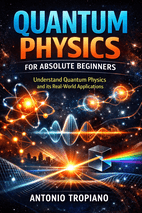
What is the book Quantum Physics for Absolute Beginners about?
Antonio Tropiano's Quantum Physics for Absolute Beginners demystifies foundational concepts like wave-particle duality and quantum entanglement using clear analogies, not complex math. It connects these principles to real-world technologies, from semiconductors to MRI machines, for curious newcomers without a scientific background.
Feature
Insta.Page
Blinkist
Shortform
Summary Depth
Full Chapter-by-Chapter
15-min overview
Section-by-section guides
Audio Narration
✓
✓
✓
Visual Mindmaps
✓
✕
✕
AI Q&A
✓
✕
✕
Quizzes
✓
✕
✕
PDF Downloads
✓
✕
✓
Price
$89.99/yr
$146/yr (PRO)
$199/yr
*Competitor data last verified July 2026.
1 Page Summary
Quantum Physics for Absolute Beginners by Antonio Tropiano lives up to its title by providing a remarkably accessible entry point into one of science's most famously counterintuitive subjects. The book strategically sidesteps complex mathematics, instead using clear analogies and thought experiments to introduce foundational concepts. Tropiano guides the reader through the revolutionary ideas that emerged in the early 20th century, from Max Planck's quantized energy and the wave-particle duality of light to Erwin Schrödinger's famous cat paradox and the principle of quantum superposition. This historical and conceptual framing allows readers to grasp why quantum mechanics represented such a dramatic break from classical physics.
The core of the book focuses on demystifying the bizarre implications of these principles, emphasizing their real-world applications to demonstrate that quantum theory is not just abstract philosophy. Tropiano explains how phenomena like quantum entanglement and tunneling are not science fiction but are engineered into the technologies that define the modern world. Readers learn how these principles are essential to the operation of lasers, MRI machines, and most significantly, the transistors and semiconductors that power all computers and smartphones, thereby connecting abstract theory to tangible, everyday devices.
Ultimately, Tropiano's work successfully conveys the profound and lasting impact of quantum physics, framing it as the fundamental framework for understanding the behavior of nature at the smallest scales. The book concludes by looking toward the future, touching on how this knowledge is driving next-generation innovations in areas like quantum computing, cryptography, and sensing. By making the subject approachable and clearly relevant, it empowers absolute beginners to appreciate a paradigm that reshaped our understanding of reality and continues to drive technological progress.
Mechanics
Overview
As the 20th century began, the world of physics appeared largely complete. The powerful framework of classical physics, built over centuries, successfully described everything from planetary orbits to the stresses in a bridge. This chapter establishes that foundation, exploring the mechanics of the everyday world—a set of rules that would soon be revealed as a brilliant approximation, perfect for the human scale but holding hidden fractures that would lead to a revolutionary new understanding of reality.
The Bedrock of Motion: Newton's Laws
The core of classical mechanics is the work of Isaac Newton. His three laws of motion provide a complete toolkit for analyzing how objects interact with forces:
The Law of Inertia: An object at rest stays at rest, and an object in motion continues at a constant velocity, unless acted upon by an external force.
F=ma: The acceleration of an object is directly proportional to the net force acting on it and inversely proportional to its mass. This quantifies how forces change motion.
Action-Reaction: For every action, there is an equal and opposite reaction. Forces always occur in pairs between interacting objects.
These laws unified earthly and celestial physics, allowing scientists to predict trajectories, design structures, and understand planetary motion with breathtaking accuracy.
Energy and the Principle of Least Action
Following Newton, the concept of energy became central. Kinetic energy was defined as the energy of motion, while potential energy was understood as stored energy due to position or configuration, like a ball held aloft or a spring wound tight. The beautiful interplay between these two forms—the conversion of potential to kinetic energy and back—governed the dynamics of systems.
This led to more elegant, generalized formulations of mechanics by thinkers like Lagrange and Hamilton. They introduced the principle of stationary action, a profound idea stating that a physical system evolves between two states along the path that minimizes (or makes stationary) a quantity called the action. The action is calculated from the difference between the system's kinetic and potential energy over time. This principle isn't just a mathematical trick; it reveals that nature is an efficient planner, choosing the most economical path from a universe of possibilities.
The World of Waves
Mechanics also explains waves—disturbances that transport energy without permanently moving the medium itself. Think of sound: a clap compresses air molecules, which bump into their neighbors in a chain reaction, propagating energy as a wave that our ears interpret as sound. We classify mechanical waves by how the medium moves:
Transverse waves (e.g., water waves): The medium moves perpendicular to the wave's direction.
Longitudinal waves (e.g., sound): The medium moves parallel to the wave's direction, creating compressions and rarefactions.
Surface waves: A combination of both, like waves on a lake.
Two defining characteristics of any wave are crucial for the quantum story to come:
Frequency: The number of wave cycles passing a point per second, measured in Hertz (Hz). High frequency means more oscillations and higher energy.
Wavelength (λ): The physical distance between successive crests (or troughs). Frequency and wavelength are intimately linked: shorter wavelengths correspond to higher frequencies, and longer wavelengths to lower frequencies. This relationship between the measurable length of a wave and its energetic frequency will become a cornerstone of quantum theory.
Key Takeaways
Classical mechanics, built on Newton's Laws, provided a complete and accurate description of motion and forces for macroscopic objects.
The principle of stationary action offers a powerful alternative perspective, showing that nature selects the path of least action from all possible paths a system could take.
The study of waves introduced the critical concepts of frequency and wavelength, inverse properties that describe a wave's energy and oscillation.
Crucially, at the dawn of the 20th century, this elegant classical framework was about to encounter phenomena it could not explain, setting the stage for the quantum revolution.
Key concepts: Mechanics
1. Mechanics
Newton's Laws of Motion
Law of Inertia: Objects remain at rest or in uniform motion unless acted upon by an external force
F=ma: Acceleration is proportional to net force and inversely proportional to mass
Action-Reaction: Forces always occur in equal and opposite pairs between interacting objects
Unified earthly and celestial physics, enabling accurate predictions of motion
Energy and Generalized Mechanics
Kinetic energy: Energy of motion
Potential energy: Stored energy due to position or configuration
Principle of stationary action: Nature selects paths that minimize action
Action calculated from difference between kinetic and potential energy over time
Lagrange and Hamilton developed elegant mathematical formulations
Mechanical Waves
Transverse waves: Medium moves perpendicular to wave direction (e.g., water waves)
Longitudinal waves: Medium moves parallel to wave direction (e.g., sound waves)
Surface waves: Combination of transverse and longitudinal motion
Frequency: Number of wave cycles per second, measured in Hertz
Wavelength: Physical distance between successive wave crests
Inverse relationship: Shorter wavelengths correspond to higher frequencies
Classical Mechanics Framework
Complete description of macroscopic objects and everyday phenomena
Successful for planetary orbits, structural engineering, and motion prediction
Revealed as an approximation at dawn of 20th century
Set stage for quantum revolution when encountering unexplained phenomena
💡 Try clicking the AI chat button to ask questions about this book!
Optics
Overview
Newton's groundbreaking work in mechanics didn't just unravel the secrets of moving objects; it also illuminated the path of light itself, giving optics a sturdy foundation for exploration. This chapter reveals how light is studied, from its origins to its interactions with the world around us, framing it through two powerful perspectives: one that follows light as straight-line rays and another that dances with its wavelike essence.
The Two Approaches to Light
Optics splits into two complementary realms. Geometrical optics simplifies light into rays, making it easy to trace reflections in mirrors and refractions through lenses. In contrast, physical optics embraces light's wave nature, unlocking a deeper understanding of how light bends and interacts in ways that rays alone can't explain, setting the stage for phenomena like diffraction and interference.
Diffraction: Light's Gentle Spread
When waves encounter an obstacle or slip through a narrow gap, they don't just stop or travel straight—they spread out and bend, a behavior known as diffraction. This effect becomes especially vivid when the opening or barrier is about the same size as the light's wavelength, creating intricate patterns that hint at light's underlying wave character. It's why light can creep into shadows and why waves reshape themselves after passing through a small aperture.
Refraction: Light's Change of Pace
As light journeys from one material to another, like from air into water, it suddenly changes speed, causing it to bend at the boundary. This refraction is all around us: it's what makes a straw look broken in a glass of water and allows lenses to focus light into sharp images. The shift in speed, dictated by the medium's density, subtly alters light's path, reminding us that light adapts to its surroundings.
Polarization: Light's Hidden Orientation
Light waves vibrate perpendicular to their travel direction, and polarization captures the geometry of this vibration. Think of it as the wave's personal signature—whether it oscillates in a steady plane (linear polarization) or swirls in a corkscrew pattern (circular or elliptical polarization). This property, unique to transverse waves like light, influences how light interacts with materials and is key to technologies like polarized sunglasses.
Key Takeaways
Optics bridges Newton's mechanical insights with the study of light, divided into ray-based geometrical optics and wave-based physical optics.
Diffraction showcases light's wave nature, where bending around obstacles depends on wavelength relative to obstacle size.
Refraction occurs when light changes speed crossing between media, leading to bending that explains everyday effects like distorted underwater views.
Polarization describes the vibration direction of light waves, with forms ranging from linear to circular, essential for understanding light's interaction with matter.
Key concepts: Optics
2. Optics
Foundations of Optics
Builds upon Newton's mechanical principles to study light
Divides into two complementary approaches: geometrical and physical optics
Explores light from its origins to its interactions with matter
Geometrical Optics
Treats light as straight-line rays for simplification
Effectively models reflection in mirrors and refraction through lenses
Provides practical tools for tracing light paths
Physical Optics
Embraces light's wave nature for deeper understanding
Explains phenomena that ray models cannot, like diffraction and interference
Reveals the fundamental wave character of light
Diffraction
Occurs when waves encounter obstacles or pass through narrow openings
Causes light to spread out and bend rather than travel straight
Most pronounced when opening/obstacle size is comparable to light's wavelength
Creates intricate patterns that demonstrate light's wave properties
Explains how light can enter shadowed areas
Refraction
Occurs when light changes speed crossing between different media
Causes bending of light at material boundaries
Explains everyday effects like distorted underwater views
Governed by the density of the medium light travels through
Enables lenses to focus light into sharp images
Polarization
Describes the vibration direction of light waves perpendicular to travel
Unique property of transverse waves like light
Includes linear, circular, and elliptical polarization patterns
Influences how light interacts with materials
Essential for technologies like polarized sunglasses
Thermodynamics
Overview
During the 19th century, the study of thermodynamics captured the imagination of physicists, becoming a cornerstone of modern science. This field explores the intricate dance between heat, work, temperature, and energy—essentially, how energy transforms and moves, shaping the behavior of matter around us. Its journey from practical engineering to profound theoretical insights reveals a fascinating chapter in the history of physics.
Historical Context and Practical Origins
Thermodynamics didn't emerge in a vacuum; it was born from the industrial age's pressing needs. The drive to understand and enhance the efficiency of early steam engines provided the initial spark. Pioneers like James Clerk Maxwell and Max Planck later built upon this foundation, elevating thermodynamics from a tool for engineers to a fundamental scientific discipline. Its principles quickly transcended machinery, finding powerful applications in chemistry and the study of chemical reactions, thereby bridging physics with other natural sciences.
Core Principles and Energy Relationships
At its heart, thermodynamics is about connection and conversion. It meticulously maps how energy transfers from one form to another—such as heat into mechanical work—and how these exchanges dictate the physical properties of materials. This framework allows us to predict everything from the expansion of gases to the flow of heat, offering a universal language for energy processes.
The Microscopic Connection: Statistical Mechanics
A pivotal evolution came with the marriage of thermodynamics to atomic theory. As scientists delved into the microscopic world, they sought to explain large-scale thermal phenomena through the behavior of countless atoms and molecules. This gave birth to statistical mechanics, where the laws of Newtonian mechanics are applied to vast ensembles of particles. This statistical approach was not just an extension; it became a crucial bridge to quantum theory, revealing how the chaos of the microscopic realm gives rise to the orderly laws we observe macroscopically.
Key Takeaways
Thermodynamics fundamentally studies the interconversion of heat, work, temperature, and energy.
Its development was deeply intertwined with the Industrial Revolution, particularly steam engine technology.
The field rapidly expanded to influence chemistry and the understanding of chemical reactions.
Statistical mechanics, linking atomic behavior to macroscopic laws, was a transformative development that paved the way for quantum physics.
Key concepts: Thermodynamics
3. Thermodynamics
Historical Development and Origins
Emerged from practical needs of the Industrial Revolution, particularly steam engine efficiency
Transitioned from engineering application to fundamental scientific discipline
Pioneers like James Clerk Maxwell and Max Planck elevated its theoretical foundations
Expanded to influence chemistry and study of chemical reactions
Fundamental Scope and Purpose
Studies interconversion of heat, work, temperature, and energy
Explores how energy transforms and moves within systems
Provides framework for predicting material behavior and energy processes
Serves as universal language for energy transfer and conversion
Microscopic Foundation: Statistical Mechanics
Connects macroscopic thermal phenomena to atomic/molecular behavior
Applies Newtonian mechanics to vast ensembles of particles
Bridges thermodynamics with quantum theory
Explains how microscopic chaos gives rise to macroscopic order
Broader Scientific Impact
Became cornerstone of modern physics with wide-ranging applications
Transcended original mechanical applications to influence multiple sciences
Reveals fundamental connections between energy, matter, and physical laws
Paved way for understanding complex systems through statistical approaches
Electromagnetism
Overview
Following the successful explanation of large-scale thermodynamic phenomena through the microscopic behavior of particles, physics turned to another pervasive force. While the ancients observed electrical and magnetic effects in isolation, the modern understanding reveals them not as separate forces, but as two intimately connected manifestations of a single, fundamental interaction: electromagnetism.
The Long Road to Unification
For centuries, electrical phenomena (like static shock) and magnetic phenomena (like lodestones) were studied as distinct curiosities. The pivotal breakthrough came with the realization that these forces are deeply intertwined. Moving electric charges create magnetic fields, and changing magnetic fields can induce electric currents. This reciprocal relationship formed the bedrock for developing a single, coherent theory that could describe both.
The Nature of the Electromagnetic Force
Electromagnetism governs the interactions between particles that possess electric charge, such as electrons and protons. This interaction is not direct contact but is mediated through invisible electric and magnetic fields. These fields fill the space around charged objects and exert forces on other charges within that space. It is this force that dictates the structure of matter itself—holding electrons in orbit around atomic nuclei and binding atoms together to form molecules. From the shock of a doorknob to the complexity of chemical bonds, electromagnetism is the engine behind countless daily phenomena.
Key Takeaways
Electricity and magnetism are not separate forces but two aspects of a single, unified electromagnetic force.
This force acts between electrically charged particles through the mediation of electric and magnetic fields.
Electromagnetism is a fundamental force responsible for atomic structure, chemical bonding, and a vast array of everyday physical phenomena.
Key concepts: Electromagnetism
4. Electromagnetism
The Long Road to Unification
Electricity and magnetism were historically studied as separate phenomena for centuries
The pivotal breakthrough was realizing these forces are deeply intertwined and reciprocal
Moving electric charges create magnetic fields, and changing magnetic fields induce electric currents
This reciprocal relationship formed the bedrock for developing a single, coherent theory
The Nature of the Electromagnetic Force
Electromagnetism governs interactions between particles with electric charge (electrons, protons)
The interaction is mediated through invisible electric and magnetic fields that fill space around charged objects
These fields exert forces on other charges within that space
Electromagnetism dictates atomic structure by holding electrons in orbit around nuclei
This force is responsible for chemical bonding and countless daily phenomena from static shock to molecular formation
Fundamental Principles of Electromagnetism
Electricity and magnetism are two aspects of a single, unified electromagnetic force
The force acts through the mediation of electric and magnetic fields rather than direct contact
Electromagnetism is a fundamental force responsible for atomic structure and chemical bonding
It explains phenomena ranging from microscopic atomic interactions to macroscopic everyday experiences
You've reached the end of the free chapters
Next chapter: “Clouds on the horizon” is locked
Keep reading Quantum Physics for Absolute Beginners — and unlock all 600+ book summaries with audio, mindmaps and AI Q&A.
$0.00 due today · 7 days free, then $89.99/year ($7.49/mo) · Cancel anytime before day 7
plus sales tax where applicable
More ways to explore Quantum Physics for Absolute Beginners
Antonio Tropiano is an Italian author and journalist known for his investigative works on organized crime and political corruption in Italy. He gained prominence with his book "Il Sistema," which exposed the intricate ties between the mafia and state institutions, drawing from his extensive experience as a crime reporter in Southern Italy.
📚 Explore Our Book Summary Library
Discover more insightful book summaries from our collection