Quantum Physics for Absolute Beginners Key Takeaways
by Antonio Tropiano
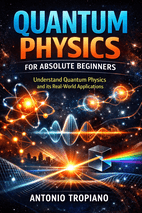
5 Main Takeaways from Quantum Physics for Absolute Beginners
Classical physics was incomplete and its anomalies necessitated a quantum revolution.
The book details how Newtonian mechanics and Maxwell's electromagnetism, while successful for everyday objects, utterly failed to explain phenomena like black-body radiation and the photoelectric effect. These 'clouds on the horizon' were critical puzzles that forced physicists like Planck and Einstein to invent an entirely new set of rules for the atomic world.
Quantum reality is defined by probability, not certainty, and observation changes the system.
The book explains that quantum particles exist in blurred, probabilistic states called wave functions until measured. The act of measurement itself forces a 'collapse' into a definite outcome, and Heisenberg's Uncertainty Principle establishes a fundamental limit on how precisely we can know paired properties like position and momentum.
Wave-particle duality is a universal and contextual feature of all matter and energy.
Light and particles like electrons display both wave-like and particle-like behavior. The book shows through the photoelectric effect and electron diffraction that which aspect manifests depends on the experimental context, unifying two concepts once thought to be mutually exclusive.
Energy is quantized in discrete packets, explaining atomic stability and spectra.
From Planck's solution for black-body radiation to Bohr's model of the atom, the book demonstrates that energy in bound systems comes in fixed, indivisible units called quanta. This quantization explains why atoms don't collapse, why they emit specific colors of light, and serves as the foundation for technologies like lasers.
Quantum mechanics is both a practical tool for technology and a profound philosophical puzzle.
The book traces how quantum principles directly enable modern devices like transistors, solar cells, and LEDs. Simultaneously, it explores unresolved interpretational questions—from the Copenhagen view to Many-Worlds—highlighting the ongoing debate about what the mathematics truly says about the nature of reality.
Executive Analysis
Antonio Tropiano’s "Quantum Physics for Absolute Beginners" constructs a coherent narrative from classical physics’ triumph to its crisis, through the quantum revolution, and into its modern implications. The five key takeaways connect to form a central thesis: our intuitive, deterministic view of reality is an approximation that breaks down at the atomic scale, requiring a probabilistic, observer-sensitive framework that, while bizarre, is powerfully predictive and technologically indispensable.
The book matters because it successfully bridges abstract theory, historical narrative, and practical application. It positions itself as an ideal primer by not only demystifying core quantum concepts but also by showing their direct impact on everyday technology, while honestly acknowledging the deep philosophical questions that remain unanswered, encouraging readers to engage with physics as a living, evolving field.
Chapter-by-Chapter Key Takeaways
Mechanics (Chapter 1)
Classical mechanics, built on Newton's Laws, provided a complete and accurate description of motion and forces for macroscopic objects.
The principle of stationary action offers a powerful alternative perspective, showing that nature selects the path of least action from all possible paths a system could take.
The study of waves introduced the critical concepts of frequency and wavelength, inverse properties that describe a wave's energy and oscillation.
Crucially, at the dawn of the 20th century, this elegant classical framework was about to encounter phenomena it could not explain, setting the stage for the quantum revolution.
Try this: Recognize that classical mechanics, for all its power, is a specific set of rules for the large-scale world that fails at atomic scales.
Optics (Chapter 2)
Optics bridges Newton's mechanical insights with the study of light, divided into ray-based geometrical optics and wave-based physical optics.
Diffraction showcases light's wave nature, where bending around obstacles depends on wavelength relative to obstacle size.
Refraction occurs when light changes speed crossing between media, leading to bending that explains everyday effects like distorted underwater views.
Polarization describes the vibration direction of light waves, with forms ranging from linear to circular, essential for understanding light's interaction with matter.
Try this: Analyze light by considering both its particle-like rays and its wave-like behaviors like diffraction and polarization.
Thermodynamics (Chapter 3)
Thermodynamics fundamentally studies the interconversion of heat, work, temperature, and energy.
Its development was deeply intertwined with the Industrial Revolution, particularly steam engine technology.
The field rapidly expanded to influence chemistry and the understanding of chemical reactions.
Statistical mechanics, linking atomic behavior to macroscopic laws, was a transformative development that paved the way for quantum physics.
Try this: Use the laws of thermodynamics and statistical mechanics to connect the behavior of vast numbers of particles to everyday phenomena like heat and work.
Electromagnetism (Chapter 4)
Electricity and magnetism are not separate forces but two aspects of a single, unified electromagnetic force.
This force acts between electrically charged particles through the mediation of electric and magnetic fields.
Electromagnetism is a fundamental force responsible for atomic structure, chemical bonding, and a vast array of everyday physical phenomena.
Try this: Unify electric and magnetic phenomena by understanding they are manifestations of a single electromagnetic field.
Clouds on the horizon (Chapter 5)
The late 19th-century confidence in a "complete" physics was undermined by two critical anomalies: the search for the luminiferous ether and the mismatched behavior of heat capacity in solids.
The Michelson-Morley experiment's failure to detect the ether challenged the very foundation of how waves travel and paved the way for Einstein's theory of relativity.
The measured heat capacity of solids dropping to zero at low temperatures defied the Dulong-Petit law and classical thermodynamics, pointing toward the need for quantum theory to explain energy at the atomic scale.
Try this: When established theory fails to explain key experiments, view it as an opportunity for foundational discovery, not just a puzzle.
Physics at the dawn of the 20th century: 3 takeaways (Chapter 6)
Classical physics was remarkably successful but incomplete. At the dawn of the 20th century, theories like Newtonian mechanics and Maxwell's electromagnetism formed a cohesive system, yet they could not explain all experimental observations, revealing inherent limitations.
Critical anomalies paved the way for revolution. Lord Kelvin's "two clouds"—the mystery of the ether and the disagreement over heat capacity in solids—were not minor issues but fundamental challenges that demanded a radical rethink of physical laws.
Einstein's dual breakthroughs bridged the old and new. By resolving both clouds with relativity and the quantum hypothesis, Einstein didn't just patch up classical physics; he ushered in the modern era, demonstrating that progress often comes from embracing the unexpected and reimagining the foundations of reality.
Try this: See scientific progress as an ongoing process where even successful paradigms contain the seeds of their own revolution.
To know more (Chapter 7)
Newton's laws are thoroughly explained by NASA, offering an authoritative source for learners.
Susskind's "The theoretical minimum" provides a comprehensive and friendly entry point into classical physics.
Understanding the history of the principle of least action enriches appreciation for its role in physics.
Lord Kelvin's speech is often misinterpreted; a dedicated article helps correct common misconceptions.
Classical physics emerges as an approximation of quantum physics, and specific resources elucidate this relationship.
Try this: Strengthen your grasp of quantum ideas by studying the classical principles they emerged from and superseded.
Temperature and light (Chapter 8)
All objects emit light, with cooler objects emitting invisible infrared radiation.
Increasing an object's temperature increases the frequency of the light it emits, causing it to glow visibly (incandesce) in a progression from red to orange to yellow to white.
Gustav Kirchhoff showed that "heat rays" and visible light are the same phenomenon, differing only in frequency.
The theoretical black-body—a perfect absorber and emitter of radiation—was established as the key object for studying how temperature alone determines the spectrum of emitted light.
Try this: Estimate an object’s temperature by observing the dominant color of the thermal radiation it emits.
The black-body experiment (Chapter 9)
A perfect black-body is an ideal emitter and absorber that does not exist naturally but can be closely approximated by a heated cavity with a small hole.
The pioneering late-19th century experiment used a heated platinum cavity, a spectrometer, and a sensitive bolometer to measure emitted light intensity at different frequencies.
The measured black-body spectrum is not flat; it forms a curve that peaks at a specific frequency and falls off on either side.
The peak frequency of this spectrum depends directly on temperature, shifting to higher frequencies as the cavity gets hotter.
Try this: Understand that a perfect emitter’s light spectrum has a specific shape and peak that shifts with temperature, revealing a deep mystery.
Oscillators might be the answer (Chapter 10)
The Wien radiation law was an empirical success but a theoretical dead end, prompting a search for a law based on fundamental physics.
The oscillator model, pioneered by Rayleigh, provided a compelling mechanical explanation for thermal radiation by linking atomic motion to light emission.
The resulting Rayleigh-Jeans law, while partially accurate, led to the nonsensical "ultraviolet catastrophe," dramatically exposing the limits of classical physics and creating the need for quantum theory.
Try this: When a model based on solid classical reasoning leads to an absurd result (like infinite energy), it signals a need for entirely new physics.
Planck’s solution (Chapter 11)
The Ultraviolet Catastrophe was not just a minor puzzle; it was a fundamental failure of classical physics, signaling that entirely new principles were needed.
Planck’s Quantization Hypothesis was the first such principle, proposing that energy is not continuous but exists in discrete packets (quanta) proportional to frequency (E = hν).
A Statistical Explanation: By combining this quantization with statistical reasoning, Planck showed that high-frequency, high-energy states are naturally suppressed, explaining the observed black-body spectrum.
A Revolutionary Act: This solution was born of necessity, marking a definitive break from classical thought and laying the cornerstone for quantum mechanics.
Try this: Accept that energy comes in discrete packets (quanta) as a necessary principle to explain real-world phenomena like thermal radiation.
The birth of quantum physics? (Chapter 12)
Max Planck introduced the quantum of energy in 1900 as a mathematical convenience, not foreseeing its physical implications.
The physics community accepted Planck's radiation law but largely ignored the revolutionary concept behind it.
Albert Einstein was the first to recognize that quantized energy challenged the continuous nature of physical laws, heralding the dawn of quantum physics.
Try this: Distinguish between a successful mathematical formula and the revolutionary physical idea it may imply, as the physics community initially did with Planck's constant.
The black-body: 3 takeaways (Chapter 13)
Universal Light Emission: All objects, regardless of size or composition, emit light due to their temperature, with visible light being just a small part of this broader spectrum.
Temperature-Driven Color: The dominant color of emitted light shifts from red to blue as an object's temperature increases, serving as a practical thermometer for stars and materials.
Classical Physics' Shortcoming: Classical theories cannot account for the observed distribution of black-body radiation, especially at high frequencies, leading to the ultraviolet catastrophe—a critical puzzle that quantum ideas will soon solve.
Try this: Use the color-temperature relationship of glowing objects as a practical tool, while remembering it was a major clue that classical physics was broken.
Hertz’s discovery (Chapter 14)
Hertz conclusively proved the existence of electromagnetic waves through a clever laboratory experiment, validating Maxwell's theory.
His experimental setup consisted of a spark-gap transmitter to generate radio waves and a simple loop-of-wire receiver to detect them.
While seeking to improve his measurements, Hertz accidentally discovered that ultraviolet light falling on the receiver's metal electrodes significantly enhanced the spark.
This accidental discovery, later named the photoelectric effect, would become a critical piece of evidence that classical physics could not explain, paving the way for quantum theory.
Try this: Pay attention to unexpected experimental side-effects, as they can reveal fundamental new phenomena, like Hertz's discovery of the photoelectric effect.
Thomson electrons (Chapter 15)
Hertz's decision to publish inconclusive data fostered collaborative scientific progress by inviting further investigation.
J.J. Thomson's work in 1897 was pivotal in explaining the cathode ray phenomena first observed years earlier.
Before Thomson's intervention, physicists had already cataloged fundamental properties of cathode rays, including their negative charge and deflection by fields, which pointed toward their particulate nature.
Try this: Share inconclusive data to foster scientific collaboration, as it allows others like J.J. Thomson to make breakthroughs you might have missed.
Lenard investigations (Chapter 16)
Energy is Independent of Intensity: The kinetic energy of photoelectrons is not affected by the brightness or intensity of the incident light. Brighter light only increases the number of electrons ejected.
Energy Depends on Frequency: The key determinant of photoelectron energy is the frequency (color) of the light. Higher frequency results in higher electron energy.
Instantaneous Emission: The photoelectric effect occurs without any measurable time delay, even with extremely faint light, contradicting the classical model of continuous energy accumulation.
A Foundational Paradox: Lenard’s meticulous work provided the clear, contradictory data that classical wave theory could not explain, setting the stage for a radical new theory of light.
Try this: Design experiments to test whether an effect's intensity or its frequency is the key determining factor, as Lenard did with photoelectron energy.
Einstein’s intuition (Chapter 17)
Einstein resolved the photoelectric puzzle by proposing that light is quantized into discrete energy packets (photons), not a continuous wave.
His theory directly explained the experimental results: electron energy depends on light frequency, not intensity.
This idea emerged from his desire to bridge the fundamental gap between the discrete physics of matter and the continuous physics of fields.
Initially met with skepticism, this revolutionary concept was a cornerstone in the development of quantum mechanics.
Try this: Explain puzzling experimental results by proposing a radical new model, like Einstein's photon, that bridges gaps between existing theories.
Millikan’s confirmation (Chapter 18)
Millikan's confirmation of Einstein's photoelectric effect was born from skeptical perseverance, turning opposition into validation.
Technical breakthroughs, such as using alkali metals and maintaining clean surfaces in vacuum, were essential for accurate experimentation.
This episode underscores how scientific progress often involves reconciling new theories with established paradigms through rigorous empirical testing.
Try this: Persist in experimental testing even when skeptical of a new theory, as Millikan did, because rigorous confirmation is how science validates revolutionary ideas.
The photoelectric effect: 4 takeaways (Chapter 19)
Alkali metals are uniquely responsive to a wide range of light frequencies in the photoelectric effect, making them ideal for experimental study.
Technical ingenuity overcame oxidation through in-vacuum surface renewal, ensuring accurate and reproducible results.
Einstein's photoelectric law was empirically confirmed with high precision, simultaneously validating Planck's constant from quantum theory.
This validation propelled quantum mechanics forward, directly influencing later breakthroughs like Bohr's atomic model and the understanding of spectral lines.
Try this: Choose appropriate materials (like alkali metals) and control their environment (in a vacuum) to accurately test and validate quantum mechanical predictions.
Atomic Spectra (Chapter 20)
Fraunhofer's discovery of spectral lines in sunlight unveiled a deep mystery that challenged classical physics.
Atomic line spectra, with each element emitting unique frequencies, proved atoms have distinct internal structures.
The hydrogen emission spectrum provided clear evidence for quantization, serving as a cornerstone for future theories.
Classical atomic models failed to explain spectral lines, signaling the need for a quantum approach to matter and light.
Try this: Use the unique spectral lines emitted by elements as a fingerprint to identify them and as evidence of quantized internal structure.
Thomson’s pudding model (Chapter 21)
The discovery of the electron provided the first tangible component for building a physical model of the atom.
Thomson's "plum pudding" model envisioned the atom as a sphere of diffuse positive charge with embedded, orbiting electrons.
A key outcome of Thomson's calculations was the prediction that electrons would arrange themselves in stable, nested groups or shells as their number increased.
While ultimately incorrect, this model represented a crucial transition from atoms as indivisible particles to atoms as complex structures with internal components.
Try this: Build models of unseen systems (like the atom) from known components (like the electron), even if the model is ultimately incomplete.
Rutherford’s solar system model (Chapter 22)
Evidence for the Nucleus: The Geiger-Marsden experiment's large-angle scattering of alpha particles proved the existence of a tiny, dense, positively charged atomic core.
A Classical Contradiction: While revolutionary, Rutherford's "solar system" model was fundamentally incompatible with classical physics, as it predicted unstable atoms that would collapse almost instantly.
A Necessary Stepping Stone: The model's failure to explain atomic stability set the stage for the next great breakthrough in physics: the development of quantum theory by Niels Bohr and others.
Try this: Probe the structure of matter by analyzing how particles scatter off it, as Rutherford did to discover the nucleus.
Bohr’s quantum hypothesis (Chapter 23)
Bohr's quantum hypothesis introduced fixed, quantized electron orbits, solving the instability and radiation issues of classical atomic models.
Electrons can only absorb or emit energy in specific amounts corresponding to transitions between these orbits, explaining the discrete lines in atomic spectra.
The Franck-Hertz experiment empirically validated Bohr's ideas by showing that electrons transfer energy to atoms in precise quanta, directly demonstrating discrete energy levels.
This convergence of theory and experiment marked a pivotal moment in the development of quantum mechanics, bridging conceptual breakthroughs with tangible evidence.
Try this: Apply the concept of quantized orbits to explain both the stability of atoms and the discrete lines in their emission spectra.
Atomic models: 4 takeaways (Chapter 24)
Experimental evidence is paramount. Models like Thomson's fell because they conflicted with hard data from experiments like Geiger-Marsden's.
Rutherford established the nuclear atom. His solar-system model correctly placed a dense, positive nucleus at the atom's center, but it failed to explain atomic stability.
Bohr saved the model with quantization. By restricting electrons to specific, quantized orbits, he explained both stability and the discrete energy levels observed in experiments.
Bohr's model was a transitional hybrid. It marked the beginning of quantum theory's application to atoms but was soon superseded by a more complete, non-classical quantum mechanics.
Try this: Let experimental evidence be the ultimate judge of scientific models, and be ready to hybridize old and new ideas to explain it, as Bohr did.
De Broglie’s waves (Chapter 25)
Unification: De Broglie's central hypothesis was that wave-particle duality is universal, applying to both light and matter.
Wave-Particle Synthesis: He resolved the duality through the wave packet, a localized group of waves representing a moving particle.
Explaining Quantization: The requirement for a stable electron wave to fit evenly around an atom's nucleus naturally leads to quantized energy levels.
Experimental Proof: The Davisson-Germer experiment confirmed de Broglie's prediction by demonstrating electron diffraction, proving matter has wave properties.
Foundational Impact: This idea broke classical conceptions of particles and directly enabled the development of modern quantum mechanics.
Try this: Extend the wave-particle duality from light to matter to find elegant explanations for quantization, as de Broglie proposed.
Schrödinger’s wave mechanics (Chapter 26)
Schrödinger's wave mechanics revolutionized quantum theory by introducing the wave function and an equation that describes its time evolution, providing a unified framework for understanding quantum systems.
Energy quantization emerges naturally from Schrödinger's equation as discrete solutions, similar to harmonics in vibrating strings, eliminating the need for arbitrary postulates used in earlier models like Bohr's atom.
While immensely practical for making predictions, the wave function's physical meaning was ambiguous until Max Born interpreted it probabilistically, linking it to the likelihood of finding particles and fundamentally challenging deterministic views of nature.
Try this: Use a wave equation (like Schrödinger's) to calculate the allowed states of a quantum system and interpret the solution as a probability map.
Other formulations of quantum mechanics (Chapter 27)
Mathematical Equivalence: Schrödinger's wave mechanics, Heisenberg's matrix mechanics, and Feynman's path integrals are different mathematical languages that describe the same underlying quantum theory. They are provably equivalent in their predictions.
Conceptual Diversity: Each formulation offers a distinct conceptual lens: Schrödinger's focuses on wave-like states, Heisenberg's on observable quantities, and Feynman's on a particle's simultaneous exploration of all possible histories.
Historical Adoption: The initial popularity of a formulation can depend heavily on the mathematical familiarity of the scientific community, as seen with the slower adoption of matrix mechanics versus the rapid embrace of wave mechanics.
Connecting Classical and Quantum: Feynman's formulation provides a profound link between quantum and classical physics, showing how the classical principle of least action arises naturally from a quantum sum over all possibilities.
Try this: Approach complex theories through multiple mathematical formulations to gain different conceptual insights and appreciate their underlying unity.
A New Physics: 3 takeaways (Chapter 28)
Wave-Particle Duality: Particles like electrons can behave as waves, with their energy linked to wave frequency, challenging classical notions of matter.
Experimental Validation: The Davisson-Germer experiment provided concrete proof of electron diffraction, confirming the wave nature of particles.
Mathematical Foundation: Schrödinger's equation emerged as a key formulation, allowing precise descriptions of quantum systems and paving the way for modern quantum mechanics.
Try this: Accept that entities can be both particles and waves, and seek experimental proof (like diffraction patterns) to confirm this duality.
Quantum Effects (Chapter 29)
Quantum mechanics was originally conceived as a universal theory of nature, not just a theory of the microscopic world.
Its fundamental principles—wave-particle duality, the role of measurement, and superposition—directly conflict with our classical, everyday experience.
A stark divide exists between the theory's incredible empirical success in predicting phenomena and the profound philosophical questions it raises about the nature of reality and knowledge.
Try this: Prepare to have your classical intuition challenged, as quantum effects are universal principles that conflict with everyday experience.
Wave-Particle duality (Chapter 30)
Schrödinger’s wave function, while successful, creates a paradox: it describes particles as probability clouds that spread out, contradicting the definite locations we observe in the macroscopic world.
The resolution to this paradox is the collapse of the wave function, an instantaneous event where a broad probability distribution transforms into a definite state (represented by a Dirac delta function) upon measurement.
Measurement is not a passive observation but an active process embedded in quantum theory. It forces a system to manifest a specific observable property, like a precise position.
Historical experiments, like detecting electron trails from radioactive decay, physically demonstrate this collapse from a probability wave into a localized, measurable particle.
Try this: Understand that in quantum mechanics, the act of measurement is not passive but actively forces a system to choose a definite state from a range of possibilities.
The Uncertainty Principle (Chapter 31)
Measurement collapses the wave function to a specific value, forcing quantum systems to switch between wavelike and particle-like behavior.
The uncertainty principle fundamentally limits simultaneous knowledge of position and momentum, with mathematical precision governed by Planck's constant.
This limitation arises from the nature of quantum states, not experimental error, and is visualized through phenomena like spreading wave packets.
Historically, it sparked a debate between Einstein's search for hidden determinism and the Copenhagen interpretation's acceptance of inherent uncertainty.
Modern physics largely sidesteps philosophical debates, valuing quantum mechanics for its empirical success and predictive reliability.
Try this: Embrace the fact that there are fundamental limits to simultaneous knowledge of certain properties, governed by nature itself, not measurement error.
Quantum Superposition and Entanglement (Chapter 32)
Quantum superposition allows particles like atoms to exist in multiple states simultaneously until measured, a concept vividly illustrated by the Schrödinger's cat thought experiment.
Quantum entanglement links particles so that the state of one instantly influences another, even across vast distances, as they share a single, unified wave function.
Decoherence explains why superposition and entanglement aren't observed in everyday macroscopic objects: interactions with the environment rapidly collapse quantum states into definite outcomes.
The Schrödinger's cat paradox, while a useful teaching tool, is resolved through modern understanding—entanglement shows how systems correlate, and decoherence prevents macroscopic superpositions, bridging quantum weirdness with the stable world we perceive.
Try this: Use the concept of decoherence—interaction with the environment—to explain why we don't see quantum weirdness like superposition in large, everyday objects.
Quantum Effects: 3 takeaways (Chapter 33)
Observation Defines Reality: Quantum objects exist in probabilistic wave states until measured. The act of measurement itself causes the wave function to collapse into a definite state.
Wave-Particle Duality is Contextual: An electron, photon, or other quantum entity behaves like a spread-out wave when not observed and like a discrete particle when observed. These are not two different things, but two complementary aspects of a single reality.
Uncertainty is Fundamental: The Uncertainty Principle is not a flaw but a feature of the quantum world. There is an inherent and unavoidable trade-off in the precision with which we can know certain paired properties, like position and velocity.
Try this: Adjust your view of reality to include probabilistic outcomes and accept that properties are not defined until they are measured.
Microelectronics (Chapter 34)
The history of computing is a history of miniaturization, moving from mechanical gears to vacuum tubes to solid-state transistors.
Transistors and modern microelectronics are only possible because of the quantum mechanical properties of semiconductors, specifically the manageable size of their band gap.
The ultimate limit to this miniaturization is not engineering, but physics itself. Quantum effects like electron tunneling prevent further scaling of conventional transistors, forcing the development of entirely new technological paradigms, such as quantum computing.
Try this: Recognize that the continued miniaturization of electronics will eventually hit a wall due to quantum effects like tunneling, forcing new paradigms.
Solar Cells (Chapter 35)
Solar cells are a direct application of quantum physics, relying on the particle nature of light.
The photovoltaic effect differs from the photoelectric effect; it occurs within semiconductors and involves exciting electrons into a mobile state without ejecting them from the material.
Absorbed sunlight creates mobile electron-hole pairs, and their movement within the cell generates an electric current.
Try this: Convert sunlight to electricity by using materials where photons can excite electrons across a specific energy gap (the band gap) within the material.
LEDs (Chapter 36)
LEDs are semiconductor devices that generate light through a process called electroluminescence.
Their operation centers on a p-n junction, where an applied electric current causes electrons to fall across a band gap, releasing energy as photons.
The specific color of light emitted is directly controlled by the width of the semiconductor's band gap, allowing for precise color engineering.
Try this: Generate specific colors of light by designing semiconductor materials with a precise band gap, so electron transitions release photons of that color.
Lasers (Chapter 37)
Lasers exploit the quantum mechanical process of stimulated emission to generate light, where an incoming photon triggers an excited atom to emit a second, identical photon.
The defining characteristic of laser light is coherence—all photons are in phase, monochromatic (single color), and highly directional.
A laser requires a gain medium to provide excited atoms, an external pumping mechanism to create a population inversion, and an optical cavity with mirrors to reflect and amplify the light via stimulated emission before emitting it as a beam.
Try this: Produce a coherent laser beam by stimulating emission in a medium where more atoms are excited than not (population inversion), within a reflective cavity.
Quantum Computing (Chapter 38)
Physical Limit: Moore's Law is facing an inevitable barrier due to quantum effects like electron tunneling at the nanoscale, forcing a shift beyond classical computing.
Qubit vs. Bit: The core unit of quantum information is the qubit, which leverages superposition to be in a blend of 0 and 1 states simultaneously, unlike a classical bit.
Quantum Parallelism: This superposition allows a quantum computer to process a vast number of potential states at once, offering exponential speedups for certain complex problems.
Probabilistic Output: Extracting a result requires measurement, which collapses the superposition to a definitive state. Quantum algorithms work by intelligently amplifying the probability of yielding the correct answer.
Try this: Leverage the parallel processing power of qubits in superposition to tackle specific complex problems, but design algorithms that yield a high-probability correct answer upon measurement.
Everyday Quantum Physics: 4 takeaways (Chapter 39)
Semiconductors are quantum materials that enable control over electron flow through energy bands, bridging conduction and insulation.
Transistors leverage quantum effects to manipulate current, forming the backbone of all modern electronic devices and computing.
LEDs and solar cells operate on photon-electron interactions, using quantum jumps between energy bands to emit light or generate electricity.
Lasers exploit stimulated emission, a quantum process that produces intense, coherent light beams for diverse practical applications.
Try this: See the semiconductors in everyday electronics as quantum materials whose behavior is governed by electron energy bands and quantum jumps.
Interpretations of Quantum Physics (Chapter 40)
Quantum physics is exceptional: its mathematical framework is spectacularly accurate, but it does not explain what the mathematics represents in reality.
The quest for a meaningful interpretation was a central concern for the theory's founders but has since been largely abandoned by the mainstream physics community in favor of instrumentalist, "shut-up and calculate" pragmatism.
The author advocates for reviving this quest, arguing that a unified interpretation could yield profound insights into the nature of reality itself.
Major interpretations fall into two camps: those accepting the standard theory's formalism (e.g., Copenhagen, many-worlds) and those seeking to alter or complete it (e.g., hidden variables).
Try this: Engage with the philosophical interpretations of quantum mechanics to grapple with what the profoundly successful mathematics might mean for the nature of reality.
The Copenhagen Interpretation (Chapter 41)
The Copenhagen Interpretation, pioneered by Bohr and Heisenberg, posits that quantum mechanics is not a direct description of reality but a computational tool for predicting measurement outcomes.
It is grounded in the belief that human experience and language are classical, making a true comprehension of the quantum realm impossible.
The wave function is best understood as encoding our knowledge of a system, not the system's literal state.
This view aligns with the philosophical position that the meaningful content of science lies in its empirical predictions, though Bohr's own take acknowledged a reality beyond human conceptual frameworks.
Try this: Use the Copenhagen interpretation as a practical framework for making predictions, accepting that the theory describes our knowledge, not an objective reality.
The Many-Worlds Interpretation (Chapter 42)
The Many-Worlds Interpretation (MWI) eliminates the need for wave function collapse and the arbitrary quantum-classical divide by treating the quantum state as a complete physical description of all systems.
Measurement results from quantum entanglement between an object, a device, and an observer, creating a superposition where every possible outcome is realized in a separate, non-interacting branch of reality.
While solving the measurement problem with mathematical consistency, MWI raises deep philosophical issues about the nature of probability, personal identity, and the apparent extravagance of a multiverse—though proponents argue the "worlds" are an emergent feature, not an added assumption.
Try this: Consider the Many-Worlds interpretation as a way to eliminate the 'collapse' of the wave function by accepting that all possibilities occur in branching universes.
Hidden Variable Theories (Chapter 43)
Hidden variable theories arise from the belief that quantum mechanics is incomplete, requiring extra information to specify single outcomes.
Bell's theorem fundamentally constrains all such theories, forcing them to abandon either locality (no instantaneous influence) or measurement independence (freedom of choice).
Bohmian mechanics is a concrete, non-local hidden variable theory that works but conflicts with the intuitive separability of objects in space and time.
More exotic proposals, like retrocausal models, attempt to bypass Bell's restrictions by allowing future events to influence the past, highlighting the extreme measures needed to complete quantum mechanics in this way.
Try this: If you seek a deterministic underpinning for quantum randomness, explore hidden variable theories but accept they must be non-local or retrocausal.
Spontaneous Collapse Theories (Chapter 44)
Spontaneous collapse theories modify the Schrödinger equation with non-linear terms to spontaneously reduce superpositions, offering a dynamical solution to the measurement problem.
The GRW model uses random, infrequent localizations for individual particles, which scale with system size to explain classical behavior in macroscopic objects.
These theories maintain the wave function as the complete ontology, with particle-like outcomes emerging from localization without hidden variables.
Significant challenges include interpreting the persistent “tails” of the wave function after collapse and explaining the emergence of a three-dimensional world from high-dimensional configuration space.
Try this: Investigate spontaneous collapse theories as a potential objective mechanism for why large objects don't appear in quantum superpositions.
Other interpretations (Chapter 45)
These alternative interpretations demonstrate the range of philosophical trade-offs in quantum foundations, balancing commitments to realism, locality, temporality, and observer-independence.
Consistent Histories uses decoherence to assign probabilities to event sequences but faces challenges in selecting a unique history from many possibilities.
The Transactional Interpretation leverages retrocausality to explain quantum events, yet questions remain about transaction selection and dynamical mechanisms.
Relational Interpretations reframe properties as relative, avoiding absolute values but complicating the emergence of classical objectivity.
Informational Interpretations prioritize information and probabilities, offering conceptual clarity while potentially sidestepping physical explanations.
No single interpretation has gained universal acceptance, reflecting the ongoing, vibrant debate about the nature of quantum reality.
Try this: Compare alternative interpretations by weighing their trade-offs between realism, locality, determinism, and simplicity to find one that aligns with your philosophical leanings.
Quantum Physics Interpretations: 4 takeaways (Chapter 46)
The Copenhagen Interpretation treats quantum theory as a calculus for prediction, firmly rooted in our classical experience and suspending questions about an underlying quantum reality.
The Many-Worlds Interpretation accepts the full reality of the wave function, leading to a deterministic multiverse where probability becomes a measure of "self-location" across countless branching worlds.
Hidden Variable Theories seek a deterministic underpinning for quantum randomness, but are constrained by Bell's Theorem to be either non-local or exhibit fine-tuned correlations between measurements and hidden states.
Spontaneous-Collapse Theories attempt to objectively explain the quantum-to-classical transition by gently altering the fundamental dynamical laws to physically destroy large-scale superpositions.
Try this: Evaluate different quantum interpretations based on how they handle the measurement problem and the transition from quantum to classical behavior.
The key takeaways (Chapter 47)
Wave-Particle Duality: The behavior of entities like electrons and photons defies a single classical category. They manifest as particles or waves depending on the experimental setup, unifying two concepts once thought to be mutually exclusive.
Quantum Superposition: A quantum system is not confined to a single, definite state before measurement. Instead, it exists in a blend of all possible states simultaneously, a concept famously illustrated by the thought experiment of Schrödinger’s cat.
Uncertainty Principle: Formulated by Heisenberg, this principle establishes a fundamental limit to precision. Certain paired properties, such as a particle's position and momentum, cannot be known with absolute certainty at the same time—a intrinsic feature of nature, not a technical limitation.
Quantum Entanglement: Particles can become inextricably linked, so that a measurement on one instantly determines the state of its partner, regardless of the distance separating them. This "spooky action at a distance" challenges classical notions of locality and remains an active area of research and philosophical debate.
Quantization of Energy: In bound systems like atoms, energy is not continuous but comes in discrete, indivisible packets called quanta. This explains the stability of atoms and their unique light spectra, and serves as the foundation for technologies like lasers.
Try this: Summarize quantum physics by its five pillars: wave-particle duality, superposition, uncertainty, entanglement, and energy quantization.
How to go forward (Chapter 48)
Quantum physics is essential to modern technology, enabling devices from computers to medical scanners, while simultaneously challenging our philosophical understanding of reality.
Deepening your knowledge can follow several paths: mastering the mathematical foundations, exploring quantum computing, studying different philosophical interpretations, or advancing to quantum field theory.
The journey of learning is as important as the destination; perseverance in the face of challenge is a shared experience, leading to a richer appreciation of the quantum world.
Engaging with this field, whether professionally or as a lifelong passion, offers a captivating window into the fundamental workings of nature.
Try this: Deepen your understanding of quantum physics by choosing a path that fits your goals, whether mathematical, technological, philosophical, or a blend.
Continue Exploring
- Read the full chapter-by-chapter summary →
- Best quotes from Quantum Physics for Absolute Beginners → (coming soon)
- Explore more book summaries →