As an Amazon Associate, we earn from qualifying purchases.
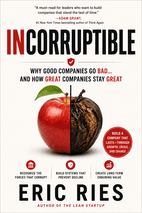
What is the book Incorruptible about?
Eric Ries's Incorruptible diagnoses "financial gravity"—the internal corruption that destroys mission-driven companies—and provides constitutional governance tools like public benefit corporations and spiritual holding companies to protect organizational ethos, for entrepreneurs and investors who want to build companies that resist short-term extraction.
Feature
Insta.Page
Blinkist
Shortform
Summary Depth
Full Chapter-by-Chapter
15-min overview
Section-by-section guides
Audio Narration
✓
✓
✓
Full access to all 700+ summaries
✓
✓
✓
Visual Mindmaps
✓
✕
✕
AI Q&A
✓
✕
✕
Missing a book? Request it, usually live within 48h
✓
✕
✕
Quizzes
✓
✕
✕
PDF Downloads
✓
✕
✓
Send to Kindle
✓
✓
✓
Price
$89.99/yr
$146/yr (PRO)
$199/yr
*Competitor data last verified July 2026.
1 Page Summary
Central Thesis: Eric Ries argues that successful companies are not destroyed by market failure but by a predictable internal corruption he calls "financial gravity"—the invisible pressure that bends organizational values toward short-term extraction rather than long-term flourishing. The book traces this pattern from Sol Price's FedMart to Robert Owen's New Lanark Mills, where investors killed profitable businesses by abandoning the principles that made them successful, and proposes a comprehensive governance architecture to permanently protect a company's mission.
Key Concepts and Approach: Ries introduces several foundational ideas to explain why good companies go bad. "Financial gravity" operates like a psychological force: whoever controls resources unconsciously shapes values downstream, overriding even explicit directives. The author reframes "profit" as "the maximization of human flourishing," exposing how conventional accounting hides destruction. The solution lies in "constitutional governance"—legal structures like public benefit corporations, spiritual holding companies, and worker cooperatives that unbundle money from power. Ries offers concrete mechanisms: the "Love Directive" (treat customers like family), the "culture bank" (every decision deposits or withdraws trust), and "mission drive" (organizations that profit only through mission attainment). The book culminates in "mission transmission," where companies project gravitational force outward through standards and civic infrastructure.
Audience and Value: This book serves entrepreneurs, board members, investors, and anyone who has watched a mission-driven organization lose its soul. Ries provides a practical toolkit—from two-page Delaware filings to two-way performance reviews—for building what he calls an "incorruptible organization." Readers gain both the diagnostic ability to spot financial gravity in action and the constitutional remedies to resist it. The book is distinctive for bridging spiritual purpose with hard-nosed legal mechanics, arguing that protecting a company's ethos requires structural guardrails, not just good intentions.
Chapter One The Mystery of the Golden Goose
Overview
The dramatic story of Sol Price, the founder of FedMart, who was ousted from his own company in 1975 despite building a revolutionary discount retail empire on a philosophy of putting customers first, employees second, and stockholders third. When the board forced him out, they abandoned his principles, spent millions trying to install conventional retail practices, and within seven years every FedMart store had closed—a textbook example of investors killing their own golden goose. This pattern isn't isolated. Two centuries earlier, Robert Owen transformed the unprofitable New Lanark Cotton Mills through what he called "enlightened capitalism," treating workers with unprecedented care and doubling the mill's value. Yet his own partners repeatedly tried to remove him, and after they finally succeeded in 1828, the mill slowly failed. The cruel irony is that these companies aren't failing in the marketplace at all—they're thriving at the very moment they're dismantled. The more golden the goose, the stronger the temptation to butcher it.
The chapter catalogs a devastating graveyard of good intentions: Sears, Polaroid, Cadbury, Toys "R" Us, and countless others—all lost to hostile takeovers, boardroom betrayals, succession failures, the temptation to harvest existing trust rather than earn it, or mission drift through a thousand small compromises. These aren't random tragedies; the actors change but the play remains the same. The root cause is a redefined concept of corruption—not just bribery or embezzlement, but any force that breaks the voluntary, informed, value-creating logic of capitalism itself. Corruption, from the Latin corrumpere meaning "to break completely," destroys trust, inflates transaction costs, and drags down the entire economy. The builders who express disgust at these betrayals aren't questioning capitalism—they're trying to defend it.
But here's the twist: for every failure, there exists a counterpart that successfully protected itself. Costco thrived where FedMart collapsed. Spain's Mondragon Corporation sustained its worker-centered approach for decades while New Lanark abandoned its reforms. John Lewis built constitutional governance; Vanguard maintained a client-first ethos; Hershey fended off takeovers through structural protections; REI flourished as a consumer cooperative. The most instructive example is Novo Nordisk, founded in 1922 by a Nobel laureate who established an ironclad governance structure—a for-profit business under a non-profit foundation's control with an unbreakable dual-class voting system. Over a century later, that foundation controls 77% of voting shares and has become the world's largest charitable foundation, proving that institutional architecture—not just good intentions—can preserve a mission across generations. The chapter ends with a clear framework: longevity requires institutionalized succession, mechanisms to survive financial pressures without being torn apart, and a constitutional foundation with tensile strength to resist short-term, extractive thinking. The question hanging over every organization is whether it is building that architecture or slowly giving in to the very temptations that have destroyed so many of its predecessors.
The Fall of a Retail Visionary
Sol Price’s story begins in 1975, when the founder of FedMart—a revolutionary membership-based discount retailer—walked into a board meeting and was blindsided. Despite building a thriving company from nothing, with annual sales north of $350 million, Price faced a hostile board that wanted more. Within hours, he was ousted from his own creation.
Price operated on a radical philosophy: first duty to customers, second to employees, third to stockholders. He capped margins, paid double the prevailing wage, and created an ethical code that forbade employees from taking even a free lunch from suppliers. His approach worked brilliantly—without a dollar spent on advertising. But going public in 1969 changed everything. Public market investors constantly pressured Price to abandon his principles. When he tried to take the company private again, the board resisted. At that fateful December 1975 meeting, they voted him out and changed the locks on his office doors.
What Happens When the Goose Dies
FedMart’s investors got what they wanted but lost everything. Abandoning Price’s philosophy, they spent $150 million trying to install conventional retail practices. Leadership churned, customer loyalty eroded, morale crumbled. By 1982, all forty-six stores closed. Eight thousand workers lost their jobs. A textbook case of investors killing their own golden goose.
Price, however, understood something his investors didn’t. His success came from three mutually reinforcing elements: careful curation (respecting customers’ time and decision fatigue), harder-is-easier choices (like paying double wages that built extraordinary loyalty), and trust as the ultimate currency. Within a week of being locked out, Price had a new office—directly above his old one—and was already planning his next venture. By the time I was a kid in San Diego, Price Club was a local institution.
The Same Script, Two Hundred Years Earlier
Robert Owen discovered the same truth in 1800. Taking over the unprofitable New Lanark Cotton Mills, he treated workers as "vital machines" deserving investment: free medical care, childcare, education, shorter shifts, no child labor under ten. Productivity and profits soared. The mill’s value more than doubled. Owen believed his "enlightened capitalism" would spread by its own success. He was spectacularly wrong. His partners tried to remove him in 1809. Then again in 1813. A third set of investors finally wrested control in 1828 and ended his reforms. The mill coasted as a cash cow until it became vulnerable and failed. Owen died essentially bankrupt.
Two Centuries of the Same Mistake
This pattern has a name: enlightened capitalism. Entrepreneurs repeatedly discover that treating people well creates exceptional value. They assume the market will reward and protect what they built. Then they watch it systematically unravel. The cruel irony? These companies aren’t failing in the marketplace—they’re thriving at the very moment they’re dismantled. The more golden the goose, the stronger the temptation to butcher it.
The graveyard of good intentions is long: Sears, Polaroid, Cadbury, Toys "R" Us, People Express Airlines, and countless others. These aren’t anecdotes. They’re symptoms of a chronic disease that has afflicted our economy for centuries. The pattern repeats across categories: hostile takeovers, boardroom betrayals, succession failures, the temptation to harvest existing trust rather than keep earning it, and mission drift through a thousand small compromises. As the author notes, "If the actors change but the play remains the same, there must be a reason why."
Corruption, Redefined
That reason is a form of corruption far broader than bribery or embezzlement. At its core, capitalism only works when transactions are fully informed, uncoerced, and voluntary—creating surplus value for both parties. Remove any of those conditions, and the mechanism breaks. The Latin corrumpere means "to break completely," and that's exactly what happens. Corruption breaks the logic of capitalism itself. Every hidden externality, every unit of extracted value drags down the entire economy's potential by eroding trust, inflating transaction costs, and destroying the civic infrastructure markets depend on. The builders who express disgust at these betrayals aren't questioning capitalism—they're trying to defend it.
The Exceptions That Prove Something
But here's the twist. For every failure in this chapter, there exists a counterpart that successfully protected itself. FedMart collapsed after investors ousted Sol Price in 1975, yet Costco has thrived with a similar low-margin, high-quality model. New Lanark abandoned Robert Owen's reforms, but Spain's Mondragon Corporation has sustained its worker-centered approach since 1956. Sears abandoned employee profit sharing; British department store John Lewis took the opposite path with a constitutional governance system since 1929. Polaroid dismantled its innovation culture after Land's ouster, but Carl Zeiss has preserved its scientific mission since 1846 through the Carl-Zeiss-Stiftung. Bank of America drifted from Giannini's community focus, but Vanguard Group has maintained a low-fee, client-first approach since 1975. Cadbury was diluted after a hostile takeover by Kraft, but the Hershey Company has repeatedly fended off takeovers thanks to Milton Hershey's governance structures. Toys "R" Us was destroyed by a leveraged buyout, but REI has thrived since 1938 as a consumer cooperative, immune to private equity raids.
Smarter Than a Nobel Laureate?
The most instructive example begins with a physician named Marie Krogh, diagnosed with incurable diabetes in 1922. Her husband, Nobel laureate August Krogh, heard rumors of a breakthrough insulin treatment in Toronto. They extended a lecture tour to investigate, and when they realized its potential, they founded Nordisk Insulinlaboratorium with a radical priority: serve patients first, advance scientific knowledge second, generate shareholder returns third—in perpetuity. They established the company as a for-profit business under a non-profit foundation's control, creating an ironclad arrangement from infancy. That company is now Novo Nordisk. For over a century, it has faced every threat in this chapter—hostile pressure, boardroom politics, market upheaval. Its foundation controls 77% of voting shares through an unbreakable dual-class structure, and has become the largest charitable foundation in the world. Before listening to advisors who peddle "best practices" younger than the trees in your local park, the author asks: Are you sure you're smarter than a Nobel laureate?
The Architecture of Institutional Longevity
**Key
Key concepts: Chapter One The Mystery of the Golden Goose
1. Chapter One The Mystery of the Golden Goose
The Golden Goose Pattern
Sol Price ousted from FedMart in 1975
Robert Owen removed from New Lanark in 1828
Companies thrive before being dismantled
Investors kill their own golden goose
Redefined Corruption
Corruption breaks capitalism's voluntary logic
From Latin corrumpere meaning to break completely
Destroys trust and inflates transaction costs
Builders defend capitalism against betrayals
FedMart's Rise and Fall
Price's philosophy: customers first, employees second
Capped margins and paid double wages
Going public in 1969 invited investor pressure
Board ousted Price; all 46 stores closed by 1982
Three Success Elements
Careful curation respecting customers' time
Harder-is-easier choices like high wages
Trust as the ultimate currency
Historical Parallel: Robert Owen
Enlightened capitalism at New Lanark Mills
Free medical care, childcare, education
Mill value doubled under his leadership
Partners removed him; mill eventually failed
Successful Counterparts
Costco thrived where FedMart collapsed
Novo Nordisk's foundation controls 77% voting shares
John Lewis, Vanguard, Hershey, REI survived
Mondragon sustained worker-centered approach
Institutional Architecture for Longevity
Ironclad governance structures protect mission
Institutionalized succession planning
Mechanisms to survive financial pressures
Constitutional foundation resists extractive thinking
💡 Try clicking the AI chat button to ask questions about this book!
Chapter Two Who Is the Bank?
Overview
A founder who built a company from nothing, who personally launched a beloved AI product, finds himself powerless to get his own organization to adopt it. His team resists, his executives deflect, and the very company he created acts as if run by some hidden rule. This raises a key question—who is the bank? Steinbeck’s famous question from The Grapes of Wrath asked the same thing: who makes the devastating decisions? The answer, then and now, is that no single person does. The organization itself has become a monster, a living thing with its own personality, wants, and hungers.
To understand why, the chapter explores ethos—the character or habit that defines a person, and by extension, an organization. Founders like Sol Price built their companies around a consistent ethos, aligning strategy and culture. But that ethos can drift. The CEO’s personal ethos of innovation collided with his company’s culture, which craved safety. That culture isn’t mystical; it’s a measurable phenomenon. Research on group intelligence shows that ants can develop collective problem-solving abilities far beyond any individual ant—and human teams do the same. Under the right structures, groups develop their own moral compass, learning patterns, and stable preferences that persist even as leaders change. Organizations are like living systems: they maintain boundaries, use resources, adapt, reproduce, and fight to survive, often overriding the will of their official leaders.
The chapter illustrates this with two contrasting case studies. At 3M, a deeply embedded innovation culture fought back when a new CEO tried to impose cost-cutting discipline. The company had a metric—the New Product Vitality Index—that allowed its board to see the damage and restore the old culture. At Boeing, the same CEO’s methods took root because a prior merger had already weakened the engineering culture. The result was catastrophic: engineers knew the 737 MAX was dangerous but shipped it anyway, leading to 346 deaths. The living system at Boeing had absorbed a new culture that prioritized share price over safety, and it persisted long after the leaders who installed it were gone.
This raises an unsettling question: can a living system apologize? Corporate apologies feel empty because no single person can make promises for an organization that will outlast them. With CEO tenure shrinking, stock holding periods collapsing, and trust in institutions at historic lows, we are left with organizations that drift toward taking what they can and protecting themselves. The CEO from the opening tried founder mode—reasserting personal control through dramatic interventions—but eventually resigned, exhausted by the struggle. Group intelligence is powerful enough to defeat even its creator.
Yet the chapter offers a way forward, not through command but through daily practice. Ethos must be cared for, like physical health. Leaders must ask hard questions: does your organization have a driving ethos, or is it drifting? Are you shaping it, or is it shaping you? The near-universal drift toward corruption, not randomness, points to a hidden pattern at work—one that the next chapter will confront. For now, the lesson is clear: you may have founded the organization, but you do not own it. It develops its own character—and will fight for its survival, regardless of your intentions.
Key Takeaways
An organization’s ethos determines whether technology amplifies human flourishing or destruction—misalignment spreads like a virus through its systems.
If you can’t confidently answer whether your organization has a driving ethos, you’re not steering; you’re along for the ride.
The near-universal drift toward corruption, not randomness, points to a hidden pattern shaping all living systems.
Key concepts: Chapter Two Who Is the Bank?
2. Chapter Two Who Is the Bank?
The Organization as a Living System
Organizations develop their own personality and survival instincts
Group intelligence can override the will of individual leaders
Living systems maintain boundaries, adapt, and fight to survive
Ethos defines the character of an organization
The Founder's Paradox
Founders can be powerless to change their own organizations
Personal ethos of innovation can clash with culture of safety
Founder mode interventions often fail against group intelligence
The creator may not own the organization's direction
Case Studies: 3M vs. Boeing
3M's innovation culture fought back and restored its ethos
Boeing's weakened engineering culture led to catastrophic failures
New Product Vitality Index helped 3M measure cultural health
Mergers can permanently alter an organization's living system
The Problem of Corporate Accountability
No single person can apologize for a living system
CEO tenure and stock holding periods are shrinking
Trust in institutions is at historic lows
Organizations drift toward self-protection and corruption
Caring for Organizational Ethos
Ethos must be maintained through daily practice like health
Leaders must ask if they shape or are shaped by the system
Near-universal drift toward corruption is not random
Alignment of ethos prevents technology from causing harm
Chapter Three Gravity
Overview
Imagine an invisible force that shapes your decisions, bends your values, and pulls you away from what you care about—without you noticing. That’s financial gravity, the psychological pressure when one party controls resources another desperately needs. It’s not malice; it’s an ancient survival reflex. For millions of years, humans tracked who held food, shelter, and safety, and adjusted their behavior. Those reflexes lie dormant in every transaction—getting a job, raising money, earning a promotion—and cause a silent drift: what we consistently do to succeed becomes what we believe, as values cascade downward from those with resource power.
This force operates under three laws. First: gravity overrides direct authority. A CFO might kill a profitable project to hit an analyst target because Wall Street’s immediate punishment outweighs a board’s eventual disappointment. Second: gravity works through perception, not intention. A manager can preach work-life balance, but if only workaholics get promoted, that’s the real rule. Third: gravity is a function of size imbalance. The bigger the resource disparity, the stronger the pull. A startup whose biggest client accounts for 40% of revenue will reshape its entire product around that client’s suggestions, without a single explicit demand.
A quantitative trader once boasted about dropping a stock 18% in two hours, comparing the company to cattle futures: “When I short cattle futures, the cows don’t care. Companies should be the same.” His cold logic exposes a design flaw: most organizations are built as if gravity doesn’t exist.
The full tragedy plays out in the story of Whole Foods. Founder John Mackey built the company on love—the “happiest workplace in America.” But when he took venture capital in 1988, those VCs got board seats. Going public in 1992 brought different gravity. By 2008, the stock crashed 90%. Mackey recovered it, maintaining premium pricing and 35% gross margins. The stock rebounded—and Mackey later called that his biggest regret. He’d missed the chance to lower prices permanently, which might have kept the company independent. But he couldn’t because of “the tyranny of quarterly earnings pressure.” Even profitable, even loved, Whole Foods was trapped. Mackey had given employees stock options, so their retirement depended on the stock price—he couldn’t risk a temporary dip. Meanwhile, hedge fund Jana Partners took an 8.3% stake, calling the stock “undervalued.” Mackey called them “predatory sharks.”
Mackey faced a cruel choice: not whether to sell, but whom. He chose Amazon, hoping their long-term thinking would be kinder. The bitter irony: the day the acquisition closed, Amazon slashed prices by up to 43%, foot traffic jumped 25%, and Jana walked away with $300 million—over a hundred times what a typical Whole Foods employee would earn in a lifetime. Whole Foods fell off Fortune’s “100 Best Companies to Work For” list; the ethos of love was lost. Research on hedge-fund activism finds no conclusive evidence of long-term value creation, only movement from one pocket to another.
The deeper systemic trap is that almost everyone frames this as a battle between conscious capitalism and greedy activists. But the real winner was financial gravity itself. Jana was merely its instrument. If Whole Foods had been built with different governance structures—an “exoskeleton” separating inside from outside—there would have been no insoluble conflict. Fighting harder within the existing system isn’t the answer; building differently is. A founder once told the author he’d been forced out of his successful company by investors, yet blamed himself for not choosing better board members. When asked what governance changes he’d make for his new company, he looked blank: “Like what?” It’s time to answer that question. Some organizations have figured out how to defy gravity, and their approaches are proven, learnable, sometimes no more than a two-page legal filing plus the courage to use it. That discipline—designing the deep structural foundations that give organizations strength—is called governance, the art of organizational soulcraft, and the subject of the next chapter.
Key Takeaways
Even a beloved, profitable company like Whole Foods can be dismantled by financial gravity when built on standard governance structures.
The real enemy isn’t any single activist investor—it’s a system that treats extraction as investment and leaves founders powerless.
The solution isn’t to fight harder within existing structures, but to build different ones from the start.
Governance design is the critical “exoskeleton” that determines whether an organization can resist corruption or will inevitably succumb.
Key concepts: Chapter Three Gravity
3. Chapter Three Gravity
Definition of Financial Gravity
Invisible force when one party controls needed resources
Ancient survival reflex that shapes decisions silently
Causes values to cascade downward from resource holders
Three Laws of Financial Gravity
Gravity overrides direct authority in decision-making
Gravity works through perception, not stated intentions
Gravity strength depends on resource imbalance size
Whole Foods Case Study
Founder Mackey built company on love and happiness
Venture capital and IPO introduced different gravity
Stock crash and quarterly pressure trapped the company
Acquired by Amazon; lost 'Best Companies' status
The Real Enemy: System, Not Individuals
Hedge fund Jana was merely gravity's instrument
No conclusive evidence activism creates long-term value
System treats extraction as investment, leaves founders powerless
Solution: Governance as Exoskeleton
Fighting harder within existing structures isn't answer
Build different governance structures from the start
Governance is organizational soulcraft and critical design
Chapter Four The New Governance
Overview
The chapter opens with a thought experiment—would you sell your startup to the world’s most evil company if the price were right? Most people refuse, yet modern governance can legally force that sale. When Elon Musk tried to walk away from Twitter, the board sued to force the deal, bound by the rule that if investors demand a sale, the company must comply. Founders often treat governance as tedious paperwork, but their own charters may require selling to the highest bidder. The Vectura story makes the stakes clear: a life-saving respiratory drug company sold to Philip Morris for just fifteen cents per share more than a competing offer, because the board claimed fiduciary duty left them no choice. Three years later, the acquirer wrote off the investment and sold the assets for a fraction of the price. This is what happens when shareholder primacy—the idea that a company’s only purpose is to maximize returns—becomes the default legal interpretation.
But that interpretation is a recent invention. Historically, corporations had to prove a defined public benefit to incorporate, and courts enforced a three-legged stool of specific purpose, duty to the corporation itself, and duty to stockholders. When Delaware adopted general incorporation in 1899, the first leg vanished, and courts began compressing trust law and agency law into a single formulation that gradually tilted toward agency. By the 1980s, cases like Revlon cemented shareholder primacy without any legislative vote. The arguments for it—moral claims of investors, residual claimant theory, unique agency problems, and a single metric for accountability—collapse under scrutiny. Customers, employees, and communities invest just as much; shareholders can offload risk while workers cannot; and the single metric trap encourages short-termism that destroys long-term value. Regulatory capture turns governance into a farce: companies lobby to weaken the rules, then claim they’re just following the law, as SVB’s CEO did before the bank’s collapse. Shareholder primacy creates a prisoner’s dilemma where every investor feels forced to extract value before someone else does, even though long-term shareholders would be better off under a different system.
Consider a geoengineering startup that could control weather patterns. Under current governance, its board might decide that maximizing shareholder value means auctioning rain to the highest bidder, turning a life-saving technology into extortion. The solution isn’t to discard governance but to complete it. Complete governance rests on four load-bearing responsibilities: compliance (following rules), purpose (a legally binding charter-level commitment), coherence (aligning systems and culture toward that purpose), and integrity (protecting the organization from corrupting external forces). With all four, boards become guardians rather than liquidators, empowered to resist selling to cigarette peddlers or weaponizing climate tech. Gravity, the force that pulls organizations down, is actually the weakest fundamental force. The same force can be harnessed to lift them up. It’s time to learn how to fly.
Key Takeaways
Regulatory capture creates a vicious cycle: companies lobby to weaken rules, then exploit those loopholes, undermining both governance and long-term value.
Shareholder primacy is self-defeating. It harms long-term shareholders, pension funds, and institutions that need stable, decades-long growth.
Complete governance requires four pillars: compliance, purpose, coherence, and integrity. Without all four, boards act as liquidators, not guardians.
The ultimate test of governance is whether an organization can resist the temptation to betray its mission for short-term gain—even when that gain is legal.
Governance and operations are two sides of the same coin. Builders must claim a seat at the governance table to protect the value they create.
Eric Ries is a renowned entrepreneur and author, best known for pioneering the Lean Startup methodology. His groundbreaking book, *The Lean Startup*, has become an essential guide for innovators and business leaders worldwide, revolutionizing how new ventures are built and launched. As a sought-after speaker and advisor, Ries has influenced countless startups and established companies with his principles of agile development and validated learning. His insights have reshaped modern entrepreneurship, emphasizing efficiency, customer feedback, and iterative design. Eric Ries's influential works are available in bookstores and on Amazon, offering practical strategies for navigating the complexities of the business landscape.
Frequently Asked Questions about Incorruptible
What is Incorruptible about?
This book exposes the hidden forces that corrupt mission-driven organizations, from financial gravity that silently bends decisions to governance structures that betray founding principles. Through vivid stories like Sol Price's FedMart and Patagonia's mission drive, it reveals why companies fail despite good intentions. The book then provides a practical blueprint for building incorruptible organizations using tools like constitutional governance, spiritual holding companies, and mission-locked ownership to protect purpose permanently.
Who is the author of Incorruptible?
Eric Ries is the author, best known for his bestselling book 'The Lean Startup', which transformed how startups are built. As an entrepreneur and investor, he has spent decades studying why companies succeed or fail, and in this work he applies systems thinking to organizational governance and long-term value creation.
Is Incorruptible worth reading?
Yes, this is a must-read for founders, executives, and anyone building or leading an organization with a mission beyond profit. It offers a rare combination of compelling storytelling and actionable frameworks—like the Love Directive, culture bank, and constitutional governance—that can genuinely protect your company's soul. The insights are both eye-opening and immediately applicable.
What are the key lessons from Incorruptible?
One critical lesson is that financial gravity—the psychological pull of resource control—will silently corrupt even well-intentioned leaders unless countered by explicit structures. Another is that mission drive requires locking purpose into legal DNA through public benefit corporations or spiritual holding companies, not just mission statements. Additionally, culture can be made tangible through the culture bank metaphor and the Todd Park Rule of never making withdrawals. Finally, individuals create gravitational force through their choices, meaning everyone has the power to shape the economy toward human flourishing.
📚 Explore Our Book Summary Library
Discover more insightful book summaries from our collection