Incorruptible Quotes
by Eric Ries
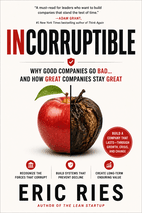
These quotes come from Eric Ries' Incorruptible, a book that challenges the way we think about business and governance. You will find sharp observations, uncomfortable truths, and a few memorable metaphors that stick with you long after reading.
What makes this book so quotable is its unflinching honesty. Ries does not shy away from calling out broken systems or exposing the gap between what companies say and what they do. Each line feels earned, born from real experience and deep reflection. Whether you are a founder, a manager, or just someone who cares about how organizations work, these quotes will make you think.
Top Quotes from Incorruptible
“Our first duty is to our customers. Our second duty is to our employees. Our third duty is to our stockholders.”
Sol Price, founder of FedMart, stating his company's priorities in a clear hierarchy.
This radical inversion of typical corporate priorities—customers first, employees second, shareholders third—challenges conventional business wisdom and defines the enlightened capitalism philosophy.
“The more golden the goose, the stronger the temptation to butcher it.”
The author summarizing the paradox where successful enlightened companies are dismantled by investors.
This metaphor powerfully captures the central thesis of the chapter—that success itself creates vulnerability to short-term profit extraction.
“We become what the gravitational field rewards, then forget we ever wanted anything else.”
Author's reflection on how organizations internalize financial pressures.
It succinctly captures the insidious process by which values shift under financial gravity, leading to loss of original mission and self-awareness.
“Profit is the maximization of human flourishing.”
The author's redefinition of profit after analyzing its blind spots and conventional flaws.
It shifts the paradigm from financial extraction to holistic value creation, giving builders a clear, ethical compass for measuring true success.
“If you raise the f—ing hot dog price, I will kill you. Figure it out.”
Costco CEO Jim Sinegal to then-COO Craig Jelinek circa 2008.
This raw, memorable threat captures an uncompromising commitment to a promise, making it instantly iconic and highlighting the power of principled leadership.
“The very metrics designed to fix the problem had become the problem.”
The author explains how customer service metrics backfired when call centers focused on handle time.
This line encapsulates the central irony of surrogation—the cure becomes the disease—making it instantly memorable and thought-provoking.
“An incoherent organization is one where what gets rewarded contradicts what gets proclaimed.”
The author defines incoherence in organizational culture.
This concise definition pinpoints the root of organizational dysfunction, making it a memorable and actionable insight.
Themes Behind the Quotes
A central theme is the tension between short term profit and long term human flourishing. Ries argues that many organizations lose their way by prioritizing shareholder value above all else, leading to a betrayal of customers and employees. The quotes explore how systems become corrupted when incentives reward extraction rather than creation. Another key idea is the concept of the superorganism, where companies become living entities with their own ethos that shapes everyone inside them.
Governance emerges as a critical foundation. Without proper governance, no amount of product building matters. The book also emphasizes trustworthiness as a rare and valuable asset, built through consistent principled action. Many quotes highlight the danger of metrics that become ends in themselves, or of incoherent organizations where rewards contradict stated values. Ultimately, the themes point toward a new kind of management discipline where profit is redefined as the maximization of human flourishing.
Quotes by Chapter
Chapter One The Mystery of the Golden Goose
“These principles will prove themselves unerringly true and will by their irresistible truth pervade society to the utmost bounds of the earth; for silence will not retard their progress, and opposition will give increased celerity to their movements.”
Author quoting Robert Owen's 'A New View of Society' 1813 as the chapter epigraph.
It encapsulates the optimistic belief that enlightened business principles will inevitably triumph, setting up the tragic irony that they are often destroyed instead.
“If you recognize you're really a fiduciary for the customer, you shouldn't make too much money.”
Sol Price explaining his philosophy of capping margins to benefit customers.
This concise statement redefines the fiduciary duty from serving shareholders to serving customers, and directly links profit restraint to customer trust.
Chapter Two Who Is the Bank?
“An emergent intelligence, every bit as alive as you or me. A superorganism. This is who the bank is.”
The author answers Steinbeck's question 'Who is the bank?' after describing how organizations develop their own character and will.
This line crystallizes the chapter's central metaphor, making the abstract concept of organizational life concrete and unsettling. It forces readers to see companies not as tools but as living beings with their own agendas.
“No individual person can ever—ever—make promises on behalf of a superorganism.”
The author explains why corporate apologies ring hollow and why trust in institutions has collapsed.
This stark assertion cuts through the hypocrisy of modern leadership, revealing a fundamental truth about accountability. It explains the deep distrust people feel toward organizations in a single, memorable sentence.
“In the US alone, trust in government fell from 77% in 1964 to just 22% today.”
The author lists statistics showing the worldwide collapse of trust in institutions.
This concrete, dramatic statistic grounds the chapter's philosophical argument in measurable reality. It makes the abstract problem of broken promises viscerally real and impossible to dismiss.
“Does it have an ethos, or is it drifting without one? Does it fight for human flourishing or against it? Is it creating value or extracting it? Are you shaping its ethos, or is it shaping yours?”
The author poses a series of reflective questions to the reader about their organization's purpose and their role within it.
These questions challenge readers to examine whether they are active shapers of their organization's values or passive participants. The rhythmic structure forces introspection about alignment between personal and organizational goals.
Chapter Three Gravity
“When the fall is all there is, it matters.”
Epigraph from the play The Lion in Winter, quoted at the start of the chapter.
This line sets the thematic tone for the chapter, emphasizing that the manner of one's fall defines character and meaning when fall is inevitable.
“But the stock movement has nothing to do with them. Their behavior is totally irrational. When I short cattle futures, the cows don’t care. Companies should be the same.”
A quantitative trader responds to the author's point about the human impact of his trades.
This quote starkly illustrates the dehumanizing disconnect between financial actors and real-world consequences, using the memorable metaphor of cows to highlight indifference.
“It's gravity all the way down.”
Author's concluding remark after describing how everyone is trapped in gravitational fields.
A succinct and powerful summary of the chapter's core argument that pressure cascades from top to bottom, making everyone a victim of the same force.
Chapter Four The New Governance
“When plunder becomes a way of life for a group of men in a society, over the course of time they create for themselves a legal system that authorizes it and a moral code that glorifies it.”
Opening epigraph by Frédéric Bastiat from his 1848 work Economic Sophisms.
This line powerfully captures how systems of exploitation become self-justifying, making it a timeless warning about institutionalized greed.
“If you don’t get governance right, nothing else you do when building your products or your company will matter for the long term.”
The author speaking directly to founders about the critical importance of governance.
It distills the book's central thesis into a blunt, memorable assertion that forces builders to prioritize legal structure over short-term tactics.
“The bottom line is that today’s governance “best practice” is that if investors demand it, any company can be destroyed at will.”
After describing the Vectura sale and the power of shareholder primacy.
This sentence reveals the alarming reality behind mainstream governance, making readers question the sanity of a system that permits destruction on demand.
“This fundamental shift in corporate purpose has never—not once—been enacted by any legislature or approved by any referendum.”
The author explaining how shareholder primacy became the dominant doctrine without democratic consent.
It highlights the undemocratic, judge-made nature of a rule that governs every public company, challenging readers to question its legitimacy.
Chapter Five The Blueprint
“We're not a health insurance company. We're not a medical group. We've certainly built those things, but those are just channels through which we deliver what we really are, which is love.”
Todd Park, founder of Devoted Health, describing the company's true product.
It redefines corporate purpose as love, challenging conventional profit-driven healthcare and offering a radical, human-centered alternative.
“When making any decision, visualize the faces of your own family members and loved ones, then ask yourself: If this decision impacted them, what would you do? Then go do that thing, big or small.”
Todd Park's verbatim directive to all Devoted Health employees for decision-making.
It operationalizes love as a practical, universal framework, showing how values can directly guide thousands of complex choices without rigid policies.
“You have it backward. This is the only possible way to solve this problem. It only works because it's so hard.”
Todd Park's reply when the author questioned the scope of his plan to rebuild the entire healthcare system.
It embraces difficulty as a necessary condition for solving complex problems, offering a counterintuitive and inspiring reframe of ambition.
Chapter Six Harder Is Easier
“It's like heroin: You do a little and you want a little bit more.”
Sinegal explaining the temptation of raising prices.
The heroin metaphor vividly illustrates the addictive nature of easy profit, serving as a striking warning against short-term thinking.
“We will never betray your trust to improve our own bottom line.”
The implicit promise of Costco's hot dog combo.
This line succinctly defines trustworthiness as a core business principle, resonating with anyone tired of corporate exploitation and broken promises.
“When a company's mission is genuinely aspirational, people think, “I want to be part of that world.” When its actions are principled and consistent, they realize, “I can count on them.” When these combine, a new asset is created, one of the most valuable and underrated assets in the world: trustworthiness.”
The author explains how mission and consistency combine to create trust.
It distills the core thesis into a memorable three-part formula, and the phrase 'most valuable and underrated assets in the world: trustworthiness' perfectly captures the chapter's central insight.
Chapter Seven Mission Drive
“I call this mission drive: the management discipline that ensures an organization only profits via mission attainment.”
The author defines the central concept of the chapter after describing Devoted Health's virtuous performance cycle.
This line crystallizes the chapter's core idea in a clear, actionable definition, making it memorable for leaders seeking to align profit with purpose.
“From the back of the room, a voice interrupted: “My friend, I am afraid you are wrong.” The room turned to see James Burke, recently promoted to company president, standing to address his colleagues. “Today, all the balls are red.””
During a J&J executive retreat, a senior leader argued profit was the only red ball that mattered, and James Burke rebuked him with this statement.
Burke's dramatic reversal of the red-ball metaphor powerfully illustrates that all stakeholder commitments are equally vital, not subordinate to profit.
“If we can’t live by this document together, then it is an act of pretension and we ought to tear it off the walls.”
James Burke declared this to his top managers when instituting the Credo Challenge at Johnson & Johnson.
The line underscores the necessity of authentic adherence to a mission statement, dismissing empty symbolism in favor of genuine organizational integrity.
Chapter Eight The Invisible Leader
“The people making these ads and the people who decide our promotions? Different planets.”
A frustrated employee at a dinner table, responding to a company ad that promised meaningful work.
It vividly captures the painful disconnect between a company's proclaimed values and its actual reward system, a feeling many workers recognize.