Incorruptible Key Takeaways

by Eric Ries

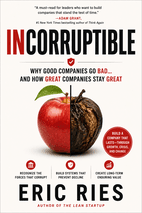
Incorruptible by Eric Ries Book Cover

5 Main Takeaways from Incorruptible

Design governance as an anti-corruption exoskeleton from day one

The book shows that even beloved companies like Whole Foods get dismantled by financial gravity when built on standard governance. The solution isn't to fight harder within existing structures but to build different ones—like public benefit corporations, supervoting shares, and mission guardian trusts—that resist the pull toward short-term extraction.

Trustworthiness is a strategic asset that compounds into market-beating returns

Trustworthiness generates four magnetic powers: talent attraction, alliance formation, alignment execution, and customer loyalty. These create a virtuous performance cycle, but they are fragile—without structural safeguards like mission-driven business models and governance protections, the gravitational pull of short-term gains destroys them.

Lock your mission early with hard structural safeguards, not just promises

Without an apparatus to back up promises, even sincere intentions are lies in practice. The epilogue highlights that foundation-owned companies survive four times longer than conventional firms. Devices like the Novo Nordisk Foundation's spiritual holding company or Tony's Open Chain's mission lock with independent guardians protect mission through leadership transitions and investment rounds.

Shareholder primacy is a legal myth that undermines long-term value

Lynn Stout's work demolishes the idea that shareholders own corporations—they own shares, and directors owe duties to the corporation itself. Treating shareholders as principals creates a legal contradiction and harms pension funds and institutions that need stable decades-long growth. Complete governance requires compliance, purpose, coherence, and integrity.

Your individual choices generate gravitational force on organizations and systems

You are not a passive victim of systems. Every decision—where you invest your labor, money, and attention—shapes organizations. The power to break addictive cycles lies in refusal: walk away when you can, and let your absence become data. Doomerism preserves the status quo; optimism is the fuel to build a world aligned with human flourishing.

Executive Analysis

These five takeaways form the core of Eric Ries's argument that organizations are not doomed to corruption but instead drift toward it because of standard governance structures that prioritize short-term extraction over long-term stewardship. The book provides a coherent playbook: start with an explicit ethos, encode it in constitutional governance, protect it with structural safeguards like mission lock and multi-entity ownership, and then reinforce it through trustworthiness and individual agency. Each takeaway reinforces the others—governance alone fails without trust, trust alone fails without structural protection, and individual action only matters when connected to systemic design.

This book matters because it moves beyond diagnosis to prescription. While many business books lament short-termism, Ries offers concrete legal and organizational mechanisms—public benefit corporations, spiritual holding companies, director oaths, employee ownership trusts—that founders, investors, and employees can implement today. It sits in the tradition of purpose-driven management (like Jim Collins) but adds a governance engineering lens that makes it uniquely actionable for anyone building or funding an organization that aims to resist the gravitational pull of corruption.

Chapter-by-Chapter Key Takeaways

Chapter Two Who Is the Bank? (Chapter 2)

  • An organization’s ethos determines whether technology amplifies human flourishing or destruction—misalignment spreads like a virus through its systems.

  • If you can’t confidently answer whether your organization has a driving ethos, you’re not steering; you’re along for the ride.

  • The near-universal drift toward corruption, not randomness, points to a hidden pattern shaping all living systems.

Try this: Audit your organization's ethos by examining whether your systems amplify human flourishing or destruction—if you can't confidently answer, you're not steering.

Chapter Three Gravity (Chapter 3)

  • Even a beloved, profitable company like Whole Foods can be dismantled by financial gravity when built on standard governance structures.

  • The real enemy isn’t any single activist investor—it’s a system that treats extraction as investment and leaves founders powerless.

  • The solution isn’t to fight harder within existing structures, but to build different ones from the start.

  • Governance design is the critical “exoskeleton” that determines whether an organization can resist corruption or will inevitably succumb.

Try this: Redesign your governance structure as an exoskeleton that resists financial gravity, rather than fighting activist investors within standard structures.

Chapter Four The New Governance (Chapter 4)

  • Regulatory capture creates a vicious cycle: companies lobby to weaken rules, then exploit those loopholes, undermining both governance and long-term value.

  • Shareholder primacy is self-defeating. It harms long-term shareholders, pension funds, and institutions that need stable, decades-long growth.

  • Complete governance requires four pillars: compliance, purpose, coherence, and integrity. Without all four, boards act as liquidators, not guardians.

  • The ultimate test of governance is whether an organization can resist the temptation to betray its mission for short-term gain—even when that gain is legal.

  • Governance and operations are two sides of the same coin. Builders must claim a seat at the governance table to protect the value they create.

Try this: Assess your board against the four pillars of compliance, purpose, coherence, and integrity—without all four, your board acts as a liquidator, not a guardian.

Chapter Six Harder Is Easier (Chapter 6)

  • Trustworthiness generates four magnetic powers: talent attraction, alliance formation, alignment execution, and customer loyalty—all feeding a virtuous performance cycle.

  • These powers are fragile. Without structural safeguards—mission-driven business models, coherent culture, governance protections—the gravitational pull of short-term gains will destroy them.

  • Radical simplicity wins: give people what they actually want (meaningful work, trustworthy investments, reliable products, honest partnerships) and trust will compound into market-beating returns.

Try this: Identify which of trustworthiness's four magnetic powers (talent, alliance, alignment, loyalty) your organization most needs, then build structural safeguards to protect them from short-term pressures.

Chapter Seven Mission Drive (Chapter 7)

  • Surrogation kills mission: any metric can become a false proxy if it’s not held in tension with others.

  • Holistic metrics require complete value accounting, fiduciary verification, and built-in natural tension.

  • Structural safeguards like Patagonia’s departmental veto system institutionalize mission over profit.

  • Without an apparatus to back up promises, even sincere intentions are lies in practice.

  • The question isn’t whether to measure, but how to measure without losing sight of the mission.

Try this: Replace any single metric that has become a false proxy for mission with a holistic dashboard that includes complete value accounting and natural tension between measures.

Chapter Eight The Invisible Leader (Chapter 8)

  • Without a dedicated department of corporate purpose (or equivalent), cultural tools become corporate New Year's resolutions—enthusiastic in January, forgotten by March.

  • A self-reinforcing system requires closed-loop feedback: culture bank, leader's guide, and two-way reviews must feed each other continuously.

  • GitLab's twenty-two reinforcement mechanisms demonstrate that ethos must be embedded in every operational decision, from hiring to compensation to crisis response.

  • Coherence creates magnetic benefits—attracting talent, customers, and contributors—but also makes the organization a more valuable acquisition target.

  • Structural protection (like supervoting shares) can safeguard mission, but reliance on founder longevity is a fragile strategy; the ultimate goal is mission protection that outlasts any individual.

Try this: Create a closed-loop feedback system with a culture bank, leader's guide, and two-way reviews that embed ethos into hiring, compensation, and crisis response.

Chapter Nine Constitutional Governance (Chapter 9)

  • Governance protections must be implemented early; the window between "too early" and "too late" is invisible and brief.

  • The public benefit corporation is a simple, powerful way to encode mission into the charter and avoid the shareholder primacy trap.

  • Mission guardians (supervoting shares, partnership structures) protect against hostile takeovers, but founder control is a temporary bridge, not a permanent solution.

  • Independent directors do not automatically protect the mission; they can become the most dangerous vectors of outside pressure.

  • Director oaths, when properly designed (specific, recited, timed, chosen, social), reduce dishonest behavior by nearly half.

  • Constitutional mechanisms like tenured voting, economic shares, codetermination, and steward ownership empower mission citizens.

  • John Lewis Partnership proves mission governance works at scale—a century later, employee owners still control the company.

  • Costco's governance fortress has survived attacks and outperformed peers, but even it is vulnerable to pressure for "best practices."

  • Dual-class and mission-protected companies statistically outperform, despite proxy advisor disapproval.

  • Twilio's 199-day crisis proves that vulnerabilities on all four fronts can destroy a company's mission sovereignty.

  • Permanent mission protection requires multiple entities (like the John Lewis Partnership's separate trust), not just single-entity governance.

  • Lawyers and investors will resist; treat their objections as alignment filters, not authority.

  • Use the "pros and cons" method with lawyers and the "magic words" sentence with investors to reclaim control of negotiations.

  • Always ask for the full menu even if you have to compromise later—getting 2 out of 10 is better than 0 out of 0.

Try this: Implement a governance protection like a public benefit corporation or supervoting shares now—the window between 'too early' and 'too late' is invisible and brief.

Chapter Ten The Constellation View (Chapter 10)

  • Alignment tools matter: Intercompany agreements, aligned ownership stakes, and layered governance turn individual entities into a coherent constellation.

  • Mission-locked structures are thriving: Employee-owned companies outperform on profitability, growth, and survival—and are increasingly chosen by founders who want to preserve their legacy.

  • Outside capital is the unsolved puzzle: Most successful mission-locked companies avoid investment, but a well-designed mission-lock vehicle could allow partnership without corruption.

  • The spiritual holding company is the most radical and oldest solution: a central entity designed to hold the mission immovable, enabling long-term alignment with capital.

Try this: Use intercompany agreements and layered governance to turn independent entities into a coherent constellation that resists outside pressure.

Chapter Eleven The Spiritual Holding Company (Chapter 11)

  • The Novo Nordisk Foundation’s SHC structure gave an indivisible decision-maker the power to veto the Serono merger despite unanimous support from operating executives.

  • The foundation’s refusal preserved a long-shot research program that produced Ozempic, Wegovy, and ultimately half a trillion dollars in shareholder value.

  • Patience and structural integrity, not prescience, were the foundation’s actual superpowers—the CEO who opposed the veto later became chairman of the foundation that blocked him.

  • This case challenges the assumption that only profit-motivated actors can be good stewards, and that public markets inevitably corrupt mission.

Try this: Explore a spiritual holding company structure if you need an indivisible decision-maker that can veto executive consensus to protect long-term mission.

Chapter Twelve Mission Transmission (Chapter 12)

  • Ethical constraints become competitive advantages when paired with premium positioning and quality

  • Open-sourcing infrastructure to competitors (Tony's Open Chain) amplifies mission transmission beyond any single company's reach

  • The no cherry-picking rule prevents greenwashing by requiring wholesale transformation

  • Community-based remediation (local facilitators, not outside auditors) creates genuine trust and lasting change

  • Governance structures like Mission Lock, with independent guardians holding veto power, protect mission through leadership transitions and investment rounds

Try this: Open-source your mission-enabling infrastructure to competitors (like Tony's Open Chain) to amplify ethical transmission beyond your own reach.

Chapter Thirteen The Power of Standards (Chapter 13)

  • The chicken-and-egg problem of standards can be overcome by starting small with a working implementation, not waiting for perfect committee consensus.

  • The incentive triangle (insurance, standards, audits) creates self-reinforcing market governance—a model Rune’s AI underwriting company is now scaling.

  • History shows that “rough consensus and running code” consistently beats top-down, theoretically perfect standards (TCP/IP vs. ISO, Linux vs. proprietary OS, Git vs. centralized version control).

  • Early adopters shape the standard and capture disproportionate value; they are not just implementing a theory but joining a movement.

  • The greatest opportunities lie in changing the rules themselves—and you are no less capable than the people who wrote the current ones.

Try this: Start a working implementation of a standard with a small group, then use 'rough consensus and running code' to attract early adopters who capture disproportionate value.

Chapter Fourteen A New Civic Infrastructure (Chapter 14)

  • Civic infrastructure often begins as a startup—credit unions, Wikipedia, LTSE all prove that scale follows from conceptual clarity and persistence.

  • The for-profit / non-profit binary blinds entrepreneurs to opportunities in interstitial spaces.

  • Building civic infrastructure requires applying every principle in this book: mission drive, financial independence, structural integrity, and standards that are legally binding and publicly enforceable.

  • Success may mean only laying the foundation for others—accepting that is essential to the personal ethos required.

  • We are not passive observers of institutions; we are the ones who create and sustain them.

Try this: Apply every governance principle from this book to build civic infrastructure—mission drive, financial independence, structural integrity, and legally binding standards.

Chapter Fifteen You Are Traffic (Chapter 15)

  • You are not a passive victim of systems; your choices generate gravitational force that shapes organizations and industries.

  • Even without formal coordination, individual decisions—when aggregated by surveillance and data—create collective pressure.

  • The power to break addictive cycles lies in refusal: walk away when you can, and let your absence become data.

  • Every story in the book works in reverse: advice for leaders is also guidance for how you invest your labor, money, and attention.

  • Doomerism is a tactic to preserve the status quo; optimism is the fuel needed to build a world aligned with human flourishing.

Try this: Walk away from organizations that violate your ethos—your absence becomes data that exerts gravitational force on the system.

Epilogue Queen of the Dead (Epilogue)

  • Shareholder primacy creates a legal contradiction: treating shareholders as principals undermines the limited liability that protects them, and no democratic law ever enacted this doctrine.

  • Lynn Stout's work demolishes the myth that shareholders own corporations; they own shares, and directors owe duties to the corporation itself.

  • Devoted Health and Costco demonstrate that purpose-driven companies can outperform while internalizing social costs—true profit requires creating net value, not just extracting it.

  • Trust is the foundation of long-term success, and the most resilient companies treat it as a strategic asset rather than an expendable resource.

  • Locking trust requires hard structures, not just words: third-party audits, public handbooks, and independent governance.

  • The best companies build a reservoir of trust by consistently making values-based decisions, especially during crises.

  • Transparency is a governance mechanism: it forces accountability and reduces the gap between stated values and actual behavior.

  • Beware of false proxies—when a metric or mission statement becomes a substitute for the real work of serving stakeholders.

  • Foundation-owned companies survive four times longer than conventional firms, with higher equity ratios and lower management turnover.

  • Employee ownership trusts prevent the most destructive short-term behaviors like "killer acquisitions" of rival R&D.

  • AI companies like Anthropic are pioneering mission-lock structures to protect safety commitments from investor pressure.

  • Ethical supply

Try this: Lock trust with hard structures: third-party audits, public handbooks, and independent governance that force transparency and accountability.

Continue Exploring