Incorruptible — Interactive Mindmaps

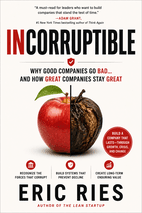
Incorruptible by Eric Ries Book Cover

by Eric Ries

Eric Ries's Incorruptible diagnoses "financial gravity"—the internal corruption that destroys mission-driven companies—and provides constitutional governance tools like public benefit corporations and spiritual holding companies to protect organizational ethos, for entrepreneurs and investors who want to build companies that resist short-term extraction.

On Insta.page you also get an Apply This Book tool that lets you combine insights from up to 3 books to solve your specific situation.

Chapter mindmaps

Free preview: chapters 1–4 are fully interactive. Click any node to expand or collapse. Subscribe to unlock the rest.

Chapter 1: Chapter One The Mystery of the Golden Goose

Key concepts: Chapter One The Mystery of the Golden Goose

1. Chapter One The Mystery of the Golden Goose

The Golden Goose Pattern

  • Sol Price ousted from FedMart in 1975
  • Robert Owen removed from New Lanark in 1828
  • Companies thrive before being dismantled
  • Investors kill their own golden goose

Redefined Corruption

  • Corruption breaks capitalism's voluntary logic
  • From Latin corrumpere meaning to break completely
  • Destroys trust and inflates transaction costs
  • Builders defend capitalism against betrayals

FedMart's Rise and Fall

  • Price's philosophy: customers first, employees second
  • Capped margins and paid double wages
  • Going public in 1969 invited investor pressure
  • Board ousted Price; all 46 stores closed by 1982

Three Success Elements

  • Careful curation respecting customers' time
  • Harder-is-easier choices like high wages
  • Trust as the ultimate currency

Historical Parallel: Robert Owen

  • Enlightened capitalism at New Lanark Mills
  • Free medical care, childcare, education
  • Mill value doubled under his leadership
  • Partners removed him; mill eventually failed

Successful Counterparts

  • Costco thrived where FedMart collapsed
  • Novo Nordisk's foundation controls 77% voting shares
  • John Lewis, Vanguard, Hershey, REI survived
  • Mondragon sustained worker-centered approach

Institutional Architecture for Longevity

  • Ironclad governance structures protect mission
  • Institutionalized succession planning
  • Mechanisms to survive financial pressures
  • Constitutional foundation resists extractive thinking

Chapter 2: Chapter Two Who Is the Bank?

Key concepts: Chapter Two Who Is the Bank?

2. Chapter Two Who Is the Bank?

The Organization as a Living System

  • Organizations develop their own personality and survival instincts
  • Group intelligence can override the will of individual leaders
  • Living systems maintain boundaries, adapt, and fight to survive
  • Ethos defines the character of an organization

The Founder's Paradox

  • Founders can be powerless to change their own organizations
  • Personal ethos of innovation can clash with culture of safety
  • Founder mode interventions often fail against group intelligence
  • The creator may not own the organization's direction

Case Studies: 3M vs. Boeing

  • 3M's innovation culture fought back and restored its ethos
  • Boeing's weakened engineering culture led to catastrophic failures
  • New Product Vitality Index helped 3M measure cultural health
  • Mergers can permanently alter an organization's living system

The Problem of Corporate Accountability

  • No single person can apologize for a living system
  • CEO tenure and stock holding periods are shrinking
  • Trust in institutions is at historic lows
  • Organizations drift toward self-protection and corruption

Caring for Organizational Ethos

  • Ethos must be maintained through daily practice like health
  • Leaders must ask if they shape or are shaped by the system
  • Near-universal drift toward corruption is not random
  • Alignment of ethos prevents technology from causing harm

Chapter 3: Chapter Three Gravity

Key concepts: Chapter Three Gravity

3. Chapter Three Gravity

Definition of Financial Gravity

  • Invisible force when one party controls needed resources
  • Ancient survival reflex that shapes decisions silently
  • Causes values to cascade downward from resource holders

Three Laws of Financial Gravity

  • Gravity overrides direct authority in decision-making
  • Gravity works through perception, not stated intentions
  • Gravity strength depends on resource imbalance size

Whole Foods Case Study

  • Founder Mackey built company on love and happiness
  • Venture capital and IPO introduced different gravity
  • Stock crash and quarterly pressure trapped the company
  • Acquired by Amazon; lost 'Best Companies' status

The Real Enemy: System, Not Individuals

  • Hedge fund Jana was merely gravity's instrument
  • No conclusive evidence activism creates long-term value
  • System treats extraction as investment, leaves founders powerless

Solution: Governance as Exoskeleton

  • Fighting harder within existing structures isn't answer
  • Build different governance structures from the start
  • Governance is organizational soulcraft and critical design

Chapter 4: Chapter Four The New Governance

Key concepts: Chapter Four The New Governance

4. Chapter Four The New Governance

The Problem with Shareholder Primacy

  • Forces boards to sell to highest bidder
  • Vectura sold to Philip Morris for pennies
  • Short-termism destroys long-term value
  • Creates a prisoner's dilemma for investors

Historical Shift in Corporate Governance

  • Originally required public benefit to incorporate
  • Three-legged stool: purpose, corporation, stockholders
  • Delaware general incorporation removed purpose leg
  • 1980s Revlon case cemented shareholder primacy

Flawed Arguments for Shareholder Primacy

  • Customers and workers invest as much as shareholders
  • Shareholders can offload risk; workers cannot
  • Single metric trap encourages short-term thinking
  • Regulatory capture turns governance into farce

Complete Governance Framework

  • Compliance: following the rules
  • Purpose: legally binding charter-level commitment
  • Coherence: aligning systems and culture
  • Integrity: protecting from corrupting forces

Boards as Guardians, Not Liquidators

  • Resist selling to cigarette peddlers
  • Prevent weaponizing climate tech
  • Protect mission from short-term gain
  • Harness gravity to lift organizations up

Chapter 5: Chapter Five The Blueprint

Mindmap locked. Subscribe to unlock all chapters of Incorruptible.

Subscribe to unlock

Chapter 6: Chapter Six Harder Is Easier

Mindmap locked. Subscribe to unlock all chapters of Incorruptible.

Subscribe to unlock

Chapter 7: Chapter Seven Mission Drive

Mindmap locked. Subscribe to unlock all chapters of Incorruptible.

Subscribe to unlock

Chapter 8: Chapter Eight The Invisible Leader

Mindmap locked. Subscribe to unlock all chapters of Incorruptible.

Subscribe to unlock

Chapter 9: Chapter Nine Constitutional Governance

Mindmap locked. Subscribe to unlock all chapters of Incorruptible.

Subscribe to unlock

Chapter 10: Chapter Ten The Constellation View

Mindmap locked. Subscribe to unlock all chapters of Incorruptible.

Subscribe to unlock

Chapter 11: Chapter Eleven The Spiritual Holding Company

Mindmap locked. Subscribe to unlock all chapters of Incorruptible.

Subscribe to unlock

Chapter 12: Chapter Twelve Mission Transmission

Mindmap locked. Subscribe to unlock all chapters of Incorruptible.

Subscribe to unlock

Chapter 13: Chapter Thirteen The Power of Standards

Mindmap locked. Subscribe to unlock all chapters of Incorruptible.

Subscribe to unlock

Chapter 14: Chapter Fourteen A New Civic Infrastructure

Mindmap locked. Subscribe to unlock all chapters of Incorruptible.

Subscribe to unlock

Chapter 15: Chapter Fifteen You Are Traffic

Mindmap locked. Subscribe to unlock all chapters of Incorruptible.

Subscribe to unlock

Chapter 16: Epilogue Queen of the Dead

Mindmap locked. Subscribe to unlock all chapters of Incorruptible.

Subscribe to unlock

Continue exploring Incorruptible