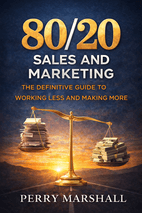
Perry Marshall's 80/20 Sales and Marketing applies the Pareto Principle to business strategy, teaching how to identify and focus on the most productive customers and activities for exponential growth. It's for entrepreneurs and marketers seeking a data-driven framework to maximize efficiency and profitability.
Feature
Insta.Page
Blinkist
Shortform
Summary Depth
Full Chapter-by-Chapter
15-min overview
Section-by-section guides
Audio Narration
✓
✓
✓
Visual Mindmaps
✓
✕
✕
AI Q&A
✓
✕
✕
Quizzes
✓
✕
✕
PDF Downloads
✓
✕
✓
Price
$89.99/yr
$146/yr (PRO)
$199/yr
*Competitor data last verified July 2026.
1 Page Summary
80/20 Sales and Marketing by Perry Marshall applies the Pareto Principle—the observation that roughly 80% of effects come from 20% of causes—to modern sales and marketing strategy. Marshall argues that this imbalance is not a flaw but a powerful, predictable pattern that can be systematically leveraged. The book's core premise is that by identifying and focusing intensely on the most productive 20% of customers, marketing channels, and sales activities, businesses can achieve exponential growth while reducing wasted effort and resources.
The work builds upon the economic insights of Vilfredo Pareto and management theories popularized by Joseph Juran, translating them into actionable digital-age tactics. Key concepts include using the "80/20 Power Curve" to grade customer value, implementing tiered pricing and service models to maximize revenue from top clients, and employing disciplined testing to find the "best 20%" of ads, keywords, and traffic sources. Marshall emphasizes that this is an iterative, fractal process; once you optimize at one level, you can apply the same principle again within your new top 20% to achieve even greater concentration of results.
The book's lasting impact lies in providing a practical, mathematical framework for strategic focus. It challenges the conventional wisdom of treating all customers and activities equally, instead advocating for a data-driven approach to reallocate energy toward high-yield opportunities. By teaching readers to continually seek and exploit these natural imbalances, 80/20 Sales and Marketing offers a timeless methodology for increasing efficiency, profitability, and scalability in any competitive business environment.
CHAPTER 1 - How 80/20 Works and Why
Overview
The chapter opens with a vivid demonstration at a marketing seminar, where the author asks the audience about shoe and domain name ownership. The exercises reveal a consistent pattern: a small minority of people own the vast majority of items. This illustrates the pervasive, often invisible, reality of the 80/20 Principle—that 80% of outcomes (like ownership, wealth, or results) typically stem from just 20% of inputs (like people or efforts). This isn't a mere business heuristic but a fundamental "law of nature" driven by positive feedback loops, observable in everything from biology to economics. The chapter argues that while our education system trains us to think in averages and bell curves, true leverage and understanding come from recognizing and acting upon this inherent imbalance.
The Core Mechanism and Exponential Leverage
The principle is often summarized as "80 percent of your results come from 20 percent of your efforts." However, its real power is recursive. You can apply the rule repeatedly to the top-performing 20%, a process the author calls climbing the "layers" of 80/20.
80/20¹: Within a system, the top 20% are 16 times more effective than the remaining 80%.
80/20²: Focusing on the top 20% of that top 20% reveals a group 250 times more effective than the baseline.
80/20³: This group is 4,000 times more effective.
80/20⁵: The leverage can reach a staggering million-to-one ratio.
This exponential leverage means that in business, one major customer, one key product, or one billboard on a major highway can have an impact equivalent to thousands of minor ones. The global wealth distribution is used as a macro-example: 80% of the world's GDP comes from just 22 countries (9% of all nations), and within that, the United States alone generates 19% of total global wealth.
From the Bell Curve to the Power Curve
The chapter critiques our standard reliance on "average" metrics and the bell curve, which shows how many people achieved a certain score. For achieving results, the 80/20 Power Curve is a far superior tool.
The Power Curve ranks individuals or items from worst to best on the x-axis, while the y-axis measures their actual capability or output.
It visually demonstrates that the top performers aren't just incrementally better; they are exponentially more capable. In a class science test, while the average might be 77%, the top student could have 50 times the "science horsepower" of the worst and 14 times that of the average.
This curve reveals that "A" players—the top performers—are often prima donnas who require special treatment, but their disproportionate impact makes it essential to identify, recruit, and nurture them. Settling for "B" players consigns you to mediocrity.
The Mathematics of Multiples: Power Laws
The underlying mathematics of the 80/20 principle are Power Laws, which describe relationships where changes in one quantity lead to proportional power changes in another. The world doesn't operate in neat increments but in multiples and orders of magnitude.
Familiar examples include the Richter scale (where a 7.0 earthquake is 10 times more powerful than a 6.0) and the decibel system for sound.
In business, this means you must stop thinking in terms of "average transaction size" and start thinking in "powers of ten." Your best customer isn't 50% better than an average one; they could be 10x, 100x, or even 1,000x more valuable.
This exponential perspective allows for "spooky accurate" predictions about your business data—like predicting the number of high-value donors in a campaign or the impact of your top salesperson—using simple tools derived from this principle.
Key Takeaways
The 80/20 Principle is a recursive natural law, not a loose rule of thumb. Its true power is unlocked by applying it in successive layers (80/20², 80/20³), revealing exponential leverage that can reach million-to-one ratios.
Forget averages and bell curves. To drive results, you must analyze your world through the 80/20 Power Curve, which focuses on identifying and cultivating the exponentially capable top performers, not the mediocre middle.
Business impact is not linear; it's exponential. Adopt the mindset of Power Laws and think in multiples of ten. Your goal is to find and leverage the few inputs that create massively disproportionate outputs.
Key concepts: CHAPTER 1 - How 80/20 Works and Why
1. CHAPTER 1 - How 80/20 Works and Why
The Pervasive Reality of 80/20
A small minority of inputs (people, efforts) consistently generates the vast majority of outcomes (ownership, wealth, results).
It is a fundamental 'law of nature' driven by positive feedback loops, observable from biology to economics.
Our education system trains us to think in averages and bell curves, but true leverage comes from recognizing this inherent imbalance.
Recursive Application and Exponential Leverage
The principle's real power is recursive—apply it repeatedly to the top-performing 20% (climbing the 'layers' of 80/20).
Leverage grows exponentially: 80/20² yields 250x effectiveness, 80/20³ yields 4,000x, and 80/20⁵ can reach a million-to-one ratio.
In business, one major customer, product, or asset can have an impact equivalent to thousands of minor ones (e.g., global wealth distribution).
The 80/20 Power Curve vs. The Bell Curve
The 80/20 Power Curve ranks items from worst to best and measures their actual capability/output, revealing exponential differences.
Top performers are not just incrementally better; they are exponentially more capable (e.g., 50x the 'horsepower' of the worst).
Identifying, recruiting, and nurturing 'A' players (top performers) is essential, as settling for 'B' players leads to mediocrity.
Power Laws: The Mathematics of Multiples
The underlying mathematics are Power Laws, where changes in one quantity lead to proportional power changes in another.
Think in multiples and orders of magnitude (e.g., Richter scale, decibel system), not linear increments or averages.
In business, this means your best customer could be 10x, 100x, or 1,000x more valuable than an average one, enabling 'spooky accurate' predictions.
💡 Try clicking the AI chat button to ask questions about this book!
CHAPTER 2 - Rack the Shotgun
Overview
This chapter opens with the story of John Paul Mendocha, who as a teenager learned a critical lesson about identifying the right audience from a seasoned gambler named Rob in Las Vegas. Using a vivid, real-world metaphor, the principle of "racking the shotgun" is introduced as a powerful method for applying the 80/20 rule to business and marketing.
The Vegas Lesson
Rob, John's mentor, took him to a loud, chaotic cabaret. Under the table, Rob surreptitiously opened and then loudly snapped shut the chamber of his sawed-off shotgun, creating that distinctive "racking" sound. In the crowd, only a few people's heads turned at the noise; the rest remained oblivious. The club owner, Bill, came over to check on them. Rob then explained the lesson to John: the handful who recognized and reacted to the sound were not easy targets ("marks"). They were street-smart and aware of their surroundings. His advice was to avoid playing poker with them and to focus on the distracted, unresponsive majority.
The Core Principle: Rack the Shotgun
The act of "racking the shotgun" is presented as a strategic metaphor. It means sending a deliberate, calculated signal into your audience. The vast majority (the 80%) will ignore it, but a vital minority (the 20%) will respond. This single action efficiently separates the highly aware and interested prospects from the disengaged crowd. The chapter emphasizes that this isn't about finding naive "marks," but about efficiently qualifying people based on their responsiveness to a specific signal.
Application in Business and Beyond
The principle applies far beyond gambling. Every business action—an offer, a price, a marketing campaign—is an opportunity to "rack the shotgun." For example, offering a free troubleshooting guide qualifies 50 interested people. Following up with a paid workshop offer then "racks a different kind of shotgun," narrowing that group down to the 10 most hyper-responsive and valuable customers. This 20% will invariably deliver more than 80% of your results. The chapter stresses that selling to the right, responsive person is fundamentally more important than any sales technique, as the wrong person cannot be persuaded.
The Universal 80/20 Sift
The narrative expands the concept to all areas of life and business. The 80/20 principle is constantly at work, sorting people, products, marketing channels, employees, and opportunities. In the digital age, there is an overwhelming amount of data available; using the "rack the shotgun" method is essential to cut through the noise and identify the true signal. The key is to pay attention to how people and opportunities self-identify through their responses.
Key Takeaways
"Rack the shotgun" is the practice of sending a deliberate signal to an audience to see who responds, thereby efficiently separating the highly engaged minority from the disengaged majority.
Qualify, then qualify again. Use sequential offers or signals to progressively narrow your focus onto the most responsive and valuable segment of your audience.
Audience over technique. Identifying and targeting the right, responsive person is more critical to success than perfecting sales or marketing tactics.
The 80/20 rule is always in motion. People and opportunities are constantly self-identifying. Your job is to design tests ("rack the shotgun") to reveal these patterns and then act on that information.
Key concepts: CHAPTER 2 - Rack the Shotgun
2. CHAPTER 2 - Rack the Shotgun
The Vegas Lesson: A Real-World Metaphor
Mentor Rob demonstrates audience segmentation using a shotgun racking sound in a crowded club.
Only a small, aware minority reacts to the signal; the distracted majority remains oblivious.
The lesson: avoid competing for the aware minority and focus on the disengaged, responsive majority.
The core insight is about efficiently identifying the right audience through their response to a deliberate signal.
The Core Principle: Rack the Shotgun
A strategic metaphor for sending a deliberate, calculated signal to an audience.
The signal separates the highly aware and interested minority (the 20%) from the disengaged majority (the 80%).
Purpose is to qualify prospects based on responsiveness, not to find naive targets.
Efficiently identifies the vital minority that will deliver the majority of results.
Application in Business and Marketing
Every business action (offer, price, campaign) is an opportunity to 'rack the shotgun.'
Use sequential signals to progressively narrow focus (e.g., free guide to paid workshop).
Identifies the most hyper-responsive and valuable customers (the 20%).
Selling to the right, responsive person is more critical than any sales technique.
The Universal 80/20 Sift
The 80/20 principle constantly sorts people, products, channels, and opportunities.
In the digital age, the method cuts through noise to identify true signals.
People and opportunities self-identify through their responses.
Essential to design tests to reveal these patterns and act on the information.
Key Takeaways and Actionable Insights
Practice sending deliberate signals to separate engaged minority from disengaged majority.
Qualify, then qualify again using sequential offers or signals.
Audience identification is more critical than perfecting sales or marketing tactics.
The 80/20 rule is dynamic; constantly test and adapt based on responses.
CHAPTER 3 - You Can Do Better
Overview
The author paints a vivid picture of his early, miserable career in sales—a relentless grind of cold calls, endless rejection, and financial struggle. He spent most of his time not selling, but desperately prospecting, often using clumsy tricks like asking for a generic "Dave in Engineering." This approach yielded little results, burying him in debt and frustration. The core problem was that 80% of his effort was wasted on low-level grunt work and unqualified prospects.
The Turning Point
His entire trajectory changed when he accidentally discovered the principles of direct marketing. He shifted his focus from chasing anyone to strategically attracting the right people. By creating tools and content that positioned him as an expert, he began to attract inbound leads. His first taste of this new world was a seamless sale to Micron, where the prospect had already done their homework. The dramatic shift meant he spent 80% of his time having meaningful conversations with interested parties, not fighting through gatekeepers. He hasn't made a cold call in 15 years.
The Exponential Power of 80/20
This personal revelation underscores a universal business truth: the Pareto Principle (80/20) is everywhere and its power is exponential. Most advertising is wildly inefficient, wasting far more than the proverbial "half." By identifying and doubling down on the effective 20%, returns don't just improve—they multiply. An 80% waste rate isn't a 4x improvement opportunity; it’s a 16x opportunity because you reallocate resources into the hyper-productive minority.
The Ripple Effect
The principle applies far beyond advertising:
A small fraction of salespeople generate most of the revenue.
A couple of songs drive an album's success.
A minority of tasks produce the bulk of your results.
The pattern compounds: 80% of the top 80% comes from 20% of the top 20%, creating hidden 1000:1 leverage points throughout any business.
Key Takeaways
Invisible Leverage is Real: Regardless of current success, significant improvements (25-250% or more) are almost always possible by identifying hidden inefficiencies.
Quality Over Quantity in Outreach: Spending the majority of your time with pre-qualified, interested prospects is transformative, making selling easier and more respectful.
The 80/20 Rule is Exponential: It's not a simple ratio; it's a compounding law. The majority of your results come from a tiny minority of causes, and within that minority, an even smaller fraction drives disproportionate outcomes.
Find Someone to Sell To First: All leverage and improvement are impossible without first correctly identifying your true, receptive audience. This is the essential foundation.
Key concepts: CHAPTER 3 - You Can Do Better
3. CHAPTER 3 - You Can Do Better
The Problem: Inefficient Sales Grind
Early career characterized by relentless cold calls and rejection
80% of effort wasted on low-level prospecting and unqualified leads
Use of clumsy tricks like asking for generic contacts yielded poor results
Financial struggle and frustration from misallocated effort
The Solution: Shift to Strategic Attraction
Discovery of direct marketing principles changed trajectory
Focus shifted from chasing anyone to attracting the right people
Created tools and content to position as an expert
Began receiving inbound leads from pre-qualified prospects
Resulted in spending 80% of time on meaningful conversations instead of gatekeepers
The Exponential Power of 80/20 (Pareto Principle)
Universal business truth with exponential impact
Most advertising is wildly inefficient with high waste rates
Identifying and doubling down on effective 20% multiplies returns
80% waste represents 16x improvement opportunity through resource reallocation
The Ripple Effect Across Business
Small fraction of salespeople generate most revenue
Minority of tasks produce bulk of results
Pattern compounds: 80% of top 80% comes from 20% of top 20%
Creates hidden 1000:1 leverage points throughout any organization
Core Principles for Transformation
Invisible leverage exists regardless of current success level
Quality over quantity in outreach transforms selling process
80/20 rule is compounding law, not simple ratio
Must first identify true receptive audience for any improvement
CHAPTER 4 - 80/20 Traffic
Overview
The chapter introduces a fundamental shift in sales strategy, arguing that traditional cold outreach is a losing proposition. Using a personal story of being outmaneuvered by a competitor, it establishes that the most effective way to attract customers is by positioning yourself as a sought-after authority. This approach "racks the shotgun," creating a steady flow of warm, interested prospects (traffic) who come to you, rather than you chasing them.
A Painful Lesson in Lead Generation
The author recounts his early days selling a cutting-edge networking technology, where he spent immense effort on "missionary work"—educating prospects through sales calls and presentations. Despite his expertise, he consistently lost deals to a competitor, Turck. Turck’s strategy was simple: they gave away a self-published book, Understanding Device Level Networks, which established them as the definitive authority in the field. Prospects, having learned the basics from Turck’s book, would then use the author’s free consultations to fill knowledge gaps before buying from his competitor. This taught a critical lesson: "You can't...position[] me as a beggar." Proactively giving away valuable information positions you as the expert people seek out.
From Beggar to Authority: The Publicity Funnel
The core mechanism for this shift is using publicity—like writing books, articles, or creating tools—not to close sales directly, but to move to the front of the line. However, publicity alone is insufficient; it must be connected to a systematic "conveyor belt" that turns interest into leads. This requires a clear next step, such as offering a problem-solving cheat sheet, diagnostic tool, or white paper in exchange for contact information. The author applied this lesson by creating a useful comparison slide chart for engineers, which thousands requested and some even paid to distribute, effectively having customers fund his marketing.
The Seven Cardinal Rules of the 80/20 Sales Pro
The chapter crystallizes the philosophy into seven non-negotiable rules:
No cold calling. Ever. Sell only to warm leads.
Know your customer acquisition cost. Determine what you're willing to pay to get a new customer.
Let prospects find you first. They are more likely to buy.
Build credibility through authorship and publishing. Write, speak, and share quality information.
Generate leads with problem-solving info, not product specs. Focus on the customer's pain, not your solution's features.
Negotiate from strength by creating excess "deal flow." Generate more leads than you can handle.
Cherish your customer database. Past buyers are your easiest future sales.
Mastering a Traffic Channel: The Editorial Strategy
To execute these rules, the author details his personal strategy: investing in relationships with trade magazine editors. He allocated the same level of attention to a group of editors as he would to a top-tier customer. By becoming a reliable source of well-written articles, he secured over 100 pages of free industry publicity in 18 months. This established his name across the industry, generated a flood of inbound leads, and built a personal asset (the editor relationships) that was independent of his employer. This asset later allowed him to launch his own consulting business, helping companies place favorable articles for a fraction of the cost of traditional advertising.
The Traffic Universe and the Mastery Imperative
The chapter provides an expansive list of potential traffic and media channels, from Google Ads and podcasts to direct mail and dimensional marketing. The critical lesson is that as a marketer or salesperson, you must become a true expert in at least one of these channels. Without this mastery, you remain dependent on ineffective tactics like cold calling. The strategic balance (the "Yin and Yang") is to develop deep proficiency in one primary channel to establish your business, while gradually diversifying into secondary channels to mitigate risk. Putting all your eggs in one basket is dangerous, but spreading yourself too thin guarantees mediocrity.
Key Takeaways
Stop cold calling. The most effective sales begin with prospects who are already interested and seeking you out.
Become a publisher. Establish authority by creating and giving away valuable, problem-focused information (books, articles, tools, cheat sheets).
Build a funnel. Always attach a clear, step-by-step mechanism to your publicity to capture leads and move them toward a sale.
Master one traffic source. Dedicate yourself to becoming exceptionally skilled at one form of advertising or publicity before diversifying.
Invest in relationships. Strategic relationships, like those with media editors, can become invaluable personal assets that generate continuous, low-cost lead flow.
Key concepts: CHAPTER 4 - 80/20 Traffic
4. CHAPTER 4 - 80/20 Traffic
The Core Philosophy: From Beggar to Authority
Traditional cold outreach is a losing proposition compared to attracting warm prospects
Position yourself as a sought-after authority to have prospects seek you out
Proactively giving away valuable information establishes you as the expert people want to buy from
The Painful Lesson: Losing to a Competitor's Authority
Author lost deals despite superior product knowledge and missionary work
Competitor Turck gave away a self-published book establishing them as definitive authority
Prospects used author's free consultations to fill knowledge gaps before buying from competitor
Critical lesson: You can't position yourself as a beggar chasing prospects
The Publicity Funnel Mechanism
Use publicity (books, articles, tools) to move to front of the line, not close sales directly
Publicity must connect to systematic 'conveyor belt' turning interest into leads
Requires clear next step (cheat sheet, diagnostic tool, white paper) in exchange for contact info
Example: Comparison slide chart for engineers generated thousands of requests and customer-funded marketing
Seven Cardinal Rules of the 80/20 Sales Pro
No cold calling ever - sell only to warm leads
Know your customer acquisition cost - determine what you'll pay for a new customer
Let prospects find you first - they're more likely to buy
Build credibility through authorship and publishing - write, speak, share quality information
Generate leads with problem-solving info, not product specs - focus on customer pain
Negotiate from strength by creating excess 'deal flow' - more leads than you can handle
Cherish your customer database - past buyers are easiest future sales
Mastering a Traffic Channel: Editorial Strategy
Invest in relationships with trade magazine editors as you would top-tier customers
Become reliable source of well-written articles to secure free industry publicity
Generated over 100 pages of free publicity in 18 months, establishing industry-wide name recognition
Built personal asset (editor relationships) independent of employer, enabling consulting business launch
The Traffic Universe and Mastery Imperative
Must become true expert in at least one traffic/media channel to avoid dependence on cold calling
Strategic balance: develop deep proficiency in one primary channel, then diversify to secondary channels
Putting all eggs in one basket is dangerous, but spreading too thin guarantees mediocrity
List includes Google Ads, podcasts, direct mail, dimensional marketing, and many other channels
Key Implementation Takeaways
Stop cold calling - effective sales begin with prospects already seeking you out
Become a publisher - establish authority by giving away valuable, problem-focused information
Build a funnel - attach clear mechanism to publicity to capture leads and move toward sale
Master one traffic source - become exceptionally skilled at one form before diversifying
Invest in relationships - strategic relationships become invaluable personal assets generating low-cost leads
You've reached the end of the free chapters
Next chapter: “How to Use the “Invisible Money” Finder at www.8020Curve.com” is locked
Keep reading 80/20 Sales and Marketing — and unlock all 600+ book summaries with audio, mindmaps and AI Q&A.
$0.00 due today · 7 days free, then $89.99/year ($7.49/mo) · Cancel anytime before day 7
Perry Marshall is a renowned marketing strategist and author celebrated for his groundbreaking work in the digital advertising space. He is widely recognized for demystifying Google Ads and empowering businesses with his pragmatic, results-driven methodologies. His influential books, including the bestselling "Ultimate Guide to Google Ads" and "80/20 Sales and Marketing," are essential reading for entrepreneurs and marketers worldwide. A sought-after speaker and consultant, Marshall has shaped modern online marketing practices through his insightful analysis and actionable frameworks. His published works are available for purchase on Amazon, offering readers proven strategies to achieve significant growth and market dominance.
📚 Explore Our Book Summary Library
Discover more insightful book summaries from our collection