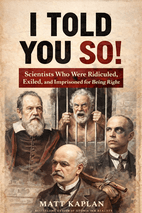
Matt Kaplan's I Told You So! argues that lifesaving medical discoveries are routinely delayed by institutional inertia and human resistance, not a lack of evidence. Through historical and modern case studies, it reveals why good ideas fail and is intended for readers interested in the history of science and the psychology of innovation.
Feature
Insta.Page
Blinkist
Shortform
Summary Depth
Full Chapter-by-Chapter
15-min overview
Section-by-section guides
Audio Narration
✓
✓
✓
Visual Mindmaps
✓
✕
✕
AI Q&A
✓
✕
✕
Quizzes
✓
✕
✕
PDF Downloads
✓
✕
✓
Price
$89.99/yr
$146/yr (PRO)
$199/yr
*Competitor data last verified July 2026.
1 Page Summary
In 'I Told You So!', science journalist Matt Kaplan argues that the history of medicine is not a simple story of progress, but a messy, human struggle where lifesaving discoveries are routinely delayed or dismissed. The book’s central thesis is that scientific advancement is often blocked not by a lack of evidence, but by a toxic blend of institutional inertia, professional ego, personal ambition, and the deep-seated human resistance to paradigm-shifting ideas. Through parallel narratives of historical and modern pioneers, Kaplan reveals a recurring pattern where evidence alone is insufficient, and communication, mentorship, and strategic storytelling are critical for an idea’s survival.
Kaplan’s distinctive approach is to juxtapose famous and lesser-known historical case studies—such as Ignaz Semmelweis’s handwashing crusade, Alexander Gordon’s work on childbed fever, and Louis Pasteur’s calculated self-promotion—with contemporary examples like Katalin Karikó’s mRNA research and challenges in paleontology. This structure powerfully illustrates how the same systemic barriers persist today. The book delves beyond the "eureka" moment to examine the fraught aftermath of discovery, exploring why brilliant minds like Semmelweis faced ruinous rejection while others, like Joseph Lister, eventually succeeded, highlighting the undervalued roles of alliance-building, teaching, and narrative control.
The book is intended for readers interested in the history of science, medicine, and the psychology of innovation. It offers a sobering yet fascinating look at the human factors that govern scientific acceptance. Readers will gain a deeper understanding of why good ideas fail, how institutional and cognitive biases operate, and why the journey from heresy to consensus is often the true battleground for progress. Ultimately, it provides crucial context for today’s scientific debates by revealing the enduring patterns that shape what we believe and when we choose to believe it.
Chapter 1
Overview
Medicine's journey is often painted as a steady march of progress, but this chapter reveals a messier truth, beginning with the enduring shadow of Hippocrates. While he shifted focus from gods to natural causes, his core theory of the four humors became a medical straitjacket for centuries, leading to often harmful treatments. This flawed legacy didn't just fade away; it was spectacularly resurrected during the Renaissance, where figures like Thomas Sydenham re-entrenched astrology and humoral balance as dogma, actively stifling empirical inquiry across Europe.
This backward slide found a perfect home in the ironically modern Vienna General Hospital, a compassionate project that became a fortress for outdated practices. Here, the young Hungarian doctor Ignaz Semmelweis confronted a nightmare: the rampant childbed fever killing mothers in his care. His crucial observation—that the fever struck wards run by doctors but spared those by midwives—shattered the prevailing belief in atmospheric causes and set him on a collision course with the establishment.
His struggle echoes powerfully across time, mirroring challenges faced by modern pioneers. The chapter explores how scientific bias operates, from what gets preserved in the fossil record to what researchers are trained to see. This leads to the tyranny of paradigms, those comforting consensus views that scientific communities protect fiercely. Paleontologist Mary Schweitzer experienced this firsthand when her discovery of soft tissue in dinosaur bones met with intense hostility, threatening her career simply because it challenged what was "known" to be impossible.
Her response was a masterclass in perseverance, doubling down on flawless, contamination-proof science until her evidence was irrefutable. After decades of struggle, her work finally sparked a revolution, but at a severe personal cost marked by isolation and vitriol. This pattern is brutally familiar. Just as Schweitzer was consumed by proving her thesis, Semmelweis's empathy for his patients turned into a dangerous, personal obsession. His all-consuming investigation identified the true, infectious cause of childbed fever, but his inability to navigate the politics of medicine and his passionate, reckless advocacy guaranteed a brutal backlash.
Through these intertwined stories, a persistent theme emerges: the fight for a new idea is never just about the data. It's a human drama against entrenched paradigms, where obsession fuels discovery but also invites destruction, and where acceptance requires not just truth, but an almost superhuman tolerance for professional and emotional siege. The resistance faced by a 19th-century physician and a 21st-century scientist reveals the same stubborn patterns, reminding us that the gates of progress are often guarded by the very people who built them.
The Hippocratic Legacy and Its Flaws
The chapter establishes Hippocrates as a foundational but deeply flawed figure. While credited with moving medicine away from superstition and toward natural causes, his core theories were problematic. He championed the concept of the four humors (blood, phlegm, yellow bile, black bile), believing illness resulted from their imbalance. Treatments aimed at restoring balance, such as draining "excess" blood or phlegm, were hit-or-miss, often doing more harm than good.
A Renaissance Backslide
After fading, these Hippocratic ideas were disastrously revived during the Renaissance by figures like Thomas Sydenham. Despite some advances (like Sydenham's use of quinine for malaria), this movement re-entrenched astrology and humoral theory as medical dogma. This paradigm spread widely across Europe, actively hindering progress by encouraging doctors to look to the stars and weather for diagnoses rather than empirical evidence.
The Vienna General Hospital: A Well-Intentioned Trap
The story then focuses on Austria-Hungary, where Empress Maria Theresa's compassionate social reforms led to the creation of the massive Vienna General Hospital in 1784. Ironically, this state-of-the-art facility for the poor became a stronghold for the worst of humoral theory. Under the direction of Gerard van Swieten and his fanatical protégé Anton de Haen, the hospital's medical school rigorously taught these outdated and often brutal practices for decades.
Ignaz Semmelweis and the Scourge of Childbed Fever
Into this environment came the young Hungarian doctor Ignaz Semmelweis. Training in the hospital's maternity ward, he was horrified by puerperal (childbed) fever, a rampant infection killing about 15% of hospitalized mothers with gruesome symptoms. Unlike his colleagues, who emotionally distanced themselves, Semmelweis was deeply troubled and determined to find the cause. His initial observations were crucial: he noted the fever struck inconsistently, often ravaging wards staffed by doctors while sparing adjacent wards run by midwives. This pattern directly contradicted the prevailing theory that blamed atmospheric or astrological conditions.
The Pervasive Nature of Scientific Bias
The chapter then pivots to a modern exploration of bias, using the author's personal experiences in paleontology. He recounts how bias operates on multiple levels: a preservation bias in the fossil record that favors large bones, and a more pernicious observation bias where researchers become blind to unexpected evidence (like missing a large rhino tooth while focused on small rodent fossils). This segues into a discussion of how aesthetic or prestige biases shape entire fields of study, like botany favoring pretty flowers or paleontology favoring dinosaurs.
The Tyranny of Paradigms
The most dangerous bias identified is the human attachment to established scientific paradigms. Once a consensus forms, it becomes a comforting "security blanket" that the community fiercely protects. Challenging a paradigm, as seen with Mary Schweitzer's soft-tissue discoveries in dinosaurs, invites intense professional hostility and risks career annihilation. The system relies on senior figures, like Schweitzer's advisor Jack Horner, to shield innovators long enough for new evidence to emerge, but this also fosters academic "fiefdoms." The stage is set to see if Semmelweis, a paradigm challenger in his own time, will have any such protection.
The Long Road to Acceptance
Mary Schweitzer’s response to the relentless criticism was not to retreat but to double down on scientific rigor. To definitively rule out contamination, she began analyzing dinosaur fossils in hermetically sealed, ultra-sterile labs. Bones were transported still encased in a full meter of surrounding sediment, only exposed to air after confirming no modern bacteria were present. This painstaking work yielded even more discoveries, including proteins like hemoglobin, actin, and tubulin—the fundamental building blocks of blood vessels and cells.
The turning point came with the 2017 publication of this airtight research. After more than two decades of professional struggle, the paleontology community could no longer easily dismiss her. Enrico Cappellini, an ancient protein expert, hailed the paper as a “milestone,” noting its state-of-the-art methodology made the findings as solid as possible. The long-held paradigm that soft tissues couldn’t fossilize finally began to crumble, sparking a revolution in molecular paleontology.
Yet, the personal cost was immense. Colleagues like Johan Lindgren express bewilderment at the vitriolic dismissal Mary endured, noting she often needs reassurance about her foundational role in the now-growing field. The criticism was not just academic; it was personal and hostile. Mary recounts one colleague whose stated goal was to “destroy” her. Despite this, by 2018 and 2019, independent labs successfully replicated her work in high-profile journals, cementing her legacy as a pioneer. However, the story underscores that such a hard-won success story remains rare.
The Emotional Toll of Discovery
The chapter then draws a powerful parallel to the 19th-century Hungarian physician Ignaz Semmelweis. Driven by a devastatingly high mortality rate from puerperal fever in his hospital ward, he embarked on a grueling, two-year investigation involving the dissection of hundreds of deceased mothers. His work ruled out the prevailing Hippocratic theory of "miasma" (bad air influenced by celestial bodies) and identified clear signs of systemic infection originating in the uterus.
Semmelweis’s motivation, however, became deeply and dangerously personal. Consumed by empathy for his dying patients, he transformed from a socially active "jolly companion" into a reclusive, obsessed investigator. Friends noted his "watchful restlessness" and a deepening depression. This obsessive commitment blinded him to the political and professional risks of openly challenging entrenched medical dogma. He lost the ability to understand why anyone would doubt his clear evidence, leading him to present his findings with a reckless passion that invited brutal backlash. His story, like Mary’s, illustrates how the fight for a new idea can become an all-consuming personal battle, with severe emotional and professional consequences.
Key Takeaways
Paradigm shifts require irrefutable evidence: Mary Schweitzer’s work only gained acceptance after she employed flawless, contamination-proof methods that the scientific community could not dispute.
The human cost of innovation is high: Pioneers challenging established norms often face intense personal and professional attacks that go beyond scientific skepticism, leading to isolation, self-doubt, and emotional turmoil.
Obsession is a double-edged sword: While the deep, personal investment of figures like Semmelweis can drive revolutionary discovery, it can also impair their judgment in navigating institutional politics, making them vulnerable to destruction.
Resistance is pattern, not anomaly: The fierce opposition faced by both a 19th-century doctor and a 21st-century paleontologist reveals a persistent pattern in how new, disruptive ideas are met, regardless of the era or field.
The nature of skepticism is not always scientific: The intensity of the backlash against a new idea
Key concepts: Chapter 1
1. Chapter 1
The Hippocratic Legacy
Shifted medicine from gods to natural causes
Four humors theory became a medical straitjacket
Led to often harmful, balance-restoring treatments
Renaissance Backslide
Hippocratic ideas revived as dogma
Figures like Sydenham re-entrenched astrology
Actively stifled empirical inquiry in Europe
Ignaz Semmelweis's Struggle
Confronted rampant childbed fever in Vienna
Crucial observation linked fever to doctors' wards
Collision course with medical establishment
Scientific Bias in Practice
Preservation bias shapes the fossil record
Observation bias blinds researchers to evidence
Aesthetic biases shape entire fields of study
Tyranny of Paradigms
Comforting consensus views fiercely protected
Challenges to paradigms meet intense hostility
Gates of progress guarded by establishment
Mary Schweitzer's Modern Parallel
Discovery of dinosaur soft tissue challenged dogma
Met hostility threatening her career
Persevered with contamination-proof science
Human Drama of Discovery
Fight for new ideas is never just about data
Obsession fuels discovery but invites destruction
Acceptance requires tolerance for professional siege
💡 Try clicking the AI chat button to ask questions about this book!
Chapter 2
Overview
Alexander Gordon began his medical career with a traditional education based on Herman Boerhaave's humoral theories. He took these ideas to his job as a city physician in Aberdeen. When puerperal fever epidemics hit, his careful notes revealed something startling: caregivers spread the disease, not the air. He proved this by tracing infections and even admitted his own role. He also linked puerperal fever to erysipelas, correctly guessing both needed an entry point to infect someone. But his important ideas about prevention were lost because he still used brutal treatments like bleeding and purging. He named midwives as carriers, which caused public anger. He had to flee, and his work was forgotten. This shows a modern problem in medicine, where treatment often gets more focus than prevention, as evolutionary biologist Daniel Lieberman points out.
Next, the chapter moves to the smallpox outbreak in Boston during the Revolutionary War. This disease was far deadlier than modern Covid-19. People had one hope: inoculation. This was an ancient practice from China. It traveled to the Ottoman Empire, where techniques involved putting pustule matter into a small cut to create immunity. Lady Mary Wortley Montagu championed it in Europe. She had lost her brother to smallpox and bore scars herself. In Constantinople, she saw its success and had her son inoculated. Back in England, she risked having her daughter inoculated. This private success caught the attention of Princess Caroline, and soon European royalty adopted the practice. But as inoculation became popular, greed changed it. Doctors monopolized the procedure, skipped safety steps, and added dangerous practices like bloodletting. This made it riskier. We see a similar greed in modern science, like in paleontology, where hoarding fossils or data stops collaboration, just like secrecy hurt inoculation's potential.
These two stories show how medical knowledge moves between cultures because of determined advocates. But that knowledge can be twisted by greed and secrecy. From Gordon's forgotten work to the troubled history of inoculation, we see that science moves forward not just with new ideas, but with a duty to share knowledge openly.
Early Training and a Fateful Return to Aberdeen
Alexander Gordon was born to tenant farmers in Aberdeen. He chose medicine over farming. His medical education was shaped by his time at Leiden University. There, the teachings of Herman Boerhaave and Hippocrates were still supreme, even decades after Boerhaave's death. After serving as a naval surgeon, Gordon returned to Aberdeen as a city physician, holding firmly to the humoral theories he learned.
The Aberdeen Epidemics and a Revolutionary Observation
Devastating waves of puerperal fever hit Aberdeen in 1789 and 1792. Gordon's meticulous notes became crucial. He proved the disease wasn't caused by the weather, because it would have spread more randomly. His analysis led to a startling conclusion: the medical staff were spreading it. He wrote that the disease only struck women visited by a doctor or nurse who had just seen an infected patient. He even confessed in his journal, "I myself was the means of carrying the infection to a great number of women." He made charts tracing the infection from one patient to the next through specific caregivers.
Connecting Puerperal Fever to Erysipelas
Gordon made another critical link. He saw that puerperal fever outbreaks happened at the same time as outbreaks of a severe skin infection called erysipelas (St. Anthony’s Fire). He noticed that patients with open wounds who were admitted during a fever outbreak would get erysipelas at the wound site. This led him to theorize both diseases needed an "inlet" for infectious matter—a cut for erysipelas and the birth canal for puerperal fever. He was right; both are caused by streptococcal bacteria.
The Treatment Bias: A Modern Parallel
The chapter then looks at a persistent mindset. It mentions Neville Ash, a UNEP director good at giving difficult feedback. This contrasts with the author's experience with reclusive scientists at London’s Natural History Museum who struggled to communicate. This leads to a discussion with Harvard evolutionary biologist Daniel Lieberman. He points out a core problem: medicine and funding are biased toward treating disease rather than preventing it. This bias comes from economic structures in both the US and UK systems.
Gordon’s Fatal Missteps and Downfall
Despite his insights into prevention, Gordon focused on treatment. He published the names of nurses and midwives he saw as carriers, making powerful enemies. Worse, he used aggressive, Boerhaave-inspired treatments like bleeding patients heavily and purging their digestive systems. He claimed some success, but these brutal practices horrified local midwives. They blamed him for the epidemic. Facing public hatred, Gordon fled Aberdeen in 1795, returning to the navy. He never practiced obstetrics again. His preventive discoveries were ignored, and he died at sea four years later.
A New Threat Emerges: Smallpox in Boston
As Gordon’s story ends, a new crisis begins. In June 1775, George Washington faced a major problem in his siege of Boston: a deadly smallpox outbreak. The text describes the horrific disease and its 30% fatality rate, much worse than modern Covid-19. It then explains that a method to fight it, inoculation, had been used for centuries in China. This process meant deliberately giving someone a weak form of the disease, often by blowing dried pustule powder up the nose. This caused a mild infection and gave lifelong immunity, cutting the death risk to about 2%.
The Ottoman Technique and Its Promises
Inoculation traveled from China along trade routes to the Ottoman Empire, reaching Constantinople by the 1600s. There, the practice changed. An ambassador named Cassem Algaida Aga reported a technique where surgeons made a cut on the hand and put matter from smallpox pustules into it. He stressed its safety, with a fatality rate below 2%. But this didn't immediately interest England.
Lady Mary Wortley Montagu's Crusade
Things changed with Lady Mary Wortley Montagu. Smallpox scarred her and killed her brother. While in Constantinople as an ambassador's wife, she saw unscarred women and learned about inoculation. To protect her children, she had her son inoculated there. Back in England during a 1721 outbreak, she risked having her daughter inoculated by an English doctor. He then successfully treated his own daughters. This private success caught the attention of Princess Caroline. Soon, European royalty adopted the procedure, including Frederick II of Prussia and Catherine II of Russia.
Royal Adoption and Rising Risks
As inoculation spread through royal courts, key safety steps were forgotten. In England, doctors often skipped properly weakening the virus or advising isolation. This made inoculated people contagious. Greed made it worse. Practitioners, wanting to keep fees high, monopolized the procedure. They added dangerous steps like pre-inoculation bloodletting, inspired by theories from Sydenham and Boerhaave. These actions likely caused more deaths, hurting the technique's promise.
Greed in Science: A Modern Parallel
The chapter draws a modern comparison in paleontology. Greed can block knowledge there, too. The author describes a 2013 incident where an auction house, Bonhams, sold a fossil as a dramatic predator-prey battle, even though experts doubted it. When bids stalled, the fossil was withdrawn and lost to science. This mirrors wider problems in research, where people hoard specimens or data for personal credit, stopping collaboration. As Dan Lieberman notes, this secrecy is the opposite of fields like genetics, where open sharing speeds up discovery. It echoes the historical problems with inoculation.
Transition to New Horizons
Finally, the chapter turns to the American colonies. It suggests that political movements during the war for independence would later help people understand diseases like puerperal fever, leading to new scientific breakthroughs.
Key Takeaways
Medical knowledge travels across cultures through personal advocacy, but greed and secrecy can distort it.
From historical doctors corrupting inoculation to modern researchers hiding data, progress is hurt when people aren't transparent.
Individual actions, like Lady Mary Wortley Montagu's courage, can create widespread change, even against big obstacles.
Science advances not only with new ideas, but with an ethical duty to share knowledge for everyone's benefit.
Key concepts: Chapter 2
2. Chapter 2
Alexander Gordon's Medical Training
Educated in Herman Boerhaave's humoral theories
Served as a naval surgeon before Aberdeen
Became a city physician in Aberdeen
Puerperal Fever Discovery
Traced epidemics to caregivers, not air
Admitted his own role in spreading infection
Used meticulous notes and charts as evidence
Link Between Puerperal Fever and Erysipelas
Observed simultaneous outbreaks of both diseases
Theorized both required an entry point to infect
Correctly identified streptococcal connection
Gordon's Downfall and Legacy
Named midwives as carriers, causing public anger
Used brutal treatments like bleeding and purging
Fled Aberdeen; his preventive insights were forgotten
Smallpox and Inoculation Origins
Smallpox was deadlier than modern Covid-19
Inoculation practiced for centuries in China
Technique involved introducing pustule matter for immunity
Lady Mary Wortley Montagu's Advocacy
Championed inoculation after seeing success in Constantinople
Had her children inoculated despite risks
Her work led European royalty to adopt the practice
Corruption of Medical Knowledge
Doctors monopolized inoculation, increasing risks
Greed and secrecy hindered progress in medicine
Parallels modern issues like data hoarding in science
Chapter 3
Overview
George Washington faced a military crisis during the American Revolution. Reports suggested the British were using smallpox as a weapon. In response, Washington secretly ordered the mass inoculation of his troops. This pragmatic act of germ warfare turned his army into an immune fighting force and helped secure victory. It also set the stage for a new kind of medical thinking, one based on numbers rather than tradition.
In France, physician Pierre Louis used statistics to challenge sacred practices like bloodletting. He proved that patients bled early for pneumonia died at a higher rate than those bled later. His method planted the seed for evidence-based medicine. His ideas traveled to America with students like Oliver Wendell Holmes.
Holmes applied this statistical rigor to an epidemic of childbed fever. He compiled evidence that doctors themselves were spreading the disease by moving from autopsies to deliveries. The medical establishment reacted with fury. Senior colleagues launched personal attacks, and his own mentor publicly betrayed him. A demoralized Holmes soon retreated from clinical practice. This clash reveals how different professional worldviews can make the same evidence seem either obvious or heretical.
As Holmes stepped back, Ignaz Semmelweis began his own investigation in Vienna. He had statistical training, but the story of his work shows that science is a social minefield. Personality and political skill matter as much as brilliance.
The chapter closes with the modern story of Carl Woese, a reclusive outsider. Using molecular biology, he discovered a third domain of life, the Archaea, redrawing the tree of life. His work was met with decades of silent rejection before finally being vindicated. These stories share a core theme: revolutionary ideas often spring from the margins and face immense social resistance. The path to truth requires not just data, but immense resilience.
Political Paralysis and Biological Warfare
The chapter opens in a political and military crisis. While British physicians bungled smallpox inoculation, politicians turned it into a partisan issue. This set the stage for 1775. Faced with reports that British General Howe was intentionally infecting civilians with smallpox—an early act of germ warfare—George Washington adapted. He abandoned a traditional siege, selecting a thousand men with prior immunity to secure Boston.
However, the threat was relentless. A colonial campaign in Quebec was decimated when smallpox infected nearly half the force. This fear led the Continental Congress to ban inoculation in 1776. Washington, recognizing this as catastrophic, defied the order. He instituted a mass, clandestine inoculation campaign for the Continental Army, coupling it with strict quarantine. This decisive action created an immune fighting force and was a pivotal factor in the American victory.
The Statistical Revolution of Pierre Louis
The American and French Revolutions cracked the foundation of unquestioned authority, including in medicine. In this climate, physician Pierre-Charles-Alexandre Louis systematically challenged ancient practices like bloodletting. He pioneered the use of numerical statistics, meticulously recording patient details and outcomes.
His famous study on pneumonia patients discovered that those bled early had a higher mortality rate (44%) than those bled later (25%). This result was logically "absurd" if bloodletting was therapeutic. Louis cautiously concluded the practice had "narrow limits," but his revolutionary method—the birth of the clinical trial—was his legacy. By insisting numbers, not tradition, judge a treatment's worth, he planted the seed for evidence-based medicine.
Exporting a Medical Revolution: Holmes and Contagion
Pierre Louis’s revolution found fertile ground in the United States through American medical students who studied in Paris, like Oliver Wendell Holmes. Holmes absorbed Louis’s numerical rigor and a new respect for the body’s own healing power. Returning home, he and his peers began to openly condemn bloodletting and the toxic "materia medica" of the era.
Holmes’s greatest application came during a puerperal fever epidemic in 1842. He performed a comprehensive literature review, compiling overwhelming evidence that the fatal infection was being carried from autopsies and sick patients to new mothers by their physicians. He asserted that "the physician and the disease entered, hand in hand, into the chamber of the unsuspecting patient." Initially ignored, his 1843 publication was met with fierce, derisive opposition when republished in 1855.
The Backlash Intensifies and a Retreat
The personal attacks on Holmes reached a fever pitch. Senior colleagues dismissed his statistical arguments and launched character assassination. The most crushing blow came when his own mentor, Harvard professor Walter Channing, publicly denied the contagious nature of the fever. This betrayal, combined with the emotional toll, proved too much. In 1847, a demoralized Holmes abandoned his private medical practice.
He turned to writing, producing poetry and popular books. His medical legacy was secured shortly after when Harvard offered him a professorship in anatomy and physiology. Seeing it as a chance to shape future doctors, he took the post, embedding the lessons of Parisian medical science into a new generation.
A Clash of Scientific Cultures
The ferocity of the opposition stemmed from a fundamental clash of scientific worldview. The author compares it to modern interdisciplinary divides. Ecologist Maria Gloria Dominguez-Bello, studying how infants acquire microbiome bacteria, found her obvious (to an ecologist) solution of vaginal swabbing for C-section babies was met with alarm by obstetricians. They saw only pathogenic risk, not an ecosystem. Similarly, Holmes, trained in Parisian numerical analysis, was operating as a medical researcher, while his opponents were traditional practitioners. They did not understand his methods and feared what they did not understand.
Semmelweis Finds a Mentor and a Precedent
As Holmes retreated, Ignaz Semmelweis in Vienna dug deeper. He enrolled in a statistics course taught by Josef Skoda, a brilliant but socially abrasive physician. Skoda rebelled against medical dogma and taught Semmelweis the scientific method and how to interpret statistical evidence. However, Skoda’s confrontational disregard for hierarchy was a trait Semmelweis would unfortunately adopt.
Skoda’s training led Semmelweis to scour hospital archives, where he made a critical discovery: a former head of obstetrics named Johann Lucas Boer. For 33 years, Boer had an astonishingly low puerperal fever rate (under 1%). His key idiosyncrasy was a refusal to use cadavers for teaching. When the government mandated cadaver use in 1822, Boer refused and was fired. He was replaced by Johann Klein—a man with little experience who would later become Semmelweis’s deeply incompatible supervisor.
The Social Minefield of Science
The story reflects on a pervasive problem: science is not a pure meritocracy of ideas. Personality and social navigation often determine success. Brilliant but abrasive scientists frequently face marginalization. The peer-review system can be weaponized for bullying. This context sets the stage for understanding the fates of both Semmelweis and Carl Woese.
Carl Woese: The Outsider Who Redrew the Tree of Life
The chapter concludes with Carl Woese, a genius who cycled through physics and biophysics before settling into microbiology. Socially, he was a recluse who despised meetings. Unburdened by biological dogma, he spent a decade analyzing ribosomal RNA sequences. He discovered that the kingdom "Monera" contained two profoundly different groups: true bacteria (Eubacteria) and a completely new domain of life, which he named Archaea. This added a third trunk to the tree of life.
When he published this finding in 1977, the biology community met it with silence and hostile whispers. A Nobel laureate warned his colleague to disassociate from "this nonsense." Woese endured years of quiet rejection before his work was validated. He eventually received top honors. His story is a testament that great ideas can triumph, but also a warning: poor social navigation or an "outsider" status can delay critical discoveries for years.
Key Takeaways
Perseverance vs. Retreat: Faced with professional opposition, Oliver Wendell Holmes retreated from clinical practice but continued influencing medicine through education.
The Culture Clash: Scientific progress is often hindered by fundamental differences in perspective between disciplines (e.g., ecology vs. obstetrics).
The Importance of Methodology: Semmelweis’s statistical training provided the analytical tools to identify a crucial precedent and formulate a data-driven hypothesis.
Personality Matters: Social abrasiveness, poor political navigation, and a lack of charisma can cripple the reception of even brilliant ideas.
Triumph of the Outsider: Revolutionary ideas from outside the established paradigm can eventually prevail, but the path is fraught with rejection and requires immense resilience.
Key concepts: Chapter 3
3. Chapter 3
Washington's Military Medical Crisis
British reportedly used smallpox as germ warfare
Washington defied Congress to inoculate troops secretly
Created an immune army pivotal for victory
Pierre Louis: Statistical Medicine Pioneer
Used statistics to challenge bloodletting tradition
Proved early bleeding increased pneumonia mortality
Laid foundation for evidence-based medicine
Oliver Wendell Holmes & Childbed Fever
Applied statistical rigor to puerperal fever epidemic
Proved doctors spread disease from autopsies
Faced furious backlash from medical establishment
Social Resistance to Medical Innovation
Holmes's mentor publicly betrayed his findings
Personal attacks forced Holmes to retreat from practice
Shows evidence can seem heretical to professionals
Core Theme: Revolutionary Ideas from Margins
Transformative ideas often face immense social resistance
Woese's Archaea discovery met with hostile silence
Established paradigms actively resist fundamental change
Chapter 4
Overview
Science often advances—or fails to—through messy collisions of ego, politics, and institutional inertia. In Vienna, a toxic war erupted between Ignaz Semmelweis and his supervisor Johann Klein, fueled by professional humiliation and the 1848 Revolution. This wasn’t an isolated case. In Paris, a young Louis Pasteur learned to survive by watching his mentor’s career be destroyed by politics; Pasteur later erased the man’s contributions to secure his own future.
These stories show a pattern where resistance to new ideas hardens into a blend of personal and scientific hatred. This animosity defends established dogma, as seen in attacks on modern pioneers like Carl Woese and Mary Schweitzer. Yet, this hostility often targets the outsider’s advantage. Individuals like Schweitzer, with her Christian faith, or paleontologist Jack Horner, with his dyslexia, can see past orthodoxies precisely because they weren’t fully indoctrinated. Tragically, this backlash can silence brilliant researchers before their breakthroughs are ever heard.
Amidst this turmoil, the work of outsiders is painstaking. Semmelweis, undeterred, methodically eliminated every false clue in his hunt for the cause of childbed fever. Centuries later, Katalin Karikó endured professional sabotage and neglect, her foundational mRNA work dismissed by journals and her own university. Her story highlights a systemic flaw: the grant dilemma that chronically undervalues preventive, long-term research.
Both Semmelweis and Karikó found a crucial turning point in partnership. Karikó’s collaboration with Drew Weissman led to the discovery that pseudouridine could cloak synthetic mRNA from immune attack, a breakthrough still met with apathy. Meanwhile, just as Semmelweis’s data pointed decisively to the contaminated hands of doctors, Klein used his political power to dismiss him, suppressing the truth to avoid the humiliation factor.
This fear of shame and the cost of change creates profound scientific inertia. The chapter closes with the modern case of researcher Betsy Repasky, who for a decade has fought institutional resistance to her findings on lab mouse temperatures—findings misrepresented and ignored due to the perceived hassle of overhauling standard practice. It underscores a sobering truth: the greatest barrier to a scientific revolution is often not the complexity of the new idea, but the entrenched power, pride, and inertia of the old world.
A Clash of Personalities and Politics
The animosity between Ignaz Semmelweis and his supervisor, Johann Klein, was profound. Klein, an aristocrat with political connections, was a rule-bound administrator. Semmelweis, driven by data and patient welfare, publicly contradicted Klein’s theory, humiliating him. This rift was widened by politics. During the 1848 Hungarian Revolution, Semmelweis openly supported the rebels—a direct affront to Klein, a member of the Austrian ruling class. This blend of professional insult and political treason created a deep-seated hatred in Klein that would later sabotage Semmelweis's work.
Pasteur's Political Education
In Paris, Louis Pasteur learned a harsh lesson about science and politics. Under his brilliant but leftist mentor Auguste Laurent, Pasteur made key discoveries. However, he watched as Laurent’s radical politics barred him from academic advancement. Pasteur internalized this lesson: to succeed, one must align with the powerful. He consequently erased Laurent's contributions from his published work to protect his own career in a conservative climate.
The Anatomy of Scientific Hatred
Resistance to new ideas often manifests as personal or scientific hatred, which frequently blend:
Personal Hatred: Driven by slights or embarrassment, as with Klein versus Semmelweis.
Scientific Hatred: Driven by the challenge to established dogma, as experienced by Oliver Wendell Holmes.
Modern pioneers like Carl Woese and Mary Schweitzer suffered from both. Woese’s reclusive nature annoyed peers, while his re-drawing of the tree of life threatened foundational beliefs. Schweitzer faced vitriol for challenging the doctrine that soft tissue could not fossilize.
The Outsider's Advantage
Outsiders—those with different backgrounds or beliefs—are often uniquely positioned to overturn entrenched ideas because they are not indoctrinated into the field’s orthodoxies.
Mary Schweitzer’s Christian faith led her to rigorously separate "belief" from testable hypothesis.
Jack Horner’s dyslexia allowed him to visualize fossils in ways others could not.
However, the vicious backlash comes at a great cost. It pushes talented researchers like Alison Moyer—who identified a critical flaw in fossil analysis—out of the field entirely, silencing potential breakthroughs.
Semmelweis Discovers a Vital Clue
Amidst the strife, Semmelweis focused on the data. He analyzed the hospital’s two maternity divisions. The disparity was shocking: Division One had a mortality rate of nearly 10%, while Division Two’s was under 4%.
Searching for a difference, Semmelweis noted that a priest passed through Division One to administer last rites. This "bell of terror," however, was merely a clue. He realized the crucial distinction lay not in the path of the priest, but in the hands of the doctors.
Persistent Investigation and Dead Ends
Semmelweis meticulously examined every other conceivable difference. Food, heating, and procedures were identical. He tested delivery positions, yet mortality rates remained unchanged. Each failed experiment honed his focus closer to the true cause. This rigor found little sympathy from Klein, who remained indifferent and personally averse to his subordinate.
A Scientist's Struggle: Katalin Karikó's Journey
In 1985, Katalin Karikó faced a similar crucible. Forced to leave Hungary, she joined a lab at Temple University, only to endure a volatile supervisor. When she secured a promising job offer, he sabotaged it, reported her to immigration, and erased her name from collaborative work. Left in limbo, Karikó patched together a precarious existence.
Her resilience led her to the University of Pennsylvania and an ally, cardiologist Elliot Barnathan. He shielded her mRNA research, even as funding agencies dismissed its potential. Karikó successfully engineered mRNA to produce proteins, but the breakthrough languished. Barnathan’s support cost him tenure, leaving Karikó exposed once more.
The Grant Dilemma in Preventive Research
This funding impasse mirrors a systemic flaw. Researchers who focus on preventive, long-term studies struggle to secure grants. Funding bodies overwhelmingly favor immediate therapeutic applications. There is a catch-22: they must prove a method improves health before receiving funds to properly test it, a timeline spanning years that grant committees are reluctant to back.
A Fateful Partnership: Karikó and Weissman
Salvation emerged with immunologist Drew Weissman. Their collaboration targeted a major hurdle: synthetic mRNA provoked severe inflammation. They discovered that a modified nucleotide, pseudouridine, could cloak the mRNA from immune detection. This fix allowed mRNA to function smoothly. Yet, this discovery was met with apathy—journals rejected their paper, and the university eventually evicted Karikó.
Unfinished Business: Semmelweis's Dismissal
Meanwhile, Semmelweis pieced together a critical pattern. Women with minimal medical intervention—like street births—had strikingly lower mortality rates. This pointed compellingly toward something carried by the staff. But as he gathered data, Klein abruptly dismissed him. The hospital’s power structure, tinged with xenophobia, actively suppressed further inquiry.
A Chilling Insight: Temperature and Immunity
The section closes with a modern vignette: a study revealed that tumors in mice grew slower in warmer environments, linked to enhanced immune activity. This underscores how easily overlooked environmental factors can wield profound influence, echoing the overlooked clues that both Semmelweis and Karikó fought to bring to light.
Scientific Inertia and a Chilling Parallel
A conversation with researcher Betsy Repasky reveals a decade of stagnation. Despite her discovery about thermally stressed mice compromising research, the global scientific community has been resistant to change. The resistance often manifests as intentional misinterpretation; critics falsely claim she demands constant warm housing, when her actual point is that mice must have a choice to thermoregulate. The core barrier is the perceived cost and complexity of overhauling worldwide laboratory practices.
The Humiliation Factor in Historical Resistance
This modern inertia finds a direct echo in the past with Semmelweis. The threat he posed to Professor Klein went beyond intellectual disagreement. As Semmelweis gathered evidence, he heightened the risk of public humiliation for the establishment. Klein understood that being exposed as presiding over thousands of preventable deaths would be disastrous. This fear of professional and public shame was a key motivator in his decision to dismiss Semmelweis, mirroring how fear of logistical upheaval stalls progress today.
Key Takeaways
Major scientific corrections often face immense institutional resistance, driven more by the cost and complexity of change than by the merits of new evidence.
Resistance frequently employs tactics like misrepresenting new findings to make them seem unreasonable or too difficult to implement.
The threat of professional humiliation is a powerful historical and modern force that can motivate the suppression of challenging ideas.
Key concepts: Chapter 4
4. Chapter 4
Scientific Resistance and Hatred
Resistance to new ideas blends personal and scientific animosity
Established dogma is defended through attacks on pioneers
Modern examples include Carl Woese and Mary Schweitzer
The Outsider's Advantage
Outsiders see past orthodoxies due to lack of indoctrination
Examples: Schweitzer's faith, Horner's dyslexia
Backlash often silences brilliant researchers prematurely
Semmelweis vs. Klein Conflict
Fueled by professional humiliation and 1848 Revolution politics
Klein used political power to suppress Semmelweis's findings
Highlights the role of ego and institutional power
Pasteur's Political Survival
Learned to align with powerful from mentor's destruction
Erased mentor's contributions to secure his own career
Demonstrates political realities of scientific advancement
Methodical Investigation Under Fire
Semmelweis eliminated false clues to find cause of childbed fever
Identified contaminated doctors' hands as transmission vector
Rigorous data collection contrasted with political opposition
Katalin Karikó's Systemic Struggle
Faced professional sabotage and neglect for mRNA research
Highlights the grant dilemma undervaluing long-term research
Collaboration with Weissman led to pseudouridine breakthrough
Scientific Inertia and Cost of Change
Fear of shame and practical hassle maintains status quo
Modern case: Betsy Repasky's lab mouse temperature findings
Greatest barrier is entrenched power, pride, and inertia
You've reached the end of the free chapters
Next chapter: “Chapter 5” is locked
Keep reading I Told You So! — and unlock all 600+ book summaries with audio, mindmaps and AI Q&A.
$0.00 due today · 7 days free, then $89.99/year ($7.49/mo) · Cancel anytime before day 7
Matt Kaplan is a science journalist and author known for his engaging explorations of natural history and the science behind myths and legends. His notable works include *The Science of Monsters* and *Science of the Magical*, which examine the biological and psychological roots of legendary creatures and phenomena. He holds a degree in biology from the University of Chicago and frequently contributes to publications like *National Geographic* and *The Economist*.
📚 Explore Our Book Summary Library
Discover more insightful book summaries from our collection