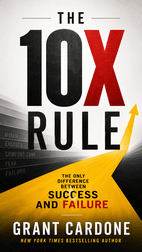
Grant Cardone's The 10X Rule presents a radical philosophy for achieving extraordinary success, built on taking ten times more action and setting goals ten times bigger than you think necessary. Written for anyone stuck in mediocrity who's ready to reject excuses and commit to relentless discipline in business, finances, and personal growth.
Feature
Insta.Page
Blinkist
Shortform
Summary Depth
Full Chapter-by-Chapter
15-min overview
Section-by-section guides
Audio Narration
✓
✓
✓
Visual Mindmaps
✓
✕
✕
AI Q&A
✓
✕
✕
Quizzes
✓
✕
✕
PDF Downloads
✓
✕
✓
Price
$89.99/yr
$146/yr (PRO)
$199/yr
*Competitor data last verified July 2026.
1 Page Summary
Based solely on the provided chapter content, Grant Cardone's The 10X Rule presents a radical philosophy for achieving extraordinary success, built on the premise that most people drastically underestimate the effort and thinking required for any meaningful accomplishment. The core concept has two parts: taking massive action—specifically ten times more than you think is necessary—and thinking at a 10X level by setting goals that are ten times bigger than what you believe you want. Cardone argues that "average" is a failing formula and that success is not a luxury but a duty and a survival mechanism. The book dismantles common obstacles such as the scarcity mindset, victim mentality, and the fear of risk, reframing them as illusions that hold people back. It also challenges conventional wisdom on competition, customer satisfaction, and time management, advocating instead for domination, customer acquisition, and a focus on "now."
The author's approach is distinctive for its unapologetic intensity and blunt, confrontational tone. Cardone uses his own life experiences—from a jobless and directionless 25-year-old to a successful entrepreneur surviving the 2008 crash—as case studies to illustrate his points. The book promotes an "all in" or "overcommit" mentality, encouraging readers to be "unreasonable," "dangerous," and to "burn the place down" with continuous action and expansion. Key tools include seeing fear as a guide for what to do next, embracing criticism as a sign of success, and cultivating traits like persistence, a "default yes" posture, and a hunger for discomfort. The ultimate goal is to create "omnipresence," making your name and brand so pervasive that they become the default association for your industry.
This book is intended for anyone who feels stuck in mediocrity and is ready to reject what Cardone calls a "middle-class mentality." The audience is not those seeking gentle motivation but rather individuals willing to take complete control, reject excuses, and commit to an unusually high level of action. Readers will gain a framework for resetting their assumptions about effort and success, learning to set audacious goals and pursue them with relentless discipline. They will walk away with a set of actionable traits and habits—from being goal-oriented and mission-driven to exercising discipline and embracing discomfort—designed to transform their approach to business, finances, relationships, and personal growth.
Chapter 1: What Is the 10X Rule?
Overview
At its core, the 10X Rule is a guarantee: if you apply it correctly, you’ll achieve what you want in far greater amounts than you ever thought possible. It applies to every area of life—spiritual, physical, mental, emotional, familial, and financial. The rule rests on a simple but radical premise: most people wildly underestimate both the level of effort and the quality of thinking required for any meaningful success. The author shares that his own success came not from luck, connections, or a special gene, but from consistently putting forth ten times the activity others did—whether in sales calls, property viewings, or business building. Yet he admits he initially failed the second half of the rule: thinking at 10X levels. That failure, he believes, kept him from reaching truly extraordinary financial success. The chapter makes clear that to get to the next level in anything, you must think and act in wildly different ways than before. Your current thoughts and actions brought you to where you are—so if you want a different result, you have to suspect both.
The Two Components of the 10X Rule
The 10X Rule has two distinct parts: the action side and the mind‑set side. The first part is about executing massive action—doing ten times what others consider reasonable. The second part is about setting targets ten times higher than you originally think you want. Most people trip up on both. They underestimate the necessary actions and also limit their dreams. The author’s regret is that he succeeded at the effort side but fell short on the thinking side—he didn’t dare to dream on a 10X scale. He emphasizes that these two components must work together: massive thoughts must be followed by massive actions. Without the larger vision, even extraordinary effort can feel like work; without the effort, the vision remains fantasy.
Why Ordinary Goals Lead to Ordinary Lives
One of the most dangerous traps is limiting your desire for success. People often say, “I don’t need extraordinary success,” or “I just want to be comfortable.” But the author insists that limiting the amount of success you desire automatically limits what you’ll do to achieve it—and what you’ll do to keep it. Success is not a one‑time event; it’s like breathing. Your last breath doesn’t sustain you—you need the next one. Similarly, a marriage can’t survive on the love felt on the wedding day. It requires continuous attention and action. The chapter argues that the desire for “more” is not a flaw; it’s a sign of being alive and aligned with your potential. Without that hunger, you risk becoming stagnant or being used as a resource for someone else’s goals.
The Four Goal‑Setting Mistakes
The author identifies four critical errors people make when pursuing goals:
Mistargeting – Setting objectives too low, which fails to provide sufficient motivation.
Underestimating required actions – Severely misjudging the amount of resources, energy, and money needed.
Competing instead of dominating – Spending too much energy trying to keep up with others rather than focusing on owning your sector.
Underestimating adversity – Not accounting for the inevitable obstacles that will arise.
The 2008 housing crisis is used as a vivid example. Many people set targets based on what neighbors and colleagues were doing (competition), not on their own survival and domination. They underestimated the adversity a market crash would bring, and they failed to take massive action to protect themselves. The author admits he too fell prey to this, getting drawn into a scheme because he wasn’t fully occupied with his own 10X goals.
Domination Mentality, Not Competition
The 10X Rule is about pure domination—not controlling others, but becoming a model for how others think and act. A 10X person never aims merely to achieve a goal; they aim to dominate the entire sector. This requires a willingness to do what others won’t do, including actions that might seem “unreasonable.” When you focus on competition, you limit your actions to what others are doing. When you focus on domination, you set your own standard and become immune to market fads and unforeseen events. The author stresses that if you start any task with a limit on the potential outcome, you will limit the actions necessary to reach even that limited outcome.
Redefining Success for the 10X Journey
The word “success” literally means “to turn out well” or “to attain a desired object or end.” But the 10X view of success goes deeper—it’s about accumulation and maintenance. You can be successful at cutting your grass once, but it grows back. True success is perpetual; it builds on itself and doesn’t feel like work because the payoff is substantial enough. The author assures readers that once you set the correct 10X target and commit to the massive effort, the process stops feeling like drudgery. The focus should be on creating extraordinary achievement, keeping it, and then creating new levels—without it ever feeling like a grind.
Key Takeaways
The 10X Rule has two parts: 10X thinking (set targets ten times higher than you think you want) and 10X action (do ten times more than you think is necessary).
Most people fail because they set goals too low, underestimate effort, compete instead of dominate, and ignore inevitable adversity.
Limiting your desire for success limits your actions and makes you vulnerable to others’ agendas.
Success is not a one‑time event; it requires continuous attention and massive action to sustain and grow.
A domination mentality—focusing on owning your sector rather than beating competitors—provides immunity to market shifts and get‑rich‑quick traps.
Key concepts: Chapter 1: What Is the 10X Rule?
1. Chapter 1: What Is the 10X Rule?
Two Core Components
10X action: do ten times what others consider reasonable
10X thinking: set targets ten times higher than you think
Both must work together for extraordinary results
Author succeeded at action but failed at thinking
Dangers of Ordinary Goals
Limiting desire for success limits actions to achieve it
Success is continuous like breathing, not a one-time event
Desire for 'more' is a sign of being alive
Without hunger you become stagnant or used by others
Four Goal-Setting Mistakes
Mistargeting: setting objectives too low
Underestimating required actions and resources
Competing instead of dominating your sector
Underestimating inevitable adversity and obstacles
Domination Mentality
Aim to dominate your sector, not just compete
Set your own standard immune to market fads
Do what others won't do, even if 'unreasonable'
Competition limits actions; domination expands them
Redefining Success
Success means accumulation and maintenance, not one event
True success builds on itself perpetually
10X target and massive effort make process feel effortless
Focus on creating, keeping, and growing extraordinary achievement
💡 Try clicking the AI chat button to ask questions about this book!
Chapter 2: Why the 10X Rule Is Vital
Overview
Think of the last time you started a big project—a new business, a major career move, even a personal goal. Chances are, you wildly underestimated what it would actually take. That's the central truth Cardone hits you with right out of the gate: every meaningful endeavor requires far more time, energy, money, and persistence than we ever predict. This chapter isn't about scaring you off; it's about resetting your assumptions so you don't quit three months in, convinced the whole idea was a failure. Cardone uses his own painful experience to show why the 10X Rule isn't just a nice philosophy—it's absolutely vital if you want to survive the inevitable surprises that will try to derail you.
The Miscalculation Trap (and the Author’s Wake-Up Call)
Cardone opens with a confession: “For every project in which I have ever been involved, I underestimated the time, energy, money, and effort necessary.” Even getting his wife to date him took ten times more work than he expected. He shares the story of starting his first business at 29, thinking it would take three months to match his previous income. It took three years—72 times longer. After three months, he was ready to quit, compiling a list of excuses: the economy sucked, clients didn't have money, he was too young. Sound familiar? The breakthrough came when he realized the problem wasn't the market—it was his original estimate of effort. Once he committed to increasing his actions tenfold (from 2–3 sales calls a day to 20–30), results started appearing. “I was getting four times the results by making 10 times the effort.”
Why “Lowering the Target” Is a Grave Mistake
One of the most dangerous responses to falling short is to reduce the goal. Cardone calls out managers who, halfway through a quarter, hold a meeting to lower quotas so the team can feel like winners. That sends a terrible message: targets are negotiable, and the way to win is to move the finish line. Instead, the 10X Rule insists the target itself is never the problem. “Never reduce a target. Instead, increase actions.” When you start making excuses or letting yourself off the hook, that's your signal that you've misjudged what's required—not that the goal is impossible.
The Emotional Calculator That Betrays You
We all carry an internal “calculator” that automatically spins explanations for failure. It's emotional, not logical, and it blames everything except our activity level: the economy is bad, the timing is wrong, people don't get it, I'm not cut out for this. Cardone argues that these are just excuses loaded into our brains by media, education, and upbringing. The real truth is simpler: you haven't correctly assessed the amount of action necessary. “Regardless of the timing, the economy, the product, or how big your venture is, the right acts done to the right degree over time will make you successful.”
Preparing for the Unforeseeable
No business plan, no matter how detailed, can predict every obstacle: legal issues, competition, technology shifts, illness, or global events. Cardone insists you must assume there will be things you can't foresee. The only hedge is to multiply every expectation by ten. If it takes less, great—you'll be pleasantly surprised. If it takes exactly ten times more, you'll be prepared. That means hiring 10 people instead of one, spending 10 times more on outreach, and accepting that the marketplace is not as enthusiastic about your idea as you are. Your potential customers don't even know you exist yet.
The Mindset of a Champion
Cardone closes the chapter with a call to attack everything with ferocious commitment. “Tackle your project with the 10X Rule—act like your life depends on it.” He urges you to manage every action as if you're being recorded for your children and grandchildren to learn from. Follow through completely—that's the common denominator of all winners. No excuses. A “take-no-prisoners” attitude. Success is not a lucky accident; it's the result of relentless, proper actions taken over time. And the more actions you take, the better your chances of getting “lucky.”
Key Takeaways
Expect to underestimate — every project will take far more time, money, and effort than you initially think. Plan for 10X from the start.
Never reduce your target — when you fall short, increase your actions, not your excuses. Lowering the goal weakens morale and signals that failure is acceptable.
Your internal “excuse calculator” is your enemy — it blames everything except your own activity level. Recognize that the real problem is almost always an incorrect estimate of effort.
Prepare for the unforeseeable — there will always be surprises (economy, competition, personal issues). 10X parameters give you a buffer to absorb them without quitting.
Success is a direct result of relentless action — approach every goal with a champion's ferocity. Follow through completely, and remember: luck is just the byproduct of massive effort.
Key concepts: Chapter 2: Why the 10X Rule Is Vital
2. Chapter 2: Why the 10X Rule Is Vital
The Miscalculation Trap
Every project requires far more effort than expected
Author's first business took 72 times longer than planned
Problem is not the market but underestimated effort
10X actions produce 4X results
Never Reduce the Target
Lowering goals sends message that failure is acceptable
Target is never the problem—actions are
Increase actions instead of reducing expectations
Excuses signal misjudged effort, not impossible goal
Excuses come from media, education, and upbringing
Real truth: you haven't assessed required action correctly
Right actions over time guarantee success
Prepare for the Unforeseeable
No plan can predict all obstacles
Multiply every expectation by ten as buffer
Hire 10 people instead of 1, spend 10X more
Marketplace doesn't know you exist yet
The Champion's Mindset
Attack every goal with ferocious commitment
Act like your life depends on it
Follow through completely—common denominator of winners
Luck is byproduct of massive effort
Chapter 3: What Is Success?
Overview
What exactly does “success” mean? The answer changes constantly depending on where you are in life. The author doesn’t just offer a dictionary definition—he argues that success is far more than a feel‑good concept. It’s a survival mechanism, a duty, and something we too often dismiss with empty platitudes. By the end, the message is clear: stop treating success like a luxury and start seeing it as essential.
The Shifting Nature of Success
Success isn’t a fixed target. What looks like winning at age seven—staying up past bedtime—means nothing by seventeen, when a later curfew takes its place. In your twenties it might be a promotion or your first apartment. Later it becomes marriage, kids, travel, money. And in old age, success often shows up as health, family, and legacy. The definition moves with your circumstances, your attention, and the people or events that matter most to you at any given moment. This fluidity means there’s no one‑size‑fits‑all answer, and that’s exactly the point.
Success as a Vital Force
Beyond personal milestones, the author insists success is crucial for survival—yours, your family’s, your company’s, even civilization’s. Without continued growth and accomplishment, any entity eventually withers. History proves it: the Vikings, Ancient Rome, Communist Russia, countless failed companies. Success isn’t optional; it’s what keeps things alive and expanding. He dismisses the idea that success is “just a journey, not a destination” as a cute but dangerous saying. When economic contractions hit, no one can pay the mortgage with a slogan. Winning—over and over—is what ensures you and your ideas endure.
Why Downplaying Success Is Dangerous
The chapter takes a sharp turn to challenge those who belittle success. The author calls out the people who say “success isn’t everything” and wonders aloud whether they’re just rationalizing their own lack of it. He doesn’t let the reader off the hook: if you quit caring, you quit winning; quit winning long enough, and you quit altogether. And nobody benefits from your failure—not your kids, not the economy, not the world waiting for your art, book, or big idea. Reversing that trajectory and actually attaining your goals? Now that’s something.
Success and the Individual
On a personal level, success builds confidence, imagination, and a sense of security. It also gives you the ability to contribute at a higher level. People who can’t provide for their families or their future put themselves and everyone around them at risk. And on a broader scale, widespread lack of success slows economies, shrinks tax revenue, and hurts schools, hospitals, and public services. The author leaves no room for doubt: success is critical, regardless of what goals you’re chasing.
Key Takeaways
Success changes meaning across life stages and circumstances—there’s no permanent definition.
Beyond personal satisfaction, success is necessary for survival and expansion of individuals, families, companies, and civilizations.
Dismissing success with clichés like “it’s a journey, not a destination” ignores its real importance in difficult times.
Failure hurts everyone; achieving your goals is what truly matters.
Key concepts: Chapter 3: What Is Success?
3. Chapter 3: What Is Success?
Success Is Not Fixed
Definition shifts with life stages
What matters at 7 differs at 17
No one-size-fits-all answer exists
Success as Survival
Growth prevents decline of entities
History shows failure of stagnant civilizations
Success keeps families and companies alive
Dangers of Downplaying Success
Clichés like 'journey not destination' are dangerous
Quit caring and you quit winning
Failure harms others, not just yourself
Personal Benefits of Success
Builds confidence and security
Enables higher-level contribution
Failure to succeed risks family and future
Broader Impact of Success
Widespread failure slows economies
Reduces tax revenue for public services
Success is essential, not optional
Chapter 4: Success Is Your Duty
Overview
There’s a moment that separates drifting from driving, wishing from demanding, and for the author, that moment came when he stopped treating success like a lottery ticket and started treating it like a moral obligation. This chapter pulls no punches: success isn’t a luxury or a lucky break—it’s a duty. And until you see it that way, you’ll keep selling yourself short.
The author lays bare two brutal wake-up calls. At 25, he was a mess—jobless, directionless, drugging and drinking daily, dying slowly without having grown old. He hadn’t committed to anything, least of all to success. The second hit at 50, during the 2008 economic crash, when his company’s future and his family’s financial security teetered because he’d gotten comfortable. Both times, the only thing that saved him was realizing he had to treat success not as optional, but as non-negotiable—a responsibility every bit as urgent as feeding your kids or protecting your home.
This isn’t about hustle culture noise. It’s about waking up to the fact that mediocrity is a choice, and choosing it when you have potential is a kind of ethical failure. The author argues that failing to insist on abundant success—in marriage, health, community, money, everything—is actually unethical, because you’re squandering the gifts you were given. And the world is full of people who lie to themselves about this: they tell themselves they didn’t really want it, that it’s fine to have just a little, that success only happens to the lucky. That’s self-deception of the highest order.
Two Pivotal Wake-Up Calls
The first lesson came from nearly dying of aimlessness. The author had 17 years of formal education, yet not one course ever mentioned that success was important, let alone that you had to pursue it with purpose. He drifted, surrounded himself with losers, and burned through opportunities until he hit rock bottom. When he finally decided that sales would be his career and that he would do whatever it took to succeed, his life started to turn.
The second came when the economy collapsed and his hard-won gains began to evaporate. He realized he had rested on his laurels—stopped treating success as a daily obligation—and put everything at risk. These two experiences taught him that success is not a one-time achievement; it’s a continuous, relentless duty. You can’t coast. You can’t think “enough” and then stop. The moment you stop demanding success from yourself, it starts slipping away.
Reframing Success as an Ethical Responsibility
Most people treat success like a preference—nice if it happens, okay if it doesn’t. The author flips that: success is a moral and ethical issue. He compares it to the way good parents care for their kids—they wake up at 3 a.m. to feed them, they work hard to provide, they’d risk their lives. That’s the intensity required. When you make success a duty to your family, your company, and your future, it stops being a wish and becomes a command.
This shift changes everything. You stop making excuses. You stop minimizing your goals. You start acting like a person who has no choice but to win. And when you approach success with that hunger—the “hungry dog on the back of a meat truck” mentality—the universe seems to rearrange itself in your favor.
Lying to Yourself About Success
One of the most dangerous habits people have is justifying failure by pretending they didn’t really want it. The author calls this out bluntly: you see it in kids who cry for a toy, then give up and say they never wanted it. Adults do the same thing with careers, relationships, and money. It’s okay to admit you wanted something and didn’t get it. That honesty is the only way to eventually get there.
The flip side is the myth of luck. Colonel Sanders pitched his chicken 80 times before anyone said yes. Stallone wrote Rocky in three days while broke and sold his dog for $50 to eat. Walt Disney was laughed at. The world only sees the win, never the mountain of action behind it. Lucky people don’t make successful people; people who fully commit to success make themselves “lucky” through relentless action.
Success becomes a habit. It creates momentum. The more you achieve, the more you expect to achieve—and the more you’re willing to risk. That magnetism people talk about? It’s just the natural byproduct of treating success like a duty instead of a maybe.
Key Takeaways
Success is not optional; it is an ethical duty to yourself, your family, your company, and your future. Treating it as a choice leads to excuses and mediocrity.
You must stop lying to yourself about what you want. Admitting you wanted something and failed is the only way to keep fighting.
“Overnight success” is a myth. What looks like luck is always the result of repeated, committed action over time.
Success is a habit, not an event. The more you achieve, the more momentum you build—but only if you refuse to rest on your laurels.
Key concepts: Chapter 4: Success Is Your Duty
4. Chapter 4: Success Is Your Duty
Success as a Moral Duty
Success is not optional; it's an ethical obligation
Mediocrity with potential is an ethical failure
Treat success with the urgency of feeding your family
Stop treating success like a lottery ticket
Two Pivotal Wake-Up Calls
At 25: jobless, directionless, and self-destructive
At 50: 2008 crash revealed complacency's cost
Success is a continuous duty, not a one-time event
Coasting leads to losing everything you gained
Reframing Success as Ethical Responsibility
Success is a command, not a preference
Approach it with the intensity of a parent at 3 a.m.
Stop making excuses and minimize your goals
Act like a person with no choice but to win
Self-Deception About Success
Don't justify failure by pretending you didn't want it
Admit wanting something and failing to keep fighting
The myth of luck hides relentless action
Colonel Sanders pitched 80 times before one yes
Success as a Habit and Momentum
Success creates momentum; the more you achieve, the more you expect
Refuse to rest on your laurels or think 'enough'
Overnight success is always repeated committed action
Magnetism is the byproduct of treating success as duty
You've reached the end of the free chapters
Next chapter: “There Is No Shortage of Success” is locked
Keep reading The 10X Rule — and unlock all 600+ book summaries with audio, mindmaps and AI Q&A.
$0.00 due today · 7 days free, then $89.99/year ($7.49/mo) · Cancel anytime before day 7
Grant Cardone is a sales expert, entrepreneur, and motivational speaker known for his high-energy approach to business and personal development. He is the founder of Cardone Capital and the author of bestselling books such as *The 10X Rule* and *Sell or Be Sold*, which focus on aggressive goal-setting and sales mastery. Cardone has built a reputation for advocating extreme effort and financial discipline, drawing from his own rise from addiction and hardship to becoming a multimillion-dollar real estate investor.
Frequently Asked Questions about The 10X Rule
What is The 10X Rule about?
The book presents the 10X Rule, which requires setting goals ten times larger than what you think you want and taking ten times the action you believe is necessary. It argues that most people drastically underestimate the effort and thinking required for meaningful success, and that average effort is a failing formula. The book covers mindset shifts such as assuming total control, embracing obsession, going all in, expanding during contractions, and treating fear as a guide. It emphasizes that success is a duty and that you must operate at a level far beyond normal to achieve extraordinary results.
Who is the author of The 10X Rule?
Grant Cardone is a self-made millionaire, sales trainer, and entrepreneur who built his success through applying the 10X Rule. He shares personal stories of underestimating the effort required for projects and learning to think and act at 10X levels. Cardone is known for his direct, no-nonsense style and his belief that obsession and massive action are essential for domination.
Is The 10X Rule worth reading?
Absolutely — it offers a powerful and unconventional framework for achieving extraordinary success. The book challenges you to abandon average thinking and embrace massive action, providing practical mindset shifts that can transform your approach to goals and obstacles. If you're ready to stop holding back and start dominating your field, this book provides the blunt, motivating push you need.
What are the key lessons from The 10X Rule?
First, set goals 10 times bigger than what you think you want and take 10 times the action — small goals kill enthusiasm and lead to quitting early. Second, average effort is a recipe for failure; you must operate at a level so far above normal that no setback can knock you down. Third, embrace obsession, fear, and discomfort as signals that you're on the right track toward success. Finally, treat success as a non-negotiable duty and assume total control over everything in your life, refusing to make excuses or play the victim.
📚 Explore Our Book Summary Library
Discover more insightful book summaries from our collection