The 10X Rule Quotes
by Grant Cardone
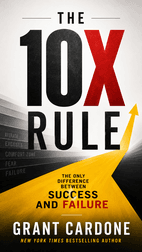
This collection brings together thirty of the most impactful lines from Grant Cardone's book, The 10X Rule. You will find straight talking advice about ambition, action, and accountability. Cardone does not sugarcoat anything. He pushes readers to think bigger and work harder than they ever thought possible.
The book is quotable because it strips away excuses and challenges conventional thinking. Each line feels like a direct challenge to settle for less. Cardone's no nonsense style makes his words stick. Whether you need a kick in the pants or a fresh perspective, these quotes deliver a dose of raw motivation without the fluff.
Top Quotes from The 10X Rule
“You must set targets that are 10 times what you think you want and then do 10 times what you think it will take to accomplish those targets.”
The author defines the core principle of the 10X Rule.
It distills the entire philosophy into a clear, actionable formula, making it easy to remember and apply.
“As long as you are alive, you will either live to accomplish your own goals and dreams or be used as a resource to accomplish someone else's.”
Near the end of the chapter, the author emphasizes personal agency.
This stark choice motivates readers to take ownership of their lives and avoid being passive participants in others' agendas.
“Never reduce a target. Instead, increase actions.”
Author criticizes managers who lower quotas to make teams feel better.
This concise, memorable command challenges a common failure mode and reframes the problem as one of insufficient action, not unrealistic goals.
“Anyone who minimizes the importance of success to your future has given up on his or her own chances of accomplishment and is spending his or her life trying to convince others to do the same.”
The author warns against people who downplay the significance of success.
This quote powerfully shifts blame from success itself to those who dismiss it, inspiring readers to reject defeatist attitudes and protect their own ambitions.
“Success is not something that happens to you; it's something that happens because of you and because of the actions you take.”
The author states this as a core principle of the chapter.
It reframes success as a product of personal responsibility rather than luck, empowering readers to take ownership.
“Don't be a little bitch—get a generator.”
The author uses this after describing how he responds to a power outage by assuming control.
Its bluntness makes it unforgettable, and it cuts through excuses with a call to immediate action.
“Your only problem is obscurity, not talent.”
Cardone advises his wife, an actress, and applies the idea broadly to any endeavor.
It reframes the biggest obstacle as being unknown rather than lacking skill, empowering people to focus on visibility and action.
Themes Behind the Quotes
A major theme across these quotes is the idea that success is a choice and a duty, not a lucky accident. Cardone insists that you must take full ownership of your results. Blaming circumstances or other people only keeps you stuck. Instead, he calls for massive and relentless action, even when it feels unreasonable.
Another recurring idea is that limits are mostly self imposed. Thinking in terms of scarcity or competition holds you back. Cardone advocates for an abundant mindset where you can create as much success as you want. He also warns against coasting or settling for average effort, because that leads to mediocrity and failure. The core message is clear. Your only real obstacles are your own small thinking and lack of action.
Quotes by Chapter
Chapter 1: What Is the 10X Rule?
“The 10X Rule is the one thing that will guarantee that you will get what you want in amounts greater than you ever thought imaginable.”
Opening statement of the chapter introducing the central concept.
This line immediately captures the book's bold promise, creating intrigue and setting a high expectation for the reader.
“Massive thoughts must be followed by massive actions.”
The author explains that thinking big alone is insufficient without corresponding effort.
It is a concise, memorable mantra that reinforces the necessity of pairing ambition with relentless execution.
Chapter 2: Why the 10X Rule Is Vital
“Regardless of how superior your product, service, or proposition is, I assure you that there will be something you don't anticipate or correctly plan.”
Author explains why unexpected events are inevitable in any venture.
This line humbles the reader by acknowledging that even the best offerings face unforeseen obstacles, making preparation and 10X effort essential.
“Once I quit calculating all the wrong reasons, I committed to making this work by increasing my efforts 10 times. And as soon as I did that, everything started to change—immediately.”
Author shares his personal turning point after nearly quitting his first business.
It shows a powerful shift from excuse-making to action, illustrating instant results from tenfold effort and giving hope to anyone stuck in a rut.
“Make no excuses, and adopt a “take- no-prisoners” attitude. Approach every situation with an “in-it-to-win-it-whatever-it-takes” mind-set.”
Author summarizes the aggressive mindset required for success.
The forceful language and memorable phrases capture the book's core ethos, motivating readers to commit fully without reservation.
Chapter 3: What Is Success?
“Success provides confidence, security, a sense of comfort, the ability to contribute at a greater level, and hope and leadership for others in terms of what is possible.”
The author lists the vital benefits of success for individuals and society.
This line encapsulates the multifaceted value of success, making it tangible and aspirational. It resonates because it ties personal achievement to broader positive impact.
“It is not enough just to play the game; it is vital that you learn to win at it.”
The author argues that passive participation is insufficient for survival and growth.
This concise, forceful statement redefines success as active mastery, motivating readers to pursue excellence rather than mere involvement.
“If you quit caring, then you quit winning; quit winning long enough, and you will just plain quit!”
The author emphasizes the dire consequences of losing interest in success.
The escalating repetition drives home the critical link between caring, winning, and persisting—a stark reminder that apathy leads to extinction.
Chapter 4: Success Is Your Duty
“One of the greatest turning points in my life occurred when I stopped casually waiting for success and instead started to approach it as a duty, obligation, and responsibility.”
The author describes a personal realization that changed his approach to life.
It encapsulates the book's central shift from passive hope to active duty, making success a deliberate choice rather than a wish.
“I literally began to see success as an ethical issue —a duty to my family, company, and future—rather than as something that may or may not happen to me.”
The author explains his new perspective on success as a moral imperative.
This reframing of success as an ethical obligation gives readers a powerful reason to pursue it seriously and consistently.
“If you don't consider it your duty to live up to your potential, then you simply won't.”
The author challenges readers to take responsibility for their own capabilities.
Its blunt, direct truth forces self-reflection and eliminates excuses, motivating readers to claim their potential.
“Success always comes as a result of earlier actions—no matter how seemingly insignificant they are or how long ago they were taken.”
The author debunks the myth of overnight success by emphasizing cumulative effort.
It reassures readers that every small action matters and encourages patience and persistence over time.
Chapter 5: There Is No Shortage of Success
“There will never be a dearth of success because it is created by those who have no limits in terms of ideas, creativity, ingenuity, talent, intelligence, originality, persistence, and determination.”
The author explains that success is not a finite resource but something people actively create.
This line reframes success as an infinite, creative act, freeing readers from the belief that others' achievements limit their own.
“The big players do not think in terms of restrictions like this. Instead, they think without limits—something that allows them to soar to levels that many others consider impossible.”
The author contrasts the mindset of high achievers with ordinary scarcity thinking.
It inspires readers to adopt a limitless perspective, showing that self-imposed restrictions are the only true barriers.
“The moment you start thinking someone else's gain is your loss, you limit yourself by thinking in terms of competition and shortages.”
The author warns against zero-sum thinking about success.
This is a powerful reminder that envy and competitive scarcity directly undermine one's own potential for achievement.
“Erase any concepts you might have that success is limited only to some and only in certain amounts. You and I can get as much as we want—at the same time.”
The author concludes with a direct call to eliminate limiting beliefs about success.
It provides a clear, empowering shift in mindset, reinforcing the idea that success is abundant and available to all simultaneously.
Chapter 6: Assume Control for Everything
“I assume control over everything that happens to me, even for those things that I appear to have no control over.”
The author explains his personal mindset of radical responsibility.
It challenges the victim mentality by claiming agency even in uncontrollable situations, inspiring proactive problem-solving.
“Until a person is done being a victim, he or she is unable to create solutions and success.”
The author wraps up his argument against victimhood.
It clearly links the identity of a victim to the inability to achieve success, motivating readers to abandon that role.
Chapter 7: Four Degrees of Action
“The more action you take, the better your chances are of getting a break.”
Grant Cardone introduces the fundamental principle of the 10X Rule.
This line succinctly captures the core message that success is proportional to action, motivating readers to increase their efforts.
“Taking normal action is the most dangerous of the levels, because it is the most accepted by society.”
Cardone warns against the complacency of average effort in the third degree of action.
It challenges the reader to reject societal norms of mediocrity and recognize that average is a trap.
“Massive action is actually the level of action that creates new problems—and until you create problems, you're not truly operating at the fourth stage of action.”
Cardone describes the defining characteristic of the highest degree of action.
This counterintuitive insight shows that problems are a sign of progress, encouraging readers to embrace challenges as proof they are pushing hard enough.
Chapter 8: Average Is a Failing Formula
“The moment I started resting on my laurels—and thought that I could “coast a bit”—I made myself a target.”
The author shares a personal lesson after being robbed of years of success by criminals when he stopped operating at 10X levels.
This line resonates because it reveals a universal vulnerability: complacency invites loss. It serves as a stark warning that even past success does not insulate you from failure if you revert to average effort.
“Average thinking and actions will only guarantee you misery, uncertainty, and failure.”
The author summarizes the chapter's core argument against average behavior.
This direct, emphatic statement crystallizes the chapter's message in a memorable warning. Its bluntness forces readers to confront the high cost of settling for average.