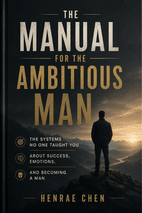
What is the book The Manual for the Ambitious Man about?
Henrae Chen's The Manual for the Ambitious Man frames personal growth as upgrading your internal operating system, teaching ambitious men to balance Agency and Communion while building physical and emotional foundations before pursuing meaningful goals and contributing to community.
Feature
Insta.Page
Blinkist
Shortform
Summary Depth
Full Chapter-by-Chapter
15-min overview
Section-by-section guides
Audio Narration
✓
✓
✓
Visual Mindmaps
✓
✕
✕
AI Q&A
✓
✕
✕
Quizzes
✓
✕
✕
PDF Downloads
✓
✕
✓
Price
$89.99/yr
$146/yr (PRO)
$199/yr
*Competitor data last verified July 2026.
1 Page Summary
This manual for self-development frames personal growth as a deliberate process of upgrading one’s internal "operating system." The author argues that most people unconsciously run default programs installed by their culture, which often pits two core human drives against each other: Agency (the need to assert oneself and control one’s environment) and Communion (the need to connect and belong). The Western lens prizes independence, while the Eastern lens prioritizes belonging, but the book’s central thesis is that true strength lies in learning to hold both perspectives simultaneously. Before any strategy or ambition can take root, the author insists on a foundational step: tending to the physical body and internal world through silence, honest feedback from trusted peers, and confronting buried emotions. This "boring, quiet work" is presented as the only guard against self-sabotage.
The book dismantles the pursuit of borrowed dreams, detailing the author’s own hollow victory after chasing a financial goal fueled by resentment. It pushes the reader to honestly interrogate what they truly want, using frameworks like Ikigai to find meaningful work that aligns with what you love, what you’re good at, what the world needs, and what you can be paid for. To break the paralysis of fear, the author offers a practical Four-Way Pressure Test and emphasizes the silent power of environment, citing the Law of Social Contagion to argue that you become the average of the five people you interact with most. Brotherhood is described not as drinking buddies, but as a network of men who hold you to a higher standard, found in places like MMA gyms or run clubs.
The manual culminates in a shift from self-focus to contribution. The author argues that while the early stages of development are necessarily selfish—building oneself into a "sovereign asset"—the Western lens ends at the self. A man who merely accumulates and guards his resources has built a "heavily fortified prison." True power, the book contends, comes from evolving that lens and plugging the indestructible individual back into the community as a power source. The epilogue reframes trauma not as a one-time event, but as a choice to continuously pick up small "grains of salt"—every cold glance or judgment we hold onto—which slowly drowns us. The final message is a simple truth: you do not have to keep picking up the salt.
The Framework
Overview
At the heart of any meaningful change lies a hidden operating system—the one that governs your behavior, decisions, and reactions. This chapter lays out that OS in plain terms. Every interaction you face boils down to a fundamental choice between three competing loyalties: Self, Tribe, or Truth. Most of us never even see the menu, let alone choose; we just run whatever program our culture installed by default. The Western lens, which this manual primarily uses, treats independence as the ultimate prize. But that prize comes with a hidden cost: the loneliness of a castle with no neighbors. The Eastern lens, on the other hand, prizes belonging, but its safety net can become a web that traps your potential. The real skill isn't picking one side—it's learning to hold both.
The Two Core Drives
Buried beneath all this cultural programming are two fundamental human drives. Agency is the urge to assert yourself, shape your environment, and take control. Communion is the urge to connect, merge, and harmonize with others. Neither is inherently good or bad. A wall needs individual stones to be strong, but a stone is useless unless it's part of a wall. The trick is to develop fierce agency—the ability to stand completely alone if necessary—and then use that strength to lift others. You become the stone that's also strong enough to be a wall.
From Default to Deliberate
Most people never realize they're trapped in their culture's default setting. The West teaches you to conquer, to win, to destroy obstacles. It celebrates the Self-Made Man. But that ideal often ends in isolation. The East teaches you to flow, to harmonize, to maintain balance. It offers an unbreakable safety net—until that net tightens. The path forward requires deliberate awareness. You have to see the operating system, understand its trade-offs, and then choose consciously. Not as a robot running a script, but as someone who can switch between modes based on what the moment demands.
Key Takeaways
Every moment offers a choice between Self, Tribe, or Truth—but most people never realize they're choosing.
Agency and Communion are the two fundamental drives; neither works well alone.
The Western ideal of independence can lead to isolation; the Eastern ideal of belonging can hold you back.
Mastery means becoming fiercely independent so you can serve your community—not despite that strength, but because of it.
Your culture's default setting is not your destiny; you can learn to toggle between modes.
Key concepts: The Framework
1. The Framework
The Hidden Operating System
Behavior is governed by a hidden OS
Three competing loyalties: Self, Tribe, or Truth
Most people run default cultural programs
Western lens prizes independence; Eastern prizes belonging
The Two Core Drives
Agency: urge to assert and control
Communion: urge to connect and harmonize
Neither drive is inherently good or bad
Mastery: fierce agency used to lift others
Cultural Defaults and Their Costs
West teaches conquering, leading to isolation
East teaches harmony, but net can trap potential
Self-Made Man ideal often ends in loneliness
Safety net of belonging can hold you back
From Default to Deliberate Choice
Awareness of the OS is the first step
Understand trade-offs of each cultural lens
Choose consciously, not as a robot
Toggle between modes based on the moment
The Path of Mastery
Become fiercely independent to serve community
Hold both independence and belonging
Culture's default is not your destiny
Strength used for others, not despite it
💡 Try clicking the AI chat button to ask questions about this book!
The Most Essential Action
Overview
The author opens with a raw, personal story about hitting rock bottom. He describes waking up one morning unable to move, caught in a depression that stripped away all motivation. What pulled him out wasn’t therapy or a grand realization—it was sunlight. Feeling the warmth on his legs, stepping outside in pajamas, then walking. That simple act rebuilt his energy and returned him to life. The lesson: your body is the base of everything. If it’s off, your mind follows. So the most essential action isn’t a productivity hack or a strategy—it’s tending to your physical and internal world first.
From there, the chapter unfolds in three distinct but connected movements: learning to sit in silence so you can hear yourself, gathering honest feedback from trusted people, and finally facing the emotions you’ve buried. Each builds on the last, and skipping ahead will make the later steps hollow. The author is blunt about the difficulty—especially around feedback, which can feel like a punch to the gut—but insists that this boring, quiet work is what actually prevents you from sabotaging your own future.
The Body as the Starting Point
Before you do anything else, get outside in the morning. Five minutes of daylight on your skin and in your eyes sends a signal that it’s safe to wake up. Walk a little. Breathe. Notice your posture—are you slouched, chin down, signaling defeat? Small adjustments to how you carry yourself shift how your mind feels. The author also suggests a simple data-collection week: pay attention to which foods give you energy versus which make you crash, experiment with sleep quality, and look at your environment. If the people and spaces around you don’t support the person you want to become, you’re fighting uphill. These aren’t sexy steps, but they’re non-negotiable. Your body processes stress through movement, and without that foundation, every other ambition wobbles.
Silence: The Boring Step That Saves You
There’s a story here about throwing chocolate milk in a friend’s face as a kid—an impulse that hijacked reason. The author’s point: age doesn’t fix that. You can still be ruled by split-second emotions unless you learn to see them coming first. That starts with silence. Most people are so saturated with noise and notifications that they can’t hear their own thoughts. So the prescription is boring on purpose: sit somewhere quiet for ten minutes a day (aim for thirty to forty-five once a week), no phone, no talking. Scan your body for tension. Notice thoughts without analyzing them. Just reconnect with yourself. This isn’t about instant clarity—it’s about building a space where clarity can eventually show up. If you can’t feel what’s happening inside, you’ll keep making decisions from pressure instead of intention.
Feedback: Data, Not a Personal Attack
Warning: you need at least one longer silent session before this step. Feedback without that foundation becomes just another task, not a real mirror. The author shares a brutal experience living with two friends who gave feedback daily, on the spot, with no filter—fights nearly broke out. They learned to shift to weekly sessions, and research backs that up: daily critical feedback can cause fatigue and drop performance. The key is to treat feedback as data, not as an attack. Your blind spots are like food in your teeth: you want someone to tell you. Reach out to two or three trusted people and ask specific questions: quirks, strengths, weaknesses, anything you’ve done that bothered them, and your biggest blind spot right now. Thank them, don’t defend, and then bring what you heard into your next silence session. Let your unconscious mind respond. Where might this pattern come from? What emotion comes up? You’re not fixing anything yet—just understanding.
Processing the Unprocessed
This section hits hardest. The author recalls a feedback session where a mention of his childhood triggered an unexpected flood of tears—a memory he thought he had buried. He learned that time doesn’t heal what you refuse to feel. If a topic still stings when someone brings it up, it’s still living in you. The solution isn’t to push it down again; it’s to let it run its course. A practical method: find a private space, do a double breath (inhale fully, then a short sharp inhale to fill the lungs, exhale—repeat ten times), then sit in silence and watch the tightness in your chest or stomach without fighting it. Let the emotion reach “zero.” This isn’t about acting out—it’s internal release. Athletes do this to clear their minds before competition. Pain is inevitable; being a prisoner to it is optional. The past leaves a mark, but you get to decide whether that mark becomes a scar or a chain.
Key Takeaways
Your body comes first. Morning sunlight, a short walk, and awareness of posture reset your nervous system. Without this base, mental clarity suffers.
Silence is a prerequisite for self-knowledge. Ten minutes daily of quiet, non-stimulated space allows you to notice emotions before they hijack your actions.
Feedback is data, not an attack. Ask trusted people for honest observations, thank them, and reflect during silence. Defensiveness is normal—practice receiving without reacting.
Unprocessed emotions don’t disappear. They live in your body until you give them space to move through. Use the double breath and stillness to feel them to zero. That’s how you stop being ruled by the past.
Key concepts: The Most Essential Action
2. The Most Essential Action
Body as Foundation
Morning sunlight resets your nervous system
Short walks and posture shifts improve mindset
Track food, sleep, and environment for energy
Movement processes stress; without it, goals wobble
Many people sprint through life chasing a finish line they never actually wanted. The chapter begins with a raw confession: hitting a financial target fueled by envy and resentment left the author feeling hollow, gambling away the winnings just to feel something real. The lesson is brutal but clear—achieving someone else’s dream with rotten intentions leaves you empty, no matter how many zeros are in the bank.
That emptiness forces a confrontation with life’s finite timeline. Because your days are numbered, you cannot afford to live by another person’s design. The solution starts with an honest interrogation of what you actually want—not what sounds impressive. A two-day exercise pushes you to write down specific desires, then dig into every “why” until you find the core emotion underneath. Your time is scarce, so the goal must be yours alone.
From desire, the chapter moves to the question of meaningful work. The pressure to pick a single career identity paralyzes most people, but a career is just one chapter in a much longer story. The Ikigai framework helps you examine work through four overlapping lenses: what you love, what you’re good at, what the world needs, and what you can be paid for. The goal isn’t a perfect job title—it’s awareness of where those circles intersect. Then you cross-reference that intersection with your life’s desire to see if the work supports the life you want.
But theory is dangerous. Paper accepts lies. To find out if your direction is real, you have to audit your behavior through The 30-Day Evidence Method. Most people are blind to their own nature—they describe the mask they wear, not their true energy patterns. The fix is simple: track cold, hard evidence. Log every activity, your energy before and after, and whether it charged or drained you. Over a month, you move from trying both cognitive and social paths to immersing yourself in one, then creating something tangible. On day thirty, the data reveals what actually energizes you—saving years of chasing the wrong path.
Once you know your authentic direction, you need a vision to guide momentum. A Vivid Vision written in present tense three years out turns random wandering into purposeful progress. Picture every detail—where you wake up, who’s around, what your work looks like. Ignore the “how” for now. You’re the architect, not the builder. Writing it down forces your brain to treat the vision as a real target. A vision board of six to eight images can prime you to spot opportunities you’d otherwise miss.
But vision is only half the equation. The author’s day-trading disaster shows that character is the price of admission. You can have the perfect map, but if you panic at the first sign of friction, the map is useless. To reach the destination, you must become the person whose habits, skills, and resilience match the goal. Six honest questions reveal who you need to become, what habits and skills that version executes, and how they handle stress and solitude. If you’re not willing to live like that version, adjust your vision to something you’ll actually stick to.
With character and vision aligned, the chapter locks in the target. Most people confuse motion with progress—like sprinting on a treadmill and stepping off exactly where they started. The fix is specific, measurable coordinates. Reframe every goal from avoidance to a “Towards” statement: instead of “I don’t want to be fat,” say “I am running a sub-25 minute 5k.” Break the big vision into two horizons: 12-month goals and 90-day goals, with no more than three priorities per sprint. Write each goal in present tense as if already achieved. Then test every goal against three filters: why now, who benefits, and what transformation is required. Set mile markers along the way so you know you’re on track before the deadline hits.
Finally, non-negotiables protect the floor you refuse to fall below. Goals are about growth; non-negotiables are about defense. Focus on three areas that govern 90% of life quality: Health, Wealth, and Relationships. For each, define one minimum standard you hold yourself to—no exceptions. A boundary without a consequence is just a suggestion; pre-decide your response to violations. If work kills your gym time, change your hours or your job. If a friend drains you, distance yourself. These lines keep you sane while taking massive action toward the life you actually want.
Key Takeaways
Chasing external goals with rotten intentions (envy, validation, anger) leads to emptiness even after “winning.”
Your finite time means you cannot afford to live someone else’s design. Interrogate your desires until you hit the core truth.
The Ikigai framework helps you find work that overlaps passion, skill, demand, and market—but it must be tested against real behavior, not theory.
The 30-Day Evidence Method tracks energy delta (before vs. after) to reveal what actually charges you, not what sounds impressive.
A Vivid Vision written in present tense gives your momentum direction, turning a hobby into a purpose.
Character is the price of admission. You must become the person whose habits, skills, and resilience match the destination.
Motion ≠ progress; you need specific, measurable coordinates for your brain to lock onto.
Reframe every goal from avoidance (running from fear) to “Towards” (moving toward capability).
Break your vision into 12-month and 90-day horizons, with no more than three priorities per sprint.
Write goals in present tense and set mile markers to track progress before the deadline.
Non-negotiables are the floor, not the ceiling. Focus on Health, Wealth, and Relationships—one rule each.
A boundary without a consequence is just a suggestion; pre-decide your response to violations.
Key concepts: Borrowed Dreams
3. Borrowed Dreams
The Emptiness of Borrowed Dreams
Chasing external goals with envy leads to hollowness
Achieving someone else's dream leaves you empty
Finite time demands living by your own design
Interrogate desires until you find core emotion
Finding Authentic Direction
Ikigai framework: passion, skill, demand, market
30-Day Evidence Method tracks energy before/after
Log activities to reveal what truly charges you
Test theory against real behavior, not paper
Vision and Character Alignment
Write a Vivid Vision in present tense three years out
Character is the price of admission for success
Become the person whose habits match the goal
Adjust vision if you won't live like that version
Setting Measurable Goals
Reframe goals from avoidance to 'Towards' statements
Break vision into 12-month and 90-day horizons
No more than three priorities per sprint
Set mile markers to track progress before deadline
Non-Negotiables for Stability
Protect floor in Health, Wealth, and Relationships
Define one minimum standard per area—no exceptions
Pre-decide consequences for boundary violations
Boundaries without consequences are just suggestions
The Price Paid
Overview
The price paid for any meaningful life comes due in ways we rarely anticipate. The author opens with a regret-minimization framework from Jeff Bezos: when fear holds you back, ask what your 80-year-old self would regret not doing. But paralysis often runs deeper than fear. The author's rock bottom—sharing a storage-room apartment with his mother, grinding a dead-end job while secretly building a startup—taught him that the worst-case scenario (homelessness) was already known from his teenage years. Choosing it voluntarily was better than staying trapped with a wasted life. To break paralysis instantly, he offers the Four-Way Pressure Test, a 22-minute exercise that forces you to confront both logical outcomes and emotional blind spots.
Environment is the silent architect of your results. If you're stuck, stop blaming work ethic and look at your location and circle. The Law of Social Contagion is real: you become the average of the five people you interact with most. Brotherhood is non-negotiable—not drinking buddies, but men who hold you to a standard. Build it by going where the work is: MMA gyms, run clubs, entrepreneurial programs. Mentorship can't be forced; become a student worth teaching by adding value. Old friendships require a slow fade, not a dramatic exit. Family is the exception—cutting them off isn't an option, so compartmentalize: love them, show up for dinner, but stop explaining your ambition. Curate your physical space ruthlessly.
For single men, finding love starts with a physical barrier: pornography. It burns out dopamine receptors and shrinks the prefrontal cortex. The author offers two paths—cold-turkey or a tapering protocol—because you can't conquer reality with a brain satisfied by illusion. Don't wait until you're wealthy; a woman who supports you when the car is beat up is priceless. Nine principles guide the approach: logic kills attraction, lead the experience, establish the dynamic early, remember your partner is not your purpose, be real not rehearsed, be comfortable with proximity, movement creates memories, have an unshakable mindset, and silence doesn't always mean rejection.
Money is not a god or status symbol; it's stored energy used to buy time—the only resource that can't be manufactured. Wealth building is like surfing: you can't control the wave, but if you're in the water every day, catching it becomes inevitable. The author learned this after abandoning a proven business to chase speculative investing, losing almost everything. Winning the long game requires distinct phases. The Hunter phase demands concentration, not diversification—pick one lane for ten to twenty years and target equity. The Disciplinarian phase is about math and measurement: track every penny, fund necessities, cut everything else. The Steward phase begins once you hit your Walk-Away Number—enough liquid capital to secure basic existence forever. Now diversification preserves wealth. Never risk the core. Never confuse biological age with economic stage.
Belief obstacles are a mathematical certainty. The material world is often a lag measure—a photonegative of past thoughts. To move forward, speak of things that don't yet exist as if they already do. The author provides a practical template: name the arena, define an unbreakable identity tied to action, set a non-negotiable daily loop, track numeric data without self-judgment, reframe failure as a model adjustment, craft an "already is" statement, contain doubt by returning to the loop, and anchor the week with the belief that consistent reps will take care of the outcome.
Processing issues requires understanding that real turmoil comes from the story we tell about what happened, not what actually happened. When triggered, survival instincts override logic. The author provides a Debrief template for pen-and-paper processing: discharge raw emotion, separate facts from story, check the story against evidence, clarify what you truly want, choose an alternative story that moves you toward that desire, and commit to one action. In high-stress moments when IQ drops, use the Double Breath to physically downshift.
The physical tax of pushing limits without processing stress leads to nervous system collapse. The author lived with severe sacrum pain for five years, dismissed by doctors but eventually understood as a sensitive nervous system alarm, not damaged tissue. The field test: stop resisting the pain. Invite it in. Separate the sensation from the story. Treat it like a spam call—acknowledge it, then go back to what you were doing. This assumes acute injury has been ruled out.
Bitterness is the path of least resistance, offering certainty and eliminating hope. The author lived in that prison, resentful of being the less-favored child in a traditional Chinese household. But bitterness produces zero return. The market doesn't care about your childhood. Staying bitter is a choice to remain poor financially and mentally. The practice of gratitude is mandatory: each night, review the day with three questions about what could be changed, what words could be used differently, and what there is to be grateful for.
Finally, the legacy variable of having children is entirely personal. No right answer, no agenda. But deciding can't happen inside your head. The babysitting simulation offers real data: volunteer to babysit children aged 2 to 6 for a full week. That specific age tests boundaries hardest. Pay attention to your raw reaction to the responsibility, not to how tired or annoyed you feel—because you won't get the bonding hormones that buffer real parents' exhaustion. Let the experience settle before deciding. Parenthood requires trading a significant piece of your life, not sacrificing all of it. Accepting that trade is the real threshold.
Balance and Minimizing Regret
The author frames this section as a filter for staying grounded: you don't want to wake up at 45 rich but empty. He lists non-negotiable things you can't buy back—starting with waiting to launch a business, trading your time for money until you die, tolerating a zero-ambition social circle, living life out of sequence, and postponing travel. These create a baseline for the regret-minimization framework: when scared of risk, ask what your 80-year-old self would regret.
But fear isn't always the blocker; sometimes it's paralysis. The author shares his rock bottom at 24: sharing a storage-room apartment with his mother, grinding a dead-end job, and pouring every free hour into a startup. His mother saw a kid "playing on the computer" and pushed for a "better job." Her protection was his trap. For six months, analysis paralysis kept him stuck—until he looked the worst-case scenario in the eye. Homelessness was a known variable from his teenage years. He realized that choosing homelessness voluntarily was better than staying in a room with a wasted life.
To break paralysis immediately, he offers the Four-Way Pressure Test, a 22-minute exercise. Write your target decision, then spend five minutes on each question:
What WILL happen if I DO this?
What WILL happen if I DON'T do this?
What WON'T happen if I DO this?
What WON'T happen if I DON'T do this?
The first three give logic; the fourth reveals the emotional leverage—the hidden truth your brain hides to keep you comfortable.
Your Environment
The author states bluntly: if you're stuck, stop blaming work ethic. Analyze your location and your circle. The Law of Social Contagion is real—you are the average of the five people you interact with most. Surround yourself with complainers, and you normalize mediocrity. Surround yourself with disciplined problem-solvers, and growth becomes the default.
Brotherhood is non-negotiable. Not drinking buddies—men who hold you to a standard, who tell you truth instead of being "yes men." Build a brotherhood by going where the work is: MMA gyms, run clubs, entrepreneurial programs. Shared struggle bonds men.
Mentorship differs from consulting. A mentor cares because they see a younger version of themselves. You can't force it; become a student worth teaching. Put yourself in their orbit, add value, let the connection form naturally. Also look behind you—help those trailing a few steps.
Managing old friendships requires a "slow fade," not a dramatic exit. Simply decline politely each time. Eventually the invitations stop. No bridges burned.
Family is the exception. In Eastern culture, cutting off family is treason. The fix: compartmentalize. Love them, show up for dinner, but stop explaining your ambition. Save war stories for the brotherhood.
Curate your location. If you're stuck at a dead-end job and too exhausted to work on your side project, don't go home. Find a "third place" with working people. If you can't leave, ruthlessly control the few square feet you have—clear the desk, build a psychological boundary. If your environment is trash, your results are trash.
Finding Love
This section is for single men only. It starts with a physical barrier: pornography. It burns out dopamine receptors, shrinks the prefrontal cortex, and creates PIED. The author offers two paths: cold-turkey disgust or a tapering protocol (restrict to once every two days, then twice a week, then once a week, down to once a quarter), redirecting reclaimed time into building your economic engine or physical training. You cannot conquer reality with a brain satisfied by illusion.
Reality of the market: Don't wait
Key concepts: The Price Paid
4. The Price Paid
Breaking Paralysis
Use regret-minimization framework to overcome fear
Worst-case scenario is often already known
Four-Way Pressure Test forces logical and emotional clarity
Curating Environment
You become average of five closest people
Build brotherhood through shared work, not drinking
Become a student worth teaching for mentorship
Compartmentalize family; stop explaining ambition
Finding Love
Pornography burns dopamine; must quit first
Don't wait for wealth; seek support in struggle
Logic kills attraction; lead and establish dynamic
Wealth as Stored Energy
Money buys time, the only non-manufacturable resource
Hunter phase: concentrate on one lane for equity
Disciplinarian phase: track every penny ruthlessly
Steward phase: preserve capital after Walk-Away Number
Overcoming Belief Obstacles
Speak of future as if it already exists
Define unbreakable identity tied to daily action
Reframe failure as model adjustment, not judgment
Processing Emotional Turmoil
Turmoil comes from story, not actual events
Debrief template: separate facts from narrative
Use Double Breath to downshift in high stress
Physical Tax and Bitterness
Pain is nervous system alarm, not damaged tissue
Stop resisting pain; treat it like spam call
Bitterness produces zero return; choose gratitude
Review day with three questions nightly
You've reached the end of the free chapters
Next chapter: “Stage 4: Contribution” is locked
Keep reading The Manual for the Ambitious Man — and unlock all 600+ book summaries with audio, mindmaps and AI Q&A.
$0.00 due today · 7 days free, then $89.99/year ($7.49/mo) · Cancel anytime before day 7
plus sales tax where applicable
More ways to explore The Manual for the Ambitious Man
Henrae Chen is a speculative fiction author and environmental scientist known for weaving ecological themes into their narratives. Their notable works include the climate-dystopian novel *The Last Arboretum* and the short story collection *Symbiotic Futures*. With a PhD in environmental policy, Chen brings a starkly researched perspective to explorations of human resilience and planetary change.
Frequently Asked Questions about The Manual for the Ambitious Man
What is The Manual for the Ambitious Man about?
This book is a practical guide for ambitious men who want to build a meaningful life from the inside out. It blends Western independence with Eastern belonging, teaching readers to balance self-interest with contribution. Through raw personal stories and actionable exercises like the Four-Way Pressure Test and a two-day desire interrogation, it shows how to break free from borrowed dreams, strengthen your body and mind, and eventually give back. The manual insists that real power comes not from accumulation but from plugging your hard-won strength into the world around you.
Who is the author of The Manual for the Ambitious Man?
Henrae Chen is the author, drawing from his own journey of hitting rock bottom—waking up immobilized by depression, sharing a storage-room apartment with his mother, and secretly building a startup from a dead-end job. His writing is blunt and personal, using these lived experiences to offer practical, no-nonsense advice for men seeking purpose and self-mastery.
Is The Manual for the Ambitious Man worth reading?
Absolutely. This book stands out because it doesn't just offer lofty ideals—it gives you concrete, time-boxed exercises (like the 22-minute Four-Way Pressure Test) to break paralysis and find your genuine desires. It's grounded in real struggle and honest reflection, making its lessons about body-first renewal, environment, brotherhood, and contribution feel earned and immediately applicable.
What are the key lessons from The Manual for the Ambitious Man?
First, your physical body is the foundation of everything—simple acts like getting sunlight and walking can pull you out of depression. Second, chase your own dreams, not borrowed ones; use the Ikigai framework to align what you love, what you're good at, and what the world needs. Third, your environment and circle shape your results—you become the average of the five people you interact with most, so surround yourself with brothers who hold you to a higher standard. Finally, trauma is a jar of salt you choose to carry; you don't have to pick up every grain, and letting go is the real path to freedom.
📚 Explore Our Book Summary Library
Discover more insightful book summaries from our collection