The Manual for the Ambitious Man Key Takeaways
by Henrae Chen
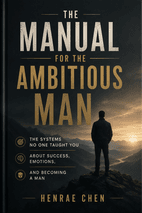
5 Main Takeaways from The Manual for the Ambitious Man
Master the toggle between independence and belonging.
The book argues that Western individualism and Eastern collectivism are both incomplete. True mastery means becoming fiercely independent so you can serve your community effectively, toggling between agency and communion as needed.
Your body and silence are non-negotiable foundations.
Without morning sunlight, movement, and ten minutes of daily silence, mental clarity suffers. Unprocessed emotions live in your body; stillness allows them to pass so you're not ruled by the past.
Stop chasing borrowed dreams by interrogating your desires.
Use the Ikigai framework, the 30-Day Evidence Method (tracking energy delta), and a Vivid Vision in present tense. Reframe goals from avoidance to 'Towards' and break them into 12-month and 90-day sprints with no more than three priorities.
Contribution is the logical next step after sovereignty.
Accumulation without contribution is a fortified prison. Build infrastructure that outlasts you, be a net-positive force, and force everyone in your proximity to elevate through your standard.
Letting go of trauma is a choice to stop collecting grains.
The real tragedy isn't the initial hurt but the decision to revisit it until it becomes identity. Use the double breath and stillness to feel emotions to zero, then choose not to pick up the grain.
Executive Analysis
The five takeaways map a progression from foundational self-mastery to transcendent contribution. The book argues that ambitious men must first reclaim their bodies and minds from cultural defaults and emotional baggage, then interrogate their desires to ensure they pursue their own dreams. Only after building this sovereign foundation can they evolve into net-positive contributors who elevate their communities and build lasting systems. Meanwhile, the epilogue reveals that letting go of trauma is a daily choice to stop reinforcing a false identity. Together, these takeaways form a cyclical practice of becoming independent so you can serve.
This book matters because it bridges the gap between personal development and meaningful legacy, offering concrete tools like the 30-Day Evidence Method, the Vivid Vision, and the double breath for emotional processing. It challenges both Western hyper-individualism and Eastern collectivist pressures, giving readers a flexible framework to toggle between modes. In a genre often dominated by vague inspiration, 'The Manual for the Ambitious Man' provides a rigorous, embodied system that demands action. For anyone feeling stuck between ambition and emptiness, this book offers a path to become both powerful and generous.
Chapter-by-Chapter Key Takeaways
The Framework (Chapter 1)
Every moment offers a choice between Self, Tribe, or Truth—but most people never realize they're choosing.
Agency and Communion are the two fundamental drives; neither works well alone.
The Western ideal of independence can lead to isolation; the Eastern ideal of belonging can hold you back.
Mastery means becoming fiercely independent so you can serve your community—not despite that strength, but because of it.
Your culture's default setting is not your destiny; you can learn to toggle between modes.
Try this: Toggle between independence and interdependence by consciously choosing Self, Tribe, or Truth in each moment, recognizing that your culture's default is not your destiny.
The Most Essential Action (Chapter 2)
Your body comes first. Morning sunlight, a short walk, and awareness of posture reset your nervous system. Without this base, mental clarity suffers.
Silence is a prerequisite for self-knowledge. Ten minutes daily of quiet, non-stimulated space allows you to notice emotions before they hijack your actions.
Feedback is data, not an attack. Ask trusted people for honest observations, thank them, and reflect during silence. Defensiveness is normal—practice receiving without reacting.
Unprocessed emotions don’t disappear. They live in your body until you give them space to move through. Use the double breath and stillness to feel them to zero. That’s how you stop being ruled by the past.
Try this: Reset your nervous system each morning with sunlight and a walk, then practice ten minutes of silence to notice emotions before they hijack you, and receive feedback as data without defensiveness.
Borrowed Dreams (Chapter 3)
Chasing external goals with rotten intentions (envy, validation, anger) leads to emptiness even after “winning.”
Your finite time means you cannot afford to live someone else’s design. Interrogate your desires until you hit the core truth.
The Ikigai framework helps you find work that overlaps passion, skill, demand, and market—but it must be tested against real behavior, not theory.
The 30-Day Evidence Method tracks energy delta (before vs. after) to reveal what actually charges you, not what sounds impressive.
A Vivid Vision written in present tense gives your momentum direction, turning a hobby into a purpose.
Character is the price of admission. You must become the person whose habits, skills, and resilience match the destination.
Motion ≠ progress; you need specific, measurable coordinates for your brain to lock onto.
Reframe every goal from avoidance (running from fear) to “Towards” (moving toward capability).
Break your vision into 12-month and 90-day horizons, with no more than three priorities per sprint.
Write goals in present tense and set mile markers to track progress before the deadline.
Non-negotiables are the floor, not the ceiling. Focus on Health, Wealth, and Relationships—one rule each.
A boundary without a consequence is just a suggestion; pre-decide your response to violations.
Try this: Test your desires against reality using the 30-Day Evidence Method by tracking energy changes, then write a Vivid Vision in present tense and break it into 12-month and 90-day sprints with non-negotiables and enforced boundaries.
Stage 4: Contribution (Chapter 5)
The fatal flaw of the Western individualist lens is that it stops at the self; accumulation without contribution is just a fortified prison.
True contribution is not guilt-driven "giving back"; it's the logical evolution of a sovereign individual plugging back into the grid as a power source.
The ultimate metric: be a net-positive force. Create more value than you extract. Force everyone in your proximity to elevate through your own standard of execution.
Build infrastructure that outlasts you—a business, a family, an idea—so the work continues beyond your biological timeline.
The final litmus test: look at your life and ask honestly—are you adding, or are you subtracting?
Try this: Shift from accumulation to contribution by evaluating whether you're a net-positive force, building systems that outlast you, and forcing everyone in your proximity to elevate through your standard.
Next chapter: “Epilogue” is locked
Keep learning from The Manual for the Ambitious Man — and unlock all 600+ book summaries with audio, mindmaps and AI Q&A.
$0.00 due today · 7 days free, then $89.99/year ($7.49/mo) · Cancel anytime before day 7
plus sales tax where applicable