The Manual for the Ambitious Man Quotes
by Henrae Chen
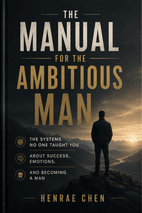
This collection pulls from a book that doesn't pander. Every line is a cold drink of water for anyone tired of soft advice. You will find sharp observations about solitude, discipline, and the traps of success. The author writes with the clarity of someone who has been through the fire and isn't interested in comforting lies.
What makes these quotes stick is their refusal to be neat. They acknowledge the cost of ambition, the weight of your own choices, and the strange relief that can come from surrender. They are not feel good slogans. They are tools for thinking, meant to be chewed on and argued with.
Top Quotes from The Manual for the Ambitious Man
“The "Self-Made Man" often builds a massive castle only to realize no one else lives there.”
This appears in the section contrasting Western independence with Eastern belonging.
It vividly captures the loneliness that can accompany extreme individualism, making the abstract risk of isolation feel tangible and relatable.
“You must be strong enough to stand alone so that you are strong enough to hold others up.”
This concludes the section on mastering Agency and Communion.
It provides a memorable, actionable reversal of typical self-reliance tropes, reframing personal strength as a foundation for service to others.
“Time does not heal what you refuse to feel.”
The author recalls a breakdown during a feedback session where a buried childhood memory surfaced.
This line challenges the common myth that time alone heals wounds, urging active emotional processing. Its poetic brevity makes it stick in the reader's mind.
“Your life is valuable because it ends. Because you have an expiration date, you cannot afford the luxury of living a life that was designed by someone else.”
The author argues that mortality gives life value and urgency.
It reframes death not as a tragedy but as a motivator to live authentically, urging readers to reject borrowed dreams.
“You build discipline the same way you build muscle. You do not think your way there. You act your way there.”
The author explains that closing the gap between vision and reality requires repeated action, not just intention.
The analogy makes the abstract concept of discipline tangible and actionable, reinforcing that change comes from doing, not wishing.
“Your environment is the ultimate leverage point. Willpower is a finite resource; environment is a constant force.”
The author introduces the concept that surroundings shape behavior more than sheer willpower.
It reframes success as a function of external conditions rather than internal grit, giving readers a tangible, often overlooked lever for change.
“Money is not a god. It is not a status symbol, but simply stored energy. A tool used to buy the only resource that cannot be manufactured: time.”
The author explains his perspective on money as stored energy.
It reframes money from a status symbol to a tool for buying time, which is a powerful insight that resonates with ambitious readers seeking freedom.
Themes Behind the Quotes
A central theme is the tension between self reliance and connection. The quotes argue that true strength starts with the ability to stand alone, but that isolation becomes a prison if you never use that strength to support others. Ambition is not just about building an empire, but about building yourself into something that can serve a larger purpose.
Another thread is the importance of honest self assessment and action. The book rejects passive waiting and digital escapism. It insists that growth comes from confronting discomfort, managing your environment, and treating your body and time as your most fundamental resources. Success is framed not as a status symbol, but as a byproduct of disciplined execution and the courage to design your own life.
Quotes by Chapter
The Framework
“A wall is only as strong as its stones, and a stone is only useful if it is part of a wall.”
This is used to illustrate the complementary relationship between Agency and Communion.
The simple, balanced analogy elegantly conveys that individual strength and collective belonging are interdependent, not opposing forces.
The Most Essential Action
“There is a strange relief in totally giving up.”
The author describes feeling depressed and finding comfort in doing nothing.
This line captures the paradoxical comfort of surrender, acknowledging a universal human experience of exhaustion. It resonates because it validates a feeling many are afraid to admit.
“Your body is the base of everything. When it is off, your mind usually follows.”
After recovering from depression by getting sunlight and walking, the author reflects on the mind-body connection.
It distills a profound truth into simple words, reminding readers that physical health underpins mental clarity. The directness makes it memorable and actionable.
“You cannot build a future if you are constantly sabotaging the present.”
After telling the story of throwing chocolate milk in anger, the author explains the need for emotional control.
This insight highlights how impulsive actions derail long-term goals, striking a chord with anyone who has self-sabotaged. It frames self-discipline as foundational to ambition.
Borrowed Dreams
“I had won the game, but I lost the prize.”
The author describes achieving his financial goal only to feel empty and blow the money.
This line captures the hollow victory of pursuing external goals without inner purpose, a powerful warning against mistaking achievement for fulfillment.
“Figure out what is true for you. There is no right or wrong. It could be a quiet life on a farm growing fresh food, or it could be building an empire in the city. Neither is better. Only one is yours.”
The author guides readers to discover their own desires rather than comparing themselves to others.
This passage liberates readers from societal pressure by validating diverse paths and emphasizing personal authenticity over status.
The Price Paid
“The risk of the street was simply better than the guarantee of a wasted life.”
The author reflects on his decision to risk homelessness rather than stay in a dead-end job.
This line encapsulates the extreme trade-off between fear of failure and the certainty of regret, making it a powerful call to action for anyone facing a similar crossroads.
“You cannot conquer reality when your brain is continually satisfied by a digital illusion.”
The author explains why pornography undermines ambition and real-world drive.
This stark metaphor captures how artificial gratification siphons masculine energy and motivation, making it a memorable warning against digital escapism.
Stage 4: Contribution
“That isn't power; that is just a heavily fortified prison.”
The author contrasts the scarce man's defensive accumulation with true power.
This line uses a stark metaphor to expose the illusion of security in hoarding, resonating with ambitious readers who seek genuine freedom.
“True contribution is the evolution of that lens. It is taking the indestructible individual you have built and plugging it back into the grid as a power source.”
The author explains the shift from selfish foundation-building to meaningful contribution.
The vivid imagery of plugging an indestructible self into the grid as a power source powerfully redefines contribution as an act of strength, not charity.
“A man of substance doesn't "give back" out of guilt or vanity. He does it because it is the ultimate expression of scale.”
The author describes the authentic motivation behind true contribution.
This reframes giving as an expansion of impact rather than a moral obligation, appealing to those who view life through ambition and leverage.
“It means setting a benchmark of execution so absolute that it forces everyone in your proximity to elevate.”
The author defines the standard of becoming a net-positive force.
This challenges readers to lead by example and lift others through sheer uncompromising quality, making it a rallying cry for high performers.
Epilogue
“The tragedy isn't that the world offered me this poison; the tragedy is that I keep indulging in it.”
The author explains that the real harm comes from repeatedly choosing to consume the bitterness of past hurts.
It reframes victimhood as an act of self-sabotage, empowering readers to recognize their own agency in perpetuating pain.
“My innocence didn't die because the world killed it; it died because I poisoned it with the memories of things I should have let fall to the floor.”
Near the end of the epilogue, the author concludes that innocence is lost through internalizing rather than releasing small wounds.
This line resonates because it places the locus of control back on the individual, offering a path toward healing by simply letting go.