Chapter 1: Greater Ambition—Engineering Your 100x Future
Chapter 1 of 4
0:000:00
EN
1x
Voice
PDF
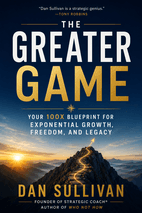
The Greater Game
by Dan Sullivan
What is the book The Greater Game about?
Dan Sullivan's The Greater Game provides a ten-multiplier framework for successful entrepreneurs to achieve exponential 100x growth by architecting self-managing teams, intellectual property, and collaborative ecosystems. Written for founders of $50M+ businesses who feel trapped by their own success and want to break free from the expertise trap.
Feature
Insta.Page
Blinkist
Shortform
The Greater Game
✓
✕
✕
Summary Depth
Full Chapter-by-Chapter
15-min overview
Section-by-section guides
Audio Narration
✓
✓
✓
Visual Mindmaps
✓
✕
✕
AI Q&A
✓
✕
✕
Quizzes
✓
✕
✕
PDF Downloads
✓
✕
✓
Price
$89.99/yr
$146/yr (PRO)
$199/yr
*Competitor data last verified July 2026.
1 Page Summary
The central thesis of The Greater Game is that true entrepreneurial fulfillment and exponential success come not from incremental optimization, but from a fundamental architectural shift in how you approach ambition, security, and growth. Dan Sullivan argues that 94.6% of entrepreneurs are trapped playing a "2x game" of incremental improvement, which leads to burnout and diminishing returns. In contrast, the 5.4% who achieve exponential "100x" results operate from a different mindset, treating success not as a destination but as a launchpad. The book is built around the "Greater Game Pyramid," which progresses through ten multipliers: from engineering a 100x future and building a secure foundation, to generating internal motivation and systematizing genius into intellectual property, and ultimately to creating new markets, practicing strategic stubbornness, and using fear as a compass.
Sullivan’s approach is distinctive for its focus on architectural design over sheer effort. Rather than prescribing harder work, the book provides a framework for building self-managing teams, intellectual property platforms, and collaborative ecosystems that scale automatically. It confronts the hidden costs of being irreplaceable—revealing that founder-dependence can cost tens of millions in exit value—and offers a four-stage "Autonomy Ladder" to move from operator to creator. Each chapter is grounded in data from the Greater Multipliers Study of over 1,000 entrepreneurs, contrasting the behaviors and outcomes of the 5.4% with the rest, and uses real-world examples of leaders who have successfully implemented these principles.
The intended audience is successful entrepreneurs who have achieved significant revenue (often $50 million or more) but feel that the game has become too small or that their business has become a "prettier prison." These readers are experiencing a paradox of success: they have won by every conventional metric, yet feel restless, indispensable, and constrained by their own operations. From the book, they will gain a systematic blueprint to break free from the "expertise trap," build businesses that thrive without their constant involvement, and ultimately shift from optimizing a job to designing a legacy and a market. The core promise is that aiming for 100x is, paradoxically, easier and more freeing than grinding for 2x.
Chapter 1: Greater Ambition—Engineering Your 100x Future
Overview
The most dangerous assumption in entrepreneurship is that success is a destination. The restlessness you feel on Monday morning—when every metric says you’ve won but the game feels too small—isn’t burnout. It’s expansion trying to break through. The entrepreneurs who reshape entire industries share a hidden allergy: they are allergic to arrival. They treat success not as a finish line but as a launchpad, and they operate from a fundamentally different architecture than the 94.6% who optimize their way to incremental gains. Data from the Greater Multipliers Study of 1,016 entrepreneurs shows that only 5.4% play the game of greater ambition—and they consistently outpace everyone else because they aim for 100x, not 2x.
The Monday Morning Paradox and the 5.4%
Every successful entrepreneur knows this paradox: you’ve hit your goals, your team is solid, competitors respect you—yet the game feels too small. That discomfort is the signal that your current ceiling is actually your future floor. Sam Walton didn’t stop at 500 stores; he was already planning 5,000. Steve Jobs didn’t think about saving Apple in 1997; he imagined putting 1,000 songs in your pocket. The data backs this up: among entrepreneurs generating $50 million or more, 28.1% maintain an unwavering 25-year vision commitment, versus only 11.3% of those under $10 million. The 5.4% share six characteristics—visionary, resilient, growth-oriented, action-oriented, confident, resourceful—that drive exponential results.
The Three Forces Reshaping the Decade
Your success has become your liability. Three converging forces will determine who wins the next decade. First, AI is commoditizing execution advantages—your operational excellence is now table stakes. Second, an estimated $124 trillion is transferring to younger generations who fund moonshots, not maintenance. Third, the market now rewards category creation (Uber, Airbnb, Tesla) with premium multiples, while category competitors scrape by at 3-5x. The only remaining moat is vision—the ability to see and create what doesn’t yet exist. If you are competing on execution, you have already lost.
The Paradox: 100x Is Easier Than 2x
Here’s the central counterintuitive insight: aiming for 2x growth means working harder within existing constraints—exhausting and linear. Aiming for 100x forces you to abandon your current model entirely. You build platforms, not products. You design ecosystems, not organizations. Over time, this architectural approach requires less effort because the systems scale without you. This is "the paradox of the greater game," and it’s the entry point to the 5.4%.
Four Transformations: From Operator to Architect
Four case studies show different paths from optimization to architecture:
Roderick Walker ran two care facility locations, working 70-hour weeks. His breakthrough came when he stopped asking "How can I work harder?" and started asking "How can I architect a system where my effort is irrelevant?" He created 147 operational checklists, real-time dashboards, and a standardized launch process. Result: 650% revenue growth, from 2 to 14 locations, and a drop from 70 to 25 weekly hours. Now he's building a platform that turns competitors into customers.
Paul VanDuyne was ready to retire at 65 until a question changed everything: "What would you accomplish if you had 25 more years to live?" That 25-year horizon transformed IMEG from a regional firm into a $1.2 billion engineering platform with a 20-person M&A machine, 56 successful acquisitions, and zero layoffs during COVID. Revenue went from $50 million to $600 million in 10 years.
Jonathan Cotten admitted he wasn’t good at operations, technology, or management. Instead of seeing these as weaknesses, he used them as a blueprint for building bulletproof processes anyone could execute. His constraints became liberation. From 2021 to 2024, he grew from $19 million to $68.6 million, from a handful of stores to 42. His insight: "Being responsible for forty-two stores is far easier than having four."
Jeff Bezos shows what happens when you layer impossible ambitions. From selling books in a garage to the Everything Store to AWS to Blue Origin, each level funded the next. The progression from books to space wasn't a distraction—it was architecture. As Bezos put it, the only way to deploy such fortune was by converting Amazon winnings into space travel.
These four stories reveal the same pattern: hit a success ceiling, have a perspective shift (question or crisis), abandon optimization for architecture, create multiplying systems, and use the resulting freedom to pursue even bigger games.
Breaking Through the Four Psychological Barriers
The chapter identifies why 94.6% stay trapped in optimization. The impostor voice ("Who am I to think this big?") is reframed as a decision, not a destiny. The failure forecast ("What if I aim for 100x and only achieve 10x?") misunderstands that the architecture for 100x inherently makes 10x inevitable. The comfort calculation ("I'm already successful, why risk it?") is countered by the fact that 52% of the Fortune 500 from 2000 no longer exist. And the resource restriction ("I don’t have the capital/team/time") is flipped: greater ambition attracts resources, it doesn't require them first.
The Five-Stage Activation Framework
The chapter provides a concrete progression: Recognition (identify where exponential opportunity is hiding), Amplification (expand from linear to exponential thinking), Architecture (design systems that multiply without you), Activation (launch your first exponential experiment in 90 days), and Acceleration (compound multipliers systematically through quarterly reviews and daily strategic focus). Each stage builds on the last, turning vision into architecture.
Your Ambition Audit and Activation Plan
The chapter includes a quick audit: if you could be bought out tomorrow and feel relieved, if you're solving the same problems as five years ago, or if you're indispensable to daily operations, you don’t have a business—you have a costly job. The activation plan breaks into concrete actions: this week, list moments when success felt too small and identify problems you solve that thousands face. Next 30 days, join a mastermind and share your 100x vision. Next quarter, choose one process to multiply through systems and remove yourself from one critical function.
The Bridge to Greater Security
The chapter closes by setting up the next one: ambition without protection is delusion. The 5.4% understand that greater ambition requires greater security—not as a brake, but as a launchpad. Your next 25 years aren’t a continuation of the last 25. They’re an architectural project, and you’ve just drawn the first blueprint.
Key Takeaways
Success is not a destination; it’s a platform for bigger games. The entrepreneurs who reshape industries are allergic to arrival.
Only 5.4% operate with greater ambition—they aim for multiplication, not optimization. This is the difference between 2x and 100x.
100x is actually easier than 2x because it forces you to abandon your current model and build systems that scale without you.
Three forces are commoditizing execution: AI, the generational wealth transfer, and the category creation premium. Vision is the only remaining moat.
Four transformational entrepreneurs—Walker, VanDuyne, Cotten, Bezos—each abandoned optimization for architecture, achieving exponential results while reducing their own effort.
The four psychological barriers (impostor voice, failure forecast, comfort calculation, resource restriction) can be dismantled by reframing ambition as a decision, not a destiny.
The Five-Stage Activation Framework (Recognition → Amplification → Architecture → Activation → Acceleration) provides a repeatable path from dreaming to architectural reality.
Start immediately: list problems you solve repeatedly, write your 25-year headline, and remove yourself from one critical function within the next quarter.
Key concepts: Chapter 1: Greater Ambition—Engineering Your 100x Future
1. Chapter 1: Greater Ambition—Engineering Your 100x Future
The 5.4% Mindset
Success is a launchpad, not a finish line
Allergic to arrival—always expanding
Six characteristics drive exponential results
Only 5.4% play the greater ambition game
Three Forces Reshaping the Decade
AI commoditizes execution advantages
$124 trillion transfers to moonshot funders
Market rewards category creation, not competition
Vision is the only remaining moat
The 100x Paradox
2x means harder work within constraints
100x forces abandoning current model
Build platforms and ecosystems, not products
Architectural approach requires less effort over time
Four Transformations: Operator to Architect
Roderick Walker: 650% growth with fewer hours
Paul VanDuyne: 25-year horizon built $1.2B platform
Jonathan Cotten: Weaknesses became bulletproof processes
Jeff Bezos: Layered impossible ambitions from books to space
Four Psychological Barriers
Impostor voice is a decision, not destiny
Failure forecast: 100x architecture ensures 10x
Comfort calculation: 52% of Fortune 500 vanished
Resource restriction: Ambition attracts resources first
Five-Stage Activation Framework
Recognition: Find exponential opportunity
Amplification: Shift from linear to exponential thinking
Architecture: Design systems that multiply without you
Activation: Launch first experiment in 90 days
The Monday Morning Paradox
Success feels too small—that's expansion breaking through
Current ceiling is your future floor
28.1% of $50M+ entrepreneurs have 25-year vision
Sam Walton planned 5,000 stores from 500
💡 Try clicking the AI chat button to ask questions about this book!
Chapter 2: Greater Security—the Foundation That Makes Everything Possible
Overview
Most entrepreneurs treat security like a brake pedal—something that limits how aggressively they can move. But a small group understands a different truth: greater security acts as a launchpad. It gives you permission to pursue big growth because you know the foundation won't crack. This isn't about building walls; it's about building springboards. A massive shift is underway, with nearly 60% of entrepreneurs planning to change their primary financial advisor within the next two years—not because their advisors are incompetent, but because those advisors are stuck in a fragmented, product-focused model while entrepreneurs need coordinated support. The next 18 months will determine whether you're building on sand or stone, and the gap between disconnected specialists and a coordinated virtual family office is costing millions in overlooked opportunities and unnecessary risk.
The data reveals a stark divide: only about one in five typical entrepreneurs feel secure enough to consistently pursue significant opportunities, while among the top group, that number jumps to nearly 60%. The difference isn't luck—it's design, and it shows up in three primary areas. Structural diversification means forming capital-efficient joint ventures, using C corps and LLCs to isolate risk, and repeating until concentration risk nearly vanishes—as Scott Akerley demonstrated by building over 30 companies where every additional venture didn't add risk but divided it, leading to a nine-figure exit. IP protection means building defensible moats through patented algorithms and technical IP worth more than inventory, as Katrina Lake showed when she turned $5,000 in savings into a $1.1 billion public company by building protection before revenue existed. Organizational strength means treating people not as an expense that increases overhead risk but as investments that decrease it, as Jennifer Borislow proved when her 80-person team transitioned seamlessly through COVID-19 and enabled her to sell her firm without losing value.
The Invincibility Audit strips away any illusion of safety by exposing two dangerous gaps: concentration risk and the coordination gap. If the value of your primary business exceeds half of your total net worth, you're highly vulnerable—over 80% means you are one disruption away from starting over. If your CPA, estate attorney, insurance specialist, and investment advisor haven't met together to coordinate your strategy within the last 90 days, you don't have a team—you have a collection of uncoordinated vendors. And that one risk that keeps you up at night and hasn't been addressed? That vulnerability, left unchecked, can bring everything down. Security isn't abstract—it's measurable. The Scorecard lets you rate yourself from 1 to 12 across key categories, with total scores revealing whether you're vulnerable, protected but likely with coordination gaps, or reaching the top standard of invincibility. The Dashboard Integration turns that score into a gap analysis that identifies exactly where you're exposed and recommends your highest-leverage path forward.
But here's the paradox most people never discover: a perfect foundation isn't the destination—it's the platform for your real game to begin. You've done everything right. Ambition is clear. Security is bulletproof. So why does success feel like a reckoning? The problem is this: the more you optimize, the less you feel. You eliminated the external threats that fueled your climb, but in their absence, you lost your internal fire. Invincibility without energy is just stagnation. Most people are trapped in a cycle where success requires more effort, effort creates exhaustion, exhaustion kills creativity, less creativity means working harder, harder work accelerates burnout, and burnout destroys value. You're not tired because you're working too hard—you're exhausted because you're drawing energy from the wrong source. The top group operates from a different engine: one where purpose creates energy, energy fuels innovation, innovation becomes intellectual property, IP multiplies value, and value enables purpose, which regenerates energy. You don't need more time off. You need a different engine entirely.
The stakes are real. Perfect systems run by depleted founders eventually fail. Brilliant expertise trapped in one person's head dies with them. Secure empires without energy become expensive museums. Protected wealth without purpose becomes a gilded cage. Your spouse has stopped asking how your day was because they see the exhaustion in your posture. Your kids have learned that successful means absent. Success without regenerative energy isn't success at all—it's a slow loss of everything that matters. Stage 2 offers a different path: Greater Motivation isn't positive thinking—it's the systematic design of self-generating energy, the discovery that mission multiplied by margin creates a force that attracts top talent and sustains you for decades. Greater Property isn't just intellectual property—it's the escape from the expertise trap, transforming your invisible genius into visible, scalable assets that earn while you sleep. Together they create something most people never achieve: energy that multiplies into assets, which in turn multiply into freedom. The foundation is built. Now it's time to power the machine.
Key Takeaways
Concentration risk above half signals vulnerability; above 80% means one disruption from disaster
If your advisory team hasn't coordinated within 90 days, you have vendors, not a real team
The cycle of effort leading to exhaustion, burnout, and value destruction is a choice, not a requirement
Energy isn't found—it's engineered through purpose, not external validation
Every solution you haven't documented is an asset left on the table
The self-generating engine: purpose creates energy, energy fuels innovation, innovation becomes IP, IP multiplies value, value enables purpose
Key concepts: Chapter 2: Greater Security—the Foundation That Makes Everything Possible
2. Chapter 2: Greater Security—the Foundation That Makes Everything Possible
Security as a Launchpad
Security enables aggressive growth, not limits it
60% of entrepreneurs plan to change advisors
Fragmented advisors cost millions in missed opportunities
Top group feels secure pursuing opportunities (60% vs 20%)
Structural Diversification
Use joint ventures, C corps, and LLCs to isolate risk
Scott Akerley built 30 companies dividing risk
Each venture reduces concentration risk
Resulted in a nine-figure exit
IP Protection
Build defensible moats with patented algorithms
Technical IP worth more than inventory
Katrina Lake turned $5,000 into $1.1 billion
Built protection before revenue existed
Organizational Strength
Treat people as investments, not expenses
Jennifer Borislow's 80-person team thrived through COVID
Team enabled seamless firm sale without value loss
People decrease overhead risk
Invincibility Audit
Concentration risk: business >50% net worth is vulnerable
Coordination gap: advisors must meet every 90 days
Unaddressed risks can bring everything down
Security is measurable, not abstract
The Energy Paradox
Perfect foundations can kill internal fire
Success without energy is stagnation
Top group uses purpose to generate energy
Energy fuels innovation, IP, and value cycle
Stage 2: Motivation and Property
Greater Motivation: systematic self-generating energy
Greater Property: escape expertise trap
Transform invisible genius into scalable assets
Energy multiplies into assets and freedom
Chapter 3: Greater Motivation—Engineering Your Self-Generating Success Engine
Overview
Imagine this: you’ve won. The business is a rocket ship, the numbers are staggering, and everyone wants your advice. Yet Monday morning feels less like a launch and more like a funeral. This isn’t burnout in the usual sense. It’s a far more insidious crisis: you’ve optimized yourself into meaninglessness. The very success you built has become a prettier prison. The problem isn’t a lack of energy—it’s that you’re drawing from the wrong source. You’ve been running on external fuel (money, status, validation) which comes with diminishing returns. The real unlock isn’t finding motivation; it’s engineering a system that generates it perpetually from within.
The Hidden Cost of External Fuel
The data is clear, and it’s brutal. An internal motivation isn’t a soft, feel-good attribute; it’s the single biggest hard asset you can own. The 5.4% of entrepreneurs who generate motivation from inside themselves don’t just feel better—they perform exponentially better, commanding higher EBITDA multiples and attracting top talent who are starving for meaning.
The problem for the other 94.6% is they are trapped on the hedonic treadmill, requiring ever-bigger hits of success to feel normal. Worse, this energy deficit is visible. Private equity buyers can literally smell your exhaustion during due diligence. A founder running on fumes is a "burned-out seller," and their valuation gets slashed by 30-40%. They aren’t buying your past performance; they are buying your future energy.
The Second Paycheck: Mission x Margin
The solution lies in a powerful distinction made by David Reiling, who transformed a failing bank into a $2.5 billion powerhouse. He stopped chasing Paycheck 1 (financial) and started architecting his life around Paycheck 2 (emotional—meaning, impact, internal generation).
He didn’t choose between purpose and profit; he multiplied them. The formula is Mission x Margin. Most people try to balance these two things, which leads to stagnation. The 5.4% integrate them so completely that they become one self-reinforcing engine. This isn’t just about feeling good; it creates a magnetic pull for A-level talent who will take a pay cut to receive that emotional paycheck.
Engineering the Flywheel, Not Finding Willpower
Motivation isn’t a feeling you chase; it’s an architecture you build. You need a self-generating success engine, a flywheel that ensures every success creates more energy, not less.
The blueprint works like this:
Purpose Clarity: Define your Mission x Margin formula.
Unique Ability Work: Focus only on what generates your highest energy and value.
Codify into IP: Turn your innovations into scalable systems.
Attract A-Players: Let your purpose be the magnet for talent.
Achieve Greater Purpose: Let success reinforce your mission.
Deeper Clarity: Use that success to refine your purpose for the next cycle.
This isn’t about willpower; it's about eliminating drains and amplifying generators. The first step is a brutal Energy Audit—identifying what drains you and committing to delegating or destroying it starting Monday.
Key Takeaways
Your energy is your enterprise value. A founder’s internal motivation is the single most valuable asset. Exhaustion is a discount.
Stop chasing Paycheck 1. You cannot power a rocket ship with an AA battery. Focus on the emotional paycheck (meaning, impact, purpose).
Multiply, don’t balance. The formula is Mission x Margin. When purpose and profit are integrated, they become a self-feeding cycle.
Engineer the architecture. Don't rely on willpower. Build a flywheel that uses success to generate more energy, not deplete it.
Do the Energy Audit. Track what drains you and what energizes you. Your job for the next quarter is to systematically eliminate the drains and amplify the generators.
Key concepts: Chapter 3: Greater Motivation—Engineering Your Self-Generating Success Engine
3. Chapter 3: Greater Motivation—Engineering Your Self-Generating Success Engine
The Crisis of External Fuel
Success can create a prettier prison of meaninglessness
External fuel (money, status) has diminishing returns
94.6% of entrepreneurs are trapped on the hedonic treadmill
Exhaustion visible to buyers slashes valuation by 30-40%
The Second Paycheck: Mission x Margin
Stop chasing Paycheck 1 (financial) alone
Architect life around Paycheck 2 (meaning, impact)
Formula is Mission x Margin, not balance
Integration creates magnetic pull for A-level talent
Engineering the Self-Generating Flywheel
Motivation is architecture, not a feeling to chase
Purpose clarity defines your Mission x Margin formula
Focus on Unique Ability work for highest energy
Codify innovations into scalable IP systems
The Flywheel Cycle
Attract A-Players through purpose magnetism
Achieve greater purpose to reinforce mission
Use success to refine purpose for deeper clarity
Every success creates more energy, not less
The Energy Audit
Your energy is your enterprise value
Track what drains vs. energizes you
Systematically eliminate drains starting Monday
Amplify generators to power the flywheel
Chapter 4: Greater Property—Your Genius Becomes Your Empire
Overview
The late-night math is brutal: $20 million in revenue, a $4 million EBITDA, and yet the business would crater by 70% if you stepped away for six months. You haven’t built an asset; you’ve built an elaborate $20 million job where you’re both warden and inmate. Meanwhile, competitors are selling at 8x, 12x, even 15x EBITDA because they stopped selling time and started selling systems. They turned their expertise into intellectual property that multiplies without them, while your brilliance dies the moment you leave the room.
This is the expertise trap—the paradox that snags 94.6% of successful entrepreneurs. The very knowledge that built your success becomes your biggest liability. Three delusions keep you stuck: that your expertise is too complex to package, that sharing secrets makes you obsolete, and that you have no time to document processes. But the market doesn’t reward effort—it rewards architecture. Founder-dependent businesses fetch 3–5x EBITDA; systematized operations get 8–12x; and IP-driven platforms in the 5.4% zone command 15–30x. On a $4 million EBITDA business, that’s the difference between a $16 million exit and an $80 million exit. Your indispensability is costing you $64 million.
Three architects prove the path. Keegan Caldwell shifted from practicing law to architecting the practice of law, building proprietary algorithms and a tech platform that cut lawyer work time by nearly 50%, boosting patent approval to 94% and revenue by 341%. John Kissell spent 48 years codifying fleet maintenance into standard operating procedures; when a sudden illness hospitalized him with 5% survival odds, his business ran itself and actually grew. Sasa Krcmar saw value where others saw junk—buying 29 companies not for their clients but for their copyrighted survey data, digitizing two million plans into a platform that now generates revenue around the clock. None of them had more expertise than you; they simply architected it differently.
The shift is from expert to architect. Experts solve problems; architects build systems that solve problems. Experts trade time for money; architects build assets that generate money. Experts are indispensable; architects are invincible. The 5.4% systematically extract and monetize their IP through a five-phase blueprint: a Brilliance Audit to find where your IP hides, Process Codification to turn invisible know-how into repeatable tools, Strategic Protection to build a legal moat, Multiplication Architecture to design revenue systems that don't need you, and Market Validation to test and iterate.
The choice is yours: continue trading time for money, stuck at 3–5x multiples, or become an architect commanding 15–30x multiples. The brilliance is already there. The systems are waiting to be built. And the bridge to Stage 3 begins with a single, almost absurdly simple act: one phone call on a Tuesday afternoon to a biggest adversary. That call marks the start of a metamorphosis from fighter to multiplier. Read these stories not as isolated cases but as a liberation sequence—a specific architectural order for turning yourself from the indispensable bottleneck into the invincible architect. The only thing standing between you and that transformation is one Monday-morning question: Will you continue being the indispensable hero who saves the day, or will you become the invincible architect who makes heroes unnecessary? The engine is built. The fuel is flowing. The vehicle is ready. All that remains is to turn the key—and let it multiply without you.
Key Takeaways
Scaling starts with a single, deliberate action—not a grand strategy. One phone call. One shift in mindset.
Read the stories as a liberation sequence rather than isolated examples. They form a step-by-step blueprint for becoming the architect.
The indispensable hero is the bottleneck. The invincible architect builds a system that doesn’t need heroics.
The vehicle is ready. The final obstacle isn’t the system itself, but your willingness to let it run without you.
Key concepts: Chapter 4: Greater Property—Your Genius Becomes Your Empire
4. Chapter 4: Greater Property—Your Genius Becomes Your Empire
The Expertise Trap
Your indispensability costs you millions in valuation
Founder-dependent businesses fetch 3-5x EBITDA
IP-driven platforms command 15-30x multiples
Three delusions keep you stuck in this trap
From Expert to Architect
Experts solve problems; architects build systems
Experts trade time; architects build assets
Experts are indispensable; architects are invincible
The 5.4% zone achieves 15-30x multiples
Three Architects Who Proved the Path
Keegan Caldwell built algorithms cutting lawyer work 50%
John Kissell's SOPs let business grow during his illness
Sasa Krcmar digitized IP from 29 acquired companies
Five-Phase IP Blueprint
Brilliance Audit to find hidden intellectual property
Process Codification turns know-how into repeatable tools
Strategic Protection builds a legal moat
Multiplication Architecture and Market Validation
The Liberation Sequence
Start with one deliberate action, not grand strategy
Read stories as step-by-step architectural blueprint
The vehicle is ready; let it run without you
Choose between indispensable hero or invincible architect
You've reached the end of the free chapters
Next chapter: “Greater Community—Your Competition Becomes Your Multiplier” is locked
Keep reading The Greater Game — and unlock all 600+ book summaries with audio, mindmaps and AI Q&A.
$0.00 due today · 7 days free, then $89.99/year ($7.49/mo) · Cancel anytime before day 7
Dan Sullivan is a renowned strategic coach and author best known for creating the Strategic Coach® program. His notable works include *Who Not How* and *The Gap and the Gain*, which focus on productivity and mindset for entrepreneurs. With over 40 years of experience, Sullivan specializes in helping high-achievers maximize their focus and collaboration.
Frequently Asked Questions about The Greater Game
What is The Greater Game about?
This book presents a framework for entrepreneurs to escape the trap of incremental optimization and achieve exponential, 100x growth. Based on a study of over 1,000 entrepreneurs, it identifies the 5.4% who consistently outperform by focusing on ten key multipliers: ambition, security, motivation, property, community, teamwork, autonomy, agency, commitment, and courage. The book provides a step-by-step architecture for building self-sustaining systems, creating new markets, and turning indispensable founders into architects of scalable success.
Who is the author of The Greater Game?
Dan Sullivan is the founder of Strategic Coach, a coaching program that has worked with thousands of entrepreneurs worldwide. He has spent decades studying the mindsets and strategies that separate high-growth founders from the rest, culminating in the Greater Multipliers Study referenced throughout the book. Sullivan is known for his frameworks that help entrepreneurs break through ceilings and build businesses that thrive without them.
Is The Greater Game worth reading?
Yes, this book is essential for any entrepreneur feeling trapped by their own success—restless on Monday morning despite hitting every metric. It offers a data-backed, actionable alternative to the grind of incremental improvement, showing how to build a business that generates exponential returns while restoring personal freedom. The insights on creating intellectual property, ecosystems, and self-managing teams can dramatically increase both valuation and quality of life.
What are the key lessons from The Greater Game?
The most powerful lesson is the '5.4% principle': only a tiny fraction of entrepreneurs intentionally design for 100x growth, and they dramatically outperform those aiming for 2x. Another key is that security should be a launchpad, not a brake—building structural diversification and a virtual family office frees you to take bigger risks. The book also emphasizes that your deepest fears are actually your compass: the 5.4% run toward fear, not away from it, and they practice 'strategic stubbornness'—unyielding commitment to the destination combined with radical flexibility in the path. Finally, turning your expertise into intellectual property and building ecosystems where competitors become collaborators can multiply your company's valuation by 5x to 10x.
📚 Explore Our Book Summary Library
Discover more insightful book summaries from our collection