The Greater Game Quotes
by Dan Sullivan
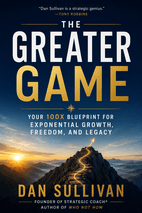
You will find lines that challenge how you think about success, ambition, and the very structure of your business. This book packs a punch because it doesn't just motivate you; it reframes your entire mindset.
The author has a gift for turning a familiar frustration into a crisp, unforgettable insight. Every quote feels like a punchy truth you wish you'd realized years ago. Expect to encounter ideas that feel both uncomfortable and liberating, the kind that stick in your head and change how you see your own path.
Top Quotes from The Greater Game
“While others celebrate reaching the summit, you're already engineering the next mountain.”
Opening line of Chapter 1, setting the theme for ambitious entrepreneurs.
It immediately captures the restless, forward-looking mindset that distinguishes breakthrough entrepreneurs from those content with success.
“The most significant risk isn't failure—it's stagnation.”
Part of the argument that the real danger is not taking bold action.
It reframes risk perception, pushing readers to see inaction as far more dangerous than failure.
“When you aim for 100x, optimization is impossible. You are forced to abandon your current model and architect something entirely new.”
Explaining the central paradox that 100x growth is easier than 2x because it forces a shift from optimization to architecture.
This encapsulates the core insight of the chapter—that radical growth requires abandoning incremental improvements for systemic redesign.
“You haven't built a $20 million asset. You've built a $20 million job—the world’s most elaborate prison, where you're both the warden and the inmate.”
The author describing the founder's realization during the $50 Million Midnight Calculation.
It vividly captures the painful irony of building a successful business that still traps the founder, making the abstract concept of 'founder dependency' visceral and memorable.
“The more you manage, the less you lead. The more you control, the less you scale.”
Part of the 5.4% insight about the paradox of leadership.
A concise, counterintuitive truth that reframes leadership from oversight to empowerment, making it instantly memorable.
“It's time to stop being the hero who saves the day and become the architect who makes heroes unnecessary.”
Call to action after explaining the dependency trap.
This line powerfully shifts the mindset from reactive problem-solving to building systems that enable others to thrive.
“In a world where execution is automated, vision becomes the only defensible moat.”
From the section revisiting the 18-month window, discussing the impact of AI on competitive advantage.
It distills the modern competitive landscape into a sharp, memorable contrast—when machines handle execution, human foresight is the last irreplaceable asset.
Themes Behind the Quotes
One major theme is the danger of arrival. Many entrepreneurs build success only to become trapped by it, mistaking their business for an asset when it is really a job that owns them. The book argues that true freedom and growth come from designing systems that work without you, not from being indispensable.
Another thread is the shift from playing the game to designing the playing field. Instead of optimizing within an old model, the most ambitious creators architect entirely new frameworks. They prioritize purpose over compensation, engineer their own motivation, and see vision as the only lasting advantage in a world that automates execution.
Quotes by Chapter
Chapter 1: Greater Ambition—Engineering Your 100x Future
“The entrepreneurs who reshape industries share this trait: They are allergic to arrival.”
From the discussion of the Monday Morning Paradox, describing the characteristic of disruptive entrepreneurs.
This memorable phrase succinctly explains why great leaders never rest on their laurels, constantly seeking the next challenge.
Chapter 2: Greater Security—the Foundation That Makes Everything Possible
“The most aggressive entrepreneurs are also the most protected. They don’t gamble—they architect certainty.”
Opening of the chapter, setting the central paradox of the 5.4% mindset.
It immediately reframes the traditional view of risk and protection, presenting security as a strategic enabler rather than a constraint.
“Greater security isn’t about protection—it's about permission.”
Part of the explanation of how the 5.4% view security as a launchpad for ambition.
This line captures the essence of the chapter's thesis: security gives entrepreneurs the freedom to pursue bold goals without fear.
“I'm not getting any of this from my CPA. I’m not getting any of this from my wealth manager. I’m not getting any of this from anybody.”
The Developer's exclamation during a joint meeting after discovering tax savings and other gaps identified through VFO coordination.
This raw, frustrated statement underscores the widespread failure of fragmented advisory systems and resonates with any entrepreneur who feels underserved.
“The 94.6% confuse complexity with security.”
Closing remark of the chapter, contrasting the majority's approach with the 5.4%'s architecture.
It's a pithy, memorable indictment of the common tendency to accumulate advisors without coordination, summarizing a key myth.
Chapter 3: Greater Motivation—Engineering Your Self-Generating Success Engine
“Without regenerative energy, your empire becomes your executioner.”
The author warns of the danger of success without internal renewal.
It captures the brutal paradox of achievement: a thriving business can crush the founder if fueled by depletion rather than regeneration.
“The entrepreneurs who build quarter-century empires don't find motivation. They engineer it.”
The author describes how the top 5.4% of entrepreneurs sustain long-term success.
This reframes motivation as a structural choice, not a lucky discovery, empowering readers to take deliberate action.
“The 5.4% don't compete on compensation; they compete on purpose.”
The author explains how David Reiling's company attracted top talent by offering meaning over money.
It distills a core competitive advantage for leaders: purpose becomes a magnet for A-players when financial rewards are no longer differentiating.
“The greatest threat to motivation isn’t failure; it’s arrival.”
The author reflects on Reed Hastings' ability to keep Netflix reinventing itself.
This counterintuitive insight warns that reaching a goal can kill the drive that got you there, urging perpetual reinvention.
Chapter 4: Greater Property—Your Genius Becomes Your Empire
“If your business depends on your presence, you don’t own an asset; you own a job.”
The Expertise Trap section explaining why most entrepreneurs remain trapped.
This is a clear, piercing definition of the core problem the chapter addresses—it reframes success as potential failure and forces the reader to question their own business structure.
“The market doesn't reward effort; it rewards architecture. It doesn’t value your time; it values your systems.”
The Valuation Evidence section contrasting founder-dependent businesses with systematized and IP-driven models.
It encapsulates the crucial shift from being a worker to being an architect, delivering a blunt truth that challenges the reader's assumptions about value creation.
“Energy without systematic capture is merely expensive enthusiasm.”
The chapter's introduction and later repeated in the bridge section.
This punchy aphorism warns that motivation alone is insufficient without IP architecture, making it a quotable reminder to convert passion into scalable assets.
Chapter 5: Greater Community—Your Competition Becomes Your Multiplier
“Your real competition isn't who you think it is. Your real competition is the belief that business must be a zero-sum game.”
The author explains the 5.4% insight about the fundamental shift needed to achieve exponential growth.
This reframes competition from a battle against others to a battle against a limiting mindset, making it both provocative and empowering for readers stuck in adversarial thinking.
“What if the exhaustion you feel isn’t from poor execution but from perfect execution of an outdated strategy?”
The author challenges the reader to reconsider the source of their burnout in the midst of competitive battles.
It delivers a startling reframe that turns exhaustion from a sign of failure into a signal of strategic misalignment, prompting deep self-reflection.
“When you build the ecosystem, you become the inevitable beneficiary of its growth.”
The author summarizes the payoff of strategic generosity and ecosystem architecture.
It succinctly states the ultimate reward of collaboration — not just survival, but becoming central to value creation — making it a powerful call to action.
Chapter 6: Greater Teamwork—from Managing People to Multiplying Genius
“You've built a $60 million prison where you're simultaneously the warden, the architect, and the only inmate who can't leave.”
Describing the founder's trap of being irreplaceable and overburdened.
This vivid metaphor captures the painful paradox of success: building a valuable enterprise that ultimately imprisons you.
“Your indispensability is costing you $80 million.”
Explaining the indispensability discount using a $10 million EBITDA example.
A shocking, concrete financial figure that drives home the high cost of remaining a bottleneck.
Chapter 7: Greater Autonomy—from Indispensable to Invincible
“If your business can’t thrive without you, you don’t own an asset; you own a job.”
From the section 'The Indispensability Trap', describing the brutal reality of founder dependency.
This line delivers the chapter's core message in a single, unforgettable sentence—it redefines success as building something that runs without you.
“Your presence is a multiplier, but your absence is exponential.”
Appears in multiple places, including 'The Indispensability Trap' and 'The Bridge', as the paradox of the 5.4%.
A concise, memorable aphorism that contrasts ordinary contribution with the leverage of true autonomy, encapsulating the entire chapter's philosophy.
“Autonomy isn't a reward you earn after decades of sacrifice; it's the architecture you build today.”
From 'The 5.4% Insight' and repeated in 'The Bridge', emphasizing proactive design.
Shifts the reader from passive waiting to immediate action, making autonomy an achievable goal rather than a distant dream.
“The more systematically you give away your expertise, the more valuable you become.”
From 'The Absence Multiplier in Action', describing Gino Wickman's counterintuitive approach to building EOS.
This insight challenges the fear of obsolescence, proving that sharing knowledge multiplies both impact and worth.
Chapter 8: Greater Agency—from Reacting to Creating Markets
“It's time to stop playing the game and start designing the playing field.”
Appears near the end of the chapter's opening section, after the author contrasts reactive optimization with market creation.
This line crystallizes the entire chapter's thesis in a single, actionable mantra. It shifts the reader's mindset from competing within existing rules to authoring entirely new ones.
“Mastery of the current game is a liability in a world of exponential disruption.”
Part of the author's reflection on the 5.4% insight, warning that optimizing within an existing system leaves one vulnerable.
It powerfully reframes competence as a potential trap, forcing readers to question whether their strengths are actually anchors in a rapidly changing environment.