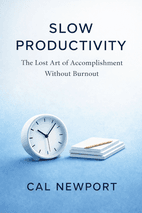
Cal Newport's Slow Productivity offers a three-part philosophy for knowledge workers overwhelmed by constant busyness, advocating for doing fewer things, working at a natural pace, and obsessing over quality to achieve sustainable, meaningful work.
Feature
Insta.Page
Blinkist
Shortform
Summary Depth
Full Chapter-by-Chapter
15-min overview
Section-by-section guides
Audio Narration
✓
✓
✓
Visual Mindmaps
✓
✕
✕
AI Q&A
✓
✕
✕
Quizzes
✓
✕
✕
PDF Downloads
✓
✕
✓
Price
$89.99/yr
$146/yr (PRO)
$199/yr
*Competitor data last verified July 2026.
1 Page Summary
Cal Newport's 'Slow Productivity' argues that the modern knowledge sector has adopted a broken definition of productivity, which he terms "pseudo-productivity." This flawed system equates visible busyness and constant activity with valuable output, a heuristic that emerged because knowledge work lacks the clear, measurable standards of industrial labor. The book positions itself as a direct alternative to this unsustainable model, proposing a philosophy of "slow productivity" designed to combat burnout and create a more humane, sustainable approach to professional accomplishment.
The book's approach is distinctive in that it builds its alternative not from scratch, but by drawing lessons from historical figures and successful cultural movements, such as the Slow Food movement. It translates these insights into a practical, three-part philosophy for knowledge workers. The core principles are: Do Fewer Things to combat overload and its administrative "overhead tax"; Work at a Natural Pace, embracing the variable, project-long rhythms of deep work over artificial daily busyness; and Obsess Over Quality, where a focus on excellence creates the leverage and space necessary for a slower, more autonomous professional life.
The intended audience is any knowledge worker feeling overwhelmed by endless communication, meetings, and the pressure of perpetual visibility. Readers will gain a coherent framework to escape the frantic pace of pseudo-productivity. The book provides both a philosophical justification and actionable strategies—from limiting commitments and containing small tasks to extending project timelines and cultivating rare skills—aimed at achieving meaningful, high-quality work while reclaiming time for a fulfilling life outside of it.
Introduction
Overview
The introduction opens with author John McPhee's struggle to begin writing a complex article about the New Jersey Pine Barrens in 1966, paralyzed by the sheer volume of his research. This historical anecdote is contrasted with the modern pandemic-era backlash against relentless productivity, setting the stage for the book's central argument: that knowledge work has adopted a broken definition of productivity, one that equates busyness with value. The chapter concludes by proposing "Slow Productivity" as a sustainable, humane alternative.
McPhee's Paralysis and Epiphany
Stuck on how to structure his vast material, McPhee spent two weeks immobilized on a backyard picnic table. His breakthrough came not from frantic effort, but from patient reflection, leading him to the realization that he could structure the entire piece around the character of Fred Brown, a local resident who connected to most of the article’s themes. This insight allowed him to organize the sprawling project, though it still took over a year to complete. The resulting work became a landmark of creative nonfiction, born from a process that valued deep thinking over visible busyness.
The Pandemic and a Growing Backlash
During the COVID-19 pandemic, a long-simmering discontent among knowledge workers erupted. The author, through his writing and audience feedback, documented a widespread exhaustion with the language and demands of hyper-productivity. Readers expressed that constant pressure to produce undermined the intrinsic pleasure of doing good work, a feeling amplified by the blurred lines between home and office. This sentiment was echoed in a wave of popular books critiquing productivity culture and in social trends like the Great Resignation and quiet quitting, signaling a profound crisis in how professional work is organized and valued.
Investigating the Exhaustion
As the author covered this discontent in his newsletter, podcast, and The New Yorker column, he found the causes were hotly debated. Theories ranged from employer exploitation and internalized hustle culture to late-stage capitalism. Amidst this confusion, however, McPhee’s story resurfaced with new relevance. It presented a paradox: here was a profoundly productive and acclaimed writer whose method involved periods of stillness and deep focus, completely at odds with the frantic, overloaded pace that defines modern knowledge work.
The Birth of "Slow Productivity"
This contrast sparked the book's core idea: the problem isn't productivity itself, but a faulty, industrialized definition of it that prioritizes busyness and visible activity over meaningful results. The author argues we can look to the habits of traditional knowledge workers like McPhee for a better model. This alternative philosophy is crystallized into three principles: Do fewer things, Work at a natural pace, and Obsess over quality. The goal is to rebuild knowledge work into something sustainable, where impressive accomplishment does not require burnout.
Key Takeaways
The current crisis in knowledge work stems from a flawed equation of productivity with constant busyness and task overload.
Historical examples, like writer John McPhee, demonstrate that profound accomplishment can arise from methods that are deliberate, focused, and unhurried.
The "Slow Productivity" philosophy offers a three-part alternative: reducing workload to a sustainable level, allowing work to unfold at a variable and human pace, and prioritizing quality above performative activity.
The book aims to provide both a justification for this new standard and practical strategies for implementing it across different professional contexts.
Key concepts: Introduction
1. Introduction
The Crisis in Modern Knowledge Work
Broken definition equates busyness with productivity
Pandemic-era backlash against relentless productivity demands
Widespread exhaustion undermines intrinsic pleasure of work
John McPhee's Counter-Example
Paralyzed by research volume for Pine Barrens article
Breakthrough came from patient reflection, not frantic effort
Structured work around a central character for organization
The Productivity Paradox
McPhee's profound productivity involved stillness and focus
Modern work values frantic pace and visible activity
Traditional knowledge workers offer better model than industrialization
Slow Productivity Philosophy
Do fewer things to reduce overload
Work at a natural, variable human pace
Obsess over quality rather than performative activity
Book's Purpose and Promise
Provide justification for new productivity standard
Offer practical implementation strategies
Make impressive accomplishment sustainable without burnout
💡 Try clicking the AI chat button to ask questions about this book!
Chapter 1: The Rise and Fall of Pseudo-Productivity
Overview
The story opens with a telling moment from 1995, where a top executive demands his staff work more visible hours, revealing an unspoken rule of the modern office: looking busy equals being productive. This belief stems from a fundamental problem in the knowledge economy—unlike in farming or factories, no one can agree on what “productivity” actually means. Surveys show that workers define it with vague platitudes about constant motion, lacking any clear metrics for real effectiveness. This confusion isn’t personal; it’s systemic. Even leading management thinkers found the topic so frustratingly nebulous that they stepped away from it, acknowledging that attempts to measure it often become “silly.”
This vagueness stands in sharp contrast to the crisp, actionable definitions that powered the Industrial Revolution, where productivity was a simple ratio of valuable output to input. That clarity allowed for systematic improvements and massive efficiency gains. But this industrial blueprint fails for knowledge work due to two key issues: the variability of effort involved in juggling complex tasks and the lack of defined systems, leaving workers to direct themselves with ad-hoc methods.
Faced with this vacuum, the knowledge sector latched onto a simple, flawed heuristic: using visible activity as a crude proxy for real productive effort. The chapter names this pseudo-productivity. It’s the philosophy that explains why we feel pressure to always be in the office, respond to messages instantly, and prioritize shallow tasks that look like work over the deep, thoughtful work that matters. This preference for visible busyness over meaningful results was then catastrophically amplified by technology. The arrival of email, networked computers, and smartphones created a low-friction demand to constantly demonstrate activity, leading to skyrocketing burnout and a work culture overwhelmed by communication that crowds out the capacity for focused, valuable work.
Yet, the story doesn’t end in inevitable exhaustion. A contrasting narrative emerges, challenging the core assumption of pseudo-productivity. While the executive demanded more relentless visible effort, a different path to success is illustrated by a creator whose work followed a nonlinear, patient three-year cycle of development. This journey shows that the most meaningful work often operates on a longer, more strategic timescale. True productivity isn’t about frantic, daily motion; it can appear “slow” but yields undeniable results that only become clear when you zoom out. The ultimate takeaway is that the slow cultivation of a vision through varied, sometimes quiet, creative focus can outperform relentless pseudo-productivity every time.
The Vague Demands of Knowledge Work
The chapter opens with a telling anecdote from 1995: CBS executive Leslie Moonves, frustrated by an empty office on a Friday afternoon, sends a memo demanding more visible hours from his staff. This incident epitomizes a core, unexamined belief in the knowledge sector: that productivity is synonymous with visible busyness. The problem, however, is that unlike in farming or manufacturing, no one in the knowledge economy can agree on what “productivity” actually means.
A survey of nearly seven hundred knowledge workers revealed that definitions of productivity were shockingly vague. Respondents typically just listed their job duties or equated productivity with constant motion (“working all the time”). None offered clear metrics for quality or effectiveness. This vagueness isn't just a personal failing; it's systemic. Management theorist Peter Drucker admitted that studying knowledge worker productivity had "barely begun," and researcher Tom Davenport found the field so frustratingly nebulous that he abandoned it, noting that when measurements are attempted, they are often "silly," like counting academic papers regardless of quality.
The Industrial Blueprint and Its Failure
This stands in stark contrast to the history of productivity in other sectors. In agriculture and manufacturing, productivity has a crisp, actionable definition: a measurable ratio of valuable output to input (e.g., bushels per acre, cars per labor-hour). This clarity enabled systematic experimentation and staggering efficiency gains, like the Norfolk crop rotation or Ford’s assembly line, which slashed Model T production time by almost 90%.
These concrete metrics failed to translate to knowledge work for two key reasons. First, the variability of effort: knowledge workers juggle shifting, multifaceted tasks, making it impossible to isolate and measure a single output. Second, the lack of defined systems: unlike a factory floor, knowledge work is largely self-directed. Peter Drucker argued the knowledge worker “must direct himself,” leading companies to outsource organization to personal, ad-hoc methods. There was no unified “assembly line” to optimize.
The Birth of Pseudo-Productivity
Faced with this vacuum of measurable productivity, the knowledge sector adopted a simple heuristic: using visible activity as a crude proxy for actual productive effort. The chapter formally names this:
Pseudo-productivity: The use of visible activity as the primary means of approximating actual productive effort.
This philosophy explains why we cling to visible office hours, feel pressure to immediately answer messages, and gravitate toward shallow, checkbox tasks over deep, thoughtful work. It’s a "mood" of frenetic motion rather than a defined system. Initially, this seemed a benign alternative to industrial drudgery. Its flaws, however, were catastrophically amplified by technology.
The Digital Accelerant and Burnout
The mid-1990s arrival of networked computers, and later smartphones, supercharged pseudo-productivity. When activity signals productivity, tools like email and Slack create a low-friction demand to constantly demonstrate busyness. Activity exploded, bleeding into nights and weekends. Studies show skyrocketing burnout rates, with workers feeling overwhelmed by a ceaseless stream of communication that crowds out the capacity for deep, meaningful work. As one survey respondent, a virtual assistant, observed, her clients became so overwhelmed they simply tried “to work on a lot and hope they make progress that way.”
This creates a grim sense of inevitability. Concrete industrial metrics don't fit knowledge work, but the pseudo-productivity alternative, when digitally turbocharged, leads to exhaustion and overload. Yet, the story of CBS's eventual turnaround hints that a better approach might be possible, setting the stage for the next section's exploration.
Contrasting Approaches to Work
The section concludes by drawing a stark contrast between Les Moonves’s command-and-control management and Anthony Zuiker’s creative process. While Moonves attempted to solve problems by demanding more visible, relentless effort from his staff, Zuiker’s path to saving the network was nonlinear and patient. His work on CSI involved a three-year cycle of intense creative development punctuated by periods of less visible activity or rest.
Redefining Productive Pace
This narrative challenges the core assumption of pseudo-productivity. Zuiker’s ultimate success demonstrates that the most meaningful and valuable work often operates on a different, longer timescale. Productivity, in this authentic sense, is not synonymous with constant, frenetic action. It can appear “slow” when viewed through the lens of busyness, but its results—like a groundbreaking television show that rescues a network—are undeniable. The true measure of his work became clear only when zoomed out to the scale of years, rendering irrelevant the question of whether he took a month off in 1999.
Key Takeaways
Visible activity is not a reliable measure of valuable productivity. Anthony Zuiker’s varied and sometimes quiet creative process was far more productive than simply being constantly busy.
Meaningful work often requires operating on longer timescales. Success can emanate from a patient, persistent pace that prioritizes deep results over daily performative effort.
The “slow” cultivation of a vision can outperform relentless pseudo-productivity. Strategic periods of focus and rest can yield outcomes that frantic, visible busyness cannot.
Key concepts: Chapter 1: The Rise and Fall of Pseudo-Productivity
2. Chapter 1: The Rise and Fall of Pseudo-Productivity
The Problem of Defining Productivity
Knowledge work lacks clear productivity metrics
Definitions are vague, equating productivity with constant motion
Systemic confusion frustrates even management experts
Industrial Productivity vs. Knowledge Work
Industrial era had crisp output/input ratios
Knowledge work has variable effort and undefined systems
Industrial measurement fails for complex, self-directed work
The Pseudo-Productivity Heuristic
Visible activity becomes proxy for real productivity
Explains pressure for constant visibility and responsiveness
Prioritizes shallow tasks over deep, meaningful work
Technology's Amplifying Role
Email and smartphones created low-friction demand
Constant communication crowds out focused work
Leads to skyrocketing burnout and overwhelmed culture
The Alternative: Slow Productivity
Meaningful work follows nonlinear, patient cycles
True productivity appears 'slow' but yields undeniable results
Cultivation of vision outperforms relentless pseudo-productivity
Historical Example: 1995 CBS Memo
Executive demanded more visible office hours
Epitomized belief that looking busy equals being productive
Revealed unspoken rule of modern knowledge work
Core Systemic Failure
Companies outsource organization to personal methods
No unified 'assembly line' to optimize knowledge work
Leaves workers with ad-hoc, ineffective approaches
Chapter 2: A Slower Alternative
Overview
The chapter opens with a vivid scene from 1986 Rome, where plans for a massive McDonald's restaurant near the Spanish Steps sparked cultural backlash. This controversy inspired activist Carlo Petrini to launch the Slow Food movement, advocating for leisurely, communal meals made from local ingredients. What began as a culinary protest soon revealed deeper insights into combating modern haste. By exploring Slow Food's success, the chapter uncovers two powerful ideas for reform: offering appealing alternatives and drawing from time-tested traditions. These concepts ripple out into other "slow" movements—from cities to medicine—before pivoting to their relevance for knowledge work. Ultimately, this leads to the proposal of "slow productivity," a new philosophy designed to counteract the burnout of pseudo-productivity through three core principles.
The Birth of a Movement
Carlo Petrini's response to the McDonald's incursion was not just criticism but a creative alternative. He founded Slow Food to champion sensual, prolonged enjoyment of meals, emphasizing local cuisines and seasonal ingredients. The movement quickly grew, with chapters across Italy and later globally, expanding its goals to include preserving food traditions and educating children about regional cultures. Events like the Salone del Gusto in Turin showcased artisanal foods, attracting thousands. This wasn't merely about nostalgia; it was a deliberate stand against the frenzy of fast-food culture, framed as a "vaccine" for modern life.
Core Ideas Behind Slow Food
As the movement gained traction, Petrini's approach crystallized into two innovative strategies. First, he focused on providing appealing alternatives rather than just critiquing flaws. Instead of writing scathing op-eds, he promoted a joyful relationship with food that made fast food seem vulgar. Second, he pulled from time-tested cultural innovations, drawing on centuries-old Italian dining traditions that had evolved through trial and error. Journalist Michael Pollan initially dismissed Slow Food as antiquarian but later recanted, recognizing its serious contribution to debates on environmentalism and globalism. These ideas proved transferable beyond the dinner table.
The Spread of Slowness
Inspired by Slow Food, a wave of related movements emerged, each targeting areas suffering from modern hurry. Carl Honoré's book In Praise of Slowness documents examples like Slow Cities (Cittaslow), which promote pedestrian-friendly, neighborly urban spaces; Slow Medicine, emphasizing holistic care; and Slow Schooling, which reduces testing pressures. More recently, Slow Media and Slow Cinema have emerged, advocating for sustainable digital content and films that reward deep attention. The mayor of Petrini's hometown noted that slowness evolved from a niche food idea into a broader cultural discussion about humanizing our pace of life.
Applying Slowness to Knowledge Work
The chapter then shifts to the world of knowledge work, where pseudo-productivity—the relentless drive to appear busy—leads to burnout. The post-pandemic period created an opening for major workplace changes, such as debates over remote work and experiments with four-day workweeks. However, these adjustments alone feel insufficient; they merely constrain pseudo-productivity without offering a fundamental alternative. Here, Petrini's framework becomes crucial: to combat overload, we need a slower conception of productivity itself, rooted in time-tested wisdom from traditional cognitive professions.
Introducing Slow Productivity
This leads to the formal introduction of "slow productivity," a philosophy for organizing knowledge work sustainably. It's defined as transforming knowledge into valuable artifacts through cognitive effort, encompassing not just office jobs but also writers, artists, and scientists throughout history. By studying these traditional knowledge workers—like Isaac Newton or Maya Angelou—we can extract general ideas about working deeply and sustainably, even if we can't replicate their exact circumstances. Slow productivity is presented as a three-principle framework: do fewer things, work at a natural pace, and obsess over quality. These principles will be elaborated in Part 2 of the book, with stories from figures like Jane Austen and Georgia O'Keeffe to illustrate their application.
Audience and Intent
The chapter clarifies that slow productivity targets those with autonomy in their work, such as freelancers, solopreneurs, or professionals with flexible roles. While it may be harder for those in tightly supervised environments, the philosophy aims to start a revolution from where self-experimentation is possible. It reassures that slowness doesn't extinguish ambition; rather, it provides a sustainable path to legacy-building accomplishments, as seen with Newton's decades-long work on the Principia. The goal is to make work a source of meaning rather than overwhelm, setting the stage for the detailed exploration in the following chapters.
Key Takeaways
Slow Food began as a response to fast-food culture, emphasizing enjoyable alternatives and traditional practices.
Two key ideas from Slow Food are: focus on appealing alternatives rather than just criticism, and draw solutions from time-tested cultural innovations.
These ideas inspired a broader "slow movement" across various domains, from cities to media.
For knowledge work, pseudo-productivity causes burnout; superficial fixes like shorter workweeks aren't enough.
"Slow productivity" offers a new philosophy based on three principles: do fewer things, work at a natural pace, and obsess over quality.
It learns from traditional knowledge workers (e.g., artists, scientists) to adapt their sustainable habits to modern jobs.
The philosophy is aimed at those with work autonomy, seeking to make productivity humane and meaningful.
Key concepts: Chapter 2: A Slower Alternative
3. Chapter 2: A Slower Alternative
Origins of the Slow Food Movement
Founded by Carlo Petrini in response to fast-food culture
Emphasized leisurely, communal meals with local ingredients
Grew into a global movement preserving food traditions
Core Strategies of Slow Food
Focus on providing appealing alternatives to fast food
Draw solutions from time-tested cultural innovations
Shift from criticism to promoting a joyful relationship with food
Expansion into Broader Slow Movements
Inspired Slow Cities, Slow Medicine, and Slow Schooling
Later included Slow Media and Slow Cinema
Evolved from a food idea to a cultural discussion on pace
The Problem in Knowledge Work
Pseudo-productivity causes burnout through constant busyness
Superficial workplace changes fail to address the root cause
Need for a fundamental alternative to current productivity models
Introduction to Slow Productivity
A philosophy for sustainable knowledge work organization
Based on three principles: do fewer things, work naturally, obsess over quality
Learns from traditional knowledge workers like artists and scientists
Chapter 3: Do Fewer Things
Overview
A popular myth about Jane Austen suggests she wrote by squeezing work between distractions. In reality, her prolific period came from a deliberate simplification of her life. Her story reveals a counterintuitive truth: doing your best work often requires doing fewer things. The modern knowledge worker faces constant overload, epitomized by endless meetings. This introduces the overhead tax—the administrative drag of coordination and communication that grows with each new commitment, fragmenting focus and slowing output.
We often stay overloaded due to a flawed stress heuristic, only saying "no" when we're already near burnout, trapping us in perpetual busyness. Yet, evidence shows that consciously doing less leads to higher quality work and greater satisfaction. Moving from insight to action requires a tactical shift. The chapter proposes a dual strategy: first, limit the big by systematically reducing major commitments. Second, contain the small by managing the minor tasks that erode focus.
Containment involves methods like putting routine tasks on autopilot, synchronizing communication, and using tools like a reverse task list. It also means choosing task-efficient projects and being willing to spend money to save mental bandwidth. This work is urgent because overload carries a profound human cost, grinding down well-being.
To operationalize this, the chapter advocates for a pull workflow. Instead of accepting all work immediately (a "push" model), you simulate a system where you only pull new projects into active work when you have capacity, using a holding tank and a limited active list. This requires a disciplined intake procedure and regular list cleaning. Ultimately, this systematic approach to doing fewer things is the foundation for a sustainable, humane, and productive professional life.
Jane Austen's Real Productivity
Jane Austen's publishing debut is often misrepresented as her scribbling secretly between social distractions. This myth suggests productivity requires cramming more into your schedule. In reality, Austen's creative breakthroughs came when her obligations were minimal. Her writing stalled during a chaotic decade in Bath under increased responsibilities. Only after moving to Chawton cottage, where her family freed her from most household tasks, did she enter her prolific period, completing major works like Sense and Sensibility and Pride and Prejudice. Austen's story underscores that meaningful work thrives with space, not relentless busyness.
The Modern Parallel: Overload and Overhead Tax
Shifting to today, the chapter highlights a program manager whose heart attack was linked to endless Zoom meetings. His experience epitomized the "Zoom Apocalypse," where remote work amplified meetings and chats. This introduces the "overhead tax": each new commitment generates administrative chores. As your workload grows, this tax consumes more time, slowing core work. Doing fewer things reduces overhead, freeing hours for focused effort.
Why We End Up Overloaded
Why do knowledge workers often hover at the edge of overload? Workers typically use stress as a self-regulation heuristic, saying no only when feeling overwhelmed. This leads to a state of maximum sustainable overhead tax—busy enough to be painful but not enough to collapse. The takeaway is that doing fewer things is a viable strategy, countering the cultural bias toward constant activity.
The Stress Heuristic Trap
We often use our own rising stress levels as the justification to finally say "no" to new requests. This "stress heuristic" means we only begin to push back when we're already nearing burnout, trapping us in a perpetual state of being almost overloaded. This reactive approach is a primary reason knowledge workers feel chronically overwhelmed.
Real-World Proof: Doing Less Works
Survey responses confirm that doing fewer things leads to better outcomes. A coach simplified her service offerings, resulting in a calmer mind, higher-quality interactions, and the same income for fewer hours. A law professor paused his frenetic publishing pace to focus deeply on a single major case, producing what he called the best work of his career.
Further examples include a teacher who quietly stopped doing unpaid, non-essential work with no negative consequences, and a civil engineering manager who found he could produce nearly as much in a 30-hour week with a narrow focus as in 60 hours of fragmented effort.
A Tactical Shift: From Insight to Action
Overload is not inherent to knowledge work but a side effect of crude self-management. In a culture of pseudo-productivity, choosing to do less can be misinterpreted as laziness. Therefore, a careful, tactical approach is required.
Proposition: Limit the Big
To implement "do fewer things," the chapter looks to mathematician Andrew Wiles. Upon committing to solve Fermat's Last Theorem, he systematically reduced competing commitments: he stopped attending non-essential conferences and worked from home to avoid distractions. His method was a set of specific rules designed to minimize major items vying for his attention.
The proposition is to adopt this systematic approach by applying intentional limits at three scales: missions, projects, and daily goals.
Limit Missions
A "mission" is any ongoing goal that directs professional life. An overload of missions makes a manageable workload impossible. The chapter cites an author who was supporting over ten different income streams and was exhausted. By slashing these missions, she achieved a sustainable schedule of 20-hour workweeks.
Limit Projects
Projects are initiatives that can't be completed in one session. A more effective strategy than simply refusing all projects is to appeal to your calendar. When a new project is proposed, estimate the time required and immediately look for space to schedule it. If you can't find the time, you must decline or explicitly cancel something else. This builds credibility and allows you to say "no" based on hard evidence.
Limit Daily Goals
For a single day, the recommendation is simple: work on at most one primary project per day. This doesn't preclude meetings or administrative tasks, but for important, creative work, focus on a single initiative. This calibrated steadiness produces substantial results over time while reducing anxiety.
Proposition: Contain the Small
Benjamin Franklin’s early career was defined by relentless hustle, but he eventually burned out. His pivot began when he hired a skilled printer named David Hall and formed a partnership, allowing Franklin to step back from day-to-day operations.
This partnership was Franklin's masterstroke for containing the small. It freed him from daily business minutiae, providing the space to transition into his iconic later roles as a statesman and scientist. His story demonstrates that achieving a slow, productive focus requires a systematic strategy to minimize small obligations.
Delegation as Liberation: The Franklin Model
Benjamin Franklin’s partnership with David Hall is a masterclass in strategic delegation. By promoting his skilled foreman to a full partner, Franklin consciously traded potential wealth for guaranteed time. He offloaded the “administrative minutiae” onto Hall’s capable shoulders. This deliberate downsizing was not a retreat but a redeployment of his energy, allowing him to dedicate himself to scientific inquiry. His story establishes the core principle: systematically removing small, draining obligations creates the space necessary for monumental work.
The author then bridges to the modern creative struggle, citing the fight against daily distractions. The underlying motivation is universal: small tasks act like “productivity termites,” and it is worth going to great lengths to contain them.
The Strategy of Containment
The goal isn’t to eliminate all small tasks but to limit their ability to dominate your mental landscape and schedule. The proposed strategies fall into two categories:
Containing the overhead of unavoidable tasks.
Preventing tasks from arriving in the first place.
Put Tasks on Autopilot
This involves moving regular, recurring tasks to a fixed, habitual schedule. By assigning specific categories of work to the same time and day each week, you eliminate the cognitive overhead of deciding when to do them. The objective is to reach a “low-stress sweet spot” where routine work is accomplished with minimal thought.
Synchronize
This approach tackles the major modern source of task-related overload: the endless, asynchronous conversations about them. The solution is to replace scattered messaging with coordinated, real-time conversation. Two methods are offered:
Office Hours: Setting aside a fixed block of time each day for quick questions.
Docket-Clearing Meetings: Regularly scheduled team meetings dedicated solely to processing collaborative tasks from a shared list.
Make Other People Work More
This aims to rebalance the ease with which others can assign you tasks. By introducing slight friction, you reduce your own overhead. Two techniques are described:
The Reverse Task List: Instead of accepting tasks via message, you maintain a public list where requestors must write their own task, including all necessary details.
Process Shifting: Redesigning common workflows so that the person requesting a service does more of the preparatory work.
Avoid Task Engines
Finally, the chapter advises proactive containment by being selective about the projects you take on. When evaluating new opportunities, assess them for their likely task footprint—the volume of small requests and administrative chores they will generate. Prioritizing projects with a smaller ongoing maintenance burden can prevent overload.
Key Takeaways
Liberate Through Delegation: Identify administrative burdens you can systematically offload to buy back time for deep work.
Contain, Don’t Just Complain: Limit the mental and scheduling damage of small tasks through strategic containment.
Systematize the Routine: Use autopilot scheduling to make recurring tasks habitual.
Key concepts: Chapter 3: Do Fewer Things
4. Chapter 3: Do Fewer Things
The Core Principle: Do Fewer Things
Meaningful work thrives with space, not busyness
Doing less leads to higher quality work and satisfaction
Counteracts the cultural bias toward constant activity
The Overhead Tax of Overload
Each new commitment generates administrative drag
Coordination and communication fragment focus
Reducing commitments frees time for core work
The Stress Heuristic Trap
We only say 'no' when nearing burnout
Traps us in a state of perpetual busyness
A reactive, flawed self-regulation method
Evidence: Doing Less Works
Simplification leads to calmer minds and better outcomes
Narrow focus can match fragmented longer hours
Real-world examples show no negative consequences
Dual Strategy for Action
First, limit the big: reduce major commitments
Second, contain the small: manage minor tasks
Requires a tactical shift from insight to action
Limit the Big: Systematic Reduction
Apply intentional limits at missions, projects, goals
Overload of missions makes workload impossible
Slash competing commitments like Andrew Wiles did
The Pull Workflow System
Simulate pulling work only when you have capacity
Use a holding tank and limited active list
Requires disciplined intake and regular list cleaning
You've reached the end of the free chapters
Next chapter: “Work at a Natural Pace” is locked
Keep reading Slow Productivity — and unlock all 600+ book summaries with audio, mindmaps and AI Q&A.
$0.00 due today · 7 days free, then $89.99/year ($7.49/mo) · Cancel anytime before day 7
Cal Newport is a renowned author and computer science professor at Georgetown University, celebrated for his influential work on the intersection of digital technology and culture. He is a leading voice on the topics of deep work, digital minimalism, and productivity in a distracted world. Newport is the bestselling author of multiple books, including "Deep Work," "Digital Minimalism," and "So Good They Can't Ignore You," which have sold millions of copies and have been translated into dozens of languages. His writing provides a philosophical and practical framework for cultivating a focused and meaningful professional life in the modern economy. His acclaimed books are available for purchase on Amazon and through other major retailers.
📚 Explore Our Book Summary Library
Discover more insightful book summaries from our collection