Slow Productivity Key Takeaways
by Cal Newport
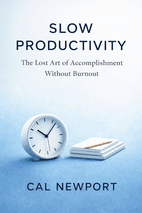
5 Main Takeaways from Slow Productivity
Visible Busyness Is a Poor Proxy for Real Productivity
The book demonstrates that constant task-switching and overload, common in knowledge work, often mask low-value activity. Instead, like writer John McPhee, focus on deliberate, deep work that yields profound results over time.
Adopt Three Core Principles: Fewer Tasks, Natural Pace, Quality Focus
Slow productivity is built on doing fewer things to reduce overload, working at a variable, human pace to sustain energy, and prioritizing genuine quality over performative busyness. This framework replaces the unsustainable pseudo-productivity model.
Liberate Time by Delegating, Containing, and Systematizing Routine Tasks
To do fewer things, identify administrative burdens to delegate, limit the impact of small tasks through containment strategies, and use autopilot scheduling for recurring duties. This frees up mental space for meaningful work, as outlined in Chapter 3.
Design Your Work Rhythm with Seasons, Breaks, and Poetic Spaces
Incorporate longer breaks like a shorter work year, add small seasonality with meeting-free days, and shape your physical workspace to support deep work. This aligns with natural human cycles, preventing burnout and fostering creativity.
Build Systems for Sustainable High-Quality Output, Not Just Hustle
Sustainable productivity requires deliberate systems, like those used by historical knowledge workers, rather than relying on willpower or constant hustle. True productivity is measured by meaningful outcomes accumulated over time, not daily activity.
Executive Analysis
The five takeaways collectively articulate Cal Newport's central thesis: that the knowledge work crisis stems from pseudo-productivity, which equates constant busyness with value. By advocating for deliberate focus, core principles like doing fewer things and working at a natural pace, and practical systems for workload reduction, the book constructs a coherent alternative. This is grounded in historical examples, such as John McPhee's writing, showing that sustainable, high-quality output arises from methodical, unhurried approaches.
This book provides a tangible escape plan for autonomous knowledge workers drowning in overload, addressing a systemic failure in work organization. Unlike superficial fixes, 'Slow Productivity' offers a philosophically grounded framework that redefines productivity around meaningful accumulation over time. Within the productivity genre, it challenges the cult of busyness by drawing from time-tested practices of artists and scientists, making it essential for reclaiming time and crafting a humane work life.
Chapter-by-Chapter Key Takeaways
Introduction (Introduction)
The current crisis in knowledge work stems from a flawed equation of productivity with constant busyness and task overload.
Historical examples, like writer John McPhee, demonstrate that profound accomplishment can arise from methods that are deliberate, focused, and unhurried.
The "Slow Productivity" philosophy offers a three-part alternative: reducing workload to a sustainable level, allowing work to unfold at a variable and human pace, and prioritizing quality above performative activity.
The book aims to provide both a justification for this new standard and practical strategies for implementing it across different professional contexts.
Try this: Reject the cult of constant busyness and instead embrace a philosophy of deliberate, focused work that prioritizes sustainable accomplishment.
The Rise and Fall of Pseudo-Productivity (Chapter 1)
Visible activity is not a reliable measure of valuable productivity. Anthony Zuiker’s varied and sometimes quiet creative process was far more productive than simply being constantly busy.
Meaningful work often requires operating on longer timescales. Success can emanate from a patient, persistent pace that prioritizes deep results over daily performative effort.
The “slow” cultivation of a vision can outperform relentless pseudo-productivity. Strategic periods of focus and rest can yield outcomes that frantic, visible busyness cannot.
Try this: Measure your productivity by the long-term value of deep work, not by visible activity, and cultivate patient persistence over frantic effort.
A Slower Alternative (Chapter 2)
Slow Food began as a response to fast-food culture, emphasizing enjoyable alternatives and traditional practices.
Two key ideas from Slow Food are: focus on appealing alternatives rather than just criticism, and draw solutions from time-tested cultural innovations.
These ideas inspired a broader "slow movement" across various domains, from cities to media.
For knowledge work, pseudo-productivity causes burnout; superficial fixes like shorter workweeks aren't enough.
"Slow productivity" offers a new philosophy based on three principles: do fewer things, work at a natural pace, and obsess over quality.
It learns from traditional knowledge workers (e.g., artists, scientists) to adapt their sustainable habits to modern jobs.
The philosophy is aimed at those with work autonomy, seeking to make productivity humane and meaningful.
Try this: Anchor your work approach in the three principles of slow productivity: do fewer things, work at a natural pace, and obsess over quality.
Do Fewer Things (Chapter 3)
Liberate Through Delegation: Identify administrative burdens you can systematically offload to buy back time for deep work.
Contain, Don’t Just Complain: Limit the mental and scheduling damage of small tasks through strategic containment.
Systematize the Routine: Use autopilot scheduling to make recurring tasks habitual.
Try this: Conduct a task audit to identify what to delegate, contain, or systematize, thereby reducing your active workload to focus on essential deep work.
Next chapter: “Work at a Natural Pace” is locked
Keep learning from Slow Productivity — and unlock all 600+ book summaries with audio, mindmaps and AI Q&A.
$0.00 due today · 7 days free, then $89.99/year ($7.49/mo) · Cancel anytime before day 7
plus sales tax where applicable