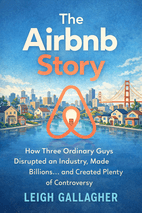
Leigh Gallagher's The Airbnb Story chronicles the home-sharing platform's rise from renting air mattresses to a global phenomenon, detailing its disruptive model and the regulatory battles it sparked. It's for readers interested in modern business, tech startups, and the complexities of the sharing economy.
Feature
Insta.Page
Blinkist
Shortform
Summary Depth
Full Chapter-by-Chapter
15-min overview
Section-by-section guides
Audio Narration
✓
✓
✓
Visual Mindmaps
✓
✕
✕
AI Q&A
✓
✕
✕
Quizzes
✓
✕
✕
PDF Downloads
✓
✕
✓
Price
$89.99/yr
$146/yr (PRO)
$199/yr
*Competitor data last verified July 2026.
1 Page Summary
In The Airbnb Story, Leigh Gallagher chronicles the meteoric rise of the home-sharing platform from its improbable origins as a way for founders Brian Chesky, Joe Gebbia, and Nathan Blecharczyk to pay rent. The book details how the trio's simple idea—renting out air mattresses in their San Francisco apartment during a design conference in 2007—evolved into a global phenomenon. Gallagher places this growth within the context of the 2008 financial crisis and the burgeoning "sharing economy," illustrating how Airbnb offered both a novel travel experience and a crucial new income stream for hosts during economic hardship.
The narrative delves into the core disruptive concepts that fueled Airbnb's success: leveraging underutilized assets (spare rooms and vacant homes), building a two-sided marketplace with a review system to foster trust, and crafting a brand centered on "belonging" rather than mere transactions. However, Gallagher provides a balanced account by thoroughly examining the intense controversy the company ignited. This includes clashes with the hotel industry, regulatory battles with cities over zoning and taxes, and concerns about its impact on housing affordability and neighborhood character, as critics argued it effectively removed long-term rental units from the market.
Gallagher's account captures the lasting impact of Airbnb, which fundamentally altered the travel and hospitality landscape by empowering millions to become micro-entrepreneurs and challenging traditional notions of accommodation. The book concludes by framing Airbnb not just as a business case study, but as a defining company of its era—one that epitomizes the promise and perils of tech-driven disruption, highlighting the ongoing tension between innovation, regulation, and community welfare that continues to shape its story.
The Hustle
Overview
The creative partnership between Brian Chesky and Joe Gebbia first ignited at the Rhode Island School of Design, where their shared knack for unconventional thinking became apparent. After graduation, their paths briefly split, with Chesky feeling stifled in a conventional design job in Los Angeles while Gebbia hustled with entrepreneurial ventures in San Francisco. Gebbia’s persistent vision finally convinced Chesky to make a desperate, overnight move to San Francisco, driven by a rent crisis that sparked a quirky solution: using air mattresses to host attendees of a sold-out design conference. This temporary hack, dubbed AirBed & Breakfast, netted them their first guests and a glimpse of potential, though they initially saw it as just a stopgap while searching for a “real” idea.
Through repeatedly telling the story to family and friends, they began to wonder if this was the kernel of their big idea. They enlisted Nathan Blecharczyk as a technical co-founder, simplified their pitch to “AirBed & Breakfast Lite,” and launched at South by Southwest, only to meet with disappointing traction but valuable insights about payment awkwardness and broader market possibilities. Guidance from advisor Michael Seibel opened doors to angel investors, but they faced a brutal string of rejections, with one investor famously walking out mid-meeting. Team fractures emerged as Blecharczyk grew skeptical, dedicating time to his own start-up, yet this period helped crystallize a grander vision: becoming a full-scale alternative to hotels.
They channeled their “hustle” into targeting the Democratic National Convention, executing a clever media strategy that briefly surged traffic but evaporated after the event, compounded by a PayPal freeze. Broke and desperate, they revived a whimsical marketing idea, creating and selling “Obama O’s” and “Cap’n McCain’s” cereals, which cleared their credit card debt but didn’t solve their core business struggles. At their lowest point, Seibel pushed them to apply to Y Combinator, leading to a pivotal interview where Chesky’s decision to present the cereal box won over Paul Graham, who admired their cockroach-like resilience.
Accepted into YC, they immersed themselves in the program’s crucible, embracing Graham’s mantra to “make something people want” by focusing on a hundred passionate users over a million lukewarm ones. Heeding his advice to “go to your users,” Chesky and Gebbia flew to New York every weekend, meeting hosts door-to-door while Blecharczyk coded in California. This grassroots work revealed critical pain points like poor photography and pricing, leading to pivotal expansions such as allowing entire home rentals and shortening the name to Airbnb. Despite enduring more rejections, including from prominent venture capitalist Fred Wilson, their shameless persistence made them model YC students, eventually achieving “ramen profitability.”
Just before Demo Day, a chance meeting with Sequoia Capital’s Greg McAdoo transformed their trajectory. McAdoo’s analysis framed their business within the massive vacation-rental market, and Sequoia’s investment provided not just capital but profound validation, igniting what Chesky called the “rocket ship.” With funding secured, growth accelerated, bookings surged, and the team—finally reunited and fully committed—proved that relentless resourcefulness, learning directly from users, and unwavering persistence could turn a weird idea into a transformative venture.
Partners in Providence
The partnership between Brian Chesky and Joe Gebbia began not in San Francisco, but years earlier at the Rhode Island School of Design (RISD). Their first collaborative design project, a six-week internship for Conair, revealed their unique creative synergy. While other student teams presented conventional hair dryer designs, Chesky and Gebbia pitched wildly unconventional ideas, like a shirt made of soap. Although met with bewilderment from executives, the experience was an epiphany for both about their combined potential to think differently.
Diverging Paths and a Persistent Vision
After graduation, their paths temporarily split. Driven by practical concerns and family expectations, Chesky moved to Los Angeles for a conventional industrial design job, which quickly left him feeling disillusioned and creatively stifled. Meanwhile, Gebbia moved to San Francisco, working at Chronicle Books while independently launching "CritBuns," a line of cheeky seat cushions—proving his entrepreneurial hustle. He repeatedly tried to convince Chesky to join him in San Francisco to start a company, a vision he’d first voiced over pizza after Chesky’s graduation.
The Move to San Francisco
Chesky’s attempt to land a design job at Method in San Francisco failed, but it introduced him to the city’s energy. After Gebbia’s roommates moved out, leaving him unable to afford the rent on his three-bedroom apartment on Rausch Street, he made a final, desperate plea. Chesky, feeling trapped in L.A., finally agreed. He broke up with his girlfriend, left his belongings, and drove north through the night, feeling a sense of possibility he hadn't experienced in years.
The Rent Problem and a "Weird" Solution
The myth that a sudden rent crisis sparked Airbnb isn't entirely accurate. Both knew about the increased rent and the need to cover an empty room for a month. Their creative, problem-solving RISD mindset kicked in. With a major design conference coming to San Francisco and hotel rooms scarce, they hatched a plan: use air mattresses (Gebbia had three in his closet) to turn their living space into a budget "bed and breakfast" for attendees. They saw it as a temporary hack to make rent.
Launching AirBed & Breakfast
They designed a simple website, hired a freelancer to build it, and promoted the service through design blogs. To their surprise, they didn’t attract backpackers but three professional designers: Amol Surve, Kat, and Michael. Surve, their first guest, became an instant advocate and even an unwitting prop in their early pitch materials. During the conference, Chesky and Gebbia hustled relentlessly to promote the concept, though they were often met with bemusement or dismissal from established designers.
The Search for the "Real" Idea
The weekend was a success—they made $1,000 and hosted a memorable experience—but they still viewed AirBed & Breakfast as a stopgap, a quirky way to buy time. The "real" company was still to be conceived. They brought in Nathan Blecharczyk, a brilliant engineer and Gebbia’s former roommate, to brainstorm new ideas. They spent weeks on concepts like a sophisticated roommate-matching site, only to be deflated when they discovered it already existed.
A Shift in Perspective
Discouraged, Chesky returned home to New York for the holidays, where his family viewed him as unemployed, not an "entrepreneur." In repeatedly explaining himself, he kept circling back to the AirBed & Breakfast story. Gebbia found himself doing the same. The shared experience of telling the tale made them begin to wonder if the temporary hack was, in fact, the kernel of their big idea. They returned to San Francisco newly energized, refined the concept for other conferences, and set their sights on launching at the massive South by Southwest festival in Austin. Their next task was convincing the crucial third co-founder, Nathan Blecharczyk, to join them.
The Scaled-Down Pitch and a Disappointing Launch
After sensing Nate Blecharczyk's apprehension about the technical workload, Brian Chesky and Joe Gebbia returned with a simplified proposal: AirBed & Breakfast Lite. This "same great product, half the code" version convinced Blecharczyk to join the effort. An early ideological debate was settled when Chesky’s idealistic view of a free service was overruled by his co-founders, who insisted on a business model.
Their official launch at South by Southwest (SXSW) was a failure in terms of traction, netting only two paying customers—one of whom was Chesky himself. Despite this, the experience was invaluable. Staying with a host they recruited from Craigslist, Chesky identified critical flaws in the payment process and the social awkwardness of exchanging cash. Furthermore, inquiries from travelers not attending a conference hinted at a broader market potential, nudging them beyond the "sold-out events" niche.
Enter the "Godfounder"
At SXSW, Chesky and Gebbia connected with Michael Seibel, the young CEO of Justin.tv. Seibel, who had recently gone through the Y Combinator program, saw logic in their idea and offered to advise them. He became their crucial guide, or "godfounder," providing feedback and introducing them to the world of angel investors—a concept entirely foreign to Chesky, who initially thought it involved literal angels. This mentorship provided structure as they refined their product.
Team Fractures and a Broader Vision
Post-SXSW, enthusiasm diverged. While Chesky and Gebbia targeted the upcoming Democratic National Convention (DNC), Blecharczyk grew skeptical, dedicating most of his time to his own Facebook advertising start-up and only sparing minimal hours for Airbnb. The situation worsened when he announced he was moving to Boston for his girlfriend, leading Chesky and Gebbia to briefly advertise for a new technical cofounder.
Paradoxically, this period of fracture led to a breakthrough in vision. Through continued conversations, they crystallized the ambition to become a full-fledged alternative to hotels, requiring a sophisticated, integrated payment and review system. This ambitious, clarified vision, combined with Blecharczyk's own start-up faltering, prompted him to recommit—remotely from Boston.
A Litany of Investor Rejections
With Chesky taking the lead as CEO, the founders began pitching to angel investors. The experience was a brutal lesson in rejection. Most investors ignored them or sent polite declines, citing concerns about the travel market, the "weird" concept, the founders' non-technical backgrounds, and a lack of traction. One investor famously walked out mid-meeting, leaving behind a half-finished smoothie—a demoralizing moment the founders documented.
The DNC: A Temporary Surge
Focusing their "hustle" on the 2008 Democratic National Convention in Denver, they launched a more robust site. A TechCrunch feature crashed their servers during a pitch meeting. To solve the critical "cold start" problem of supply and demand, they executed a clever media strategy, pitching small local blogs to create a domino effect that eventually reached national outlets. The result was 800 listings and 80 bookings. However, a PayPal freeze created a payment crisis, and once the convention ended, traffic evaporated again. The success was fleeting.
The Cereal Hustle
Broke and desperate, Chesky and Gebbia revived a pre-DNC marketing idea: creating limited-edition presidential candidate cereals, "Obama O's" and "Cap'n McCain's." Over Blecharczyk's objections, they hand-assembled 1,000 boxes in their kitchen. Pitching them as collector's items to the press worked brilliantly; Obama O's sold out in days, some reselling for hundreds of dollars. The venture cleared their $40,000 credit card debt but left them no closer to solving their core business problem, leading Blecharczyk to further disengage.
A Final, Desperate Gamble
Living off leftover cereal, Chesky and Gebbia were at their lowest point when Michael Seibel delivered a hard truth: they were failing and needed to apply to Y Combinator. Despite pride in their previous launches, they submitted a last-minute application, convincing a sleepy Blecharczyk to be included. During a frantic preparation for their interview, Gebbia was vetoed from bringing the now-iconic cereal boxes as a prop. Their tense interview with Paul Graham ended with him questioning the very premise of their idea, leaving their fate uncertain.
The Pivotal Pitch and a Call That Almost Failed
The meeting with Paul Graham reached its turning point when Brian Chesky pulled out the Obama O's cereal box. Against Nate Blecharczyk's wishes, he had smuggled it into the meeting and handed it to Graham, who initially took it as an odd gift. The founders quickly explained that this cereal was how they had initially funded the company. Hearing the story, Graham leaned back and delivered his now-famous assessment: “You guys are like cockroaches. You just won’t die.” He outlined the strict terms of a potential Y Combinator offer: acceptance had to be immediate.
The tension peaked during the car ride home. When Graham’s call came through, Chesky answered only for the connection to drop on the notorious dead zone of I-280. Panicked, the founders frantically weaved through traffic until they regained a signal in San Francisco and received the official offer. Graham later revealed the cereal was the clincher: “If you can convince people to pay forty dollars for a four-dollar box of cereal, you can probably convince people to sleep in other people's airbeds.” With no other options, they accepted, gaining $20,000 for a 6% stake. After an “intervention,” Blecharczyk agreed to move back to San Francisco, reuniting the founding trio just in time for the program’s January 2009 start.
Immersion in the Y Combinator Crucible
Y Combinator (YC) was a unique hybrid of startup factory, school, and fund, built on the mantra “Make something people want.” For the AirBed & Breakfast team, admission came during the depths of the Great Recession, a time when venture capital had frozen. Unlike others, they couldn’t defer; this was their last shot. They made a pact: three months of total focus, 8 a.m. to midnight, seven days a week. If they failed to get funding by Demo Day, they would disband.
Graham’s early advice was transformative. First, he emphasized the importance of a hundred passionate users over a million lukewarm ones. Second, upon learning their users were concentrated in New York, he pointedly asked, “What are you still doing here?” and sent them directly to their customers.
Door-to-Door in New York
Heeding Graham’s advice, Chesky and Gebbia began flying to New York every weekend, trudging through snow to meet hosts door-to-door while Blecharczyk coded in California. They observed users in their homes, identifying two major pain points: poor photography and pricing confusion. With a rented wide-angle lens, they became their own professional photographers. Chesky manually processed payments with a paper checkbook, while Gebbia handled all customer service calls on his cell phone.
This grassroots work revealed the limitations of their original model. They encountered hosts like touring drummer David Rozenblatt, who wanted to rent his entire apartment while he was away, challenging the “airbed” and “breakfast” requirements. This led to a pivotal expansion: dropping the breakfast mandate and allowing entire home rentals. Around this time, Graham also suggested shortening the name, leading to the purchase of the domain Airbnb.
Rejections, Relentlessness, and "Wiggles of Hope"
Despite their hustle, major rejections persisted. Influential venture capitalist Fred Wilson passed, writing later that his firm “couldn't wrap our heads around air mattresses on living room floors as the next hotel room.” Undeterred, the founders became model YC students, famously “more shameless” and “more curious” than others. They secured weekly office hours with Graham by showing up first and leaving last.
Their persistence began to show results. Bookings slowly climbed to twenty per day. A few weeks before Demo Day, they hit a critical milestone: “Ramen profitable,” defined by Graham as making enough to feed themselves. They reached their goal of $1,000 per week in revenue, celebrating with champagne on their rooftop.
The Sequoia Validation and the Rocket Ship Ignites
As Demo Day neared, a chance visit by Sequoia Capital’s Greg McAdoo changed everything. McAdoo, who had deeply analyzed the vacation-rental industry, was intrigued by Graham’s description of the team’s “intellectual toughness.” In a conversation, McAdoo framed their business within the $40 billion vacation-rental market—a connection the founders hadn’t formally made. Impressed by their community-building approach and trust mechanisms, Sequoia offered a term sheet for $585,000. Combined with an investment from Youniversity Ventures, the total $615,000 round valued Airbnb at $2.4 million.
This was the ultimate legitimization. “The moment Sequoia funded us, the rocket ship took off,” Chesky said. The investment was a massive injection of confidence, proving they had been right all along. The timing aligned perfectly for Blecharczyk’s personal life, as his fiancée matched for a medical residency at Stanford, allowing him to commit fully to San Francisco.
With funding, they began paying themselves a $60,000 salary. Growth accelerated, reaching seventy daily bookings by August 2009, aided by quirky listings like treehouses and igloos. The struggle, however, was not forgotten. Chesky reflected that starting Airbnb was the hardest thing he’d ever done—scary, not romantic, at the time.
Key Takeaways
Resourcefulness Opens Doors: The story of the Obama O's cereal demonstrated a powerful "hustle" mentality that convinced Paul Graham of the team's relentless determination.
Learn from Users, Not Assumptions: Graham’s directive to "go to your users" forced the founders out of the building, leading to critical, ground-level insights that reshaped their business model.
Passionate Early Adopters Trump Scale: The Y Combinator principle of valuing a small group of users who "love you" over a large group who "sort of like you" provided a crucial, non-obvious focus.
Persistence is a Foundational Skill: Their "shameless" curiosity and relentless pursuit of guidance (like weekly office hours with Graham) set them apart from other startups.
Strategic Validation is Transformative: Securing investment from a top-tier firm like Sequoia Capital provided far more than capital; it provided market legitimacy and a vital confidence boost after a long period of rejection.
Stay Nimble and Listen: User feedback, like a drummer's request to rent his entire apartment, directly led to pivotal expansions of their service offering, proving the importance of operational flexibility.
Key concepts: The Hustle
1. The Hustle
Origins of the Partnership
Creative synergy formed at RISD through unconventional design projects
Shared mindset for problem-solving and thinking differently
Initial collaboration revealed their combined potential
Diverging Paths and Reunion
Chesky took conventional job in LA, felt creatively stifled
Gebbia pursued entrepreneurial ventures in San Francisco
Gebbia's persistent vision convinced Chesky to move to SF
Desperate move driven by rent crisis and opportunity
Genesis of the Idea
Rent problem sparked creative solution using air mattresses
Targeted design conference attendees with scarce hotel options
Initially viewed as temporary hack to make rent
Dubbed 'AirBed & Breakfast' as quirky stopgap solution
Early Development and Struggles
Enlisted Nathan Blecharczyk as technical co-founder
Simplified to 'AirBed & Breakfast Lite' for SXSW launch
Faced disappointing traction but gained valuable insights
Brutal investor rejections and team fractures emerged
Survival Hustle and Pivotal Moments
Targeted DNC with media strategy for temporary traffic surge
Created and sold 'Obama O's' and 'Cap'n McCain's' cereals to clear debt
Applied to Y Combinator at lowest point
Cereal box presentation won over Paul Graham, demonstrating resilience
Y Combinator Transformation
Embraced 'make something people want' mantra
Focused on hundred passionate users over million lukewarm ones
Door-to-door user research revealed critical pain points
Pivotal expansions: entire home rentals and shortening name to Airbnb
Breakthrough and Validation
Achieved 'ramen profitability' through shameless persistence
Sequoia Capital's Greg McAdoo framed business within massive market
Investment provided both capital and profound validation
Ignited 'rocket ship' growth with team fully reunited and committed
The Scaled-Down Pitch and a Disappointing Launch
Simplified the product to 'AirBed & Breakfast Lite' to convince skeptical co-founder Nathan Blecharczyk to join.
Launched officially at SXSW but gained minimal traction, with only two paying customers.
Identified critical product flaws during the launch, including awkward payment processes.
Received inquiries from non-conference travelers, hinting at a broader market potential.
Enter the 'Godfounder'
Connected with Michael Seibel, CEO of Justin.tv, who became a crucial advisor.
Seibel introduced them to the world of angel investing and startup mentorship.
Provided structure and guidance, helping refine their product and strategy.
Team Fractures and a Broader Vision
Blecharczyk grew skeptical post-SXSW, focusing on his own startup and considering leaving.
Chesky and Gebbia briefly advertised for a new technical co-founder.
Paradoxically, this period led to a clarified vision: becoming a full alternative to hotels.
Blecharczyk recommitted remotely after his own startup faltered and the new vision resonated.
A Litany of Investor Rejections
Faced brutal, repeated rejections from angel investors.
Investors cited concerns about the market, the 'weird' concept, and the founders' backgrounds.
Experienced demoralizing moments, including an investor walking out mid-meeting.
The DNC: A Temporary Surge
Executed a targeted hustle for the 2008 Democratic National Convention.
Used a clever media strategy pitching local blogs to create a domino effect of coverage.
Achieved 800 listings and 80 bookings, but success was fleeting.
Faced a critical payment crisis when PayPal froze their account.
The Cereal Hustle
Created and sold limited-edition candidate cereals ('Obama O's', 'Cap'n McCain's') out of desperation.
The marketing stunt was a press success, clearing their $40,000 credit card debt.
Despite financial relief, it did not solve their core business problem, causing further team strain.
The Pivotal Pitch and a Call That Almost Failed
Chesky smuggled the Obama O's cereal box into the Y Combinator interview against Blecharczyk's wishes, using it to explain their initial funding story.
Paul Graham's assessment—'You guys are like cockroaches. You just won’t die'—signaled a shift in perception, leading to a strict, immediate-offer ultimatum.
A critical phone call with Graham was nearly lost in a dead zone on I-280, forcing a frantic drive to regain signal and secure the official YC acceptance.
Graham later stated the cereal story was the clincher, proving the founders' ability to convince people—a key skill for their business model.
The deal was finalized: $20,000 for a 6% stake, and after an 'intervention,' Blecharczyk agreed to move back, reuniting the trio for Y Combinator.
Immersion in the Y Combinator Crucible
Y Combinator operated as a startup factory during the Great Recession, with the mantra 'Make something people want' as its core philosophy.
The founders made a pact: three months of total focus (8 a.m. to midnight, seven days a week) with disbandment as the consequence if funding failed by Demo Day.
Paul Graham's early advice was transformative: prioritize a hundred passionate users over a million lukewarm ones, and go directly to where your users are.
Graham's pointed question—'What are you still doing here?'—sent them to New York, directly engaging with their concentrated user base.
Door-to-Door in New York
Chesky and Gebbia flew to New York every weekend, meeting hosts in person while Blecharczyk coded in California, observing users in their homes.
They identified two major pain points: poor photography and pricing confusion, leading them to become their own photographers with a rented wide-angle lens.
Manual processes defined early operations: Chesky handled payments with a paper checkbook, and Gebbia managed all customer service on his cell phone.
Encounters with hosts like touring drummer David Rozenblatt revealed the need to expand beyond 'airbeds' and 'breakfast,' leading to entire home rentals.
Paul Graham suggested shortening the name, resulting in the purchase of the domain Airbnb, marking a pivotal rebranding moment.
Rejections, Relentlessness, and 'Wiggles of Hope'
Major rejections persisted, notably from venture capitalist Fred Wilson, who couldn't envision 'air mattresses on living room floors as the next hotel room.'
The founders became model YC students—described as 'more shameless' and 'more curious'—securing weekly office hours by showing up first and leaving last.
Bookings slowly climbed to twenty per day, and a few weeks before Demo Day, they achieved 'Ramen profitable' ($1,000 per week in revenue).
They celebrated reaching ramen profitability with champagne on their rooftop, a symbolic milestone proving they could at least feed themselves.
The Sequoia Validation and the Rocket Ship Ignites
Sequoia Capital's Greg McAdoo, who had analyzed the vacation-rental industry, was intrigued by the team's 'intellectual toughness' and sought a conversation.
McAdoo framed Airbnb within the $40 billion vacation-rental market—a connection the founders hadn't formally made—validating their business at scale.
Impressed by their community-building and trust mechanisms, Sequoia offered a $585,000 term sheet, leading to a total $615,000 round at a $2.4 million valuation.
Chesky described Sequoia's investment as the moment 'the rocket ship took off,' providing ultimate legitimization and a massive injection of confidence.
With funding, growth accelerated to seventy daily bookings, supported by quirky listings, and the founders began paying themselves a $60,000 salary.
The Obama O's Pivot: A Hustle That Secured YC
Created and sold limited-edition 'Obama O's' cereal to fund their startup, demonstrating extreme resourcefulness.
The unconventional hustle convinced Paul Graham of the team's relentless, 'spiky' determination to succeed.
This act of creativity and grit was the decisive factor in their acceptance into Y Combinator's winter 2009 batch.
Y Combinator's Foundational Guidance
Paul Graham's directive to 'go to your users' forced founders out of theoretical planning and into direct customer interaction.
Embraced the principle of seeking a small number of users who 'love you' over a large number who 'sort of like you'.
Leveraged weekly office hours with Graham for persistent, shameless guidance, setting them apart from other startups.
User Feedback Drives Product Evolution
Direct conversations with users in New York revealed the initial 'air mattress' concept was too narrow.
A drummer's request to rent his entire apartment sparked the pivotal idea to expand into full-home rentals.
Operational flexibility and listening to user needs directly shaped the service's core offering.
The Transformative Power of Strategic Validation
Securing investment from Sequoia Capital provided crucial market legitimacy after a long period of rejection.
The funding was about more than capital; it served as a vital confidence boost for the exhausted founders.
This validation from a top-tier firm signaled that their refined model had serious market potential.
Cultivating the Hustle Mentality
Defined 'hustle' as creative problem-solving, relentless execution, and a refusal to accept 'no' as a final answer.
Resourcefulness was identified as a key trait that could open doors capital and connections alone could not.
Persistence in seeking advice and acting on feedback became a foundational skill for the startup's survival and growth.
💡 Try clicking the AI chat button to ask questions about this book!
Building a Company
Overview
After achieving product/market fit, the focus shifted to constructing an enduring business. This began by establishing the company's cultural DNA through meticulously chosen early hires, guided by a set of core values before the first résumé was even reviewed. With a tiny team, ingenious growth hacks like the Craigslist integration fueled their two-sided marketplace, leveraging powerful network effects to seed new markets globally. A relentless focus on design became a core principle, with the team obsessing over simplifying the user experience and solving complex engineering challenges like the seamless payments system.
Technological agility was key; by embracing the cloud with Amazon Web Services, the small engineering team could focus on the product rather than servers, though stability was a constant battle. This technical foundation supported meteoric growth, which finally captured the attention of elite investors like Reid Hoffman. His investment, followed by a massive funding round from Andreessen Horowitz, cemented Airbnb's status as a potential industry giant and unicorn.
This success immediately attracted formidable challenges. The company faced an "all-out ground war" with well-funded clone competitors in Europe, forcing a strategic decision to expand internationally rather than merge. An even more profound test came with a devastating safety crisis, when a host's blog post about a robbery went viral. The company's initially poor response forced a reckoning. Leadership learned to reject consensus in a crisis, issuing a profound public apology and implementing groundbreaking trust and safety measures like the $50,000 host guarantee, which marked a pivotal "rebirth" for the company.
In the aftermath, professionalizing the team became critical as the founders entered a new, lonelier phase of leadership. They were now "building the plane while flying it"—scaling operations, hiring hundreds, and putting management structures in place amidst daily firefighting. This hypergrowth continued as the company matured, making key executive hires and moving to a large headquarters. Its model became so iconic it spawned an entire generation of "Airbnb of X" startups across industries.
Ultimately, Airbnb’s story transcends its internal operations. Its true scale and identity lie in the vast, global community of hosts and travelers who embraced its vision. This decentralized network transformed the company from a successful platform into a widespread cultural and economic movement.
The Foundation of a Company
Having achieved the critical milestone of product/market fit, the Airbnb founders transitioned from simply proving their concept to the daunting task of building an enduring company. This shift required moving beyond their founding trio and establishing the foundational elements of culture, team, and scalable operations.
Defining DNA Through First Hires
Recognizing that early hires would set the company's cultural DNA, the founders approached their first recruitment with immense care. Inspired by admired companies like Zappos, Apple, and Nike, they first defined a set of ten core values to guide their hiring before even reviewing a résumé. Their search for the first engineer was exhaustive, culminating in hiring Nick Grandy, a Y Combinator alum who joined just as the company entered a steep growth curve. The interview process became famously rigorous, as illustrated by Joe Zadeh’s experience of about fifteen hours of interviews plus a take-home coding challenge, a process designed to ensure a perfect cultural and technical fit.
"Growth Hacking" and Network Effects
With a tiny team, driving user growth required ingenuity. Nate Blecharczyk became the master of "growth hacks," most notably creating a clever, unofficial integration with Craigslist that allowed Airbnb hosts to cross-post their listings with one click. This tactic leveraged Craigslist's massive audience to fuel Airbnb's own supply and demand. The company's business model—a two-sided marketplace taking a service fee from guests and a smaller fee from hosts—relied on a powerful global network effect. A traveler from France using Airbnb in New York would likely introduce the platform back home, seeding new markets organically and cheaply, a significant advantage over competitors like Uber that required heavy local investment.
Design as a Core Principle
A key differentiator for Airbnb was its obsessive focus on product design, turning the founders' lack of technical background into a major asset. They applied Steve Jobs's "three-click rule," aiming to make booking a space never more than three clicks away. This design philosophy extended beyond the website's aesthetics to the entire user experience. The most complex implementation was the payments system; after rejecting an initial Amazon solution for being too clunky, Blecharczyk built a seamless system that could securely collect money from guests and remit it to hosts, a foundational engineering feat. Other critical product challenges included building a 24/7 customer service platform and developing sophisticated search algorithms to solve the "two-sided, super-personalized matching problem" between unique homes and unique travelers.
Embracing the Cloud & The Hustle Pays Off
With the foundational idea validated, the company leveraged a pivotal technological shift: the cloud. By migrating its entire online infrastructure to Amazon Web Services, Airbnb avoided the immense burden of building and maintaining its own servers. This allowed the small engineering team, led by Nathan Blecharczyk, to focus exclusively on perfecting their unique platform. However, these new tools were immature; keeping the site stable was a constant battle, symbolized by Blecharczyk’s phone alerts—“AIRBED DEFLATED!”—that often woke him in the night.
This technical sophistication underpinned explosive growth. Following their first funding from Sequoia, the challenge became keeping pace with demand, with nights booked growing 800% in 2010. This traction finally caught the attention of elite investors who had initially passed. A pivotal meeting with LinkedIn co-founder and Greylock Partners investor Reid Hoffman revealed a critical misperception: Hoffman had originally heard Airbnb pitched as a "Couchsurfing model" and wasn't interested. Upon hearing the founders' pitch, he instantly recognized it as "eBay for space"—a massive, original idea—and immediately offered to invest. He was particularly impressed by the founders' proven "chutzpah and hustle," the scrappy, unscalable actions (like selling Obama O’s) that are essential for launching successful marketplaces.
Greylock led a $7.2 million Series A in November 2010. The growth continued to skyrocket, hitting one million nights booked by January 2011 and two million by May. Then came the seismic event: in July 2011, Airbnb announced a $112 million funding round led by Andreessen Horowitz, valuing the company at $1.2 billion and making it a "unicorn" before the term was even coined. This round was a thunderclap in Silicon Valley, signaling that Airbnb was considered a potential giant.
The First Major Crisis: Clones and a "Punch in the Face"
Success attracted formidable competitors. The Samwer brothers of Rocket Internet, notorious for cloning successful U.S. startups abroad, launched Wimdu (and Airizu in China). With $90 million, they rapidly built a vast European operation, aggressively poaching Airbnb hosts. This sparked an "all-out ground war." Seeking advice from mentors like Mark Zuckerberg and Paul Graham, CEO Brian Chesky faced a "bet the company" moment on whether to buy Wimdu. He ultimately followed Graham's counsel that "missionaries usually win" over "mercenaries," refusing to absorb a mercenary culture. Instead, Airbnb acquired a smaller German rival and launched a frantic international expansion to reclaim Europe.
This competitive threat was soon eclipsed by a devastating safety crisis. In late June 2011, a host named EJ blogged about her San Francisco apartment being violently ransacked and robbed by an Airbnb guest. Her post, from an ideal user who embodied Airbnb's values, went viral. The company was unprepared and internally divided on how to respond. An initial statement from Chesky made things worse, as EJ contradicted its claims, revealing that the company had asked her to take her blog down and had failed to support her adequately.
Amid conflicting advice from high-profile advisers and lawyers, Chesky reached a turning point. He decided to stop managing for PR outcomes and instead act on the company’s values. On August 1, he published a profound apology, admitting, "We have really screwed things up." Against most advice, he instituted a retroactive $50,000 host guarantee (soon raised to $1 million), a 24/7 customer hotline, and doubled support. Marc Andreessen advised adding Chesky’s personal email and boosting the guarantee. The key lesson for Chesky was to reject consensus in a crisis: "Usually in a crisis you have to go left or right." He called this experience a "rebirth" for Airbnb, a sudden "punch in the face" that forced maturity.
Building the Plane While Flying It
In the aftermath, Airbnb made crucial hires in communications (Kim Rubey) and legal/operations (Belinda Johnson from Yahoo) to professionalize its response systems. The founders were now navigating a profoundly different phase. The early struggle for survival ("How do I not die?") had evolved into intense "firefighting." They were scaling at a breakneck pace—hiring hundreds, opening global offices, and trying to build management structures, company culture, and product roadmaps while simultaneously handling daily operational emergencies. As Reid Hoffman told Chesky, it was like "jumping off a cliff and assembling the airplane on the way down." Chesky reflected that while the founding story is often glorified, the subsequent stages of hypergrowth are far harder and lonelier, a prolonged test of leadership with no simple playbook.
Sustaining Hypergrowth
While still operating in a state of hypergrowth, the company continued to mature structurally. It made critical executive hires to bolster its leadership and, in 2013, signaled its massive scale with a move into expansive new headquarters. The brand’s influence had become so profound that its name became a shorthand for an entire business model. New startups across various industries—from boats (Boatbound) to equipment (dukana) to pet care (DogVacay)—were pitching themselves as the "Airbnb of" their respective niches, a testament to its iconic status as a disruptor.
The External Movement
Today, Airbnb stands as a juggernaut, with over 2,500 employees and a significant internal infrastructure, including a large engineering team and an even larger customer-service department. Yet, its true power and identity extend far beyond its corporate walls. The most vital part of the Airbnb story is its global community: the millions of hosts and travelers worldwide. This vast, decentralized network didn't just use a service; they embraced and propagated a new way of connecting and traveling. It was this community that ultimately transformed the company from a successful venture into a widespread cultural and economic movement.
Key Takeaways
Airbnb’s operational maturation during hypergrowth included key executive hires and a move to a large new headquarters in 2013.
The company’s business model became so iconic it spawned an entire generation of "Airbnb of X" startups across different industries.
Airbnb’s true scale and impact lie in its massive external community of hosts and travelers, which transformed it from a company into a global movement.
Key concepts: Building a Company
2. Building a Company
Transition to Building an Enduring Company
Shift from product/market fit to constructing a lasting business
Establishing company's cultural DNA through early hires
Focus on core values before recruitment begins
Growth Strategy and Network Effects
Ingenious growth hacks like Craigslist integration
Two-sided marketplace with powerful global network effects
Organic market seeding through user cross-pollination
Design and Product Philosophy
Obsessive focus on simplifying user experience
Application of Steve Jobs's 'three-click rule'
Solving complex engineering challenges like seamless payments
Technological Infrastructure
Embracing cloud computing with Amazon Web Services
Focus on product development over server maintenance
Constant battle for platform stability during growth
Funding and Industry Recognition
Attracting elite investors like Reid Hoffman
Massive funding round from Andreessen Horowitz
Achieving unicorn status as potential industry giant
Competitive Challenges and Strategic Response
Facing well-funded clone competitors in Europe
Strategic decision to expand internationally rather than merge
Navigating the 'all-out ground war' in key markets
Crisis Management and Safety Transformation
Devastating safety crisis from viral robbery incident
Learning to reject consensus during emergencies
Implementing groundbreaking trust measures like $50,000 host guarantee
Scaling Operations and Leadership Evolution
Professionalizing the team during hypergrowth phase
Building management structures while 'flying the plane'
Transition to executive hiring and corporate headquarters
Cultural Impact and Industry Influence
Spawned 'Airbnb of X' startup generation across industries
Transformation from platform to cultural movement
Building a global community of hosts and travelers
Explosive Growth and Elite Investor Recognition
Nights booked grew 800% in 2010 following Sequoia funding, creating intense scaling pressure.
Reid Hoffman's investment pivot occurred when he re-framed Airbnb as 'eBay for space' rather than 'Couchsurfing model'.
Hoffman was impressed by the founders' proven 'chutzpah and hustle' through unscalable actions like selling Obama O's.
A $112M Series B led by Andreessen Horowitz in 2011 valued Airbnb at $1.2B, making it a pre-unicorn era 'unicorn'.
Competitive Threat: The Clone Wars
The Samwer brothers launched Wimdu with $90M, aggressively cloning Airbnb and poaching hosts in Europe.
Chesky faced a 'bet the company' decision on whether to acquire the clone, seeking advice from Zuckerberg and Graham.
Following Paul Graham's advice that 'missionaries usually win' over 'mercenaries', Chesky refused to buy Wimdu.
Airbnb instead acquired a smaller German rival and launched a frantic international expansion to combat the clone.
The Safety Crisis and Company Rebirth
A host's viral blog post about her apartment being ransacked exposed Airbnb's unpreparedness for a safety crisis.
Initial mishandling, including asking the host to take down her post, worsened the public relations disaster.
Chesky pivoted by acting on company values, publishing a profound public apology: 'We have really screwed things up.'
Against consensus, he instituted a $50K (later $1M) host guarantee, a 24/7 hotline, and doubled support, calling the crisis a 'rebirth'.
Professionalizing Operations and Scaling Leadership
Key hires in communications (Kim Rubey) and legal/operations (Belinda Johnson) were made to build professional systems.
The challenge evolved from survival to intense 'firefighting' while scaling globally at a breakneck pace.
Reid Hoffman described the phase as 'jumping off a cliff and assembling the airplane on the way down.'
Chesky found the hypergrowth stage lonelier and harder than the founding story, a prolonged test of leadership.
Iconic Status and Cultural Movement
Airbnb's business model became a shorthand for disruption, spawning a generation of 'Airbnb of X' startups.
The company matured structurally with key executive hires and a move to expansive new headquarters in 2013.
True power shifted from internal operations to the massive external community of hosts and travelers.
The global, decentralized network transformed Airbnb from a company into a widespread cultural and economic movement.
Airbnb Nation
Overview
What began as a couch-surfing experiment has exploded into a global phenomenon, connecting millions through the simple, radical act of opening a home. Airbnb’s staggering scale—with millions of unique listings from castles to spare rooms—caters to a universal desire for authentic travel, offering an "anticommodity" escape from standardized hotel chains. This appeal was crystallized into a powerful brand mission: "belong anywhere." More than a slogan, it captures the intimate connection guests feel when staying in a personally curated space, a sentiment that resonated deeply and helped the platform expand far beyond its millennial roots to include travelers of all ages, including retirees living as full-time nomads.
The entire model hinges on transforming ordinary people into hospitality providers. Recognizing this, Airbnb evolved from a tech platform into a hospitality educator, democratizing service standards and leveraging its two-way review system to create accountability. The pinnacle of this incentive ecosystem is the Superhost program, which rewards high-performing hosts with better visibility, effectively professionalizing what was once a casual side hustle. For many, hosting has become a sophisticated business, spawning an entire cottage industry of supporting startups.
This vast, decentralized network is bound together by a sense of community, exemplified by events like the Airbnb Open summit—a gathering violently interrupted by the 2015 Paris attacks, testing the company’s crisis response. At its heart, Airbnb’s promise is one of humanity: a transformative journey toward human connection that sets it apart from more transactional sharing-economy peers. Yet, as the chapter suggests, this reliance on human nature is both its core strength and its greatest source of unpredictable complexity.
The Scale and Scope of Airbnb's World
Airbnb's rise is less a corporate success story and more a cultural phenomenon. While the company itself employs thousands, the "movement" involves millions of users worldwide, with 1.8 million people staying in an Airbnb on a single peak night in 2016. Despite this scale, the concept remains foreign or unsettling to many, who cite fears of bedbugs or safety. Yet its explosive growth points to a fundamental need it fills, evolving from a "couch-surfing" platform for millennials into a service with something for everyone, epitomized by Gwyneth Paltrow’s stays in multi-thousand-dollar-per-night villas.
The inventory is staggering in its diversity and whimsy. Three million unique listings range from a $20 air mattress in a kitchen to multi-story penthouses costing thousands per night. The platform offers escapism through nearly 3,000 castles, hundreds of treehouses (the most wish-listed property type), windmills, houseboats, yurts, and even a vegetarian bus in Sweden. While these quirky listings generate media buzz, the vast majority are utilitarian—spare rooms, entire apartments, or guest cottages across every price point and level of host interaction, from complete privacy to shared meals.
The "Anticommodity" Appeal
Airbnb's success hinges on more than just price, though offering affordable lodging in expensive cities like New York was fundamentally disruptive. It tapped into a growing desire for authentic, unique travel experiences, a reaction against the standardized sameness of large hotel chains. As Marriott's CEO noted, modern travelers want to feel a sense of place. Airbnb caters to this by offering "homespun" stays in real neighborhoods, allowing guests to live "like a local" in residential areas often inaccessible to tourists. This shift represents a re-personalization of travel, trading impersonal hotel corridors for a stay in a Craftsman bungalow or a historic carriage house tucked down a Georgetown alley.
Branding Around "Belonging"
By 2014, Airbnb formalized its core appeal into a comprehensive rebrand centered on the idea of "belonging anywhere." Spearheaded by community expert Douglas Atkin, this new mission aimed to position Airbnb as more than a lodging site—it was about community, trust, and using technology to foster human connection. The rebrand introduced a new warm red color (Rausch), a tagline, and the "Bélo" logo, designed to resemble a heart, a location pin, and an "A."
The media was initially skeptical, deriding the "hippy-dippy" concept and mocking the Bélo's abstract, genitalia-like shape. However, the concept resonated deeply with users. "Belonging" in Airbnb's context didn't necessarily mean socializing with hosts; it meant the intimate connection formed by staying in a personally curated space, venturing into local neighborhoods, and having a hosted experience. This connection—to a host's book collection, decor, or folded towels—evokes a lost sense of personal touch in travel. User engagement was immense, with over 80,000 people creating their own versions of the logo.
An Expanding User Base
The platform's demographics have broadened significantly from its early adopter base. While millennials remain core users who treat "Airbnb" as a verb, the average guest is 35, and a third are over 40. Hosts average 43 years old, with the over-60 segment being the fastest-growing. Users now include people like Sheila Riordan, 55, who chooses Airbnb for its charm, value, and local insight over conventional hotels, despite friends finding her choice "daring." This expansion shows Airbnb's transition from a niche, budget option to a mainstream travel platform appealing to a wide range of ages and sensibilities.
The Rise of the Full-Time Nomad
The most dedicated users are "hipster nomads" and retirees who live almost exclusively in Airbnb listings, forming a new class of global super-users. Examples include entrepreneurs traveling the world for a year, a creative director sampling 136 listings in Hong Kong to avoid the "expat bubble," and most notably, Michael and Debbie Campbell, a retired Seattle couple. For over four years, they have lived nomadically across 56 countries on a strict budget, renting whole apartments for an average of nine days at a time. They emphasize they are not on vacation but "living daily lives in other people's homes," forming deep, unexpected friendships with hosts along the way. Their story, chronicled at seniornomads.com, resonated widely, inspiring others to consider a lifestyle unbounded by a permanent address.
Transforming Hosts into Hospitality Providers
The chapter reveals that the foundational challenge for Airbnb is managing its vast, decentralized network of hosts. The company’s entire model depends on convincing millions of people to become amateur hoteliers. A pivotal moment came in late 2012 when CEO Brian Chesky, inspired by the Cornell Hospitality Quarterly and Chip Conley's book Peak, decided Airbnb needed to evolve from a tech platform into a genuine hospitality company. He recruited Conley, a boutique hotel chain founder, to lead this transformation. Conley’s task was to democratize hospitality, taking it from a corporatized industry back to its personal roots.
He embarked on a mission to educate hosts, traveling to twenty-five cities to teach them how to be effective innkeepers. He established centralized educational resources, a mentorship program, and clear standards. These guidelines encouraged hosts to communicate promptly, set clear house rules, maintain impeccable cleanliness, and even add personal touches like welcome notes or airport pickups. However, these were suggestions, not mandates. The real mechanism for enforcing quality became Airbnb’s two-way review system, which creates a powerful feedback loop and mutual accountability between guests and hosts.
The Superhost Incentive Engine
Airbnb leverages its control over search rankings to shape host behavior. High-performing hosts are rewarded with greater visibility. The pinnacle of this system is the “Superhost” status, awarded automatically to hosts who meet rigorous metrics: hosting at least ten trips a year, maintaining a 90% response rate, receiving five-star reviews 80% of the time, and rarely canceling. Superhosts receive a special badge, premium placement in search results, dedicated support, and product previews. This reward-based ecosystem, with over 200,000 Superhosts, is Airbnb’s most effective tool for elevating service quality without direct control over its providers.
The Professionalization of Hosting
What began as a side hustle has, for many, blossomed into a sophisticated business. The chapter profiles several hosts who exemplify this professionalization:
Evelyn Badia in Brooklyn turned hosting into a “low six-figure” income and built a consulting brand, calling herself a “hostician.” She runs webinars, sells guides, and manages a large community, recognizing that many successful hosts are not young tech optimizers but older adults seeking income and connection.
Pol McCann in Sydney used his hosting revenue to purchase additional properties, building a portfolio that generates $100,000 annually and will fund his retirement.
Jonathan Morgan in Savannah operates six listings across three properties, strategically investing in amenities like bicycles to attract his target demographic and even finding romantic partners among his guests.
This professional wave has spawned a “pick and shovel” cottage industry of start-ups like Guesty (property management), Pillow (full-service hosting), Everbooked (dynamic pricing), and Keycafe (key exchange solutions). These companies, many venture-funded, address the practical pain points of running a hosting business, further entrenching Airbnb’s ecosystem.
Building Community and Facing Crisis
Airbnb formalized its host community with the launch of Airbnb Open, a global summit. The 2015 event in Paris, drawing 5,000 hosts, was a celebration of the company’s growth and community. However, the gathering was violently interrupted by the coordinated terrorist attacks of November 13. With employees and hosts scattered across the city, Chesky and his team established an impromptu command center, eventually accounting for everyone’s safety—a harrowing test of the company’s crisis management and a stark reminder of the world in which it operates.
The Core of “Belong Anywhere”
Following the 2014 launch of its “Belong anywhere” mission, Chesky tasked researcher Douglas Atkin with defining it. Atkin’s findings framed it as a “transformation journey”: travelers move from feeling alone to feeling accepted by their host, then safe to be themselves, ultimately feeling like a “freer, better, more complete” version of themselves. This idealistic vision fuels a cult-like devotion among Airbnb's core community. The chapter posits that this promise of humanity—the intimate, personal exchange of opening one’s home—is what fundamentally distinguishes Airbnb from transactional peers like Uber. As marketing partner Elisa Schreiber noted, “Uber is transactional. Airbnb is humanity.” Yet, the chapter concludes with a sobering foreshadowing: this same humanity is unpredictable and not always benevolent, leading to the complex challenges the company must navigate.
Key Takeaways
Airbnb’s success hinges on professionally educating and incentivizing its decentralized host network, using tools like the review system and Superhost program to enforce quality.
Hosting has evolved from a casual side income into a professionalized small business for many, fueling an entire ancillary industry of supporting services.
The company invests heavily in building a loyal host community through events like Airbnb Open, which also tested its crisis response capabilities.
At its core, Airbnb differentiates itself in the sharing economy through its focus on human connection and the idealistic “belong anywhere” transformation, though this reliance on human nature also introduces significant risk and complexity.
Key concepts: Airbnb Nation
3. Airbnb Nation
The Airbnb Phenomenon: Scale and Scope
Global cultural movement connecting millions through home-sharing
Staggering inventory of 3 million unique listings from castles to spare rooms
Evolved from millennial couch-surfing to service for all demographics
Peak occupancy of 1.8 million guests in a single night (2016)
The Anticommodity Appeal
Reaction against standardized sameness of hotel chains
Offers authentic, unique travel experiences in real neighborhoods
Enables guests to 'live like a local' in residential areas
Represents re-personalization of travel through homespun stays
Brand Mission: Belong Anywhere
Core brand positioning around community, trust and human connection
Bélo logo symbolizes heart, location pin, and 'A'
Resonates through intimate connection to personally curated spaces
High user engagement with 80,000+ creating custom logo versions
Democratizing Hospitality
Transforms ordinary people into hospitality providers
Two-way review system creates accountability and trust
Superhost program professionalizes hosting with visibility rewards
Spawned cottage industry of supporting startups and services
Expanding User Demographics
Broadened from millennial early adopters to all age groups
Average guest age is 35, with one-third over 40
Hosts average 43 years old, fastest-growing segment is over-60
Transitioned from niche budget option to mainstream travel platform
Core Tension: Humanity vs. Complexity
Promise of transformative human connection sets Airbnb apart
Reliance on human nature is both core strength and source of unpredictability
Community events like Airbnb Open exemplify network bonds
Crisis response tested by events like 2015 Paris attacks
The Rise of the Global Super-User
Hipster nomads and retirees form a new class living almost exclusively in Airbnb listings.
Examples include entrepreneurs, creatives avoiding 'expat bubbles,' and budget-conscious retirees like the Campbells.
Michael and Debbie Campbell exemplify the lifestyle, living nomadically in 56 countries over four years.
This lifestyle is framed as 'living daily lives in other people's homes,' not vacationing.
Their story inspired a broader movement toward an address-free lifestyle.
Strategic Shift to Hospitality
Airbnb's foundational challenge is managing its decentralized network of amateur hosts.
CEO Brian Chesky, inspired by hospitality literature, decided to evolve from a tech platform to a hospitality company.
Chip Conley was recruited to democratize hospitality, returning it to personal roots.
Conley educated hosts through city tours, centralized resources, and mentorship programs.
Quality is primarily enforced through the two-way review system, creating mutual accountability.
The Superhost System as Behavioral Engine
Airbnb uses search ranking control to incentivize and shape host behavior.
Superhost status is awarded automatically based on rigorous performance metrics.
Metrics include hosting volume, response rate, five-star reviews, and low cancellation rates.
Rewards include a badge, premium search placement, dedicated support, and product previews.
This reward-based ecosystem is Airbnb's key tool for elevating service quality without direct control.
Professionalization of the Hosting Economy
Hosting has evolved from a side hustle into a sophisticated business for many.
Profiled hosts include Evelyn Badia (consultant 'hostician'), Pol McCann (property portfolio), and Jonathan Morgan (strategic operator).
Successful hosts are often older adults seeking income and connection, not just young tech optimizers.
A 'pick and shovel' cottage industry of venture-funded startups supports professional hosts.
Companies like Guesty, Pillow, Everbooked, and Keycafe address operational pain points, entrenching Airbnb's ecosystem.
Community Building and Crisis Management
Airbnb formalized its host community with the global summit Airbnb Open.
The 2015 Paris event, attended by 5,000 hosts, was interrupted by the November 13 terrorist attacks.
The crisis tested the company's emergency response as leadership established a command center to ensure safety.
This event highlighted both the strength of the community and the volatile global context in which Airbnb operates.
The Ideology of 'Belong Anywhere'
Researcher Douglas Atkin framed 'Belong Anywhere' as a 'transformation journey' for travelers.
The journey progresses from feeling alone to accepted, safe, and finally a 'freer, better' self.
This vision fuels cult-like devotion within Airbnb's core community.
The promise of 'humanity'—intimate, personal exchange—differentiates Airbnb from transactional peers like Uber.
The chapter foreshadows that this same humanity is unpredictable and can lead to complex challenges.
Professionalization of Hosting
Hosting has evolved from a casual side activity into a professionalized small business for many operators.
An entire ancillary industry has emerged to support hosts with services like property management, cleaning, and key exchange.
This professionalization is a key driver of the platform's scale and service consistency.
Quality Control Mechanisms
Airbnb enforces quality and trust primarily through its reciprocal review system.
The Superhost program provides status and tangible incentives to reward high-performing hosts.
These tools educate and incentivize the decentralized host network to maintain standards.
Community Building and Loyalty
Airbnb invests heavily in building a loyal host community through large-scale events like Airbnb Open.
These gatherings serve to educate, inspire, and strengthen the emotional bond between hosts and the company.
The community structure was tested and proved valuable during crisis response scenarios.
Core Ideology and Differentiation
Airbnb differentiates itself within the sharing economy through a focus on human connection and community.
The "belong anywhere" ethos represents an idealistic transformation of the travel experience.
This reliance on positive human interaction and trust introduces significant operational risk and complexity.
The Bad and the Ugly
Overview
Even as Airbnb built its brand on ideals of community and belonging, the messy reality of human behavior introduced severe challenges that tested the platform’s foundations. From elaborate scams to violent assaults, the service revealed vulnerabilities inherent in opening private homes to strangers. Incidents like a fraudulent PGA Championship party that transformed a quiet home into a chaotic hip-hop event exposed how determined bad actors could bypass safeguards, while bureaucratic responses often left hosts feeling abandoned in their search for accountability. More terrifying were policy gaps in emergency response, starkly illustrated when a young guest assaulted in Madrid found that Airbnb’s protocols initially prevented direct aid to law enforcement, a failure the company later admitted and worked to fix.
In response to such crises, Airbnb developed a sophisticated Trust and Safety apparatus, employing data science and crisis management to proactively assess risk and react to incidents. However, preventative tools like reviews and Verified ID had clear limits, and the company’s avoidance of a public customer service phone number could leave users feeling unsupported. Beyond malice, tragic accidents in listings raised questions about liability and the lack of uniform safety standards compared to hotels, a grey zone where Airbnb provides insurance but disclaims legal responsibility.
Perhaps the most profound crisis emerged from within the community itself: an epidemic of racial discrimination. Studies and viral stories revealed that the very profile features designed to build trust were enabling systemic bias by hosts. This struck at the core of Airbnb’s identity, forcing a reckoning with its legal and moral obligations. The company responded with policy reforms, but the issue highlighted a fundamental legal ambiguity—was Airbnb a neutral platform or an accountable service provider? Ultimately, these cumulative challenges underscored a central tension of the sharing economy: the exchange of traditional, regulated protections for the intimacy and variety of peer-to-peer connections, requiring both the company and its users to navigate a complex landscape of risk and trust.
Despite Airbnb's idealistic promise, the service inevitably encounters bad actors. Incidents like EJ's ransacking in 2011 were early lessons, but over the years, more severe cases emerged: a Stockholm brothel, a New York sex party, and a Calgary home wrecked during an orgy. These rare but impactful events highlight the vulnerabilities in home-sharing.
Elaborate Fraud: The PGA Championship Party
In July 2016, Barbara Loughlin listed her New Jersey home during the PGA Championship, hoping to rent to golfers. She received a booking from "Kay" (alias "Plush"), who claimed to host a Golf Digest party. Despite verifying driver's licenses and using a supplemental contract, red flags emerged—none of the guests had golf ties. On the event day, neighbors reported young revelers in swimwear, not golfers. Loughlin returned to find her property transformed into "In2deep," a promoted hip-hop pool party with hundreds of attendees, security, DJs, and cash bars. Police shut it down, causing minimal property damage but profound emotional distress and neighborhood disruption.
Bureaucratic Hurdles in Seeking Accountability
Loughlin's efforts to hold Plush accountable through Airbnb were frustrating. Customer service, after delays, repeatedly directed her to the Host Guarantee for property damage reimbursement, ignoring her requests to identify the fraudster or prevent future scams. Email exchanges with representatives like Katie C. focused on claim processes while citing privacy policies. Loughlin wanted Airbnb to help pursue legal action or at least provide a phone call, but communication remained impersonal. She ultimately refused a settlement that required releasing Airbnb from liability, feeling the system protected scammers over hosts.
A Terrifying Assault and Policy Gaps
In 2015, nineteen-year-old Jacob Lopez was allegedly assaulted by his host in a Madrid Airbnb. During the incident, he texted his mother for help. When she contacted Airbnb, employees said they couldn't provide the address or call police directly; she had to contact Madrid police, facing language barriers. Lopez escaped by bluffing about friends awaiting him. This viral story exposed critical flaws in Airbnb's emergency response. Executives, including CEO Brian Chesky, admitted the policy was too hesitant, originally designed to avoid escalating situations. Subsequently, Airbnb updated protocols to allow direct law enforcement contact in real-time emergencies and added features for emergency contacts and itinerary sharing.
Ongoing Challenges and System Refinements
These incidents underscore Airbnb's struggle to balance trust with safety. Executives like Emily Gonzales and Nick Shapiro acknowledged unacceptable delays in responses and the need for improved verification systems, such as an enhanced Verified ID. Chesky reflected that past policies "missed the nuance" of real-time emergencies. The company emphasizes a multilayer defense—reviews, verification, and host judgment—but as Loughlin's experience shows, determined fraudsters can exploit gaps, prompting continuous evolution in safety measures.
Statistical Defenses and Systemic Vulnerabilities
Facing intense scrutiny after incidents like the Lopez case, Airbnb’s public response consistently emphasizes the statistical rarity of such events. The company points to data showing that in 2015, only 0.002 percent of stays resulted in over $1,000 in damage, and that fewer than a fraction of one percent of all bookings were problematic. While acknowledging that "even one incident is one too many," the message is clear: given the immense scale—millions of stays—the platform is remarkably safe. Executives like Chris Lehane argue that violent crime rates in hotels, though difficult to compare directly, suggest Airbnb’s model isn’t uniquely dangerous. However, as one travel editor notes, the narrative damage from high-profile incidents is real and can deter hosts, underscoring the inherent risk of a business built on others' assets.
Building the Trust and Safety Apparatus
The potential for catastrophe was a primary concern for early skeptics, a fear nearly realized during the 2011 "EJ" crisis. That pivotal event led directly to the creation of Airbnb’s dedicated Trust and Safety division. This global team of 250 operates like a hybrid of customer service, cybersecurity, and emergency response. It employs data scientists to build predictive risk models (assigning credibility scores to reservations), machine learning engineers to detect fraud, and crisis-management specialists to handle active emergencies. Incidents are triaged on a four-tier scale, from payment fraud (Tier One) to threats to physical safety (Tier Four). The system is designed to be proactive, with teams scanning for suspicious activity, and reactive, with specialized units for law-enforcement liaison and victim advocacy.
Preventative Tools and Their Limits
Airbnb integrates multiple product features to prevent issues. The foundational review system remains a key reputation tool. In the U.S., background checks are standard, while the optional "Verified ID" process offers enhanced identity verification. A Trust & Safety Advisory Board of external experts provides quarterly guidance. Despite these layers, gaps are evident. A scammer like "Plush" bypassed verification, and victims like Barbara Loughlin faced frustrating delays in reaching emergency support. The company deliberately does not list a customer service phone number on its website, arguing that life-safety emergencies should first go to 911, and that they monitor social media for distress signals—a policy that can leave users feeling abandoned during critical moments.
Accidents and the Liability Grey Zone
Beyond malicious acts, tragic accidents expose another vulnerability. The deaths of Zak Stone’s father (from a fallen tree swing) and a Canadian woman (from carbon monoxide poisoning) highlighted dangers posed by property conditions themselves. Legally, Airbnb disclaims all liability for host conduct or premises safety, though it has provided financial settlements in some cases. To address this, the company now offers hosts primary liability insurance coverage of up to $1 million. Critics, including the hotel industry, argue that unlike regulated hotels, Airbnb listings face no mandatory safety standards for fire codes, carbon monoxide detectors, or disability access. The company provides safety recommendations to hosts but has no control over their implementation, leaving guests to assume a risk inherently different from that of a traditional hotel.
The Epidemic of Racial Discrimination
While trust and safety systems addressed criminal or negligent behavior, Airbnb was unprepared for widespread discrimination by its own users. Academic studies revealed systemic bias: non-black hosts could charge 12% more for equivalent properties, and requests from guests with distinctively African American names were 16% less likely to be accepted. The issue exploded publicly in 2016 with the #AirbnbWhileBlack movement and viral stories of users being denied rentals. Facing lawsuits and a full-blown PR crisis, CEO Brian Chesky apologized for being "slow to address these problems." The company launched a 90-day review, consulted experts like former Attorney General Eric Holder, and implemented reforms including a mandatory "community commitment" pledge, an "Open Doors" rebooking guarantee for discriminated guests, increased "Instant Book" listings to bypass host approval, and unconscious-bias training.
Legal Ambiguities and Adjusted Expectations
The discrimination controversy highlighted a fundamental legal ambiguity: is Airbnb merely a neutral platform, or does it bear responsibility as a service provider? The company's response included both policy changes and a legal maneuver—enforcing its terms of service to force a discrimination lawsuit into private arbitration, thus avoiding a public court ruling. Some legal scholars argue true accountability may require new legislation. This situation points to a broader shift in consumer trade-offs within the sharing economy. As one expert notes, users may be exchanging the predictable protections of traditional industries (hotels, taxis) for the variety and intimacy of peer-to-peer platforms, accepting a different, and perhaps higher, degree of personal risk. Notably, some of Airbnb’s own most violated hosts returned to the platform, suggesting a complex calculus of benefit and trust.
The Legal Gray Zone
The legal landscape for Airbnb was ambiguous. Unlike hotels, which are clearly bound by civil rights laws as public accommodations, Airbnb operates as a platform, creating regulatory distance. It places the burden of complying with local laws on individual hosts. Notably, the federal Civil Rights Act of 1964 does not apply to people renting fewer than five rooms in their own home. This meant hosts could legally reject guests for a wide range of reasons—from smoking or hosting a bachelor party to more troubling personal prejudices. Anecdotes from the author’s research included a host who rented exclusively to travelers from China because they “paid well” and another who preferred “orientals” for being “nice, quiet, no problems.”
A Crisis of Core Identity
Beyond legality, discrimination represented an existential threat to Airbnb. For many companies, such an issue might be tangential to their core product. For Airbnb, whose entire brand and mission is built on “belonging,” widespread discrimination was its polar opposite. As CEO Brian Chesky stated, this wasn’t just a problem to address; it was an obstacle to the company's fundamental purpose. He acknowledged that the very features designed to build trust—member photos and detailed profiles—were the primary mechanisms enabling bias. The Harvard researchers had identified this as a critical unintended consequence of a routine trust-building tool.
Acknowledging Blind Spots
Chesky publicly reflected on why Airbnb was slow to confront the issue. One reason was an intense focus on using photos and identities for safety, which blinded them to the potential for harm. More fundamentally, he attributed the oversight to the homogeneous perspective of the founding team: “We didn’t think about it as they built the platform because they were ‘three white guys.’” This admission pointed to a need for a comprehensive reevaluation of the platform’s design and policies to align with the inclusive mission it professed.
Key Takeaways
Airbnb operated in a legal gray area where federal civil rights laws often did not apply to individual hosts, permitting a range of discriminatory behaviors.
Discrimination was an existential crisis for Airbnb, directly contradicting its core brand promise of "belonging."
The very tools meant to foster trust—user photos and profiles—were identified as the key enablers of racial bias on the platform.
Company leadership admitted to significant blind spots, citing a hyper-focus on growth and safety, and a lack of diverse perspective in the founding team, as reasons for the delayed response.
Key concepts: The Bad and the Ugly
4. The Bad and the Ugly
The Reality of Harm: From Fraud to Violence
Elaborate scams bypass safeguards, like the PGA Championship party fraud
Violent incidents expose critical policy gaps in emergency response
Tragic accidents in listings raise questions about liability and safety standards
Rare but severe cases (brothels, sex parties, property destruction) highlight inherent vulnerabilities
Elaborate Fraud: The PGA Championship Party Case
Host Barbara Loughlin's property transformed into promoted hip-hop pool party 'In2deep'
Fraudster used alias 'Plush' with fabricated story about Golf Digest event
Red flags ignored despite host verification efforts (driver's licenses, contracts)
Minimal property damage but profound emotional distress and neighborhood disruption
Systemic Failures in Accountability and Support
Bureaucratic customer service delays and impersonal communication
Focus on property damage claims over identifying fraudsters or preventing future scams
Privacy policies used to avoid providing host with fraudster information
Hosts feel system protects scammers over community members
Emergency Response Policy Gaps: Madrid Assault Case
2015 assault on guest Jacob Lopez exposed critical flaws in real-time response
Airbnb initially refused to provide address or contact police directly to guest's mother
Policy originally designed to avoid escalation but failed in emergency situations
Viral story forced policy updates allowing direct law enforcement contact
Trust and Safety Apparatus: Evolution and Limitations
Multilayer defense system (reviews, verification, host judgment) with clear limits
Enhanced Verified ID and data science approaches to proactive risk assessment
Avoidance of public customer service phone number leaves users feeling unsupported
Continuous system refinements but determined bad actors still exploit gaps
Epidemic of Racial Discrimination
Profile features designed to build trust instead enable systemic bias by hosts
Studies and viral stories reveal discrimination strikes at core of Airbnb's identity
Forces reckoning with legal and moral obligations beyond platform neutrality
Highlights fundamental tension between community ideals and human behavior
Legal and Philosophical Ambiguities
Central question: Is Airbnb a neutral platform or accountable service provider?
Liability grey zone: provides insurance but disclaims legal responsibility
Exchange of traditional regulated protections for peer-to-peer intimacy
Requires both company and users to navigate complex landscape of risk and trust
Statistical Defense and Narrative Risk
Airbnb emphasizes statistical rarity of incidents, citing 0.002% of stays causing >$1,000 damage in 2015
Executives compare platform safety to hotel crime rates, arguing Airbnb isn't uniquely dangerous
High-profile incidents cause significant narrative damage that can deter hosts despite low frequency
Company acknowledges 'even one incident is one too many' while highlighting scale of millions of stays
Trust and Safety Infrastructure
Created after 2011 'EJ' crisis as dedicated division with 250 global staff
Operates as hybrid of customer service, cybersecurity, and emergency response
Uses predictive risk models, machine learning for fraud detection, and crisis-management specialists
Incidents triaged on four-tier scale from payment fraud to physical safety threats
Prevention Systems and Their Shortcomings
Relies on review systems, U.S. background checks, and optional 'Verified ID' process