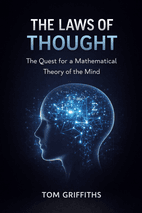
Tom Griffiths's The Laws of Thought reinterprets human cognition through computational principles, arguing our mental shortcuts are optimal solutions to complex problems. It offers a resource-rational framework for students and researchers in cognitive science and AI.
Feature
Insta.Page
Blinkist
Shortform
Summary Depth
Full Chapter-by-Chapter
15-min overview
Section-by-section guides
Audio Narration
✓
✓
✓
Visual Mindmaps
✓
✕
✕
AI Q&A
✓
✕
✕
Quizzes
✓
✕
✕
PDF Downloads
✓
✕
✓
Price
$89.99/yr
$146/yr (PRO)
$199/yr
*Competitor data last verified July 2026.
1 Page Summary
Published in 2018, The Laws of Thought by Tom Griffiths is not a historical treatise on logic but a modern exploration of how human cognition can be understood through the lens of computation and probability. The book's core argument is that many of the apparent flaws and irrationalities in human thinking are not bugs but features—optimal solutions to the fundamental computational problems our minds face. Griffiths posits that the brain operates under constraints of time, information, and processing power, making it a "resource-rational" system. He illustrates how concepts from computer science, like optimal stopping, caching, and approximation algorithms, provide powerful models for explaining why we jump to conclusions, how we manage memory, and the way we make decisions under uncertainty.
The work is situated within the contemporary intersection of cognitive science, artificial intelligence, and behavioral economics. It builds upon the legacy of Herbert Simon's concept of "bounded rationality" but updates it with the formal tools of 21st-century computational theory and Bayesian statistics. Rather than viewing the mind as a poor logical engine, Griffiths reframes it as a remarkably efficient probabilistic machine, evolved to navigate a complex and noisy world. The historical context is the ongoing dialogue between the idealized models of rational choice theory and the empirical findings of cognitive psychology, with Griffiths offering a synthesis that uses the rigor of the former to explain the phenomena of the latter.
The lasting impact of The Laws of Thought lies in its accessible yet rigorous framework for rethinking intelligence, both human and artificial. It provides a compelling bridge between the disciplines, showing how the principles guiding efficient algorithms can shed light on the structure of human thought. This perspective has significant implications for designing better AI systems that can handle uncertainty like humans do, for improving decision-making in real-world contexts, and for fostering a more nuanced understanding of our own cognitive strengths and limitations. The book ultimately argues that by studying the computational laws of thought, we can better understand what it means to be intelligently adaptive.
1. Turning Aristotle into Arithmetic
Overview
This chapter follows the long, intricate quest to transform human reasoning into a precise mathematical game. It begins in the 17th century with Gottfried Wilhelm Leibniz, a brilliant polymath obsessed with a seemingly impossible idea: could the structures of logic be described with the certainty of arithmetic? He focused on Aristotle's system of syllogisms—structured arguments like "Every wise person is pious; Some wise person is wealthy; Therefore, some wealthy person is pious"—and tried to devise a numerical code for them. He assigned conceptual terms pairs of numbers, attempting to check logical validity through divisibility. Despite his creative genius, the scheme repeatedly failed, unable to reliably turn Aristotle into calculation.
Leibniz’s work was part of a broader intellectual dream of a perfect, universal language, championed by thinkers like Descartes and John Wilkins, who designed complex symbolic systems to map concepts directly. Leibniz envisioned something more powerful: a universal characteristic where numbers captured the logical essence of ideas, allowing truth to be computed. Though unrealized, this effort helped pioneer a revolutionary view of the mind as a formal system—a digital, rule-based process of token manipulation, as medium-independent as a game of chess. This formalist perspective became a cornerstone for future theories of cognition.
The baton was picked up a century later by George Boole, a self-taught mathematician. Unaware of Leibniz's notes, he succeeded where his predecessor had stumbled. Boole created an elegant algebraic system where symbols like x and y represented classes of things. He applied operations like multiplication (for "and") and introduced a telling law: x² = x, indicating his logic dealt fundamentally with two states. He gave the symbols 1 and 0 meanings as "everything" and "nothing." With this calculus, he could translate syllogisms into equations and prove their validity through algebraic manipulation, finally achieving the dream of turning logic into reliable arithmetic.
Boole's system was refined into propositional logic, which uses truth tables to define connectives like AND and IMPLIES based on simple true/false values. This semantic approach allowed for mechanical checks of validity. But the true power emerged in shifting from meaning to pure syntax—using predefined inference rules to manipulate symbols step-by-step, discovering truth through formal derivation alone. This was the ultimate realization of Leibniz's vision: reasoning reduced to a game of symbols, potentially executable by a machine.
Boole's legacy extended far beyond his 1847 breakthrough. His academic career led him to University College Cork, and his intellectual influence lived on powerfully through his family. His widow, Mary, was a pioneering thinker, and their daughters made significant contributions to mathematics, science, and literature. This legacy subtly traces a line from structured Victorian thought to twentieth-century physics, including connections to the Manhattan Project. Yet, for nearly a century, Boolean logic remained a powerful mathematical and philosophical tool. Its potential as a blueprint for the actual mechanics of the human mind—for modeling how we really think and use language—would await its next great synthesis in the emerging fields of modern psychology and linguistics.
Leibniz's Grand Ambition: A Mathematical Mind
The chapter opens by introducing Gottfried Wilhelm Leibniz, a polymath of staggering intellect born in 1646. From a young age, he was drawn to logic, captivated by the "division and order of thoughts" it offered. As his mathematical prowess grew, he became obsessed with a singular question: could the structures of logic and human thought be described using the precision of mathematics? His early dissertation explored mathematical combinations, and by 1679, while serving as a court counselor in Hanover, he was engaged in a intense, private struggle. A series of fragmented notes reveals him repeatedly proposing and then abandoning arithmetical schemes to formalize reasoning, each attempt ending in frustration.
The Aristotelian Foundation
Leibniz chose to start his quest not with all of thought, but with a specific, well-defined subset: Aristotle's syllogisms. A syllogism is a logical argument with two premises and a conclusion, such as "Every wise person is pious; Some wise person is wealthy; Therefore, some wealthy person is pious." Aristotle's genius was in focusing on the form of the argument, not its content. He defined all possible syllogisms by limiting statements to four types ("Every A is B," "No A is B," "Some A is B," "Some A is not B") and arranging three terms (A, B, C) in three standard patterns or "Figures." This yielded 192 possible arguments, of which Aristotle identified 14 as valid.
Leibniz aimed to go beyond Aristotle's list. He sought a mathematical algorithm that could automatically identify valid syllogisms. His proposed method was ingenious: assign each conceptual term (like "wise person") a pair of numbers, one positive and one negative. The truth of a statement like "Every A is B" would be checked by seeing if A's numbers were divisible by B's. He believed that from the numerical representations of the premises, one could compute—via the properties of prime numbers—whether a conclusion was valid. Despite creative efforts, the scheme kept failing, incorrectly validating some arguments and failing on others. He could not turn Aristotle into reliable arithmetic.
The Dream of a Universal Language
Leibniz's work was part of a larger 17th-century intellectual movement: the pursuit of a perfect, universal language. Thinkers like René Descartes dreamed of a language where concepts were arranged with the orderly clarity of numbers, allowing for direct comparison and eliminating ambiguity. John Wilkins made a massive attempt with his Essay Towards a Real Character and a Philosophical Language (1668). He organized all concepts into a hierarchical tree (Genus, Difference, Species) and created written symbols and spoken words that directly reflected this structure. In this system, knowing the word for something meant understanding its place in the universe of knowledge, making nonsensical statements ("A cat is a fish") obviously false.
Leibniz envisioned something even more powerful: a universal characteristic. In his system, the numbers assigned to concepts wouldn't just indicate hierarchical position (as in Wilkins's scheme) but would capture their intrinsic logical essence. This would allow the truth of statements and the validity of inferences to be checked through calculation. He saw this as the ultimate thinking tool, a mental microscope far surpassing optical instruments. This vision was deeply connected to another of his inventions: a mechanical calculator capable of multiplication and division. He believed that if reason could be reduced to arithmetic, it could be automated.
The Birth of a Formalist Perspective
Although Leibniz never completed his system, he, along with Descartes and Wilkins, established a revolutionary way of viewing the mind: as a formal system. A formal system is defined by three key properties:
It is a token manipulation system: It has a set of symbols (tokens), initial states, and rules for how those symbols can be rearranged.
It is digital: It operates in discrete, unambiguous steps with no "in-between" states.
It is medium independent: Its logic is separate from its physical implementation.
A familiar example is the game of chess. The pieces are tokens, their starting positions are the initial state, and the movement rules govern manipulation. A move is either legal or not (digital), and the game can be played with ornate pieces, cardboard, or on a computer screen (medium independent). This contrasts with analog activities like fencing, which rely on continuous, interpretable physical motion.
By attempting to reduce thought to a formal, mathematical game, these early thinkers laid the conceptual groundwork for understanding cognition itself as a process of rule-governed symbol manipulation—a foundational idea for future cognitive science.
Key Takeaways
Gottfried Leibniz's failed attempts to mathematize Aristotle's syllogisms represent a critical early struggle to formalize human reasoning.
His work was part of a broader 17th-century pursuit of a perfect, universal language that would eliminate ambiguity by directly mapping symbols to concepts and their relationships.
Although Leibniz did not succeed, he helped pioneer the view of the mind as a formal system—a digital, rule-based, token-manipulation process that is independent of its physical medium, much like a game of chess. This formalist perspective became a cornerstone of later cognitive theory.
Boole's Algebraic Logic
George Boole, a self-taught mathematician and schoolteacher, independently took up Leibniz's challenge of creating a formal system for thought. His unique education, steeped in both classical languages and the abstract algebraic calculus of French mathematicians, prepared him for this task. The spark came from a public feud between logicians Augustus De Morgan and William Hamilton. Boole saw a path to resolve it mathematically, leading to a period of intense, almost obsessive work where he would rise in the middle of winter nights to jot down his racing thoughts.
He published his breakthrough, The Mathematical Analysis of Logic, in a matter of weeks, but spent years refining it into his masterpiece, An Investigation of the Laws of Thought. His goal was explicit: to uncover the fundamental laws of reasoning and express them in a symbolic calculus.
Boole's system was elegantly simple. He let symbols like x and y stand for classes of things (e.g., "white things," "sheep"). He then applied the machinery of algebra:
The combination xy (meaning x × y) represented the class of things that are both x and y ("white sheep").
He established rules like xy = yx (commutativity) and a surprising new law: x² = x. This law, which only holds true in ordinary algebra if x is 0 or 1, revealed that his system was fundamentally about two states.
The symbols 1 and 0 took on special meanings: 1 for the universal class (everything), and 0 for the empty class (nothing).
With this framework, Boole could translate Aristotle's syllogisms into algebraic equations. For example, "Every A is B" became a = ab. Proving a syllogism valid then became a matter of algebraic manipulation. If you know a = ab and b = bc, you can substitute to get a = abc, then a = ac, proving "Every A is C." Boole had successfully turned Aristotle's verbal logic into arithmetic.
From Classes to Propositions: Truth Tables
While revolutionary, Boole's system had limitations. Later logicians refined it, leading to the development of propositional logic—a simpler system dealing with statements that are either true (T) or false (F). Propositions (e.g., P="It rained," Q="The grass is wet") are combined using logical connectives defined by truth tables.
These tables precisely define operations like AND (˄), OR (˅), NOT (¬), and IMPLIES (→). For instance, P ˄ Q is only true if both P and Q are true. The definition of P → Q is particularly important: it is only false when P is true and Q is false; it is considered true if P is false, regardless of Q.
Truth tables provide a mechanical, semantic way to check the validity of an argument by examining all possible combinations of truth values. For example, the classic valid form modus ponens (If P then Q; P is true; therefore Q) can be proven by showing there is no possible world where the premises are true and the conclusion false.
Syntax Over Semantics: The Power of Inference Rules
The true power of logic lies in moving from semantics (meaning and truth tables) to syntax (symbol manipulation). Instead of laboriously checking massive truth tables for every complex argument, we can use simple, pre-verified inference rules—like modus ponens—as building blocks.
For example, from the premises (P ˅ Q) → R and P ˄ S, we can syntactically derive R:
From P ˄ S, infer P.
From P, infer P ˅ Q.
From P ˅ Q and (P ˅ Q) → R, use modus ponens to infer R.
This reduction of discovering truth to following formal rules was the monumental step envisioned by Descartes and Leibniz. It suggested that thought itself could be modeled as a game of symbolic manipulation, potentially executable by a machine.
A Lasting Legacy
Boole's academic success led him to become a professor at University College Cork, where he married Mary Everest. His life was tragically cut short by pneumonia at age 49. His intellectual legacy, however, was powerfully extended by his family.
His widow, Mary Boole, was a pioneering writer and mathematical psychologist. Their five daughters achieved extraordinary things:
Mary Ellen married mathematician Charles Hinton, a pioneer in visualizing the fourth dimension.
Margaret was the mother of Sir Geoffrey Taylor, a famed mathematical physicist on the Manhattan Project.
Alicia became an intuitive geometer who made significant discoveries about four-dimensional shapes through visualization.
Lucy was the first woman professor at the London School of Medicine for Women.
Ethel was a successful novelist and married Wilfrid Voynich, namesake of the Voynich manuscript.
Through his work and his family, George Boole's vision of formalizing thought left an indelible mark on mathematics, logic, and science.
The narrative now reveals the fascinating legacy of the Hinton family, tracing a direct line from the Victorian mathematician and educator James Hinton to the twentieth century’s most pivotal scientific endeavors. His descendants made remarkable contributions, including Joan Hinton, a nuclear physicist who worked on the Manhattan Project—a poignant connection between a family devoted to structured thought and the era-defining application of scientific logic.
This historical thread subtly sets the stage for understanding George Boole’s true impact. His great innovation was to liberate logic from philosophy and language, transforming it into a precise, abstract algebra of thought. He demonstrated that the principles of valid reasoning could be expressed through symbolic equations, much like the rules of arithmetic. This created a formal system where symbols like x, y, and + or × could represent logical classes and operations.
For nearly a century, Boolean logic existed primarily as a powerful mathematical and philosophical tool. Its revolutionary potential for modeling the mechanics of the mind remained untapped. The chapter closes by pointing forward to the next great synthesis: it would take the rise of modern psychology and linguistics in the twentieth century for scholars to finally test Boole’s system not just as a theory of correct thought, but as a potential blueprint for the actual processes of human reasoning and language.
Key Takeaways
The Hinton family legacy illustrates a direct historical through-line from Victorian mathematical thought to modern physics.
George Boole’s seminal achievement was creating a formal, algebraic system for logic, making reasoning computable.
While revolutionary, Boolean logic would not be applied as a theory of human cognition until a century later, bridging mathematics to psychology and linguistics.
Key concepts: 1. Turning Aristotle into Arithmetic
1. Turning Aristotle into Arithmetic
Leibniz's Grand Ambition: A Mathematical Mind
Polymath Gottfried Wilhelm Leibniz sought to describe logic with mathematical precision
Focused on formalizing Aristotle's syllogisms through numerical coding
Proposed checking logical validity via divisibility of assigned number pairs
Despite creative efforts, his arithmetical schemes repeatedly failed
The Aristotelian Foundation
Aristotle's syllogisms provided a structured starting point with defined forms
Syllogisms use four statement types and three terms arranged in standard Figures
Aristotle identified 14 valid arguments out of 192 possible combinations
Leibniz aimed to create a mathematical algorithm to automatically identify validity
The Dream of a Universal Language
Part of broader intellectual movement for a perfect, universal language
Thinkers like Descartes and John Wilkins designed symbolic systems to map concepts
Leibniz envisioned a 'universal characteristic' where numbers captured logical essence
Pioneered view of mind as formal system—rule-based token manipulation independent of medium
Boole's Breakthrough: Algebraic Logic
George Boole created an elegant algebraic system for logic unaware of Leibniz's work
Used symbols (x, y) to represent classes with operations like multiplication for 'and'
Introduced fundamental law x² = x, indicating logic of two states
Assigned meanings to 1 ('everything') and 0 ('nothing') in his calculus
From Boolean Algebra to Formal Systems
Boole's system refined into propositional logic with truth tables for connectives
Shifted from meaning to pure syntax using predefined inference rules
Enabled mechanical checks of validity through symbolic manipulation
Realized Leibniz's vision of reasoning as executable symbolic game
Boolean Legacy and Future Impact
Boole's family continued his intellectual legacy through mathematics and science
Boolean logic remained philosophical/mathematical tool for nearly a century
Potential as blueprint for actual mechanics of human mind awaited later synthesis
Connected structured Victorian thought to twentieth-century fields including physics
The 17th-Century Pursuit of a Universal Language
Descartes and Wilkins envisioned a perfect language where concepts were arranged with numerical clarity to eliminate ambiguity.
John Wilkins created a hierarchical tree of concepts (Genus, Difference, Species) with symbols reflecting this structure.
In Wilkins's system, knowing a word meant understanding its place in knowledge, making nonsensical statements obviously false.
Leibniz aimed for a 'universal characteristic' where numbers captured logical essence, not just hierarchical position.
Leibniz connected this to his mechanical calculator, believing reason reduced to arithmetic could be automated.
The Mind as a Formal System
Leibniz, Descartes, and Wilkins pioneered viewing the mind as a formal system of token manipulation.
A formal system is defined by three properties: token manipulation, digital operation, and medium independence.
Chess exemplifies a formal system with discrete rules, digital states, and implementation-independent logic.
This formalist perspective framed cognition as rule-governed symbol manipulation, foundational for cognitive science.
The approach contrasted with analog activities like fencing, which rely on continuous physical interpretation.
George Boole's Algebraic Logic
Boole independently created a formal system for thought, inspired by a feud between logicians De Morgan and Hamilton.
He used algebraic symbols (x, y) to represent classes of things and operations like xy for intersection ('white sheep').
Boole introduced the law x² = x, revealing his system was fundamentally about two states (0 and 1).
He assigned 1 to the universal class (everything) and 0 to the empty class (nothing).
Boole successfully translated Aristotle's syllogisms into algebraic equations, proving validity through manipulation.
Refinement to Propositional Logic and Truth Tables
Later logicians refined Boole's system into propositional logic, dealing with statements as true or false.
Logical connectives (AND, OR, NOT, IMPLIES) are precisely defined using truth tables.
Truth tables provide a complete digital specification of logical operations, e.g., P ∧ Q is true only if both are true.
The IMPLIES operation (→) is defined as false only when the antecedent is true and consequent is false.
This development simplified and generalized logical analysis beyond class-based reasoning.
Truth Tables as Mechanical Validity Checks
Provide a semantic method to verify argument validity by examining all possible truth value combinations.
Can prove classic valid forms like modus ponens by showing no scenario exists where premises are true and conclusion false.
Offer a systematic way to check logical consistency across all possible worlds.
Syntax Over Semantics: The Power of Inference Rules
Moves logic from semantics (meaning/truth tables) to syntax (symbol manipulation).
Uses pre-verified inference rules like modus ponens as building blocks for complex derivations.
Enables step-by-step symbolic proofs without exhaustive truth table checks.
Suggests thought itself could be modeled as formal symbolic manipulation, potentially executable by a machine.
Boole's Personal Legacy and Family Impact
Boole's life was cut short by pneumonia at age 49, but his intellectual legacy continued through his family.
His widow, Mary Boole, was a pioneering writer and mathematical psychologist.
His five daughters achieved extraordinary success in mathematics, science, medicine, and literature.
Family connections include Charles Hinton (fourth-dimension visualization) and Sir Geoffrey Taylor (Manhattan Project physicist).
Boole's Conceptual Innovation: Algebra of Thought
Liberated logic from philosophy and language, transforming it into a precise, abstract algebra.
Demonstrated that valid reasoning principles could be expressed through symbolic equations like arithmetic.
Created a formal system where symbols represent logical classes and operations.
His system remained primarily a mathematical/philosophical tool for nearly a century before being applied to cognition.
Historical Through-line and Forward Outlook
The Hinton family legacy connects Victorian mathematical thought to 20th-century physics.
Boolean logic's potential for modeling mental mechanics remained untapped for decades.
The stage is set for the next synthesis: applying Boolean logic to human reasoning and language processes.
Requires 20th-century developments in psychology and linguistics to test Boole's system as a blueprint for actual thought.
💡 Try clicking the AI chat button to ask questions about this book!
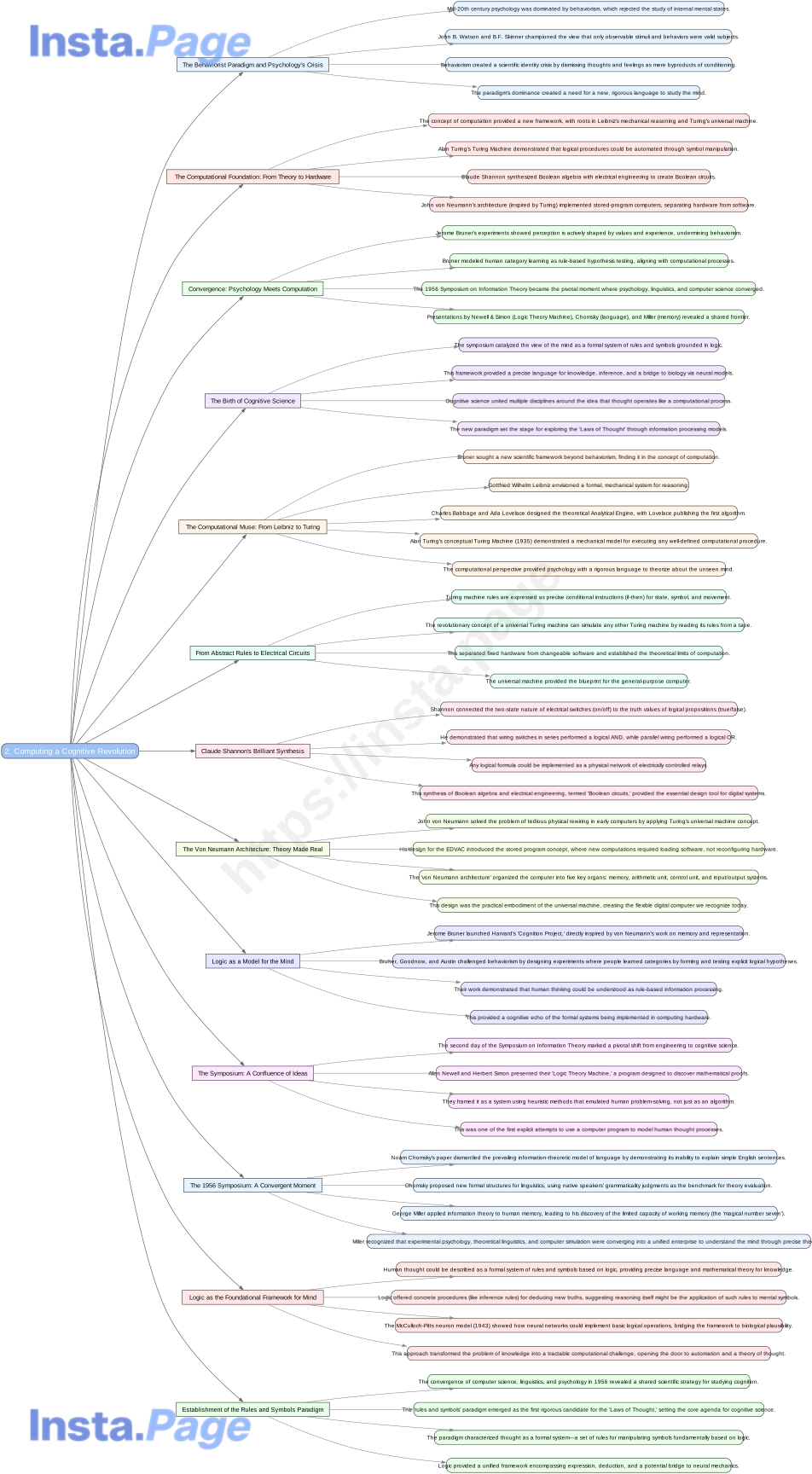
2. Computing a Cognitive Revolution
Overview
In the mid-20th century, psychology was gripped by a scientific identity crisis, dominated by behaviorism, which insisted that only observable stimuli and behaviors were valid subjects of study, dismissing internal mental states as irrelevant. This paradigm, championed by figures like John B. Watson and B.F. Skinner with his radical behaviorism, treated thoughts and feelings as mere byproducts of environmental conditioning. But challenges were brewing; Jerome Bruner's experiments on perception revealed that people don't all experience the same objective reality—our minds actively shape what we see based on values and past experiences, directly undermining behaviorist assumptions.
Seeking a rigorous new language for the mind, pioneers looked to the emerging concept of computation. This idea had a rich lineage, from Gottfried Wilhelm Leibniz's dreams of mechanical reasoning to Alan Turing's breakthrough Turing Machine, an abstract model showing that any logical procedure could be automated through symbol manipulation. Turing's concept of a universal machine, which could simulate any other by reading instructions from a tape, brilliantly separated fixed hardware from changeable software, providing a theoretical foundation for general-purpose computers.
This abstract theory soon sparked practical innovation. Claude Shannon made a dazzling leap by synthesizing Boolean algebra with electrical engineering, demonstrating that networks of switches could physically implement logical operations, creating Boolean circuits. John von Neumann then brought these ideas to life, drafting the von Neumann architecture for the EDVAC computer. Inspired by Turing's universal machine and loosely analogized to the human brain, this design featured a stored program in memory, allowing flexible computation without physical rewiring.
Psychologists quickly recognized the potential. Bruner, influenced by von Neumann's work, launched experiments where people learned categories by forming and testing logical hypotheses, not through gradual association. This demonstrated that human thinking could be modeled as rule-based information processing, echoing the formal systems being built in silicon. The pivotal moment arrived at the 1956 Symposium on Information Theory, where these threads converged. Allen Newell and Herbert Simon presented their Logic Theory Machine, a program that used heuristic methods to emulate human problem-solving. Noam Chomsky followed by dismantling behaviorist-friendly models of language, proposing new formal structures based on grammaticality judgments. George Miller shared research applying information theory to memory, soon leading to his famous "magical number seven" concept.
Together, these presentations revealed a shared frontier: understanding the mind as a formal system of rules and symbols grounded in logic. This framework offered a precise language for knowledge, inference rules for deduction, and even a bridge to biology through the McCulloch-Pitts neuron model, which showed how neural networks could compute logical functions. The symposium catalyzed the birth of cognitive science, uniting psychology, linguistics, and computer science around the idea that thought itself operates like a computational process, setting the stage for decades of exploration into the Laws of Thought.
The 1956 Symposium and the Crisis in Psychology
The attendees gathering at MIT on September 11, 1956, were unaware they were witnessing the birth of modern cognitive science. For decades, psychology had grappled with a fundamental problem: its subject—the mind—could not be directly observed or measured. Early pioneers like Wilhelm Wundt and William James relied on inferring mental states from measurable behaviors, such as reaction times in sound experiments, to theorize about attention and consciousness.
This indirect approach bred anxiety about scientific rigor, leading to the rise of behaviorism. This school of thought argued psychology should concern itself only with observable stimuli and behaviors, dismissing internal states like thoughts and feelings as irrelevant or even illusory. By that September morning, behaviorism was psychology's dominant paradigm.
The Foundations of Behaviorism
The behaviorist movement was formally launched in 1913 by John B. Watson, who declared psychology must become a purely objective science focused on predicting and controlling behavior, with no reliance on introspection. His famous "Little Albert" experiment aimed to show complex emotions like fear were merely learned responses. After a scandal ended his academic career, Watson applied his insights to advertising.
The torch was carried by B.F. Skinner, who developed radical behaviorism. While acknowledging thoughts and feelings exist, he insisted they should not be used to explain behavior. Instead, he argued, they are themselves a form of behavior to be explained by the same principles of learning (operant conditioning) observed in animals. Concepts like knowledge and memory, for Skinner, were simply labels for how our behavior is changed by environmental contingencies.
Early Cracks in the Behaviorist Framework
Even as Skinner taught at nearby Harvard, the limitations of behaviorism were being exposed. Psychologist Jerome Bruner, whose own experience with blindness shaped his interest in internal mental models, conducted pioneering studies on perception. In one key experiment with Cecile Goodman, children overestimated the size of coins, with poorer children exaggerating sizes more than wealthier ones.
This work suggested a radical idea: people do not all experience the same objective environment identically. Our perception is shaped by internal factors like value and personal history. This was a direct challenge to behaviorism, which depended on measurable, objective stimuli. Bruner drew inspiration from literature, seeing in Shakespeare and Faulkner the truth that the "experienced world" is constructed by the mind.
The Computational Muse: From Leibniz to Turing
Bruner realized that to move beyond behaviorism scientifically, psychology needed a new framework for conceptualizing the mind. He found it in the emerging idea of computation. This concept had a long gestation:
Gottfried Wilhelm Leibniz envisioned a formal, mechanical system for reasoning.
Charles Babbage and Ada Lovelace designed the theoretical Analytical Engine, a general-purpose mechanical computer, with Lovelace notably writing the first published algorithm.
The critical leap came from Alan Turing. In 1935, he conceptualized a simple abstract device—the Turing Machine. It consisted of an infinite tape, a read/write head, and a finite set of rules based on its internal state and the symbol it read. Turing demonstrated that such a machine could, in principle, execute any well-defined computational procedure.
This was the breakthrough: a formal, mechanical model for manipulating symbols according to rules—a potential blueprint for a "thinking machine" that could automate logical and mathematical processes. This computational perspective would provide the rigorous new language psychology needed to theorize about the unseen mind.
From Abstract Rules to Electrical Circuits
The chapter builds on the idea of inference rules by showing how they can be expressed as precise instructions for a Turing machine. Each rule is a conditional statement: if the machine is in a certain state and reads a certain symbol, then it writes a new symbol, changes state, and moves its head. Simple examples illustrate machines that erase data or count parity, but the revolutionary leap is Alan Turing’s concept of a universal machine. This single, theoretical device can simulate any other Turing machine by reading its rules from a tape, effectively separating the fixed hardware from the changeable software. This foundational idea established the limits of computation—proving some problems are unsolvable by any machine—while simultaneously providing the blueprint for a general-purpose computer.
Claude Shannon’s Brilliant Synthesis
While Turing theorized, a young Claude Shannon made a breathtakingly practical connection at MIT. Working on complex switch controllers for analog computers, he recalled his studies in logic. He realized the two-state nature of electrical switches (on/off) perfectly mirrored the truth values of logical propositions (true/false). He demonstrated that wiring switches in series performed a logical AND, while wiring them in parallel performed a logical OR. By using electrically controlled relays, which could themselves trigger other circuits, he showed that any logical formula could be implemented as a physical network of switches. This synthesis of Boolean algebra and electrical engineering, which he delightfully termed "Boolean circuits," provided the essential design tool for building complex digital systems.
The Von Neumann Architecture: Theory Made Real
The paths of Turing and Shannon converged in Princeton, drawn into the orbit of the polymath John von Neumann. Confronted with the tedious, weeks-long rewiring required by early computers like the ENIAC, von Neumann saw the solution in Turing’s universal machine. He drafted the design for the EDVAC, a computer with a stored program. Its "von Neumann architecture" organized the machine into five key organs, inspired by the human brain: a memory (like Turing's tape), an arithmetic unit, a control unit, and input/output systems. This design meant a new computation required only loading a new program into memory, not physically reconfiguring the machine. It was the practical embodiment of the universal machine, creating the flexible digital computer we recognize today.
Logic as a Model for the Mind
This computational revolution sparked a parallel revolution in psychology. Psychologist Jerome Bruner, inspired by von Neumann’s work on memory and representation at the Institute for Advanced Study, returned to Harvard to launch a "Cognition Project." He, along with Jacqueline Goodnow and George Austin, challenged behaviorism by using logic to model human thought. They designed elegant experiments where people learned new categories (like "black circles") from cards with varying attributes. Participants didn't learn through gradual association; they formed and tested explicit logical hypotheses. This demonstrated that human thinking could be understood as rule-based information processing—a direct cognitive echo of the formal systems being implemented in silicon and wire.
The Symposium: A Confluence of Ideas
The second day of the Symposium on Information Theory marked a pivotal shift from pure engineering to cognitive science. Allen Newell and Herbert Simon presented their "Logic Theory Machine," a program designed to discover mathematical proofs. Crucially, they framed it not as a mere algorithm but as a system relying on heuristic methods that emulated human problem-solving. This was one of the first explicit attempts to use a computer to model human thought processes.
Following this, Noam Chomsky delivered his landmark paper, "Three Models for the Description of Language." He systematically dismantled the prevailing mathematical model of language used by information theorists (and implicitly endorsed by behaviorists) by presenting simple English sentences it could not explain. In its place, he proposed new formal structures that could capture linguistic complexity, using native speakers' grammaticality judgments as the benchmark for evaluating theories. This set a new, rigorous agenda for linguistics.
The session concluded with George Miller's own work, where he applied information theory to human memory. This research would soon crystallize into his famous paper on the "magical number seven," describing the limited capacity of human working memory. For Miller, the symposium was a revelation. He intuitively grasped that experimental psychology, theoretical linguistics, and computer simulation were converging into a single, larger enterprise aimed at understanding the mind through precise, testable theories.
Logic as the Foundational Framework
The collective work presented in 1956, from Bruner’s category learning to the symposium's papers, converged on a powerful idea: human thought could be described as a formal system of rules and symbols based on logic. This approach offered compelling answers to fundamental questions about the mind.
Abstractly, logic provided a precise language (with propositions, conjunctions, etc.) for expressing facts and concepts, alongside a mathematical theory for determining truth. It turned the problem of knowledge into a tractable computational challenge. Concretely, it offered procedures—inference rules like modus ponens—for deducing new truths from old ones. This syntactic process not only opened the door to computer automation but also suggested a theory of thought itself: perhaps reasoning is just the application of such rules to mental symbols.
This logical framework even extended to a theory of the brain. The 1943 paper by Warren McCulloch and Walter Pitts, "A Logical Calculus of the Ideas Immanent in Nervous Activity," showed how networks of simplified neurons could implement basic logical operations (AND, OR, NOT). By using excitatory and inhibitory connections, neural circuits could, in principle, compute logical functions, providing a biological plausibility to the idea of the brain as a symbol-processing machine.
Key Takeaways
The 1956 Symposium on Information Theory was a catalytic event where computer science (Newell & Simon's AI), theoretical linguistics (Chomsky's formal models), and experimental psychology (Miller's memory work) converged, revealing a shared scientific strategy for studying the mind.
The dominant theme emerging from this period was the characterization of thought as a formal system—a set of rules for manipulating symbols, fundamentally based on logic.
Logic offered a unified framework: a language for precise expression, a method for deduction (inference rules), and even a potential bridge to neural mechanics via the McCulloch-Pitts neuron model.
This "rules and symbols" paradigm established itself as the first rigorous candidate for the "Laws of Thought," setting the agenda for the nascent field of cognitive science.
3. Solving Problems
Overview
In the bustling labs of the postwar RAND Corporation, a moment of clarity struck Herbert Simon as he watched a computer generate radar maps. He realized machines could manipulate abstract symbols, not just numbers, echoing Ada Lovelace's old idea and setting the stage for a new era of problem-solving. Alongside Allen Newell and Clifford Shaw, Simon shifted from chess to logic, crafting the Logic Theorist—a program that proved mathematical theorems by acting out human-like reasoning steps. This wasn't just about games or math; it tackled a universal hurdle: the overwhelming "tree" of choices in any formal system, where each decision branches into countless possibilities.
To navigate this tree, the trio drew on diverse backgrounds—Newell's physics, Simon's logic, and Shaw's programming—blending heuristics from puzzle-solving guides with technical skill. Their work evolved into the General Problem Solver (GPS), which used means-ends analysis to chip away at gaps between problems and solutions. Yet, human thought proved even more structured, leading to production systems: flexible "if-then" rules that model everything from basic computations to deep reasoning. This crystallized into the physical symbol system hypothesis, suggesting that intelligence, whether human or artificial, springs from physical machines manipulating symbols.
This idea fueled twin missions: cognitive science simulates our minds with symbol systems, while AI builds them to act smart. Projects like encoding common sense into millions of rules show both ambition and limits, as seen in chatbots such as Eugene Goostman. These rule-based approaches can mimic conversation by leaning on human input, but they often stumble on nuance, revealing that complexity in behavior often comes from simple rules clashing with intricate environments—much like an ant's winding path on a beach.
Ultimately, the journey highlights that intelligence isn't just a solo feat; it's deeply social. Newell and Simon's partnership exemplified how collaboration sparks creativity, and humans flourish by guiding each other through problems. From symbolic insights to social bonds, this chapter paints a picture where machines and minds meet, reminding us that solving puzzles is as much about connection as it is about computation.
The Postwar Laboratory and a Symbolic Insight
In the aftermath of World War II, the newly formed RAND Corporation continued the military's focus on complex problem-solving. One of its projects, the Systems Research Laboratory, created simulated military environments using human participants to study organizational decision-making. It was here, in 1952, that political scientist and economist Herbert Simon, serving as a consultant, witnessed a pivotal moment. Watching scientists Allen Newell and Clifford Shaw generate simulated radar maps on a computer, Simon realized the machine was manipulating not just numbers, but abstract symbols. This echoed Ada Lovelace's century-old idea and fundamentally shifted his perspective: computers could be general-purpose symbol processors.
This insight, combined with a later talk by John von Neumann on computer chess, set a new direction. During a long drive in 1954, Newell and Simon discussed creating a chess-playing program. Their goal, however, was not chess itself, but using it as a vehicle to understand how to tackle "ultracomplicated problems." Newell, joined by programmer Clifford Shaw, began testing ideas on RAND's JOHNNIAC computer, eventually moving to Pittsburgh to collaborate formally with Simon.
The Birth of the Logic Theorist
The trio's project evolved from chess to geometry and finally settled on the domain of mathematical logic. By late 1955, they knew they could write a program to prove logical theorems. In a dramatic classroom announcement in January 1956, Simon declared, "Over the Christmas holiday, Al Newell and I invented a thinking machine."
The "machine" was initially human. Simon demonstrated the concept by having his family and students act out the program's steps using cards, successfully proving theorems. Meanwhile, Newell and Shaw worked to translate this into code for the JOHNNIAC. Their fully automated Logic Theorist produced its first proof on August 9, 1956, shortly after the program was presented at the seminal Dartmouth workshop where the term "artificial intelligence" was coined.
The Unifying Challenge: Searching a Tree of Choices
Chess, geometry, and logic are all formal systems—sets of rules and symbols. Working within any such system immediately presents a core problem: an overwhelming number of choices about which rule to apply next. In chess, for instance, the possible positions branch out exponentially from the opening move, creating a vast "tree" of possibilities. The same branching occurs when constructing a mathematical proof by applying inference rules. The challenge is navigating this enormous tree efficiently without examining every single branch.
Paths to a Solution: Diverse Backgrounds Converge
Newell, Simon, and Shaw arrived at this problem from different backgrounds:
Allen Newell, a physicist by training, was inspired by mathematician George Pélya's book How to Solve It, which analyzed heuristic strategies for proof-discovery.
Herbert Simon, interested in the logic of organizations, had studied mathematical logic under philosopher Rudolf Carnap and was familiar with Bertrand Russell and Alfred North Whitehead's Principia Mathematica, which aimed to ground all mathematics in logic.
Clifford Shaw, a mathematician and programmer, provided the essential technical skill to implement their ideas on the JOHNNIAC.
Logic Theorist combined these strands. It operated on the logical system of Principia Mathematica, using heuristics from Pélya—like working backward from a goal or looking for analogous proofs—to guide its search through the tree of possible inferences. Shaw developed a new "information-processing language" based on lists to manage this search process effectively.
The program succeeded, proving several theorems from Principia Mathematica and even finding a more elegant proof for one. When informed, Bertrand Russell replied with witty admiration for the machine that had bested a decade of his and Whitehead's manual labor.
From Specific Problems to a General Architecture
Studying how people actually solved logic problems revealed a dominant heuristic not fully captured by Logic Theorist: means-ends analysis. This strategy involves identifying the difference between your current state and your goal, then taking an action to reduce that difference.
Newell, Shaw, and Simon embedded this heuristic into a new program called the General Problem Solver (GPS), designed to work across multiple domains like logic and algebra. However, when analyzing how people solved complex puzzles like cryptarithmetic (e.g., SEND + MORE = MONEY), Newell realized GPS still fell short. People weren't just searching a tree; they were setting sub-goals and manipulating symbols in a more structured way.
The solution, outlined by Newell in 1967, was the production system—a set of "if-then" rules where a specific condition ("if") triggers a specific action ("then"). This architecture proved remarkably powerful. A simple production system could, for example, perform computations like converting binary numbers to strings of symbols. More complex sets of productions could model the sophisticated, goal-directed steps a human takes when reasoning through a difficult puzzle. This framework became the foundation for Newell and Simon's subsequent monumental work on human cognition.
Physical Symbol Systems
In their 1976 Turing Award speech, Newell and Simon presented a compelling framework for understanding intelligence: the physical symbol system. This is a physical machine, like a digital computer, that produces and manipulates symbol structures representing objects and their behaviors in the world. They boldly hypothesized that such a system possesses the necessary and sufficient means for general intelligent action. The necessity claim implies that any intelligent system will be a physical symbol system, while sufficiency suggests that building one is all we need to achieve intelligence.
Exploring the Hypothesis Through AI and Cognition
Testing this hypothesis became a dual endeavor. Cognitive science uses physical symbol systems modeled on computers to simulate human thought processes, with Simon believing that all aspects of human thinking could eventually be captured this way. Meanwhile, AI researchers build systems to exhibit intelligent behavior, pushing the boundaries of what rules and symbols can achieve. This inspired ambitious projects like Doug Lenat's, which spent decades encoding over twenty-five million rules to capture common sense—the tacit knowledge humans use daily, such as understanding that people typically sleep at night in specific ways.
Chatbots and the Illusion of Conversation
A practical application of rule-based systems emerged in chatbots, designed to engage in human-like dialogue. Alan Turing's imitation game, where a machine tries to fool judges into thinking it's human, found a contender in Eugene Goostman, a chatbot that simulated a thirteen-year-old Ukrainian boy. At a 2014 Turing test, it convinced a third of judges by relying on a massive set of if-then rules. While it could handle common queries, its limitations were exposed in exchanges with computer scientist Scott Aaronson, where it gave evasive or nonsensical answers to deeper questions. This showed both the power and the fragility of rule-based approaches.
Simplicity in a Complex World
Simon's parable of an ant on a beach offers a profound insight: the ant's winding path appears complex, but much of that complexity comes from the beach's contours, not the ant itself. Similarly, human behavior might be guided by relatively simple rules, with environmental complexity shaping our actions. This perspective helps explain how chatbots can seem intelligent in conversations—they rely on humans to provide rich input, allowing simple response rules to suffice. It reframes the challenge of AI as one of understanding how basic mechanisms interact with intricate settings.
The Social Dimension of Intelligence
Newell and Simon's legacy extends beyond technical models to the human aspects of problem-solving. They demonstrated how heuristics and production systems could break down complex tasks like chess or logic into manageable goals. Their partnership itself exemplified a key heuristic: combining complementary minds to enhance creativity and insight. Simon, reflecting on human needs, emphasized that we thrive not just on solving problems but on connecting with others, creating environments where we guide and support each other's journeys.
Key Takeaways
Physical symbol systems, which physically instantiate rules and symbols, form a foundational theory for both human and artificial intelligence.
Rule-based approaches have enabled significant advances in modeling cognition and creating AI, such as chatbots that mimic conversation.
Complexity in behavior often arises from simple rules interacting with complex environments, reducing the need for intricate internal mechanisms.
Projects like encoding common sense knowledge highlight the ambition of rule-based AI but also reveal practical challenges in capturing human nuance.
Human intelligence is deeply social, with collaboration and environmental shaping playing crucial roles in problem-solving and creativity.
Key concepts: 3. Solving Problems
3. Solving Problems
The Symbolic Insight and Postwar Context
Herbert Simon's realization at RAND that computers could manipulate abstract symbols, not just numbers
Echoed Ada Lovelace's century-old idea of general-purpose computation
Shifted perspective from numerical calculation to symbolic processing as foundation for intelligence
Collaboration between Simon, Allen Newell, and Clifford Shaw began with chess as test domain
Development of the Logic Theorist
Program evolved from chess to mathematical logic as test domain
Simon's dramatic 1956 announcement: 'Over the Christmas holiday, Al Newell and I invented a thinking machine'
Initial demonstration used humans acting out program steps with cards
First automated proof produced August 9, 1956, shortly after Dartmouth AI workshop
The Core Problem: Searching Formal Systems
Chess, geometry, and logic all present the same fundamental challenge
Working within formal systems creates overwhelming 'tree' of choices
Each decision branches into countless possibilities requiring efficient navigation
Exponential branching makes exhaustive search impossible for complex problems
Interdisciplinary Collaboration and Heuristics
Newell brought physics background and inspiration from George Pélya's heuristic strategies
Simon contributed logic training under Rudolf Carnap and familiarity with Principia Mathematica
Shaw provided essential programming expertise on the JOHNNIAC computer
Diverse backgrounds enabled blending of heuristics with technical implementation
Evolution to General Problem Solving
Logic Theorist evolved into General Problem Solver (GPS) using means-ends analysis
Human thought modeled through production systems (if-then rules)
Physical symbol system hypothesis: intelligence emerges from physical machines manipulating symbols
Dual missions emerged: cognitive science (simulating minds) and AI (building intelligent systems)
Limits and Social Dimensions of Intelligence
Rule-based approaches can mimic conversation but stumble on nuance
Complex behavior often emerges from simple rules in intricate environments
Intelligence is fundamentally social, exemplified by Newell and Simon's partnership
Human flourishing depends on collaborative problem-solving and guidance
Logic Theorist: Bridging Heuristics and Computation
Combined Polya's heuristics with the logical system of Principia Mathematica
Used strategies like working backward and analogy to guide search through inference trees
Developed a new list-based information-processing language to manage search effectively
Successfully proved theorems and found a more elegant proof than the original
General Problem Solver and Means-Ends Analysis
Means-ends analysis identified as a dominant human heuristic: reducing differences between current state and goal
GPS was designed to apply this heuristic across multiple domains like logic and algebra
Analysis of complex puzzles revealed GPS limitations in modeling human sub-goal setting
Led to the development of the production system architecture
Production Systems: Foundation for Cognitive Modeling
Architecture based on 'if-then' rules where conditions trigger specific actions
Proved powerful for modeling both simple computations and complex human reasoning
Became the foundation for Newell and Simon's work on human cognition
Could model sophisticated, goal-directed steps in problem-solving
Physical Symbol System Hypothesis
Intelligence arises from physical machines that produce and manipulate symbol structures
Hypothesis: Such systems are necessary and sufficient for general intelligent action
Necessity claim: Any intelligent system will be a physical symbol system
Sufficiency claim: Building such a system is all that's needed to achieve intelligence
Testing the Hypothesis: AI and Cognitive Science
Cognitive science uses physical symbol systems to simulate human thought processes
AI researchers build systems to exhibit intelligent behavior through rules and symbols
Inspired ambitious projects like encoding common sense knowledge with millions of rules
Revealed both the potential and challenges of capturing human tacit knowledge
Rule-Based Chatbots and the Turing Test
Practical application of rule-based systems in conversational agents
Eugene Goostman demonstrated both capabilities and limitations of rule-based approaches
Could handle common queries but failed on deeper, more nuanced questions
Showed the illusion of intelligence through environmental interaction rather than deep understanding
Simplicity in Complex Environments
Simon's ant parable: complex behavior emerges from simple rules interacting with complex environments
Environmental complexity shapes actions more than intricate internal mechanisms
Chatbots appear intelligent because humans provide rich input to simple response rules
Reframes AI challenge as understanding basic mechanisms in intricate settings
Social and Collaborative Dimensions of Intelligence
Newell and Simon's partnership exemplified heuristic of combining complementary minds
Human intelligence thrives on connection, not just problem-solving
Creating environments for mutual guidance and support enhances creativity
Social collaboration plays crucial role in breaking down complex tasks
4. Language as a Formal System
Overview
The chapter traces Noam Chomsky's journey from a dissatisfied student to a revolutionary figure who reshaped linguistics. It begins with his formative years, deeply influenced by his upbringing and mentorship under Zellig Harris, where he grew disillusioned with the behaviorist, cataloguing methods of his time. This led to his core insight: language should be studied not as collected speech, but as a formal system of rules that generates sentences.
This insight positioned him directly against the prevailing view in information theory, which treated language as a statistical problem of predicting word sequences. Chomsky famously dismantled this model with the sentence “Colorless green ideas sleep furiously,” demonstrating that grammaticality depends on abstract structure, not the probability of words co-occurring.
He then introduced a rigorous, mathematical framework for understanding this structure. He defined a grammar as a formal device that specifies all valid sentences. He evaluated three progressively powerful models: inadequate finite-state grammars (which mirrored the flawed statistical view), more robust phrase-structure grammars (which used hierarchical rules), and his culminating model, transformational grammar. This model proposed that a simple core of kernel sentences, generated by phrase-structure rules, could be manipulated by transformational rules to produce the vast surface complexity of real language.
This work led to the establishment of the Chomsky hierarchy, a classification of formal languages by their generative power. A central question became where human languages fit, with evidence suggesting they are at least mildly context-sensitive. The power of this formal approach was its ability to explain fundamental cognitive traits: the productivity of language (creating infinite novel sentences), its hierarchical organization, and its compositionality.
The implications were profound, extending beyond linguistics to inspire fields from music to computer science. However, this formal, rule-based view of mind created a major puzzle: if the rules are so complex, how do children learn them so effortlessly from limited data? This is the core of the poverty of the stimulus argument. Chomsky contended that such rapid, uniform acquisition is impossible without significant innate knowledge—a biologically endowed “language organ.” This was framed as a modern solution to Plato's problem of knowledge, further sharpened by the logical problem of language acquisition, which questions how learners can ever definitively rule out incorrect grammatical hypotheses.
Chomsky's Formative Years
At twenty-seven, Noam Chomsky took the stage at the 1956 Symposium on Information Theory, a young professor whose massive manuscript, The Logical Structure of Linguistic Theory, had just been rejected. His audience included luminaries like Claude Shannon, mathematicians dedicated to the theory of communication. Chomsky intended to tell them their understanding of language was fundamentally flawed.
His own path to this moment was deeply influenced by his upbringing. The son of a Hebrew scholar, Chomsky was immersed in language and radical politics from a young age. As a dissatisfied undergraduate at the University of Pennsylvania, he was ready to drop out until he met linguist Zellig Harris. Their shared political views led to a collaboration on linguistics, then dominated by behaviorist, observation-focused methods aimed at cataloging the sounds and structures of spoken language.
While proofreading Harris's book on structural linguistics, Chomsky began to question this approach. Drawing on his studies in logic and philosophy, he wondered if language could be described not as a set of procedures for analyzing speech, but as a formal system of rules that generated the language itself. He explored this in his master’s thesis on Hebrew, treating language as a logical system. A pivotal insight came in 1953, realizing that the pursuit of "discovery procedures" for analyzing data was futile, while the generative approach consistently yielded interesting results. This culminated in his dissertation and his controversial appointment at MIT, setting the stage for his confrontation with the information theorists.
The Statistical Model and Its Limits
Information theorists, like Shannon, approached language as an engineering problem to create efficient codes. Their models relied on statistical probabilities—calculating how often letters and words (or pairs of words) appear together. A sentence could be generated by starting with a common word and then selecting each subsequent word based on the observed frequency of what followed the previous word. This method produced plausible, if strange, approximations of English and aligned perfectly with behaviorist psychology, which explained language learning as the associative strengthening of links between observable words.
Chomsky dismantled this model with a single, crafted sentence: “Colorless green ideas sleep furiously.” While nonsensical, any English speaker recognizes it as grammatically correct, unlike the scrambled “Furiously sleep ideas green colorless.” A statistical model based on word co-occurrence fails here because the pairs of words (“colorless green,” “ideas sleep,” etc.) are so improbable they would never appear in any counted corpus. Chomsky demonstrated that no system based purely on the statistical sequencing of observable elements could account for the grammaticality of sentences built from novel combinations. This argument married linguistic intuition with mathematical rigor, providing a clear criterion for evaluating theories of language.
Three Formal Models for Language
In his paper “Three Models for the Description of Language,” Chomsky reframed the linguist’s task in starkly mathematical terms. He defined a language simply as a set of sentences constructed from a finite alphabet, and a grammar as a formal device (a system of rules) that generates all and only the sentences of that language.
Model 1: Finite-State Grammars (The Villain). This model formalized the information theorists' sequential view. Imagine a board game where you move from a START to a FINISH space, writing down words on the paths you take. The sentence you produce depends only on your current position (state) and the available next moves. Chomsky argued that English cannot be a "finite-state language." He used examples like nested sentences (“The dog the cat the mouse fears chases runs”) and a simplified “apple^n banana^n” language to prove that some grammatical structures require tracking dependencies over arbitrary distances, which a finite-state system with limited memory cannot do.
Model 2: Phrase-Structure Grammars (The Hero). This more powerful model uses hierarchical rewrite rules. Starting with the symbol Sentence, rules break it into constituents like NounPhrase and VerbPhrase, which are further rewritten until actual words are produced. This system directly captures the underlying hierarchical structure that makes “Colorless green ideas sleep furiously” grammatical, regardless of word probability. It can also generate the “apple-banana” language that stumped finite-state grammars, proving its greater expressive power.
Model 3: Transformational Grammar (The Helping Hand). Chomsky recognized that phrase-structure rules alone were insufficient to easily capture relationships between sentence types (e.g., declarative vs. question, active vs. passive). He proposed adding transformations—rules that could take a sentence generated by a phrase-structure grammar and systematically alter it into a related form. This third model combined the generative power of phrase-structure rules with the flexibility of transformations to account for the full complexity of human language.
Transformations and Kernel Sentences
The final piece of Chomsky's formal model was the concept of transformations. He proposed that the deep structure of a language—its "kernel" of basic sentences generated by a phrase structure grammar—could be manipulated by a set of transformational rules to produce the immense variety of surface sentences we actually use. This elegant division of labor simplified the linguist's task: the phrase structure grammar only had to account for a core set of sentences, while transformations handled the higher-level syntactic operations that created complexity. Chomsky concluded that this approach could reduce language's "immense complexity... to manageable proportions" and offer insight into how we use and understand language.
The Chomsky Hierarchy and Its Implications
George Miller's rescue of Chomsky's manuscript from a fire marked the beginning of a fruitful collaboration, helping to bridge formal linguistics and psychology. As Chomsky's ideas gained prominence through his 1957 book Syntactic Structures, one powerful concept captured the field's imagination: a hierarchy of formal languages. Chomsky demonstrated that finite-state languages are a proper subset of those producible by phrase structure grammars. He further divided phrase structure grammars into two types:
Context-free grammars: Rules apply regardless of surrounding symbols (e.g., X -> Y).
Context-sensitive grammars: Rules apply only when a symbol is in a specific context (e.g., Z X W -> Z Y W).
This led to the Chomsky hierarchy: finite-state languages ⊂ context-free languages ⊂ context-sensitive languages. This framework prompted a crucial question: where do human languages fit? Chomsky had already shown English required at least context-free power. Later research, analyzing structures like cross-serial dependencies in Dutch and Swiss German (where corresponding nouns and verbs are interwoven), argued that human languages are at least mildly context-sensitive, occupying a refined region within the hierarchy.
The Allure and Impact of Formal Systems
Chomsky's generative approach was revolutionary, shifting linguistics from describing languages to modeling the cognitive system that generates them. Its influence radiated far beyond linguistics, inspiring new analyses in music (Leonard Bernstein), moral reasoning, and computer science. The core power of formal systems like phrase structure grammars lies in how they explain three signature features of human cognition:
Productivity: A finite set of rules can generate an infinite variety of novel sentences (or actions).
Hierarchy: Complex structures are built from nested, reusable parts (evident in sentences, music, and everyday tasks).
Compositionality: A small set of elements can be recombined in systematic ways to create new meanings or behaviors.
This formal, rule-based perspective on mind directly paralleled the work of Newell and Simon, creating a unified intellectual front for the nascent cognitive science. However, it also created a new, profound challenge: if the rules are so complex, how could a child possibly learn them?
The Poverty of the Stimulus and Innate Knowledge
This learning challenge, crystallized in Chomsky's devastating 1959 review of B.F. Skinner's Verbal Behavior, is known as the poverty of the stimulus argument. Children acquire a complex, abstract grammar rapidly and uniformly from limited and often messy linguistic input. Chomsky argued this feat is inexplicable without positing significant innate, biologically endowed knowledge—a "language organ" that grows in the mind much like a physical organ grows in the body. He framed this as a modern answer to "Plato's problem": how we know so much from such limited experience.
The argument gained theoretical force from the logical problem of language acquisition. If the true grammar of a language is a subset of a potential learner's hypothesis, positive examples alone can never prove the hypothesis wrong. For instance, how does a child learning English definitively rule out a grammar that allows the ungrammatical "I said her no" if they never hear it? This suggested that learners must be pre-equipped with constraints narrowing the space of possible grammars. While this problem motivated decades of research, the subsequent success of AI systems in learning language from data alone invites a re-examination of its practical difficulty—a theme the book promises to explore.
Key Takeaways
Chomsky's model combined a phrase structure grammar for generating kernel sentences with transformational rules to produce complex surface structures.
The Chomsky hierarchy formally classifies languages by generative power (finite-state ⊂ context-free ⊂ context-sensitive), with evidence placing human languages in the mildly context-sensitive range.
Generative grammar demonstrated the power of formal systems to explain the productivity, hierarchy, and compositionality intrinsic to human language and behavior.
The poverty of the stimulus argument posits that children's rapid and uniform language acquisition requires significant innate, biologically endowed knowledge.
The logical problem of language acquisition highlights a theoretical learning challenge when the true language is a subset of a hypothesized one, though its practical significance is reevaluated in light of modern AI.
Key concepts: 4. Language as a Formal System
4. Language as a Formal System
Chomsky's Formative Years and Core Insight
Disillusionment with behaviorist, cataloguing methods of structural linguistics
Mentorship under Zellig Harris and influence of logic/philosophy studies
Key insight: Language as a formal system of rules that generates sentences
Shift from 'discovery procedures' to generative approach in his master's thesis on Hebrew
Critique of the Statistical Model of Language
Information theory (e.g., Shannon) treated language as statistical word-sequence prediction
Aligned with behaviorist psychology: learning as associative strengthening of word links
Chomsky's counterexample: 'Colorless green ideas sleep furiously' demonstrates grammaticality independent of word co-occurrence probability
Shows statistical models cannot account for grammaticality of novel combinations
Formal Grammar as a Mathematical Framework
Grammar defined as a formal device specifying all valid sentences
Three progressively powerful models: finite-state, phrase-structure, and transformational grammar
Tom Griffiths is a professor of history and philosophy at the University of Melbourne and the Australian National University, renowned for his expertise in environmental history and the history of science. His notable works include the award-winning book *Slicing the Silence: Voyaging to Antarctica*, which explores the continent's human and natural history. His research often examines the intersection of deep time, environmental change, and human understanding.
📚 Explore Our Book Summary Library
Discover more insightful book summaries from our collection