Billion Dollar Lessons Quotes
by Paul B. Carroll
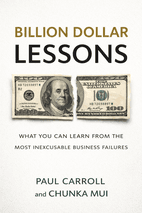
This collection gathers some of the most memorable lines from Billion Dollar Lessons, a book that dissects massive business failures and what they teach us. You will find quotes that are witty, blunt, and often surprising. Some use vivid metaphors, others deliver cold hard truths. Each one captures a moment of insight about strategy, ego, or the market.
What makes the book so quotable is its ability to turn painful corporate disasters into enduring lessons. The authors have a knack for finding the perfect analogy or a simple phrase that cuts through the noise. These lines stick with you because they reveal the human flaws behind billion dollar mistakes. They are reminders that even the smartest executives can fall for tempting fallacies.
Top Quotes from Billion Dollar Lessons
“Fired? Hell, I spent $10 million educating you. I just want to be sure you learned the right lessons.”
CEO Tom Watson Jr. responds to an executive who expected to be fired after losing $10 million.
It reframes failure as an expensive education rather than a career-ending disaster, urging readers to extract lessons from mistakes.
“The market can stay irrational longer than you can stay solvent.”
John Maynard Keynes's observation, quoted in the chapter about Long Term Capital Management's collapse.
This famous quote underscores the peril of betting against market irrationality, a key lesson from financial engineering disasters.
“Aristotle said, “The whole is greater than the sum of its parts,” but we're pretty sure Aristotle never saw a rollup.”
The author introduces the concept of rollups by contrasting with Aristotle's famous quote.
This line is memorable because it humorously undermines the theoretical appeal of rollups, setting up the chapter's critical tone.
“Executives were rearranging the proverbial deck chairs on the Titanic.”
The authors describe how executives respond to threats by making minor improvements instead of facing the real danger.
This metaphor vividly captures the futility of making superficial changes while ignoring an existential crisis, making it instantly memorable.
“It was filmless photography,” he said, “so management's reaction was, ‘that's cute—but don’t tell anyone about it.”
Steven J. Sasson, the engineer who invented the first digital camera at Kodak, recalls his bosses' dismissive response.
This quote reveals the deep-seated resistance to disruptive innovation even within a company that invented the technology, highlighting the power of organizational denial.
“In a cynical mood, we once decided that marketing is when you lie to your customers; market research is when you lie to yourself.”
The authors' opening observation about self-deception in strategic failures.
This line perfectly captures the central theme of the chapter—how companies delude themselves about technology, leading to disastrous decisions.
“Putting two drunks together doesn't make a stable person.”
Consultant and author Gary Hamel on the folly of merging two troubled companies.
This memorable metaphor instantly captures the core risk of consolidation: combining weaknesses doesn't create strength.
Themes Behind the Quotes
The first major theme is the danger of strategic overconfidence. Many quotes highlight how executives chase seductive ideas like synergy or rollups, promising something for nothing. They ignore warning signs, rearrange deck chairs on the Titanic, and even commit fraud to avoid reporting bad news. The pattern is a refusal to admit failure and a tendency to double down on flawed strategies.
Another theme is the gap between perception and reality. Leaders often see opportunity where customers see nothing, or they dismiss disruptive innovations as cute but irrelevant. The quotes also point to the value of defensiveness, questioning assumptions, and learning from past mistakes. Underneath all the billion dollar losses is a simple truth: success requires humility, not just ambition.
Quotes by Chapter
Introduction
“Imagine a sports team that decides it will only play offense and not play defense. It's time executives focused some of their attention on defense.”
Authors argue that business leaders neglect learning from failures.
The vivid sports analogy makes the case for defensive strategic thinking, a concept often overlooked in business success stories.
“Once launched, the strategies were doomed to fail, and these failures probably could not have been prevented by even spotless execution—unless the implementers were licensed to kill the strategy itself.”
Authors explain their finding that many major failures stem from bad strategies, not poor execution.
The dramatic phrase 'licensed to kill the strategy itself' underscores that execution cannot rescue a fundamentally flawed plan.
“The process isn’t designed to produce the best answers; it's designed to produce the best questions.”
Authors describe the devil's advocate review for evaluating strategy.
This memorable inversion challenges the typical pursuit of certainty and champions inquiry as a tool for avoiding costly mistakes.
ONE - Illusions of Synergy
“Doan do it. I tried it tree times. It dudn't woik.”
Groucho Marx joking to a bride about marriage.
The quote humorously captures the repeated failure of synergy strategies despite optimism, mirroring marriage failures.
“The burden of proof should be on showing that anything really good is likely to come out of one.”
Warren Hellman, former president of Lehman Brothers, speaking about mergers.
It powerfully advocates for skepticism, shifting the burden of proof to those claiming benefits.
“Yet synergies are seductive. They promise something for nothing.”
The authors' observation about the allure of synergies.
It succinctly explains why executives ignore evidence of failure—promises of easy gains are emotionally appealing.
“Where United's strategists saw synergy, customers saw next to nothing.”
The failed UAL synergy strategy with Hertz and Westin.
It highlights the critical disconnect between corporate strategy and customer reality, a common pitfall.
TWO - Faulty Financial Engineering
“Financial alchemists may become rich, but gullible investors rather than business achievements will usually be the source of their wealth.”
Warren Buffett wrote this to his shareholders, as recounted in the chapter.
It powerfully distinguishes genuine business success from financial manipulation, encapsulating the chapter's theme that alchemy ultimately fails and investors pay the price.
“I'd give a lot to mark my weight to ‘model’ rather than to ‘market.”
Warren Buffett, using his trademark humor, on the dangers of marking to model instead of market.
This witty line memorably criticizes the accounting tricks that allow companies to obscure true financial health, illustrating the 'mark to myth' concept.
“The great pity is that they did not know how to take advantage of their advantages.”
An industry analyst commenting on Heilig-Meyers' failure despite favorable market conditions.
It succinctly expresses the tragedy of a company that had all the pieces but mismanaged them, resonating with anyone who has seen potential squandered.
THREE - Deflated Rollups
“Sometimes, rollups look like an attempt to stitch together a bunch of rock groups to form an orchestra.”
The author uses a metaphor to describe the flawed strategy of rollups.
The vivid imagery of mismatched parts captures the inherent difficulty of merging disparate small businesses into a cohesive whole.
“If every time one of those went public you put a dollar into it, and you put another dollar into the S&P 500, you would have $92 in those companies versus $264 in the S&P.”
A Booz Allen study comparing the performance of rollups to the S&P 500.
This statistic starkly illustrates the massive underperformance of rollups, making the investment risk concrete and unforgettable.
“So, executives will sometimes go to any length—even fraud—to prevent reporting a setback.”
The author explains why fraud is common in rollups.
This line exposes the extreme pressure on executives to maintain growth, leading to unethical behavior that harms investors.
FOUR - Staying the (Misguided) Course
“Kodak kept its plane on autopilot until it flew into the side of the mountain.”
The authors summarize Kodak's failure to adapt to digital photography despite early warnings.
It extends the chapter's opening aviation metaphor to a concrete case, underscoring the tragic inevitability of ignoring clear warning signs.
“When we began this search, our No. 1 candidate was God, and we stepped down from that.”
Roberto Goizueta, a Kodak director, said this when announcing the hiring of CEO George Fisher in 1993.
The hyperbole captures both the board's high hopes and the dangerous overconfidence that often accompanies leadership changes, setting the stage for Fisher's ultimately unsuccessful turnaround.
FIVE - Misjudged Adjacencies
“The only thing the successful companies had in common is, well, that they were successful.”
The author summarizes the Bain study findings on adjacency strategies, noting that no replicable formula emerged.
This line underscores the difficulty of distilling a simple recipe for success, reminding readers that past performance doesn't easily transfer to new contexts.
“If you need a new car, it's a prudent thing to go out and get one. But you don't buy eight of them and pay sticker price for each.”
Douglas Barr, a former major Oglebay Norton shareholder, criticizes CEO John Lauer's overzealous acquisition spree.
The analogy makes the perils of overexpansion vivid and intuitive, capturing how excessive debt and overpayment can doom a company.
“The company is poised for tremendous growth... or an ugly fall.”
An analyst comments on Oglebay Norton's precarious financial position after its debt-fueled acquisitions.
This succinctly frames the high-stakes gamble of adjacency moves, foreshadowing the bankruptcy that followed.
“In theory, what's going on in the core business should have no bearing on the assessment that’s made of a new opportunity. In practice, however, it seems that the worse the current business looks, the more likely a company is to make a bad bet on an adjacent market.”
The author introduces the first red flag pattern in adjacency failures: fleeing from a struggling core.
This insight reveals a common cognitive bias—desperation clouds judgment—and serves as a caution for managers facing core-business decline.
SIX - Fumbling Technology
“No amount of luck or sophisticated execution could have saved them.”
Describing technology-dependent strategies that were ill conceived from the start.
It underscores the idea that some failures are inevitable due to flawed assumptions, no matter how well executed.
“Who wants to use a phone that won't even work indoors, that weighs 16 ounces and costs $5 a minute?”
An analyst's critique of Iridium's satellite phone service.
This blunt question highlights the absurdity of Iridium's product limitations, making the failure seem obvious in hindsight.
“The amazing thing was that it worked at all.”
Howard Anderson, a venture capitalist, described his experience using an Iridium phone.
This deadpan understatement perfectly conveys the enormous gap between Iridium's grand vision and its pathetic real-world performance.
Coda
“If processes and values aren't similar, back off and reconsider.”
Joseph Bowers' straightforward advice to companies considering a consolidation acquisition.
This actionable warning cuts through the hype of synergy, offering a clear red flag that executives often ignore.