The AI Handbook for Sales Professionals Key Takeaways
by JD Miller
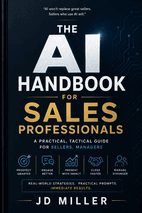
5 Main Takeaways from The AI Handbook for Sales Professionals
AI Automates Patterns, Humans Own Empathy
AI excels at pattern recognition and repetitive tasks, but lacks true understanding of emotions or long-term context. Sales professionals should delegate data-heavy work to AI while doubling down on empathy, trust, and strategic judgment to win complex deals.
Prepare for Three Levels of AI Maturity
Most organizations operate at Level 2, requiring clear accountability and ethics by design. The path to Level 3 demands treating data as intellectual property, cross-functional collaboration, and embedded governance that tracks fairness alongside revenue.
AI Transforms Sales Roles from Doers to Strategists
Sales engineers shift from demo machines to early-stage advisors, frontline managers move from inspecting past performance to architecting future success, and RevOps become proactive strategic partners instead of reactive data fixers.
Ethical Governance Is Non-Negotiable for AI in Sales
An AI governance council with members from revenue, legal, security, and HR must ask critical questions about bias, fairness, and hallucinations. Without it, risks like algorithmic redlining or automated employment actions can backfire.
Human Skills Remain Irreplaceable in the AI Era
Despite AI's predictive power, adoption remains low (19% of US workers in 2025). The most successful sellers will use AI to amplify their uniquely human abilities—building consensus, trust, and strategic relationships—not to replace them.
Executive Analysis
These five takeaways form the book's central argument: AI is a powerful pattern-recognition tool that, when strategically deployed, frees sales professionals to focus on irreplaceable human skills. The author insists that success requires a deliberate journey through maturity levels, ethical guardrails, and role transformation—not just buying a chatbot. The core thesis is that AI amplifies but does not substitute human judgment, and that organizations must build governance and culture alongside technology.
This book matters because it bridges the gap between AI hype and practical sales execution. Unlike generic AI primers or sales theory books, it offers specific, role-based guidance for sales engineers, managers, and RevOps—backed by real case studies and a clear maturity framework. For any sales leader looking to move from experimentation to strategic advantage, this handbook provides the actionable roadmap missing from most AI content.
Chapter-by-Chapter Key Takeaways
Demystifying AI (Chapter 1)
AI is fundamentally about pattern recognition, evolved from simple rules-based systems to machine learning that refines itself with more data.
The ChatGPT "revolution" was a change in scale (massive computing power) not a change in concept.
AI works through four steps: data collection, feature extraction (often discovering patterns humans wouldn't find), model training, and prediction.
AI excels at discriminative tasks ("Is this A or B?") and generative tasks (creating new, statistically similar content).
AI's key limitations are lack of long-term context, no theory of mind, and inability to genuinely understand emotions.
Sales professionals who learn to delegate repetitive tasks to AI while doubling down on empathy, trust, and strategic judgment will thrive.
Try this: Identify two repetitive sales tasks (e.g., data entry, initial prospecting) and pilot an AI tool to automate them, then reinvest the saved time into high-empathy client conversations.
Getting Ready for AI (Chapter 2)
Level 2 requires clear human accountability and “ethics by design” from the start, not as an afterthought.
Cross-functional collaboration demands a common language between sales, IT, finance, marketing, and customer success.
Level 3 treats data as intellectual property, using a semantic layer and synthetic data for decision-making simulations.
Agentic mesh and proprietary models create an AI-native infrastructure where technology serves the seller.
People and culture shift toward orchestrating AI processes, rewarding uniquely human skills like empathy and strategic thinking.
Governance becomes embedded, tracking fairness and bias as rigorously as revenue.
The path from Level 2 to Level 3 is incremental but transformative—start now and build step by step.
Try this: Convene a cross-functional readiness team with sales, IT, legal, and finance to define data ownership, ethics guidelines, and a shared language for AI adoption.
AI for Sales Engineers (Chapter 4)
A foundational AI use case: feed an LLM with product specs and discovery notes to generate custom demo scripts in minutes.
Advanced platforms (Navattic, Reprise, Demoboost, Consensus) let prospects explore interactive sandboxes independently, with AI personalization based on role and behavior.
The case study shows that training an AI agent on product docs, sales playbooks, and high-performing scripts can slash new SE onboarding time to four months.
For RFP responses, tools like AutoRFP.ai and Tenderbolt create first drafts from approved libraries, freeing SEs for higher-value validation and strategy.
The strategic shift: SEs move from “demo machine” to early-stage advisor, entering first live calls with rich intent data and skipping the generic pitch.
Try this: Feed your product specs and top-performing demo scripts into an LLM to automatically generate customized demo outlines, freeing you to focus on discovery and strategic advice.
AI for the Frontline Manager (Chapter 5)
Reliable AI forecasts free managers to focus on influencing deal outcomes and coaching, not defending numbers.
Intent data and AI routing improve lead conversion but require ethical safeguards to avoid systemic bias.
Automated process enforcement lets managers manage by exception and redesign systems for predictable growth.
The ultimate shift: from inspecting past performance to architecting future success—applying human judgment where it matters most.
Try this: Replace manual pipeline review with an AI forecasting tool, then use the reclaimed time to coach reps on deal influence and system design rather than defending numbers.
Next chapter: “AI for Revenue Operations” is locked
Keep learning from The AI Handbook for Sales Professionals — and unlock all 600+ book summaries with audio, mindmaps and AI Q&A.
$0.00 due today · 7 days free, then $89.99/year ($7.49/mo) · Cancel anytime before day 7
plus sales tax where applicable