The AI Handbook for Sales Professionals Quotes
by JD Miller
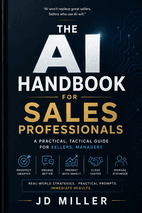
This page collects the sharpest, most quotable lines from JD Miller's handbook on AI for sales professionals. You will find predictions about AI's impact, warnings about the dangers of poor data, and insights on how to preserve human connection in an automated world. Miller writes with clarity and conviction, turning complex ideas into memorable one liners that stick with you. His book earns its quotability because it balances bold forecasts with practical advice. These aren't just clever phrases. They are lenses through which to rethink your entire approach to sales in the age of AI.
Top Quotes from The AI Handbook for Sales Professionals
“When you graduate in four years, the vast majority of you will go to work in jobs that have not yet been invented.”
The convocation speaker said this to the author's freshman class at the University of Illinois in 1993.
It captures the prescient uncertainty of technological change and resonates with anyone who has seen entire industries evolve around them.
“I think about the web skeptics from years ago who now access it multiple times a day from the phones in their pockets, and I know we can’t pretend Al technologies won't seriously change our professional and personal lives.”
The author reflects on how skeptics of the internet now rely on it daily.
This line uses a relatable, concrete image to gently challenge readers who might be dismissing AI's significance.
“Sellers who don't adapt risk becoming the 1990s encyclopedia salesmen: a relic whose primary asset—knowing the facts—was instantly devalued when information became a universal commodity.”
Warning sales professionals about the risk of not adapting.
The encyclopedia salesman analogy is a powerful, memorable way to convey that the value of pure information is disappearing, urging sellers to evolve.
“Frontline sellers suddenly have a historic opportunity to delegate the digital heavy lifting to an algorithm, while reclaiming their time to do only what a human can—communicate with nuance, build deep trust, and navigate the complex interpersonal politics needed to close large deals.”
Opening paragraph of the chapter, framing the AI opportunity for sellers.
It captures the core value proposition of AI in sales: automating the mundane so humans can focus on uniquely human relationship-building skills.
“The goal of social selling is not to “trick” a prospect into thinking that you're their best friend. It's to prove that you've done enough homework to be a valuable professional partner in a way that only a human can be.”
Section on AI personalization risks, discussing what effective social selling truly means.
Distills the essence of authentic sales relationships, contrasting genuine value with manipulative tactics.
“Just because you can, doesn't mean you should.”
This maxim follows the governance council's primary rule as a cautionary note.
Its brevity and directness make it a memorable reminder that technological capability does not justify every use case, especially when cultural and legal risks are high.
Themes Behind the Quotes
One major theme is the tension between automation and humanity. Many quotes emphasize that AI should handle repetitive tasks so sellers can focus on what only humans can do: build trust, navigate nuance, and forge real relationships. But they also warn against using AI in ways that feel creepy or fake. The goal is delegation, not deception. Another theme is the urgency of adaptation. Miller repeatedly shows that AI is not a passing fad but a fundamental shift. Sales professionals who fail to embrace it risk becoming obsolete. Yet he also stresses that human judgment must remain in control. Data informs decisions, but people make the final call. Ethics and quality of data are recurring concerns too. Garbage data leads to bad outcomes, and companies must design AI responsibly from the start.
Quotes by Chapter
Introduction
“Today, Al tools enable us to delegate much more work, and the lowest-cost resource we can send it to is now a computer algorithm, rather than an entry-level worker.”
The author applies an early management lesson about delegation to the AI era.
It succinctly frames AI as a new tier of resource, forcing sales professionals to rethink how work gets done.
“While I know I'm not smart enough to make precise predictions about exactly how Al will transform our work and personal lives, I am confident it will have a seismic impact.”
The author admits his own limitations while still asserting AI's importance.
This humble and honest statement builds trust with readers who are also uncertain about AI's future.
Demystifying AI
“The introduction of ChatGPT, then, wasn’t a new fundamental concept in Al. It was a change in scale.”
The author explains what the release of ChatGPT represented in the history of AI.
This line demystifies AI hype by clarifying that the technology itself is not new; only the scale has changed, helping readers cut through the noise.
“Today’s Al lacks a “theory of mind” that understands that humans have their own beliefs, desires, intentions, and emotions that will affect their behavior.”
Discussing the limitations of current AI.
It pinpoints a fundamental human quality—theory of mind—that AI lacks, reinforcing why human sales skills remain irreplaceable.
“Generative Al tools may indeed tell you that “they're having a great day,” or “are disappointed that it's going to rain this afternoon,” but they're doing so because they've learned those are the words that are most frequently used responses to the weather data they've been trained on—nothing more.”
Illustrating AI's inability to genuinely understand emotions.
This quote vividly shows the difference between simulated empathy and real understanding, a critical insight for sales professionals who rely on authentic connection.
Getting Ready for AI
“Al adoption is not just another tool to incorporate into the usual way of doing things—it’s the lever for a fundamental business transformation, and navigating this shift is a mandate for every employee.”
The author argues that AI is a strategic imperative for modern businesses, not just an incremental tool.
This line reframes AI from a simple upgrade to a transformative force, making it clear that resisting or treating it casually is a strategic mistake. It resonates because it sets a high-stakes, urgent tone that compels action.
“A 2024 Salesforce report found that salespeople spend only 28% of their time actually selling.”
The author cites this statistic early in the chapter to illustrate the potential for AI to reclaim lost selling time.
This stark number immediately grabs attention and provides a concrete, data-driven reason to adopt AI—it directly addresses the pain point of wasted time. It's memorable because it turns an abstract benefit into a measurable, relatable problem.
“By building in “ethics by design,” you ensure your Al tools are robust, trustworthy, and reliable from day one—avoiding legal troubles and building trust with all stakeholders along the way.”
From the discussion of Level 2 governance, emphasizing proactive ethics integration rather than treating it as a final hurdle.
This line captures a proactive mindset that resonates with leaders who want to avoid costly compliance failures and build lasting trust through ethical AI deployment.
“In these organizations, decision-making across every part of the sales function is data-driven and Al-informed, enabling Al insights to drive innovative new business models and value streams based on proprietary intelligence.”
From the opening description of Level 3, the fully enabled sales team.
It paints a compelling vision of AI as a transformative force that permeates all decisions, inspiring sales professionals to aim for deeper integration beyond simple tool usage.
AI for the Quota-Carrying Seller
“The old axiom “garbage in, garbage out” is especially important for Al—getting the signal data wrong leads to poor conclusions that send sellers down a dead-end path.”
Section on data quality for AI-enabled lead scoring, warning about bad inputs.
A timeless, punchy reminder that AI is only as good as its data, making it a memorable caution for any sales team adopting AI tools.
“Calling a prospect and saying, “I see that you just ran a search for my product,” is downright creepy and is likely to have the opposite of the intended effect on your sales process.”
Discussion on ethical use of buyer intent data and avoiding digital stalking.
Humorously highlights the fine line between helpful personalization and invasive creepiness, making the ethical guideline stick in readers' minds.
AI for Sales Engineers
“By delegating the rote work of demo preparation and initial RFP drafting to Al, the SE can move from being a tactical bottleneck to a strategic accelerator of the technical win.”
The concluding paragraph of the chapter summarizing the benefit of AI for sales engineers.
It encapsulates the core transformation from bottleneck to accelerator, which is the central thesis of the chapter.
“Prospects are often forced to sit through demonstration components that are irrelevant to their business problem—which may introduce unnecessary objections or questions into the sales cycle—while the truly deal- moving topics get short shrift.”
Description of the problem with generic demos in the 'Level 1: Foundational' section.
It vividly illustrates the waste and risk of irrelevant demos, resonating with any SE who has experienced that frustration.
“By offering a basic demo experience before their first meeting, the SE enters their first live call knowing exactly which features the prospect hovered over, clicked on, or rewatched.”
Explanation of the strategic shift when using interactive demos before live calls.
It highlights a concrete, measurable advantage of AI-driven demos, turning first meetings into deeper, more tailored conversations.
“In the same way that a frontline seller may use an LLM like ChatGPT, Claude, or Gemini to conduct pre-meeting prep, sales engineers can use similar tools—seeded with a library of demo content, product specs, and notes from any discovery calls that have already taken place without them—to create a custom demo script for every interaction in minutes.”
Section on Level 1 demo customization using LLMs.
It provides a clear, actionable blueprint for SEs to immediately leverage AI tools, making it highly practical and empowering.
AI for the Frontline Manager
“A great seller thrives on individual achievement, personal quota attainment, and competition. In contrast, a great manager must prioritize predictability, consistency, and the collaborative development of a team in which everyone contributes to the result.”
The author contrasts the mindset of a salesperson with that of a frontline manager.
This line powerfully captures the fundamental shift in priorities required for effective leadership, making it relatable for new managers.
“Ultimately, the manager becomes a bottleneck to team performance, limiting the team's revenue potential to their own personal span of control and stalling their own career in the process.”
The author warns about the trap of micromanaging and over-involvement.
It vividly illustrates the paradox of trying to do everything yourself, which hurts both the team and the manager's own growth.
“If 72% of an individual contributor's time is spent on nonselling tasks, their manager carries an even greater administrative burden —robbing their calendar of time spent on uniquely human, high-impact activities like strategic thinking, motivational leadership, and personalized development coaching.”
The author explains the time crunch that frontline managers face.
The specific statistic and the contrast with high-value human activities make a compelling case for AI automation.
“Managers find it easy to identify the extreme ends of the performance curve—the sellers who are clearly superior or woefully deficient—but the majority in the middle often lose out on necessary coaching that can move them into the top-performing categories.”
The author describes a common coaching gap.
This highlights a critical blind spot in management, reminding leaders to focus on the middle performers who have the most potential for growth.
AI for the Strategy Setting CRO
“Because Al analysis is only as good as the data it ingests, tools that over-index on easy- to-scrape sources—such as tech or healthcare firms with massive digital footprints—often overlook industries with lower digital maturity, like law firms or manufacturing.”
From the section on AI-driven market intelligence, warning about biased data sources.
This line powerfully underscores a fundamental limitation of AI: garbage in, garbage out. It reminds sales leaders to actively seek out less-digitized sectors to avoid competing in crowded markets.
“Ultimately, a business partnership is one between groups of human beings who operate with deep interpersonal trust and collaboration—the use of Al for partner recruitment should facilitate, not fake, that work.”
Conclusion of the partner recruitment section, emphasizing the human element.
This quote grounds the discussion of AI in core human values, serving as an ethical touchstone that technology must augment, not replace, genuine relationships.
“Should your Al tool hallucinate and assist your partner in promising a product, capability, or contractual obligation that you're not prepared to fulfill, you not only may lose credibility with them, but you may also incur significant legal liability.”
A cautionary note in the section on AI-enabled coselling and partner support.
It delivers a stark, real-world warning about the dangers of AI hallucinations in a business context, making the case for rigorous governance and human oversight.
“Sharing raw CRM data with partners (even “trusted” ones with confidentiality agreements in place) can trigger risks related to price fixing, violations of antitrust laws, or GDPR/CCPA concerns related to “third-party sharing” consent that was not properly obtained.”
The text discusses data privacy and legal risks when sharing CRM data with partners.
It underscores the serious legal consequences that can arise from AI-driven data sharing, making it a critical warning for CROs.
AI for Revenue Operations
“The governance council's primary rule must be “the algorithm informs the plan, but human beings make the decision.””
This rule is stated in the chapter as a guiding principle for using AI in quota and territory assignments.
It encapsulates the critical balance between leveraging AI's insights and retaining human judgment, which is a core theme for sales professionals wary of over-automation.