Wisdom Takes Work Quotes
by Ryan Holiday
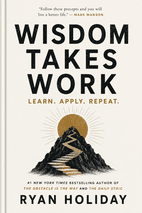
These quotes from Ryan Holiday's Wisdom Takes Work cut straight to the point. They remind us that wisdom isn't handed out for free, it's earned through reading, reflecting, and wrestling with tough truths. You'll find lines that push you to think, challenge your assumptions, and maybe even humble you a bit.
What makes this book so quotable is how it blends ancient philosophy with modern grit. Each quote feels like a sharp tool you can carry around, whether it's about the power of books, the danger of foolishness, or the simple need to pay attention. They're the kind of lines you want to save, share, and come back to.
Top Quotes from Wisdom Takes Work
“Books are,” he said, “the best provisions a man can take with him on life's journey.”
Montaigne reflects on his love of reading while traveling with his saddlebags full of books.
The line beautifully frames books as essential companions for life's journey, affirming the enduring value of literature and learning.
“He had explored an unknown and unprecedented new continent—himself.”
The author summarizes Montaigne's lifelong project of self-discovery through his essays.
This metaphor powerfully reframes self-exploration as a grand adventure, inspiring readers to see their own inner world as uncharted territory.
“Conversations with the dead. That's what books are!”
Zeno realizes the meaning of the Oracle's advice after hearing a story about Socrates.
This line captures the central metaphor of the chapter—that reading is conversing with the dead—and is both clever and profound, urging readers to see books as a bridge to past wisdom.
“You must read. Read something new. Read something old. Reread something you've already read. Read a few pages of this one or that one. Linger when a passage strikes you. Read something critical. Read something beautiful. Read something dark. Read something you disagree with. Reflect. Read more. Repeat. Talk to the dead until you die.”
The author ends the section with a call to action for readers.
This rhythmic, imperative list inspires a comprehensive reading lifestyle, emphasizing the depth and variety required for true learning, and leaves a memorable final image of talking to the dead.
“Focus is the skill that wisdom depends on.”
After describing Samuel Scudder's lesson from Louis Agassiz on intensely observing a fish.
This concise sentence distills the entire lesson of the section—that wisdom requires sustained, deep focus—making it a memorable takeaway.
“If your wisdom has not taken you down a peg, then you do not have wisdom.”
The author states a hard truth about the nature of wisdom.
It succinctly argues that genuine wisdom always humbles its possessor, making humility the litmus test for true insight.
“I claim not to have controlled events,” he wrote in a letter in 1864, “but confess plainly that events have controlled me.”
Abraham Lincoln wrote this in an 1864 letter reflecting on his presidency.
It reveals Lincoln's profound humility and recognition of external forces beyond his control, a lesson for all leaders.
Themes Behind the Quotes
One major theme is the relentless pursuit of self knowledge. The quotes emphasize that understanding yourself is a difficult but essential journey, one that requires constant reading and honest reflection. They also warn against the contagious nature of foolishness, urging you to be at war with the ignorance both inside and outside yourself.
Another theme is the value of focus and humility. Real wisdom demands the discipline to concentrate, to question every assumption, and to accept that you are not in control of events. The book strips away ego and leaves you with a stark truth: wisdom has to work on you before you can truly claim it.
Quotes by Chapter
Introduction: This Is the Way
“It is a “thorny enterprise,” he said, “of following a path as wandering as that of the mind and penetrating the dark depths of its inner folds.””
Montaigne describes the difficulty of writing essays that explore the mind's labyrinthine nature.
It captures the challenging yet rewarding pursuit of self-awareness, using vivid imagery that resonates with anyone on a journey of introspection.
“I studied in order to show off; later, a little, to make myself wiser; now I do it for amusement, never for profit.”
Montaigne describes the evolution of his motivation for learning across different stages of life.
It traces a relatable arc from ego-driven to wisdom-seeking to pure joy, reminding us that true learning is never finished and should be pursued for its own sake.
Part I: The Agoge (Your Training Ground)
“It doesn't matter that we can read. If we don’t, as General Mattis has said, we are choosing to be functionally illiterate.”
The author argues that not reading is a choice equivalent to functional illiteracy.
It's a sharp, challenging statement that reframes the act of reading as a moral and intellectual duty, compelling readers to examine their own habits.
Part II: The Sirens (The Perilous Rocks You Must Beware)
“Foolishness is contagious, stupidity seeks converts.”
From the opening section of the chapter, describing the universal struggle against foolishness.
It succinctly captures the idea that stupidity spreads like a disease, reminding readers to be vigilant against their own and others' foolishness.
“Each of us must be at war with the fool within and outside of us.”
Same section, emphasizing the personal battle against folly.
It frames wisdom as an active, ongoing war, making the reader feel the urgency and personal responsibility.
“All requirements, all assumptions, all regulations and constraints must be scrutinized. Only the laws of physics are binding.”
Part of Musk's algorithm that he repeatedly uses to break through conventional thinking.
This line encapsulates the first-principles approach that challenges assumptions and is a powerful call to question everything.
“My mind is a storm,” he admitted in an interview. “I don't think most people would want to be me. They may think they would want to be me, but they don't. They don't know, they don’t understand.”
Musk's own admission about his inner turmoil in an interview.
It reveals the human cost behind genius and success, making Musk relatable and highlighting the dark side of a brilliant but troubled mind.
Part III: The Apotheosis (Touching the Divine)
“Tell us of the man who clawed his way up from nothing, they said, the man with “the voice of thunder” and “deeds as strong as the rock.””
Remote tribesmen asking Tolstoy to tell them about Abraham Lincoln.
This shows how Lincoln's rise from poverty and his legendary character transcend culture and time. It underscores the universal appeal of someone who overcomes immense odds through inner strength.
“Something awful must have happened to a human being to be able to put a cattle prod against a woman's breasts,” he said. “What happens to the woman is ghastly. What happens to the man who does it is in some ways much, much worse.”
The author reflects on the psychological damage inflicted on perpetrators of violence.
This line forces readers to extend empathy even to those who commit atrocities, highlighting the profound human cost on both sides.