Relativity Key Takeaways
by Albert Einstein
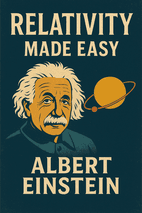
5 Main Takeaways from Relativity
Simultaneity is not absolute but relative to your frame of reference.
Einstein uses the example of lightning strikes on a train embankment to demonstrate that events simultaneous for a stationary observer may not be for a moving one. This relativity of simultaneity forces us to discard absolute time, forming the cornerstone of special relativity.
The speed of light is constant for all inertial observers.
No matter the motion of the source or observer, light in vacuum always travels at speed c. This constancy, confirmed by experiments like Fizeau's, leads to time dilation, length contraction, and the Lorentz transformation, reshaping our concepts of space and time.
Gravity is indistinguishable from acceleration, curving the fabric of space-time.
The equality of inertial and gravitational mass means that forces from acceleration and gravity are equivalent, as shown in thought experiments like the accelerated chest. This equivalence principle underpins general relativity, where mass and energy curve the four-dimensional space-time continuum.
Space and time merge into a four-dimensional continuum in relativity.
Minkowski's formulation integrates time as a dimension with space, allowing Lorentz transformations to be seen as rotations in this continuum. In general relativity, this continuum is curved by gravity, affecting the motion of planets and the path of light.
The universe might be finite yet unbounded, like a spherical surface.
Using non-Euclidean geometry, Einstein proposes a cosmos that is closed but without edges, analogous to the surface of a sphere. This model resolves Newton's cosmological paradox and suggests a dynamic relationship where matter determines the geometry of space.
Executive Analysis
Einstein's "Relativity" systematically dismantles Newtonian absolutes by first establishing that time and simultaneity are relative to motion, grounded in the constancy of light speed. This leads to the unification of space and time into a four-dimensional continuum, where the equivalence of gravity and acceleration naturally curves this continuum. The culmination is a cosmological vision where matter shapes a finite yet unbounded universe, resolving classical paradoxes. Thus, the takeaways form a coherent argument: from relative motion to curved space-time, all driven by empirical principles and geometric reasoning.
This book matters because it redefined fundamental concepts of space, time, and gravity, influencing modern physics from black holes to cosmology. For readers, it offers a mindset shift—understanding that our perceptions of time and space are frame-dependent, with practical implications in technologies like satellite navigation. As a seminal work, it sits at the heart of 20th-century science, making complex ideas accessible and showcasing how revolutionary theories emerge from questioning basic assumptions.
Chapter-by-Chapter Key Takeaways
1. Physical Meaning of Geometrical Propositions (Chapter 1)
Geometrical propositions are "true" only within their logical system, based on axioms, not necessarily through correspondence with reality.
We instinctively connect abstract geometrical concepts to physical objects, such as using rigid bodies to define distances and lines.
By supplementing geometry with physical assumptions, it becomes a branch of physics, allowing empirical validation.
The empirical truth of geometry is provisional and limited, rooted in everyday experiences that may not hold in all contexts, as later theories will reveal.
Try this: Scrutinize the physical assumptions behind geometric axioms to understand their real-world applicability.
2. The System of Co-ordinates (Chapter 2)
Distance measurement relies on a standard rod applied repeatedly between points, forming the basis for all length assessments.
Positions are specified relative to rigid bodies, using distinguishable points or numerical measures to describe events in space.
Refinements allow independence from landmarks by employing numerical values and indirect methods, such as optical observations.
Cartesian coordinates use three perpendicular planes to define positions via x, y, z coordinates, streamlining spatial descriptions.
Euclidean geometry underpins physical interpretations, ensuring that distance and position maintain clear, consistent meanings in science.
Try this: Employ coordinate systems with standard measuring rods to objectively specify locations in space.
3. Space and Time in Classical Mechanics (Chapter 3)
Motion is always relative to a chosen reference body or coordinate system, not absolute space.
The trajectory of an object varies depending on the observer's frame, as shown in the stone-dropping experiment.
Replacing vague notions of 'space' with concrete reference frames clarifies physical descriptions.
Time must be defined in terms of observable, measurable events to complete the description of motion.
Classical mechanics relies on this relative framework, setting the foundation for later challenges in relativity theory.
Try this: Define all motion relative to a specific reference frame and operationalize time through observable events.
5. The Principle of Relativity (Chapter 4)
The principle of relativity ensures that natural laws are identical in all uniformly moving, non-rotating frames of reference.
Everyday analogies, like observing motion from a moving train, help visualize how this principle operates in practice.
Historical doubts from electrodynamics and optics are counterbalanced by the principle's consistency with classical mechanics and lack of observed directional effects in nature.
The absence of anisotropic properties in physical space, despite Earth's motion, serves as a strong empirical validation of the principle.
Try this: Apply the principle of relativity to verify that physical laws hold equally in all uniformly moving reference frames.
7. The Apparent Incompatibility of the Law of Propagation of Light with the Principle of Relativity (Chapter 5)
Light propagates at a constant speed c in vacuum, supported by robust experimental evidence, and this speed is independent of the source's motion or the light's color.
When combined with classical velocity addition, this constancy leads to a prediction that light's speed should vary for observers in different inertial frames, directly contradicting the principle of relativity.
The resulting dilemma forces a choice between upholding relativity or the light propagation law, but historical progress in physics indicates that neither can be easily abandoned, pointing toward the need for a revolutionary framework.
Try this: Acknowledge the conflict between constant light speed and classical velocity addition as a catalyst for revolutionary physics.
8. On the Idea of Time in Physics (Chapter 6)
Simultaneity in physics is not an innate concept but must be defined through observable, experimental procedures to have real meaning.
The constancy of light speed over equal distances serves as a foundational stipulation, not a proven fact, enabling a coherent definition of time.
Time itself is operationalized using synchronized clocks, with each event's time determined by local clock readings, relying on the assumption that identical clocks run at the same rate when stationary relative to each other.
This approach resolves apparent conflicts between relativity and light propagation, forming the core of the Special Theory of Relativity's logical rigor.
Try this: Define simultaneity operationally using light signals and synchronized clocks to establish a coherent concept of time.
9. The Relativity of Simultaneity (Chapter 7)
Simultaneity is relative: Events that are simultaneous in one reference frame may not be in another, depending on the observer's motion.
Time is frame-dependent: Each reference body has its own "time," and statements about event timing are meaningless without specifying the frame.
Foundation for relativity: This concept resolves conflicts between light propagation and motion, underscoring that classical assumptions about absolute time must be discarded.
Try this: Accept that simultaneity is relative and always specify the reference frame when discussing event timing.
10. On the Relativity of the Conception of Distance (Chapter 8)
Distance is not an absolute quantity but relative to the observer's frame of reference.
Measurements taken from a moving system (like a train) can differ from those in a stationary system (like an embankment).
This relativity challenges previous assumptions and emphasizes the need for a consistent definition of time and space across frames.
Try this: Measure distances with the understanding that they are relative to your frame of reference, not absolute.
11. The Lorentz Transformation (Chapter 9)
The Lorentz transformation resolves the conflict between relativity and light's constant speed by rejecting absolute time and space.
It introduces interdependent space and time coordinates that vary with relative motion, encapsulated in a set of equations.
This transformation ensures that the speed of light remains c in all inertial frames, a cornerstone of special relativity.
The Galilean transformation is a limiting case of the Lorentz transformation, valid only at low velocities compared to light speed.
Try this: Use Lorentz transformations to convert space and time coordinates between inertial frames, preserving the constant speed of light.
12. The Behaviour of Measuring Rods and Clocks in Motion (Chapter 10)
Moving objects contract in the direction of motion by a factor of √(1 - v²/c²), making them shorter than when at rest.
Clocks in motion tick slower, with time intervals stretching by the same factor, illustrating time dilation.
The speed of light c serves as an absolute limit; no real object can reach or exceed it, as reflected in the Lorentz transformation's equations.
These effects are reciprocal and consistent with the principle of relativity, highlighting how motion universally influences measurements of space and time.
Try this: Account for length contraction and time dilation when measuring objects or time intervals in relative motion.
13. Theorem of the Addition of Velocities. The Experiment of Fizeau (Chapter 11)
The relativistic velocity addition formula, W = (v + w) / (1 + v w / c²), is empirically supported over the classical W = v + w.
Fizeau's experiment with light in moving fluids serves as a critical test, demonstrating relativistic effects even at non-relativistic speeds.
This validation reinforces the consistency of relativity with experimental data, bridging theory and observation in a practical context.
Try this: Apply the relativistic velocity addition formula when combining speeds, especially near light speed, as validated by experiments like Fizeau's.
14. The Heuristic Value of the Theory of Relativity (Chapter 12)
The Theory of Relativity elegantly unifies and generalizes hypotheses from Maxwell-Lorentz electrodynamics, demonstrating its heuristic power to simplify complex physical concepts.
Empirical evidence, such as Fizeau's experiment, consistently supports the theory, showing how it aligns with and enhances our understanding of light behavior.
By combining the principle of relativity with the constancy of light speed, the derivation of the Lorentz transformation marks a decisive break from classical mechanics, providing a more accurate framework for describing events in nature.
Try this: Appreciate how relativity elegantly unifies electrodynamics and is supported by empirical evidence like light behavior.
15. General Results of the Theory (Chapter 13)
Natural laws must be covariant under Lorentz transformations to align with relativity.
The theory simplifies electrodynamics by reducing independent hypotheses and enhancing theoretical plausibility.
Classical mechanics requires modification for high-velocity motions, with negligible effects at everyday scales.
Kinetic energy in relativity prevents velocities from reaching light speed and introduces the rest energy term ( m c^2 ).
Mass and energy are unified, with mass varying based on energy changes, encapsulated in ( E = m c^2 ).
Conservation of mass and energy merge into a single law, emphasizing energy's primacy.
Actions at a distance propagate at light speed, eliminating instantaneous interactions and refining gravitational concepts.
Try this: Formulate physical laws to be covariant under Lorentz transformations and recognize mass-energy equivalence through E=mc².
16. Experience and the Special Theory of Relativity (Chapter 14)
The Special Theory of Relativity is strongly supported by a wide range of experimental evidence, particularly from electromagnetism and astronomical observations.
It successfully explains phenomena like electron motion and the absence of ether-drift effects without requiring auxiliary hypotheses, demonstrating its predictive power and simplicity.
By building on the Maxwell-Lorentz framework, relativity provides a unified approach that consistently aligns with empirical data, reinforcing its validity in modern physics.
Try this: Trust the predictions of special relativity due to its extensive experimental validation in electromagnetism and astronomy.
17. Minkowski’s Four-Dimensional Space (Chapter 15)
The universe is best described as a four-dimensional space-time continuum, where events are defined by three spatial and one temporal coordinate.
Relativity integrates time with space, contrasting with classical mechanics where time was absolute and independent.
Minkowski's use of an imaginary time coordinate aligns space-time with Euclidean geometry, enhancing the clarity and mathematical elegance of relativity.
This four-dimensional perspective is foundational for understanding both special and general relativity, even if the full mathematical depth isn't necessary for grasping the core ideas.
Try this: Adopt a four-dimensional space-time perspective to seamlessly integrate time with spatial coordinates in physical descriptions.
18. Special and General Principle of Relativity (Chapter 16)
Motion is fundamentally relative, with no single reference body inherently preferred for describing events.
The special principle of relativity ensures that natural laws hold the same form in all inertial frames (those in uniform motion).
The general principle of relativity extends this equivalence to all frames of reference, though practical challenges like non-uniform motion reveal limitations in its current formulation.
Empirical evidence underpins these principles, emphasizing that their validity stems from observation rather than pure logic.
Try this: Extend the principle of relativity to all reference frames, acknowledging the challenges of non-uniform motion.
19. The Gravitational Field (Chapter 17)
Gravitational interactions are mediated by fields, not direct action at a distance, similar to electromagnetic fields, which provides a more coherent explanation for force transmission.
The intensity of a gravitational field decreases predictably with distance from its source, governed by specific laws that define its spatial properties.
A defining feature of gravitational fields is that they impart identical acceleration to all objects, independent of material or state, leading to the equivalence of inertial and gravitational mass.
This equivalence challenges earlier notions of motion and relativity, suggesting that non-uniform motion can be reconciled through field theory, paving the way for advanced concepts in physics.
Try this: Understand gravitational interactions as fields that accelerate all objects equally, based on the equivalence principle.
20. The Equality of Inertial and Gravitational Mass as an Argument for the General Postulate of Relativity (Chapter 18)
The equality of inertial and gravitational mass is not just an empirical fact but a fundamental principle that allows acceleration to be indistinguishable from gravity.
Thought experiments, like the accelerated chest, show that observers in non-inertial frames can interpret their experiences as being in a gravitational field, supporting the general postulate of relativity.
This equivalence implies that physical laws must be consistent across all reference frames, leading to profound insights into gravitation and the development of general relativity.
A critical nuance is that while some gravitational fields can be viewed as apparent effects of acceleration, others, like Earth's field, are inherent and cannot be eliminated by frame changes.
Try this: Use the equivalence of inertial and gravitational mass to interpret acceleration as gravitational effects in non-inertial frames.
21. In What Respects are the Foundations of Classical Mechanics and of the Special Theory of Relativity Unsatisfactory? (Chapter 19)
Classical mechanics and special relativity are flawed in their uncritical acceptance of preferred reference frames, which lack a justified basis.
The logical mind inherently seeks reasons for observed disparities, whether in everyday phenomena or fundamental physics.
This dissatisfaction paves the way for further exploration, such as the general theory of relativity, which aims to resolve these foundational issues.
Try this: Question the foundational assumptions of classical mechanics and special relativity regarding preferred reference frames.
22. A Few Inferences from the General Principle of Relativity (Chapter 20)
The general principle of relativity resolves classical mechanics' shortcomings by providing a consistent framework for all reference frames.
Gravitational fields cause light rays to curve, with measurable effects like starlight deflection near massive objects.
Special relativity is not invalidated but is a subset of general relativity, applicable where gravity is negligible.
This theory enables the theoretical derivation of gravitational influences and sets the stage for uncovering the fundamental laws of gravity.
Try this: Apply general relativity to explain gravitational phenomena such as light deflection and planetary motion.
23. Behaviour of Clocks and Measuring-Rods on a Rotating Body of Reference (Chapter 21)
Clocks in a rotating reference frame run at different rates depending on their position, illustrating time dilation in gravitational fields.
Measuring-rods exhibit length contraction in tangential directions but not radial ones, leading to non-Euclidean geometric properties.
Euclidean geometry does not hold exactly in such scenarios, complicating the definition of coordinates and time.
These findings emphasize the need for refined mathematical tools in general relativity to accurately describe gravitational effects.
Try this: Account for time dilation and length contraction in rotating reference frames, where geometry becomes non-Euclidean.
24. Euclidean and Non-Euclidean Continuum (Chapter 22)
A continuum allows continuous movement between points, but its Euclidean or non-Euclidean character depends on consistent distance measurements.
Physical changes, like temperature variations, can disrupt geometric constructions, revealing how our perception of space is tied to measurement methods.
By adjusting how we define and compare lengths, we can maintain a Euclidean framework even in challenging conditions, emphasizing the role of human interpretation in geometry.
Try this: Recognize that Euclidean geometry is maintained by adjusting measurement methods to account for physical distortions.
25. Gaussian Co-ordinates (Chapter 23)
Gaussian coordinates replace Cartesian systems in non-Euclidean geometries by assigning numerical values to points via u and v curves.
The distance formula ds² incorporates coefficients that adapt to local curvature, allowing accurate measurements in curved spaces.
This method generalizes to higher dimensions, facilitating applications in physics, such as Einstein's general relativity.
It requires that small regions behave approximately Euclidean, ensuring practicality in real-world scenarios like variably heated surfaces.
Try this: Use Gaussian coordinates with adaptive distance formulas to describe positions in non-Euclidean geometries.
26. The Space-Time Continuum of the Special Theory of Relativity Considered as a Euclidean Continuum (Chapter 24)
Galileian Coordinate Systems: These are the preferred frames in special relativity for defining events in spacetime with clear physical interpretations.
Lorentz Transformations: These equations govern transitions between inertial frames and ensure the universal validity of the speed of light.
Invariant Spacetime Interval: The quantity ds² = dx² + dy² + dz² - c²dt² is conserved under Lorentz transformations, emphasizing the geometric consistency of spacetime.
Try this: Use Galilean coordinate systems and Lorentz transformations in special relativity, preserving the invariant space-time interval.
27. The Space-Time Continuum of the General Theory of Relativity is not a Euclidean Continuum (Chapter 25)
Euclidean geometry fails in general relativity due to gravitational fields altering the speed of light and distorting space-time.
Gaussian coordinates offer a practical alternative, using arbitrary numbering to describe events without direct physical interpretation.
Physical meaning arises from encounters between world-lines, emphasizing that observable interactions define reality in the space-time continuum.
This framework supports a flexible approach to relativity, moving beyond rigid reference systems to accommodate the complexities of gravity.
Try this: Abandon Euclidean geometry for gravitational fields and use Gaussian coordinates to describe space-time events.
28. Exact Formulation of the General Principle of Relativity (Chapter 26)
Gaussian coordinates offer a universal method for describing spacetime events, eliminating the need for rigid reference bodies.
The exact general principle of relativity states that all Gaussian coordinate systems are equivalent for formulating physical laws.
This principle extends special relativity by allowing any coordinate transformation, not just Lorentz ones, to preserve equation forms.
Gravitational fields necessitate non-rigid reference systems, like the "reference-mollusc," to account for distortions in time and space.
The integration of space and time into a single continuum underscores the flexibility required in modern physics.
Try this: Formulate physical laws to be covariant under all coordinate transformations, as per the general principle of relativity.
29. The Solution of the Problem of Gravitation on the Basis of the General Principle of Relativity (Chapter 27)
Gravitational fields emerge naturally from coordinate transformations between reference frames
The theory generalizes Newtonian gravity without special assumptions, reproducing it as a weak-field approximation
Mercury's orbital precession provides crucial empirical validation, resolving a long-standing anomaly in planetary astronomy
Additional confirmation comes from light bending and gravitational redshift phenomena
The approach satisfies energy conservation and maintains consistency with special relativity
Try this: Derive gravitational fields from coordinate transformations and validate with empirical tests like Mercury's orbital precession.
30. Cosmological Difficulties of Newton’s Theory (Chapter 28)
Newton's theory of gravity inherently suggests a finite universe with a central density, conflicting with the intuitive view of an infinite, uniform cosmos.
A finite "island universe" model leads to stars and light escaping forever, resulting in gradual cosmic impoverishment.
Seeliger proposed modifying Newton's inverse square law to allow for constant density in an infinite universe, but this lacks empirical or theoretical justification.
The modification highlights a fundamental tension in classical mechanics, underscoring the need for a more coherent cosmological framework.
Try this: Recognize the cosmological difficulties in Newton's theory, such as the paradox of a finite universe.
31. The Possibility of a ‘Finite’ and Yet ‘Unbounded’ Universe (Chapter 29)
The universe may be finite in volume yet unbounded, analogous to the surface of a sphere where one can travel indefinitely without reaching a limit.
Non-Euclidean geometry provides a framework for understanding curved space, resolving paradoxes like the infinite gravitational field in Newton's theory.
In a spherical universe, geometric properties deviate from Euclidean norms—for example, the ratio of a circle's circumference to its diameter is less than π and varies with size.
Observable regions of a curved universe might appear flat if too small, highlighting the challenge of detecting global curvature from local measurements.
Riemann's three-dimensional spherical space offers a coherent model where all points are equivalent, and straight lines eventually reconverge, emphasizing the elegance and plausibility of a finite, unbounded cosmos.
Try this: Consider a finite yet unbounded universe model using non-Euclidean geometry to resolve cosmological paradoxes.
32. The Structure of Space According to the General Theory of Relativity (Chapter 30)
Finite, Boundless Spaces: Spherical and elliptical models demonstrate that space can be closed and finite without edges, offering simple, symmetrical frameworks for understanding the universe.
Matter Determines Geometry: According to General Relativity, the properties of space are not independent but are shaped by matter, enabling inferences about cosmic structure from observational data.
Practical Approximations: By considering matter as nearly stationary relative to light speed, we can derive preliminary insights into whether the universe is infinite or finite, bridging theory with empirical evidence.
Try this: Infer the structure of space from the distribution of matter using general relativity, considering finite boundless models.
Albert Einstein: Relativity (Chapter 31)
Gravitational fields cause space-time to curve, making Euclidean geometry an imperfect model for our universe.
A quasi-Euclidean universe would have zero average matter density, but since matter exists, the cosmos is likely quasi-spherical and finite.
The radius of the universe is inversely related to the average density of matter, as shown by Einstein's equation, emphasizing that matter shapes the very structure of space.
Try this: Accept that gravitational fields curve space-time, suggesting a quasi-spherical, finite universe based on matter density.
Simple Derivation of the Lorentz Transformation (Chapter 32)
The Lorentz transformation emerges naturally from the constancy of light speed and the principle of relativity, connecting coordinates between inertial frames with relative velocity v.
Key equations for the x-axis include time dilation and length contraction, encapsulated in x′ = γ(x − vt) and t′ = γ(t − vx/c²), where γ = 1/√(1 − v²/c²).
The transformation extends seamlessly to three dimensions by leaving perpendicular coordinates unchanged, ensuring the invariance of the spacetime interval.
This derivation underscores the inseparable link between space and time, providing a mathematical framework that upholds Einstein's postulates across all inertial reference frames.
Try this: Derive the Lorentz transformation from the constancy of light speed and the principle of relativity.
Minkowski’s Four-dimensional Space (‘World’) (Chapter 33)
Introducing an imaginary time coordinate allows time to be integrated with space in a symmetric manner, simplifying the Lorentz transformation.
Minkowski's four-dimensional "world" redefines physics as an existence in spacetime, where events are represented as points in this continuum.
The analogy to Euclidean geometry highlights that Lorentz transformations can be viewed as rotations in four-dimensional space, emphasizing the geometric nature of relativity.
This framework unifies time and space, providing a deeper insight into how natural laws operate in a relativistic universe.
Try this: Use Minkowski's four-dimensional space-time framework to view physics as geometry in a continuum.
The Experimental Confirmation of the General Theory of Relativity (Chapter 34)
Mercury's Perihelion Shift: General Relativity accurately explained the 43 seconds of arc per century precession in Mercury's orbit, resolving a long-standing anomaly in Newtonian mechanics.
Light Deflection Confirmation: The 1919 solar eclipse expeditions provided empirical proof that light bends in gravitational fields, with measured stellar shifts matching theoretical predictions.
Gravitational Redshift: The theory predicted a redshift in spectral lines due to gravity, though early measurements were delicate, it underscored the interplay between gravity, time, and light.
Theoretical Validation: These experiments demonstrated that General Relativity could successfully predict and explain phenomena beyond the reach of previous theories, marking a pivotal moment in scientific confirmation.
Try this: Confirm general relativity through experimental tests like Mercury's precession, light deflection, and gravitational redshift.
The Structure of Space According to the General Theory of Relativity (Chapter 35)
Gravitational Redshift is Real: The observed redshift of spectral lines from dense stars like Sirius B provided a critical empirical validation of General Theory of Relativity.
The Universe is Expanding: The theory, through Friedman's work, naturally predicts an expanding universe, a concept confirmed by Hubble's observations of galactic redshifts.
A Cosmological Conundrum: The expansion model, while successful, initially created a significant conflict by suggesting a universe younger than the stars within it.
An Open Question on Finiteness: Unlike the original static model that implied a finite, closed universe, the theory of expanding space is compatible with either a finite or infinite three-dimensional space.
Try this: Observe gravitational redshift and universal expansion as empirical confirmations of general relativity's cosmological predictions.
Relativity and the Problem of Space (Chapter 36)
Newtonian mechanics requires space and time to be independent realities to define acceleration, despite philosophical objections.
Descartes' view that space is inseparable from matter highlights early resistance to abstract concepts, though it has limitations in explaining broader phenomena.
The concept of space evolves from tangible experiences, like container capacity, but becomes contentious when abstracted into an independent entity.
This historical tension sets the groundwork for relativistic insights, emphasizing the need to rethink space beyond Newtonian and Cartesian frameworks.
Try this: Trace the historical evolution of the concept of space from tangible experiences to an independent abstract entity.
Continue Exploring
- Read the full chapter-by-chapter summary →
- Best quotes from Relativity → (coming soon)
- Explore more book summaries →