Relativity Quotes
by Albert Einstein
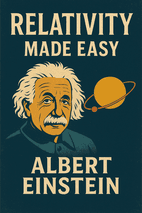
In this collection, you will find Einstein's own words from his groundbreaking book 'Relativity'. The lines range from philosophical reflections on geometry and truth to crystal clear explanations of why time and length are not absolute. Einstein has a gift for making deep ideas feel immediate and personal, often using simple thought experiments with trains and lightning. What makes this book so quotable is how it invites readers to question assumptions they never knew they had. Each quote is a small window into a mind that reimagined the universe, yet always kept the conversation grounded in everyday experience.
The passages here capture the birth of a new way of thinking. They show a scientist grappling with paradoxes and choosing clarity over comfort. Whether discussing the nature of space or the meaning of simultaneity, Einstein writes with a directness that still resonates today. These quotes are not just historical artifacts but living invitations to think differently about the world around us.
Top Quotes from Relativity
“Now it has long been known that the last question is not only unanswerable by the methods of geometry, but that it is in itself entirely without meaning.”
Einstein comments on the question of the truth of geometrical axioms.
This line challenges the reader's assumptions about truth in mathematics, revealing that foundational axioms are not subject to proof or disproof within the system itself.
“In the first place we entirely shun the vague word ‘space’, of which, we must honestly acknowledge, we cannot form the slightest conception, and we replace it by ‘motion relative to a practically rigid body of reference’.”
Einstein introduces his operational definition of space in classical mechanics.
This line reveals Einstein's intellectual honesty and insistence on concrete, observable concepts. It resonates because it admits the abstractness of 'space' while providing a clear, relative replacement that foreshadows relativity.
“Who would imagine that this simple law has plunged the conscientiously thoughtful physicist into the greatest intellectual difficulties?”
Rhetorical question immediately after stating the law.
Dramatically highlights the unexpected and profound challenge posed by a seemingly trivial fact.
“In view of this dilemma, there appears to be nothing else for it than to abandon either the principle of relativity or the simple law of the propagation of light in vacuo.”
After deriving the contradiction between constant light speed and relativity.
Presents the stark, unavoidable choice that forces a revolution in physics.
“Events which are simultaneous with reference to the embankment are not simultaneous with respect to the train, and vice versa (relativity of simultaneity).”
Einstein states the central result of the thought experiment with the lightning flashes and the moving train.
This sentence encapsulates the revolutionary idea that simultaneity is not absolute but depends on the observer's frame of reference, overturning centuries of intuitive physics.
“Every reference-body (co-ordinate system) has its own particular time; unless we are told the reference-body to which the statement of time refers, there is no meaning in a statement of the time of an event.”
Einstein draws the philosophical consequence from the relativity of simultaneity.
It boldly asserts that time itself becomes observer-dependent, challenging the notion of a universal clock and paving the way for the modern understanding of spacetime.
“Thus the length of the train as measured from the embankment may be different from that obtained by measuring in the train itself.”
Einstein derives the consequence of the two different measurement methods.
This direct statement of length contraction is both startling and memorable, encapsulating a key prediction of special relativity.
Themes Behind the Quotes
A central theme is the relativity of fundamental concepts like space, time, and simultaneity. Einstein shows that these ideas are not fixed but depend on the observer's state of motion. He replaces vague notions like absolute space with precise references to bodies of reference and coordinate systems. This shift forces a reexamination of what we mean by distance, duration, and even truth itself. Another recurring theme is the importance of operational definitions. Einstein insists that a concept is only meaningful if we can specify an empirical method to test it. This rigorous approach leads to surprising conclusions, such as the relativity of simultaneity and the flexibility of measurement.
The quotes also highlight the interplay between simplicity and paradox. Einstein starts from the deceptively simple principle that light travels at a constant speed and the principle of relativity, then follows their logical consequences even when they contradict common sense. He does not shy away from intellectual difficulties but embraces them as opportunities for deeper understanding. Throughout, there is a persistent call to drop unwarranted assumptions and let experience guide theory. The result is a collection of ideas that are as philosophically rich as they are scientifically profound.
Quotes by Chapter
1. Physical Meaning of Geometrical Propositions
“The concept ‘true’ does not tally with the assertions of pure geometry, because by the word ‘true’ we are eventually in the habit of designating always the correspondence with a ‘real’ object; geometry, however, is not concerned with the relation of the ideas involved in it to objects of experience, but only with the logical connection of these ideas among themselves.”
Einstein distinguishes between empirical truth and logical consistency in geometry.
This passage clearly separates the meaning of truth in abstract mathematics from its everyday usage, prompting reflection on the nature of knowledge and reality.
“Geometry, which has been supplemented in this way, is then to be treated as a branch of physics.”
Einstein describes how Euclidean geometry becomes a physical science when linked to rigid bodies.
This concise statement marks a pivotal shift from pure mathematics to applied science, showing how abstract ideas gain empirical meaning.
“Of course the conviction of the ‘truth’ of geometrical propositions in this sense is founded exclusively on rather incomplete experience.”
Einstein acknowledges the empirical basis for believing geometrical statements.
This line humbly reminds readers that even our most certain physical knowledge rests on limited observation, foreshadowing the relativity revolution.
2. The System of Co-ordinates
“Every description of the scene of an event or of the position of an object in space is based on the specification of the point on a rigid body (body of reference) with which that event or object coincides.”
Einstein describes the fundamental basis for specifying the location of an event or object in space.
This line establishes that all spatial descriptions are relative to a chosen reference body, a key concept for understanding relativity. It underscores the necessity of a coordinate system grounded in a physical object.
“The earth is the rigid body to which the specification of place refers; ‘Times Square, New York’ is a well-defined point to which a name has been assigned and with which the event coincides in space.”
Einstein uses the everyday example of Times Square to illustrate place specification.
It makes the abstract concept of a rigid body of reference tangible and relatable. The quote shows how a familiar location serves as a coordinate point on Earth.
“From this consideration we see that it will be advantageous if, in the description of position, it should be possible by means of numerical measures to make ourselves independent of the existence of marked positions (possessing names) on the rigid body of reference.”
Einstein explains the advantage of using numerical measures instead of named points after discussing the cloud over Times Square.
This marks the transition from primitive naming to abstract coordinates, highlighting the power of mathematics. It foreshadows the Cartesian system and the need for measurement independence.
“In practice, the rigid surfaces which constitute the system of co-ordinates are generally not available; furthermore, the magnitudes of the co-ordinates are not actually determined by constructions with rigid rods, but by indirect means.”
Einstein notes the practical difficulties in implementing an ideal coordinate system in physics and astronomy.
It humbly acknowledges that real-world measurements rely on indirect methods, not perfect geometric constructions. This prepares the reader for the complexities in relativistic physics.
3. Space and Time in Classical Mechanics
“With the aid of this example it is clearly seen that there is no such thing as an independently existing trajectory (lit. ‘path-curve')&, but only a trajectory relative to a particular body of reference.”
After describing the stone dropped from a moving train, Einstein concludes about the relativity of motion.
This is a core insight of relativity—that motion is not absolute but frame-dependent. The phrase 'no such thing as an independently existing trajectory' challenges intuitive notions and elegantly captures a fundamental principle.
“We imagine two clocks of identical construction; the man at the railway-carriage window is holding one of them, and the man on the footpath the other. Each of the observers determines the position on his own reference-body occupied by the stone at each tick of the clock he is holding in his hand.”
Einstein describes how to operationally define time in classical mechanics using two observers with synchronized clocks.
This passage beautifully illustrates the need for an observer-dependent measurement of time, even in classical physics. It shows how careful operational definitions are required, setting the stage for the more radical redefinition of time in relativity.
5. The Principle of Relativity
“If, relative to K, K’ is a uniformly moving co-ordinate system devoid of rotation, then natural phenomena run their course with respect to K’ according to exactly the same general laws as with respect to K.”
Einstein formulates the Principle of Relativity in the restricted sense.
This is the core definition of the principle, elegantly stating that physical laws are identical in all uniformly moving reference frames.
“But that a principle of such broad generality should hold with such exactness in one domain of phenomena, and yet should be invalid for another, is a priori not very probable.”
Einstein argues for the plausibility of extending the principle of relativity beyond mechanics.
This line captures the intuitive appeal of unity in physics, anticipating the eventual generalization to special relativity.
“However, the most careful observations have never revealed such anisotropic properties in terrestrial physical space, i.e. a physical non-equivalence of different directions. This is a very powerful argument in favour of the principle of relativity.”
Einstein cites empirical evidence against absolute motion based on Earth’s orbital velocity.
It grounds the abstract principle in concrete experimental fact, showing how observation supports the relativity of motion.
7. The Apparent Incompatibility of the Law of Propagation of Light with the Principle of Relativity
“There is hardly a simpler law in physics than that according to which light is propagated in empty space.”
Opening of the chapter, stating the seeming simplicity of the law of light propagation.
It sets up the central irony of the chapter: the simplest law leads to the deepest intellectual crisis.
“Those of you who have carefully followed the preceding discussion are almost sure to expect that we should retain the principle of relativity, which appeals so convincingly to the intellect because it is so natural and simple.”
Anticipating the reader's intuitive preference for relativity.
Shows how natural the principle seems, making the eventual abandonment of the naive light law and the birth of special relativity all the more surprising.
8. On the Idea of Time in Physics
“The concept does not exist for the physicist until he has the possibility of discovering whether or not it is fulfilled in an actual case.”
Einstein discussing the need for an operational definition of simultaneity.
This line encapsulates the operationalist philosophy that physical concepts must be grounded in empirical verification, a cornerstone of Einstein's approach.
“We thus require a definition of simultaneity such that this definition supplies us with the method by means of which, in the present case, he can decide by experiment whether or not both the lightning strokes occurred simultaneously.”
Einstein stating the requirement for a workable definition of simultaneity.
It highlights the critical shift from vague intuition to a precise, experiment-based criterion, forcing readers to reconsider what 'simultaneous' truly means.
“There is only one demand to be made of the definition of simultaneity, namely, that in every real case it must supply us with an empirical decision as to whether or not the conception that has to be defined is fulfilled.”
The imaginary observer's reply to Einstein's objection about circular reasoning.
This succinctly expresses the sole criterion for a physical definition—empirical testability—making it a memorable principle of scientific methodology.
“That light requires the same time to traverse the path A——> M as for the path B ——> M is in reality neither a supposition nor a hypothesis about the physical nature of light, but a stipulation which I can make of my own free will in order to arrive at a definition of simultaneity.”
The observer clarifying that the equality of light travel times is a convention, not an assumption.
This is a profound insight: simultaneity is not an absolute fact but a free choice of definition, challenging deeply held intuitions about time.
9. The Relativity of Simultaneity
“Now before the advent of the Theory of Relativity it had always tacitly been assumed in physics that the statement of time had an absolute significance, i.e. that it is independent of the state of motion of the body of reference.”
Einstein contrasts the old assumption with the new relativistic perspective.
This line highlights the profound shift in thinking that relativity demands, making clear that what was once taken for granted is actually a misconception.
10. On the Relativity of the Conception of Distance
“Moreover, the considerations of Section 6 are based on yet a second assumption, which, in the light of a strict consideration, appears to be arbitrary, although it was always tacitly made even before the introduction of the Theory of Relativity.”
Einstein opens the chapter by pointing out a hidden assumption that has been implicitly accepted even before relativity.
This line forces readers to reconsider what they take for granted in physics, highlighting the revolutionary nature of Einstein's thought.
“A priori it is by no means certain that this last measurement will supply us with the same result as the first.”
Einstein compares measuring the distance between two points on the train from the train itself versus from the embankment.
It succinctly captures the core uncertainty that leads to the relativity of length, challenging the intuitive belief in absolute measurements.
“If the man in the carriage covers the distance w in a unit of time — measured from the train, then this distance — as measured from the enbankment — is not necessarily also equal to w.”
Einstein gives the example of a passenger walking on the train to illustrate the relativity of distance.
The concrete, relatable scenario makes an abstract concept tangible, and the typo 'enbankment' adds a touch of historical authenticity.
11. The Lorentz Transformation
“If we drop these hypotheses, then the dilemma of Section 7 disappears, because the theorem of the addition of velocities derived in Section 6 becomes invalid.”
Einstein summarizes how abandoning classical assumptions resolves the apparent conflict between light propagation and relativity.
It crisply identifies the core conceptual shift that leads to the Lorentz transformation, making clear that the paradox arises from unwarranted classical ideas.